Car Dealer Money Guide: Negotiating, Financing, Leasing, Trading in and Selling
Treat any car-dealer offer as four separate money deals: out-the-door price first, then trade-in, then financing or lease math, then add-ons. Mix them together and you can overpay by thousands through a low monthly payment, a weak trade figure, or padded fees. This guide lays out the negotiation order, the checks to run on the worksheet, and the formulas that let you compare buying, financing, leasing, trading in, and selling.
See the deal as four money buckets

A dealership transaction looks like one deal, but it has four moving parts: front-end price, financing or lease terms, trade-in value, and add-ons or fees. Focus on only one bucket, especially the payment, and it gets easy to miss where the total cost rises somewhere else.
Front-end price sets the base
This is the selling price of the vehicle before financing, lease charges, trade credit, and dealer products. For buyers and lessees alike, this number comes first because the rest of the transaction is built on it.
Consumer Reports recommends negotiating one thing at a time and starting from the average transaction price rather than the invoice price. That matters because invoice pricing often says little about the current market for a specific trim, color, or inventory situation.
Financing or lease terms can hide profit
A dealer can give ground on price and still make back margin through a higher APR, a longer term, a marked-up money factor, or products rolled into the contract. USSFUCU warns that low monthly payments can mean terms of 60 months or more.
That is why U.S. News says to focus on the total out-the-door price, not the monthly payment. The payment is an output, not the main deal term.
Trade-in value changes the real net cost
Trade-in allowance is part of the total deal value, but it should stay separate from the vehicle price discussion. U.S. The same source says to treat the trade-in as a completely separate transaction.
If a dealer raises the trade offer by about $1,000 but also raises the new-car price by about $1,000, the shopper ends up with no net gain. The paper trail needs to show those numbers on separate lines.
Add-ons and fees often decide whether the deal stays good
Dealer fees and finance-office products are where many clean-looking deals go bad. Documentation fees, advertising fees, preparation fees, and market adjustment fees can all change the final number. GAP insurance and credit life insurance can also raise total repayment costs.
USSFUCU notes that dealers may frame buying as three transactions: price, trade-in, and financing. In practice, there is a fourth bucket that deserves the same scrutiny: add-ons and fees.
Picture two dealers offering the same vehicle. Dealer A is about $800 lower on selling price, but Dealer B gives about $1,200 more for the trade and does not add a prep fee. The better deal is not the lower sticker deal. It is the one with the lower total structure.
What should you negotiate first at a car dealership?
Negotiate the out-the-door price first, then the financing or lease structure, then the trade-in, and finish with add-ons and fees. That order keeps each bucket visible on paper. If those topics get blended together early, the dealer can shift profit from one place to another without moving the payment much.
Start with the out-the-door price
The first written number to request is the out-the-door price. The FTC says to get it in writing before going to the lot, and says it should include taxes and fees. (FTC)
Ask for one line that totals the vehicle selling price, sales tax, title or registration, the documentation fee, and any dealer-installed accessories or mandatory store charges already on that stock number. That gives you a comparison number you can use across stores, even when one has accessories installed, a higher documentation fee, or a market adjustment line. It also keeps the conversation away from “What payment do you want?” too early.
Move next to the loan or lease structure
Once the vehicle price is written down, then check the APR, term length, amount financed, and any products added to the contract. For a lease, this means cap cost first, then money factor, then mileage allowance, due-at-signing, and disposition terms.
A bank or credit-union pre-approval gives you a live benchmark: the approved APR, the term, the maximum amount, and sometimes the lender fees. It does not guarantee the dealer cannot do better, but it gives you a firm ceiling and a rate the finance office has to beat on the same structure, not by stretching the term or adding products.
Handle the trade-in only after the vehicle side is written
Ask for a separate appraisal and a separate trade figure. Keep the trade worksheet apart from the purchase or lease worksheet. If the dealer tries to present only a net difference number, ask to see the vehicle selling price and trade allowance as separate lines.
Finish with fees, products, and contract review
This is where shoppers need to slow down. Review every fee and every product line before signing. Taxes and registration are generally fixed government charges. Dealer-imposed fees and add-ons need inspection, and many products are optional.
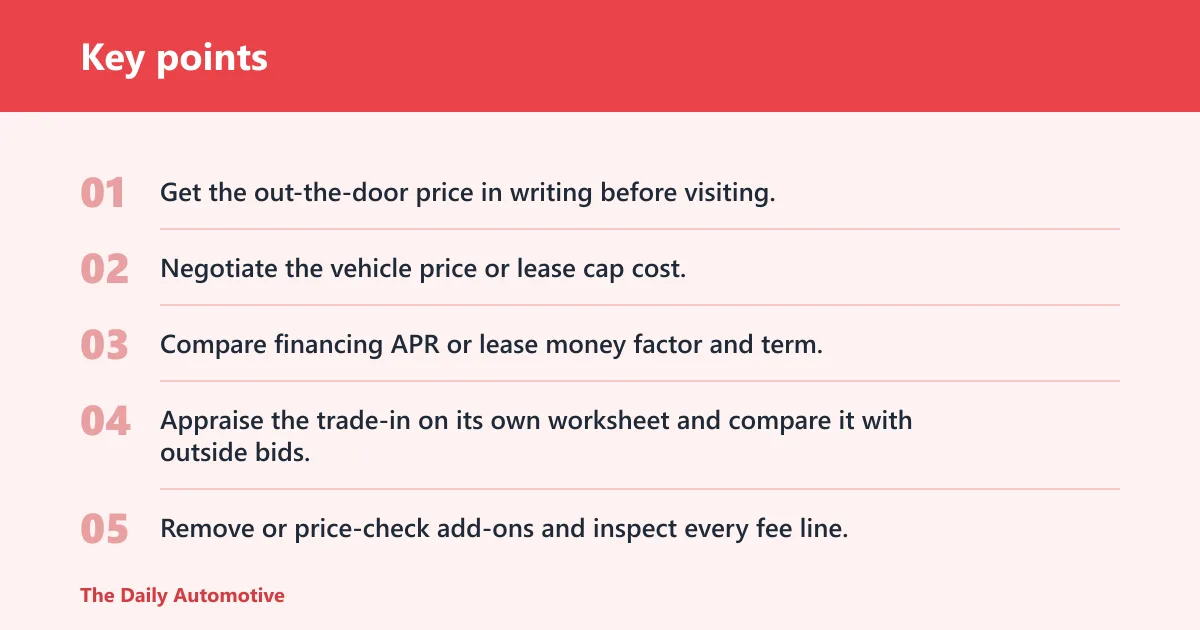
- Get the out-the-door price in writing before visiting.
- Negotiate the vehicle price or lease cap cost.
- Compare financing APR or lease money factor and term.
- Appraise the trade-in on its own worksheet and compare it with outside bids.
- Remove or price-check add-ons and inspect every fee line.
Documents to Gather Before You Sell a Car
Before you hand over the keys, make sure you have the title, bill of sale, ID, and any needed odometer or lien documents ready. The supporting guide on car sale paperwork explains which forms apply in a private sale, dealer trade-in, or financed payoff, plus what to do if the title is lost, damaged, or shared.
This matters because missing paperwork can delay payment, stall the transfer, or leave you responsible for the car after it’s gone. It also points out where state rules may add extra forms, so you can avoid last-minute surprises and complete the sale cleanly.
When a dealership may take the car back after delivery
In most cases, buying a car is final once you sign and drive away, but there are a few exceptions worth knowing. The supporting article explains when a dealership may be required to accept a return, such as a written return policy, a financing problem, a lemon-law defect, or a proven misrepresentation. It also breaks down what to check first in the contract and loan paperwork so you know whether you have a real path to unwind the sale or just a difficult negotiation.
If you need the details, the car return rules article walks through the decision points and the consequences of missing deadlines, including possible fees, loan liability, and credit damage.
What to know about returning a car after purchase
There usually is no automatic 3-day right to return a car, so the practical question is which exit path applies: a signed dealer return policy, a state cooling-off rule, a lemon-law or fraud claim, or simply the dealer’s discretion. The supporting guide breaks those options down so you can tell whether you have a real chance to unwind the deal or need to prepare for a different fix.
That matters because the first 24 hours can determine your leverage. If you have a complaint, proof of a defect, or a written return promise, the next steps are very different from a normal buyer’s remorse situation. See the 3-day return rule guide for the exact decision path.
When you have to register the car
Registration deadlines are usually short: many states give you about 10 to 30 days after the sale or delivery date, and the clock starts then—not when you get around to it. This supporting guide breaks down when that timer begins, what documents you need first, and how the rules change for private sales, dealer purchases, and special cases like moving states or waiting on title paperwork.
That matters because missing the deadline can lead to late fees, citation risk, and delays getting plates or proof of ownership. If you want the practical timeline in one place, see the car registration deadline guide.
What out-the-door price should you ask for?
Ask for a written out-the-door quote that includes the vehicle selling price, taxes, registration, documentation fee, and every dealer fee or accessory already attached to the car. That is the comparison number. A quote without taxes and fees is easy to manipulate and weak for apples-to-apples shopping.
What belongs in the quote
The quote should show the selling price, destination if not already included, dealer-installed accessories, documentation fee, advertising fee if charged, preparation fee if charged, market adjustment fee if charged, taxes, title, registration, and any other mandatory amount the dealer expects at signing.
If the dealer plans to include add-ons such as paint protection, nitrogen, wheel locks, or theft products, those should appear too. A vague “plus fees” line is not enough.
How to request it before visiting
The FTC says to get an out-the-door price in writing before going to the lot. A simple request works: ask for the exact out-the-door total on stock number X, including taxes and all fees, with no placeholders.
Written quotes create a cleaner comparison and reduce the chance that the conversation turns into a payment pitch before the numbers are pinned down.
How to compare two quotes with different fees
Use the final out-the-door total, then inspect the line items that created it. A lower selling price can still lose if the dealer adds a sizeable documentation fee, prep charge, and accessory package.
Suppose one store quotes a selling price that is about $500 lower, but its documentation and prep fees are about $899 higher combined. The lower advertised price is not the lower deal. The written out-the-door number makes that plain.
When timing your purchase can lower the price
If you want the best shot at a lower price, timing matters most when dealers are under pressure to move metal or clear inventory. The car buying timing guide explains when month-end, late December, and active incentive periods can improve your negotiating position, and when stock levels matter more than the calendar. That helps you decide whether to push harder on price or focus on the right trim before it disappears.
It also separates the best time to buy new cars from used cars, so you can match your strategy to the market instead of relying on generic advice.
How a Private Sale Can Put More Money in Your Pocket
If you want the highest possible sale price, a private buyer often beats a trade-in—but only if you handle pricing, paperwork, payment, and title transfer correctly. The step-by-step guide to selling a car privately shows how to set a realistic asking price, screen buyers, protect yourself on test drives, and make sure the title changes hands only after verified funds clear.
That matters because one missed step can cost you the car, the money, or both. It’s especially useful if you still have a loan, because the process changes when a lien must be paid off before the title can move.
How do you stop the deal from becoming a payment conversation?
Keep returning to three numbers before discussing payments: out-the-door price, amount financed or due at signing, and APR or money factor. A payment alone can hide a longer term, a higher rate, or added products. If the dealer quotes only a payment, ask what price, term, and financed amount produced it.
Why monthly payment is weak on its own
USSFUCU warns that a low payment can come from terms of 60 months or more. The same payment can also be created by stretching a lease, increasing due-at-signing, or rolling GAP and service products into the contract.
The result is a deal that feels affordable month to month while total cost climbs.
The redirect that keeps the structure visible
When asked for a target payment, move the discussion back to the worksheet. Ask for the out-the-door price, the APR or money factor, the term, and the itemized amount financed. Then compare those figures against the pre-approval or lease benchmarks.
That puts the dealer on the same scorecard the shopper is using.
The numbers to write down before any payment matters
- Out-the-door price
- Cash down payment
- Trade allowance
- Payoff on current loan, if any
- Amount financed or total due at signing
- APR or money factor
- Term length and mileage allowance for leases
- Every add-on and every dealer fee
A common first-timer mistake is agreeing that a payment “looks fine” before checking whether the loan term got extended and whether products were rolled in. By the time the final paperwork appears, the structure is already tilted against the buyer.
Should you get pre-approved before you go?
Yes. Pre-approval from a bank or credit union sets a budget ceiling and gives a rate benchmark the dealer has to beat. It does not guarantee the best financing, but it keeps the transaction anchored. Before that, check the credit report because approval odds and APR are tied directly to the credit profile.
Why the credit report comes first
The FTC recommends getting a credit report before visiting the dealership. Errors, old balances, or identity issues can affect loan approval and interest rate, and they are easier to address before there is a live deal on the desk.
For shoppers near the edge of a rate tier, a report review can change the timing of the purchase decision.
What pre-approval actually does
Pre-approval gives a shopper a realistic spending ceiling and a financing benchmark. U.S. The same source suggests a 20/4/10 rule for car affordability, which many shoppers use as a starting guardrail when deciding how much payment, term, and overall vehicle cost fit the household budget.
Bring the pre-approval to the dealer and ask whether the finance office can beat it with the same amount financed, the same term, and no added products. If the dealer can do that, good. If not, the outside approval is still available.
When the dealer offer is better and when it is not
The dealer may have access to lender promotions or subsidized rates. But a lower rate is not automatically a better deal if the dealer raises the selling price, reduces the trade allowance, or adds expensive products.
Compare the whole worksheet, not just the APR box.
Why a pre-approval can protect your deal
Getting pre-approved before you shop gives you a clear financing benchmark, so you can tell whether the dealer’s offer is truly better or just easier to sign. The supporting article explains how pre-approval helps you compare APR, term, amount financed, and fees on equal footing, which matters because a small rate bump or longer loan can add a lot of interest over time. It also covers when dealer financing or manufacturer promo rates may beat your pre-approval, and what to check if a lender says no. If you want to avoid treating the monthly payment as the only number that matters, start with car loan pre-approval.
How does lease math actually work?
Lease math starts with cap cost, not payment. Negotiate the cap cost like a purchase price, then verify the money factor, residual value, mileage allowance, due-at-signing amount, and end-of-lease charges. Payment shopping without those inputs can hide an overpriced lease just as easily as it hides an overpriced loan.
Cap cost is the lease price that matters
The cap cost is the negotiated price in the lease. The Vantage Group says lease negotiation should focus on cap cost and money factor. If the dealer jumps straight to a monthly number, ask for the cap cost line first.
A lower cap cost reduces the depreciation portion of the lease and directly lowers the payment.
Residual value is usually fixed
The residual value is the vehicle’s projected value at lease end, generally stated as a percentage of MSRP. The Vantage Group says residual value is set by the bank and is not negotiable.
That means lease shoppers should not waste time trying to move the residual. The work is in the cap cost, money factor, and fee structure.
Money factor is the finance charge in disguise
Money factor is the lease equivalent of an interest rate. The Vantage Group says it can be converted to APR by multiplying by 2,400. If the money factor is 0.00200, the rough APR equivalent is 4.8.
That conversion lets shoppers compare lease financing with loan financing in more familiar terms.
Lease traps beyond the payment
Watch mileage allowance, excess-mile penalties, due-at-signing totals, acquisition fees, disposition fees, and any capitalized add-ons. A low lease payment can come from a large upfront amount rather than a strong cap cost or money factor.
Say your lease quote drops by about $45 per month after the dealer changes only one variable: due at signing jumps by about $2,000. The payment improved, but the structure got worse for anyone trying to limit upfront cash.
How Lease Mileage Penalties Can Change Your Total Cost
Lease mileage penalties are the fee you pay for driving more than your contract allows, and they can turn a “good deal” into an expensive one fast. The supporting article explains the typical per-mile range, how lease companies calculate the charge, and when buying extra miles ahead of time is cheaper than paying at the end. That matters because even a modest overage can add up to hundreds or thousands of dollars.
If you want the numbers behind those charges and the tradeoff between prepaid miles and end-of-lease bills, see lease mileage penalties.
Know Which Lease-End Damages Can Be Charged
Lease return charges usually come from damage that goes beyond normal use, so the key question is whether the car meets the lender’s turn-in standards. The supporting guide explains how excess wear and tear is defined, which issues most often trigger fees, and where you may be able to challenge a bill. It helps you spot the difference between ordinary aging and chargeable damage before the inspection.
If you are nearing lease-end, use this lease wear guide to check common problem areas like paint, tires, glass, wheels, interior damage, and missing parts. That matters because a few small defects can add up fast if you do not document them and address them before turn-in.
When a lease buyout makes sense
A lease buyout is worth considering when the car’s all-in purchase cost is lower than what it would cost to replace it, and the monthly payment still fits your budget. The supporting article breaks down the key numbers so you can compare the buyout price, expected wear-and-tear charges, and current market value before you decide. That matters because the wrong choice can mean overpaying for a car you could have returned, or walking away from a vehicle that is actually a good deal to keep. For a step-by-step breakdown, see lease buyout guide.
Trading in a leased car can work, but only when the numbers and lender rules line up
If you still have a lease, the key question is whether the car’s trade-in value is higher than the payoff amount and whether the leasing company allows a dealer payoff or early buyout. If the payoff is too high, rolling the lease into a new deal can erase any equity and may add taxes or fees you did not expect. The right move depends on the contract, the dealer’s process, and your state’s tax rules.
The supporting guide on lease trade-ins explains the payoff math, when you can trade at another dealership, and how taxes and end-of-lease charges affect the final cost. That matters because it helps you compare a trade-in against buying out the lease or simply finishing the term.
How should you handle a trade-in?
Handle the trade-in as a separate transaction with its own written figure. Get the new-car price or lease cap cost settled first, then ask for the trade allowance, then compare that number against offers from other dealers or instant-buy services. Blending the trade too early makes the net deal look better than it is.
Why separate valuation matters
U.S. The same source says to treat the trade-in as a completely separate transaction. That protects against the classic move where the trade number rises while the new-car price or financing terms get worse somewhere else.
The goal is to know whether the trade itself is strong, independent of the replacement vehicle.
How to shop the trade
Get multiple appraisals. That can include the selling dealer, another franchised dealer, and an instant-buy offer. Then compare those figures against the tax effect in the shopper’s state, if applicable, and the convenience of one-stop delivery.
A high trade number at one store can still lose if that store has a higher out-the-door price on the next vehicle.
Negative equity and where it goes
If the current loan payoff exceeds the trade value, the difference is negative equity. It does not disappear. It gets paid in cash, deferred by keeping the current vehicle longer, or rolled into the next loan or lease where allowed.
Rolling it forward raises the next deal’s effective cost and can distort payment comparisons badly, especially if the term gets stretched to absorb it.
Trading in a car with an existing loan
Yes, you can trade in a car you still owe money on, but the deal depends on one number: the payoff amount. The dealer can send that payoff to your lender at closing, then apply any remaining trade-in value toward your next car. If the payoff is higher than the trade-in value, the difference becomes negative equity and can change your down payment, loan size, or monthly payment.
The supporting guide on trading with a loan explains how the payoff process works, how to compare your loan balance to the offer, and when the numbers say to wait, pay down the loan, or roll the balance into a cheaper vehicle.
How damage and warning lights change a trade-in offer
If your car has body damage or a check engine light, a dealer will usually still consider it, but the offer may drop fast once repair risk is factored in. The supporting guide explains which problems tend to cut trade-in value the most, when a small fix may be worth doing first, and when it is smarter to sell the car as-is instead of pouring money into repairs.
It also covers what dealers inspect, how a financed trade-in can affect the deal, and why getting a second offer matters before you accept the first number. If you are trying to protect equity, this trade-in damage guide helps you separate a manageable defect from a value-killing one.
How to judge an extended warranty offer
An extended warranty only makes sense when the contract costs less than the repairs you are likely to face, and you plan to keep the car long enough to use it. The key question is whether the price, deductible, and exclusions still leave you ahead compared with paying for repairs yourself.
The supporting guide breaks down when coverage is worth buying, what it usually covers and excludes, and why dealer quotes can look safer than they really are. If you are weighing a plan, this extended warranty guide helps you compare the quote against likely repair risk before you sign.
Manufacturer vs. Third-Party Warranty Choice
Choosing between OEM-backed coverage and a third-party contract comes down to how new the car is, how long you want protection, and how much flexibility you want at the repair shop. The manufacturer vs third-party warranty guide breaks down what each plan typically covers, how claims are handled, and where each option tends to fit best. That matters because the wrong contract can cost more upfront, limit where you can get repairs, or leave you without coverage when mileage climbs. It also explains transferability and resale implications, which can affect the car’s value when you decide to sell.
How to bargain down a dealer extended warranty
Dealer extended warranties are usually negotiable, and the biggest savings often come from treating the contract like any other add-on: compare the total price before you discuss coverage details. The supporting guide on dealer extended warranty negotiation explains which parts of the contract move the price, what to ask in the finance office, and why the deductible, term length, and exclusions matter just as much as the headline cost.
That matters because a cheaper warranty can still be a bad value if the coverage is thin or the rules are hard to use. Knowing how to negotiate helps you decide whether to buy, how much to pay, and when it is smarter to walk away.
How insurers decide a car is totaled
An insurer usually totals a car when the repair estimate, salvage value, and related costs cross its total-loss threshold or when the vehicle cannot be repaired safely. The supporting guide breaks down how that decision is made, what valuation method the carrier may use, and where state rules can change the outcome. It also shows you what documents to gather if you want to challenge the estimate or the payout.
That matters because the total-loss label affects whether you get a cash settlement, how much you receive, and whether you can keep the car. If you want the details behind the numbers, start with total-loss decisions.
How a claim can change your insurance cost
This article explains when filing an auto insurance claim can raise your premium and when it usually will not. It breaks down at-fault claims, not-at-fault claims, and how collision or comprehensive coverage can affect the outcome, so you can judge the likely rate impact before you file.
That matters because the wrong decision can cost more over time than the repair itself. The guide shows a simple break-even approach using your deductible, the repair estimate, and the likely renewal surcharge, plus when paying out of pocket may be the cheaper move. See the full claim and rates guide for the math.
What happens to the loan after a total loss?
If your car is totaled, the insurance payout usually goes to the lender first, and the key question is whether that payout fully covers your remaining balance. If the car is worth less than you owe, you may still have a shortfall after the claim settles. The supporting guide on car loan payoff explains how that payoff order works, when gap insurance can help, and why fees or negative equity can still matter. That matters because the wrong payout assumption can leave you making payments on a car you no longer have, or paying off a balance after the insurer has closed the claim.
Car dealer money scorecard
This scorecard keeps the four buckets visible by buyer type. Use it as a worksheet, not a reading exercise. The right first move changes a little by scenario, but the same rule holds: pin down one bucket before moving to the next.
| Buyer type | Front-end price | Financing/lease terms | Trade-in value | Add-ons/fees |
|---|---|---|---|---|
| Cash buyer | Negotiate out-the-door price first; verify written total includes taxes and fees before visiting. | No loan, but verify no finance products or payment-based menu gets inserted later. | If trading, value it separately after price is written. | Common failure point: dealer adds accessories, documentation fee, prep fee, or market adjustment after a “cash deal” sounds simple. |
| Finance buyer | Negotiate selling price and out-the-door total first. | Verify APR, term, amount financed, and whether dealer beat pre-approval cleanly. | Shop trade separately and keep payoff visible if there is a loan. | Common failure point: lower payment created by longer term, higher rate, or rolled-in GAP and credit life insurance. |
| Lease shopper | Negotiate cap cost first because it drives the lease payment. | Verify money factor, residual value, mileage allowance, due at signing, and disposition terms in writing. | If trading, ask whether equity is reducing cap cost or covering drive-off charges. | Common failure point: payment looks low because due at signing rose or add-ons were capitalized into the lease. |
| Trade-in owner | Set vehicle price first so trade credit cannot mask markup. | Verify whether negative equity is being rolled into the next contract and by how much. | Get at least one outside appraisal and compare the tax impact separately. | Common failure point: inflated trade offer paired with weak selling price and extra fees that erase the gain. |
What is usually negotiable, partly negotiable, or generally fixed?
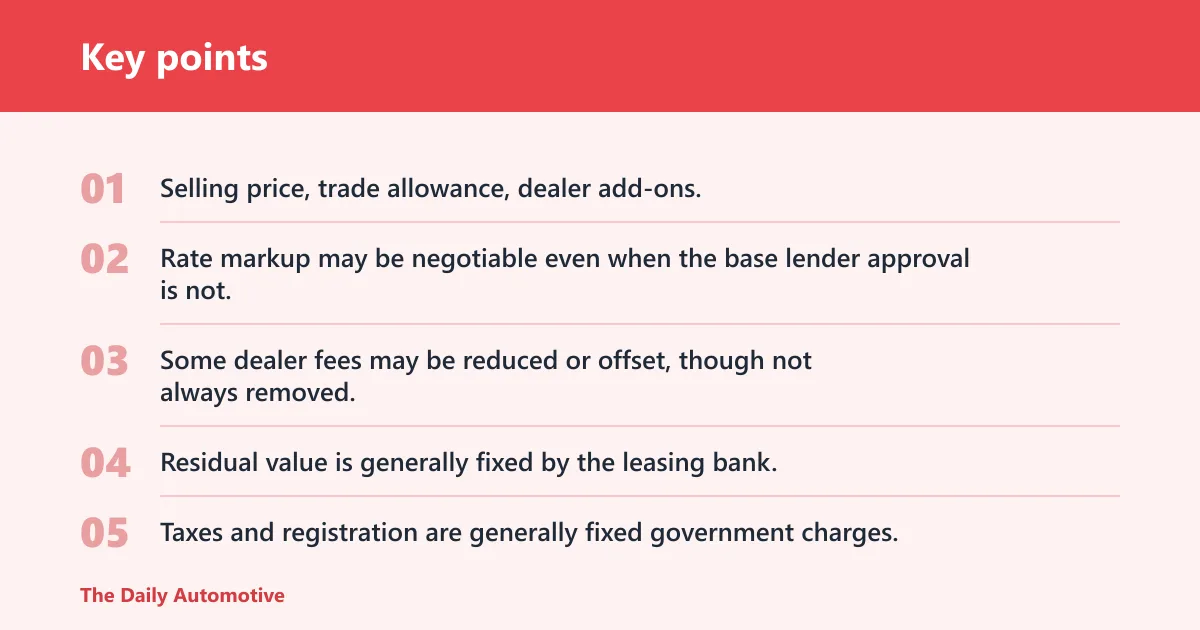
Selling price, trade allowance, dealer add-ons, and many finance-office products are usually negotiable. Rate markup may be negotiable even when the base lender approval is not. Some dealer fees may be reduced or offset, though not always removed.
Residual value is generally fixed by the leasing bank. Taxes and registration are generally fixed government charges. Market adjustments, documentation fees, advertising fees, and preparation fees are dealer-side items that need direct scrutiny.
Failure-case walkthrough
Here is how a bad structure hides in plain sight. The dealer drops the monthly payment by extending the loan term. At the same time, the selling price stays high, the trade-in allowance comes in low, and GAP plus credit life insurance get added to the amount financed.
On paper, the shopper sees one “comfortable” payment. In reality, all four buckets moved the wrong way. The front-end price was weak. The back-end financing was stretched. The trade underperformed. The add-ons raised repayment.
Subprime shoppers should be extra strict here. Credit challenges can make approval itself feel like the win, but the structure still matters. Check the credit report first, use any pre-approval available as a benchmark, limit extras, and avoid letting negative equity ride forward unless there is no better path.
Upside-down trade owners should ask one direct question on every worksheet: how much unpaid balance is being added to the next contract? If that line is unclear, the deal is unclear.
How car loan shopping affects your credit score
Shopping for auto financing can affect your score, but usually less than people fear. The key issue is hard inquiries: each lender review can shave a few points, while scoring models often treat multiple auto-loan inquiries as one event if they happen within a short shopping window. This matters because a few extra pulls outside that window can lower your score and make borrowing more expensive. The supporting guide on car loan credit impact explains how rate shopping works, when inquiries count together, and how to compare offers without creating avoidable credit damage.
How to match a car payment to your salary
If you want a fast reality check, this guide shows how to convert your income into a safe car budget and monthly payment limit. It explains the common 15% to 20% take-home-pay rule, why a tighter 10% cap can protect your budget, and how to account for insurance, fuel, repairs, and depreciation before you sign.
It also breaks down gross pay versus take-home pay, shows how loans can stretch or shrink what you can afford, and compares buying versus leasing. For a practical framework, see car affordability by salary.
When can a debit card work for a rental car?
A debit card can sometimes get you through rental pickup, but approval depends on the location, the vehicle class, and the company’s identity checks. Airport counters and higher-end cars are more likely to require a credit card, while neighborhood branches may be more flexible. The catch is that even when a debit card is accepted, the rental company often places a hold on your account, so you need enough cash available beyond the quoted rate.
The supporting guide breaks down the rules by branch type and major brands, explains what paperwork you may need at the desk, and shows how to plan for the authorization hold. If you want to avoid a surprise denial at pickup, the debit card rental guide gives the specifics that matter before you book.
Should you buy rental car damage coverage?
The short answer is: only if you do not already have similar protection or you want to avoid a large deductible after a rental-car mishap. The supporting guide explains what a collision damage waiver is, how it compares with your personal auto policy and credit card benefits, and which situations make it redundant. It also shows what CDW usually does and does not cover, so you can judge the real risk before you decline at the counter. For a clear breakdown of the tradeoff, see collision damage waiver.
When Your Own Auto Policy May Already Cover a Rental
If you already carry liability, collision, and comprehensive coverage, your personal policy may protect you in a rental car, which can make the counter’s damage waiver unnecessary. The catch is that coverage is not automatic in every situation: deductibles, exclusions, and loss-of-use charges can still leave you paying out of pocket. The rental car insurance guide breaks down when your own policy is enough, when a credit card may help, and when the rental desk add-on is still worth considering.
That matters because the cheapest option is not always the safest one. Knowing the gaps before you book helps you avoid duplicate coverage without skipping protection you actually need.
Which fees and add-ons change the total cost most?
The biggest total-cost movers are dealer-imposed fees, market adjustments, and financed add-ons in the back office. Documentation fees, advertising fees, preparation fees, and accessory packages can raise the out-the-door total fast. GAP insurance and credit life insurance can also increase repayment if they are rolled into the contract.
Fees to inspect line by line
Start with documentation fees, advertising fees, preparation fees, and market adjustment fees. These are the lines most likely to vary by store and most likely to distort a “good price” headline.
Ask which charges are government fees and which are dealer-imposed. Registration, title, and taxes are generally not negotiation targets in the same way. Dealer charges are different, and they should at least be questioned and compared.
Add-ons that raise repayment
USSFUCU identifies GAP insurance and credit life insurance as dealer-sold products that can raise repayment costs. Some shoppers may want GAP, especially with low down payments or negative equity, but the key is to compare price and source rather than accepting the first offer.
Third-party or insurer-provided options may cost less where available. The same logic applies to service contracts and appearance products: evaluate them separately from the vehicle deal.
Fixed, removable, and replaceable charges
Taxes and registration are generally fixed. Dealer add-ons are often removable. Some fees may not disappear, but the dealer may offset them through a lower selling price if pressed on the total out-the-door figure.
The practical test is simple: can the dealer show the charge is required by the state or lender, or is it store-created? If it is store-created, it belongs in the negotiation.
Break the total into fixed, challengeable, and optional charges
The fastest way to negotiate a new-car deal is to treat the out-the-door number as three separate buckets: government charges you usually can’t change, dealer fees that may be negotiable, and add-ons you can often remove. That keeps the conversation on the parts that actually move the final price instead of getting stuck on the monthly payment. The supporting guide on out-the-door price negotiation shows how to identify which line items are fixed, which ones deserve pushback, and how to ask for a written quote so you can compare offers line by line.
Frequently asked questions
What should I negotiate first at a car dealership: price, financing, or trade-in?
Start with the out-the-door price, then move to financing or lease terms, then handle the trade-in, and only then review add-ons and fees. The same source recommends negotiating one thing at a time. That order keeps one concession from being canceled out somewhere else on the worksheet.
How do I keep the dealer from focusing only on the monthly payment?
Ask for the out-the-door price, amount financed, APR or money factor, and term before discussing any payment. A payment can be lowered by stretching the term or adding upfront cash. The payment matters, but only after the structure behind it is fully itemized.
What out-the-door price should I ask the dealer for?
Ask for a written out-the-door quote that includes the selling price, taxes, registration, documentation fee, and every dealer fee or installed accessory. The FTC says to get that price in writing before going to the lot, and that it should include taxes and fees.
How does leasing math work compared with buying a car?
For a lease, negotiate cap cost first because it is the lease version of the vehicle price. Then verify money factor, residual value, mileage, due-at-signing, and end-of-lease charges. Residual value is bank-set and generally not negotiable; money factor can be converted to APR by multiplying by 2,400.
What parts of a car deal are actually negotiable?
Selling price, trade-in allowance, many add-ons, and some rate markup are often negotiable. Some dealer fees may be reduced or offset, though not always removed. Residual value on a lease is generally fixed, and taxes and registration are usually government-set rather than dealer-controlled.
How do I avoid getting trapped in a bad financing or lease structure?
Use one worksheet for all four buckets: out-the-door price, financing or lease terms, trade-in value, and add-ons or fees. Get pre-approved, check the credit report first, and do not judge the deal by payment alone. If one bucket changes, recalculate the whole structure before signing.
Products related to this article
Sponsored / affiliate links. As an Amazon Associate I earn from qualifying purchases. I may earn additional commission from eligible campaigns.
 FH Group Car Seat Cover Front Set Striking Striped Car Seat Covers with Front Seat Covers and Rear Split Bench, Universal Fit Interior Accessories for Cars, Trucks, and SUVs – Gray
 Auto Car Dent Repair Puller Head Paintless-Dent Repair Removal Kit for Slide Hammer Pulling Tab Adapter Pulling Tabs Car Aluminum-alloy Puller Head Adapter Screw Glue-tabs for Slide Hammer and