When Is the Best Time to Trade in a Car?
The best time to trade in a car is when your equity is positive, the payoff is below the trade-in offer, and you are still ahead of major repair or warranty-expiry costs. Wait too long, and a low-payment loan can turn into negative equity plus bigger repair bills. Use this checklist to decide whether to trade now, wait a few months, or hold the car.
What timing can and cannot fix
Timing can improve your position, but it cannot erase a weak loan balance or a car that has already dropped hard in value. The biggest gains come from catching the car before mileage, warranty loss, and depreciation push the offer too low. If convenience matters, a trade-in can still be the right move.
The trade-in decision in one minute
Start with three numbers: current market value, remaining payoff, and the cost of holding the car for another six months. If the offer is higher than the payoff, you have positive equity. If the payoff is higher, the gap is negative equity and may be rolled into the next loan.
That gap matters because it changes the amount you finance next. A smaller trade-in amount means less down payment power, while a negative balance can add to the new loan and raise monthly payments. Dealerships can evaluate a trade using live market data, which helps you compare offers quickly.
Trade-in equity and loan balance
Positive equity means the car is worth more than the remaining loan balance. Negative equity means the opposite. If you still owe on the car, the question is not only whether you can trade it in, but whether the timing keeps the gap small enough to manage.
How much payoff changes the next loan
The remaining payoff amount is the number your lender needs to close the loan. If the trade-in offer does not cover it, the shortfall may be added to the next contract. That rollover increases the amount financed and can make the new vehicle cost more over time.
Say your car is worth $18,000 and the payoff is $16,200. That $1,800 gap is positive equity. If the payoff were $19,000 instead, the dealer would need to absorb or roll $1,000 in negative equity, which usually pushes the next loan amount up.
When prepayment penalties matter
Some loans charge a prepayment penalty for paying off early. If your contract has one, trading too soon can wipe out part of the equity advantage. Check the payoff quote and the loan agreement before you assume an early trade is free.
This matters most for owners who are considering a trade only because the payment feels manageable. A low monthly payment can hide a long payoff tail, especially in the early part of an auto loan.
When should you trade in now?
Trade now when the math, repair risk, or convenience case is already strong. A vehicle with positive equity, a warranty that is about to end, or repair bills that are starting to climb can be a good candidate. If you need a faster path than listing the car yourself, trade-in timing matters less than timing your payoff and appraisal correctly.
Warranty ending soon
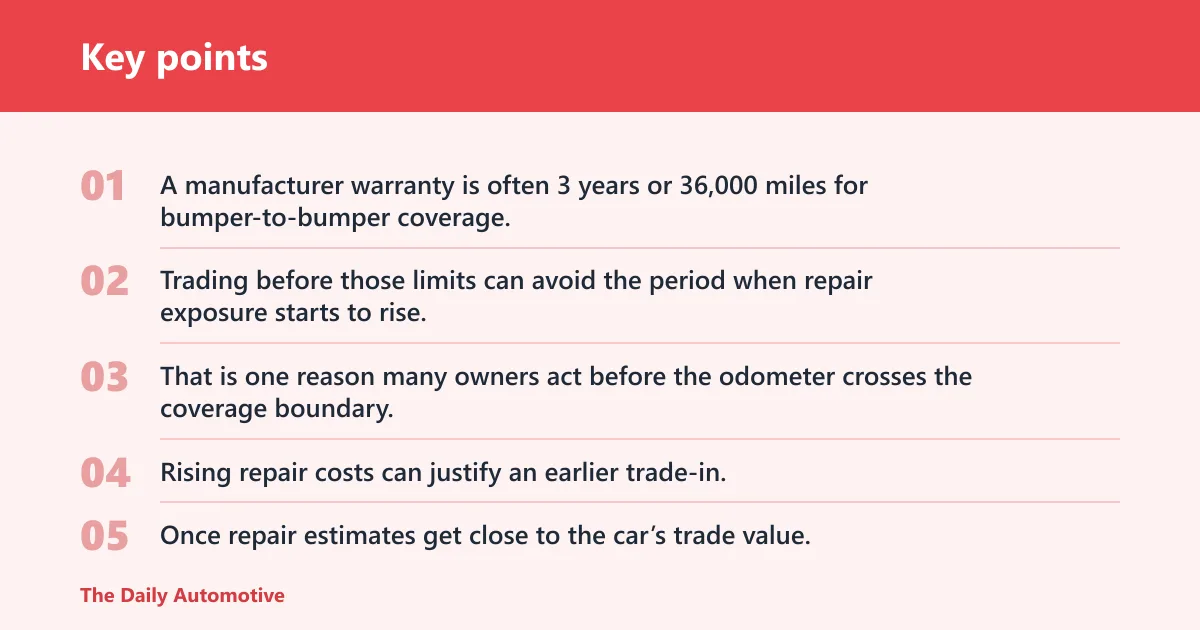
A manufacturer warranty is often 3 years or 36,000 miles for bumper-to-bumper coverage, and powertrain coverage often lasts 5 years or 60,000 miles. Trading before those limits can avoid the period when repair exposure starts to rise. That is one reason many owners act before the odometer crosses the coverage boundary.
Repair bills rising fast
Rising repair costs can justify an earlier trade-in, especially if a transmission or engine repair is on the horizon. Once repair estimates get close to the car’s trade value, holding the vehicle longer may stop making financial sense. The same logic applies when repeated small repairs start piling up.
Picture a sedan with 58,500 miles, a worn A/C compressor, and a warranty that ends at 60,000 miles. If the next repair is due before coverage ends, trading before the line can protect value better than waiting for the failed part to land on your bill.
You have positive equity
Positive equity is the cleanest place to trade from. It gives you room to offset taxes, fees, or a new down payment without dragging old debt into the next deal. If you are already ahead, waiting only makes sense if the car is still covered and depreciation is likely to stay mild.
You need convenience over private sale
Trade-in can be worthwhile if you prioritize convenience over maximum price. The dealership handles paperwork, payoff coordination, and title transfer. A private sale can bring more money, but it also adds listings, calls, test drives, and negotiation.
Mileage and warranty timing
Mileage thresholds matter because buyers and dealers often adjust offers around known breakpoints. The drop is not identical for every model, but appraisal patterns often shift near 30,000 to 40,000 miles, 60,000 to 70,000 miles, and 100,000 miles. Timing before or after those points can change how a vehicle is priced.
30,000 to 40,000 miles
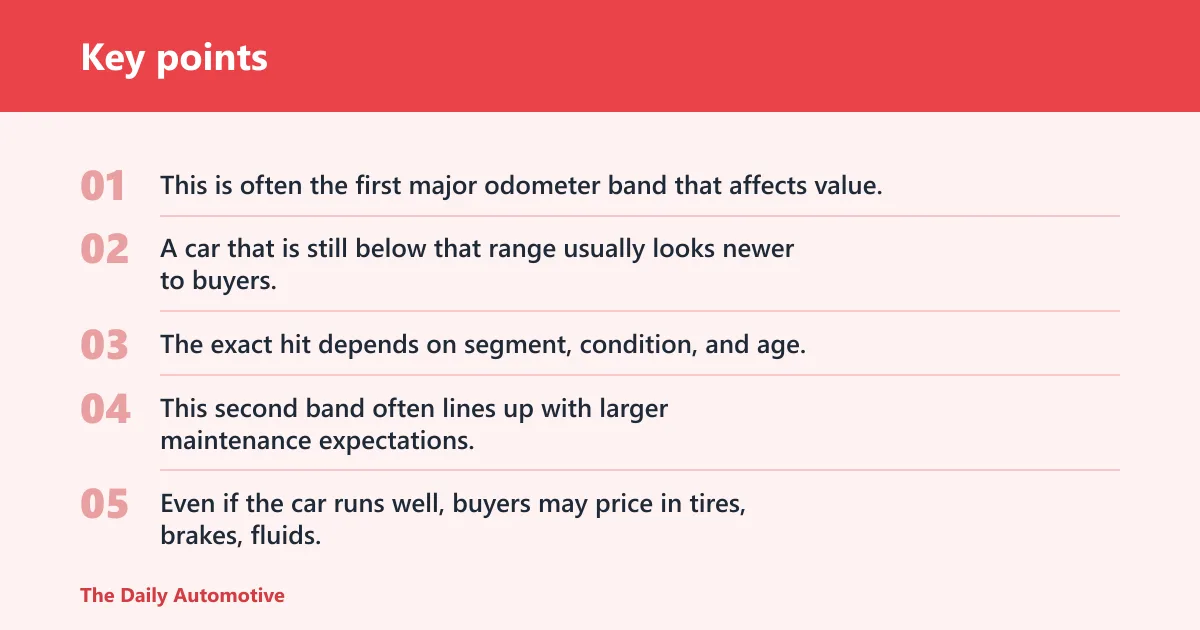
This is often the first major odometer band that affects value. A car that is still below that range usually looks newer to buyers, while a car just above it can feel less fresh in the appraisal process. The exact hit depends on segment, condition, and age.
60,000 to 70,000 miles
This second band often lines up with larger maintenance expectations. Even if the car runs well, buyers may price in tires, brakes, fluids, or powertrain concerns. A vehicle that is just under 60,000 miles can sometimes appraise better than one that has already crossed past 70,000.
Around 100,000 miles
Crossing 100,000 miles can trigger another sharp trade-in value drop. That is partly because buyers expect more wear and higher repair risk. If your car is near that number and the value still compares well against the payoff, waiting too long can make the trade less efficient.
Before 3/36 or 5/60 coverage ends
Trading before the 3-year/36,000-mile bumper-to-bumper limit or the 5-year/60,000-mile powertrain limit can help you avoid the value drag that comes with an out-of-warranty car. Once coverage ends, the next owner assumes more repair risk, and that pressure usually shows up in the offer.
Common first-timer mistake: waiting until the warranty is already gone, then asking why the offer dropped faster than expected. The answer is usually not one event. It is warranty loss, mileage, and time all hitting at once.
Seasonal trade-in timing
The best seasonal window cited for trade-ins is February to April. That period lines up with tax refund demand and stronger dealer appetite for used inventory. It is also a period when many shoppers are active, which can help turnover at the dealership.
Late winter and early spring
Late winter and early spring can be better than midsummer or late fall because dealers often want cleaner used inventory ahead of spring sales activity. That does not guarantee a higher offer, but it can improve the odds of a faster appraisal and a stronger bid.
Inventory cycles and model-year rollout
New model-year rollouts can make a current vehicle feel older even if it still drives well. That effect can push trade values down, especially when the outgoing design is now one model year behind the newest lot stock. Timing before that shift can preserve value.
Seasonal effects are not the same everywhere. In some regions, demand is driven more by weather and tax refunds; in others, dealer inventory targets matter more than consumer traffic. The best timing is the one that matches both the calendar and your equity position.
What to check before you visit
Before you step into a dealership, gather the payoff quote, a market-value estimate, and your registration or title paperwork. That lets you see whether the trade covers the loan and whether the dealer’s number is close enough to move forward. It also reduces the chance of surprises in the finance office.
- Request the payoff amount from your lender and note the date the quote expires.
- Estimate current market value using several sources so you can compare ranges, not one number.
- Check for prepayment penalties or lease-end charges that could change the math.
- Compare the trade-in offer with your payoff to see whether equity is positive or negative.
- Ask how taxes, registration, and fees will be handled on the next purchase.
In some states, a trade-in can reduce the taxable amount on the next car. In others, the savings are handled differently. That is worth checking before you sign, because tax treatment can change the real cost of moving now versus waiting.
Suppose a compact SUV is at about 38,200 miles, still under the common 5-year/60,000-mile powertrain limit, and the payoff is only slightly below the trade offer. Waiting about six months could move it into a worse mileage band and weaker warranty territory, even if the loan balance does not change much.
Trade-in timing checklist
| Owner situation | What to verify | Trade now/wait signal | Likely financial effect |
|---|---|---|---|
| Positive equity | Trade-in offer is above the remaining payoff | Trade now if the car is near a mileage or warranty threshold | Lower amount financed on the next car |
| Negative equity | Gap between market value and payoff | Wait if the gap is large and the car is still reliable | Rolling the deficit raises the next loan amount |
| 30,000 to 40,000 miles | Service history, condition, and how close the car is to the band | Trade now if value is already strong | Crossing the band can trim appraisal strength |
| 60,000 to 70,000 miles | Upcoming maintenance and powertrain coverage status | Trade now if warranty is ending soon | Higher repair risk can reduce buyer appetite |
| Near 100,000 miles | Major wear items, repair estimates, and market demand | Trade now if the offer is still acceptable | Value can drop sharply after the milestone |
| Warranty ending soon | 3-year/36,000-mile and 5-year/60,000-mile limits | Trade now if repairs are starting to rise | Out-of-warranty cars usually appraise lower |
| Recent purchase with fees | Sales tax, title, registration, and any short ownership period charges | Wait if you would repeat too many costs too soon | Fees can wipe out most of the equity gain |
| Lease or PCP contract | End date, mileage limit, and any early-exit charge | Trade near contract end unless the equity is unusually strong | Early exit can trigger fees or loss of built-in value |
Frequently asked questions
When is the best time to trade in a car?
The best time is when your equity is positive, the payoff is below the offer, and the car is still ahead of major mileage or warranty breakpoints. If repair costs are climbing or the vehicle is nearing a model-year reset, trading sooner often protects more value than waiting.
When is the best time to trade in a car with negative equity?
With negative equity, the best time is usually when the gap is smallest and the car is still reliable. Waiting can help only if your payoff falls faster than the car depreciates, but that is not guaranteed. If the gap is large, delaying a few months may not change the outcome enough.
When is the best time to trade in a car you still owe on?
Trade it when the payoff quote is lower than the offer or close enough that the difference is manageable. If you still owe on the car, timing matters because the lender’s payoff amount controls whether you start the next loan from a clean position or with rolled-over debt.
When is the best month to trade in a car?
February through April is the strongest seasonal window in the guidance here. Tax refund demand and dealer interest in used inventory can make appraisals more attractive in that period. Outside those months, the best month is the one that catches your car before a mileage, warranty, or repair-cost drop.
When is the best time to trade in a car mileage wise?
Those breakpoints can change appraisals enough to matter, especially when the vehicle is also losing warranty coverage.
Can you trade in a car after 1 year?
Yes, but it is often a costly time because many new vehicles lose 15% to 20% of retail value in the first year. If you trade after only one year, the payoff may still be high relative to the offer. That means more chance of negative equity unless the car has unusually strong demand.
Products related to this article
Sponsored / affiliate links. As an Amazon Associate I earn from qualifying purchases. I may earn additional commission from eligible campaigns.
 Headlight Stain Remover Polishing Paste,Car Lamp Care Brightening Clean Yellow Reconditioning Paste,Polishing Cleaner for Cars, Trucks, Motorcycles, RVs (3PC)
 Headlight Stain Remover Polishing Paste,Car Lamp Care Brightening Clean Yellow Reconditioning Paste,Polishing Cleaner for Cars, Trucks, Motorcycles, RVs (1PC)