Which Dealer Add-Ons Can You Refuse?
You can refuse any dealer add-on before you sign. After the contract is signed, pre-installed items and agreed fees are much harder to remove, and you may only get relief through a refund policy or state law. If you miss that moment, you can pay hundreds or thousands for products you did not want and may not be able to cancel later. This guide explains which add-ons you can refuse, which charges are harder to undo, and what to say in the finance office.
This guide is part of our Car Dealer Money Guide: Negotiating, Financing, Leasing, Trading In and Selling series.
What dealer add-ons are optional?
Paint protection, VIN etching, fabric protection, nitrogen tire fill, and extended warranties are commonly sold at the dealership, but they are separate from the car itself and should be itemized. Dealers may still refuse to sell the vehicle unless you accept a package, so “optional” does not always mean “easy to remove.”
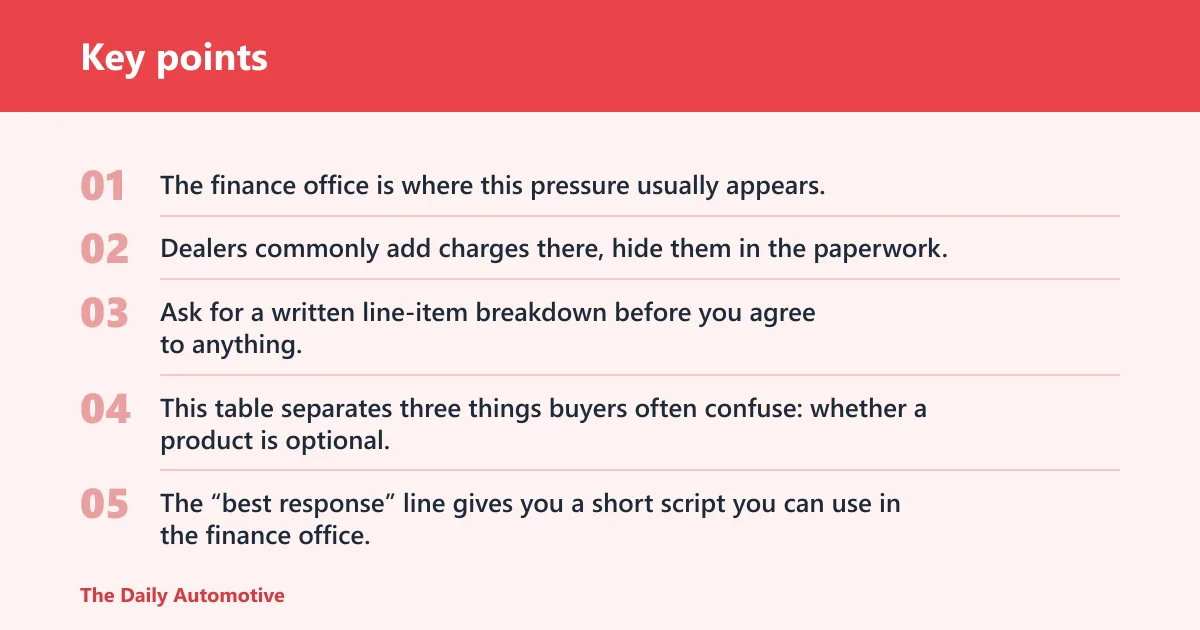
The finance office is where this pressure usually appears. Dealers commonly add charges there, hide them in the paperwork, or fold them into the monthly payment, which makes the total harder to see. Ask for a written line-item breakdown before you agree to anything.
Refusal matrix for dealer add-ons
This table separates three things buyers often confuse: whether a product is optional, whether it is commonly pre-installed, and whether it may be cancellable after signing. The “best response” line gives you a short script you can use in the finance office.
| Add-on type | Typically optional? | Commonly pre-installed? | Can usually be refused before signing? | May be cancellable after signing? | Best one-sentence buyer response |
|---|---|---|---|---|---|
| Paint protection / paint sealant | Yes | Sometimes | Yes | Sometimes, if a contract or refund rule allows it | “Remove the paint sealant line item; I’m not buying it.” |
| VIN etching | Yes | Sometimes | Yes | Sometimes, depending on whether it was billed as a separate contract item | “I do not want VIN etching, so leave it off the deal.” |
| Fabric or interior protection | Yes | Sometimes | Yes | Sometimes, if the paperwork gives you a cancellation right | “Take off the interior protection; I decline that product.” |
| Nitrogen tire fill | Yes | Sometimes | Yes | Usually not useful to cancel after it is done | “I only want normal tire inflation, so remove the nitrogen charge.” |
| Extended warranty / vehicle service contract | Yes | No | Yes | Sometimes, under the separate contract’s cancellation rules | “I’ll compare service contracts later; do not add this one today.” |
| GAP insurance | Yes | No | Yes | Sometimes, depending on the policy and lender rules | “Quote GAP separately; I need to compare it before I decide.” |
Can you refuse add-ons before signing?
Yes. Before you sign, you can refuse to pay for optional dealer add-ons, and you should do that in writing if the numbers are being hidden in the payment. The catch is that the dealer may still decide not to sell the car on your terms. That is a refusal by the dealer, not a requirement for you to accept the product.
Before the contract is signed, slow the process down. Ask for the purchase agreement, the finance worksheet, and the itemized list of every add-on. If the dealer keeps saying a product is mandatory, ask for the rule in writing and be ready to walk.
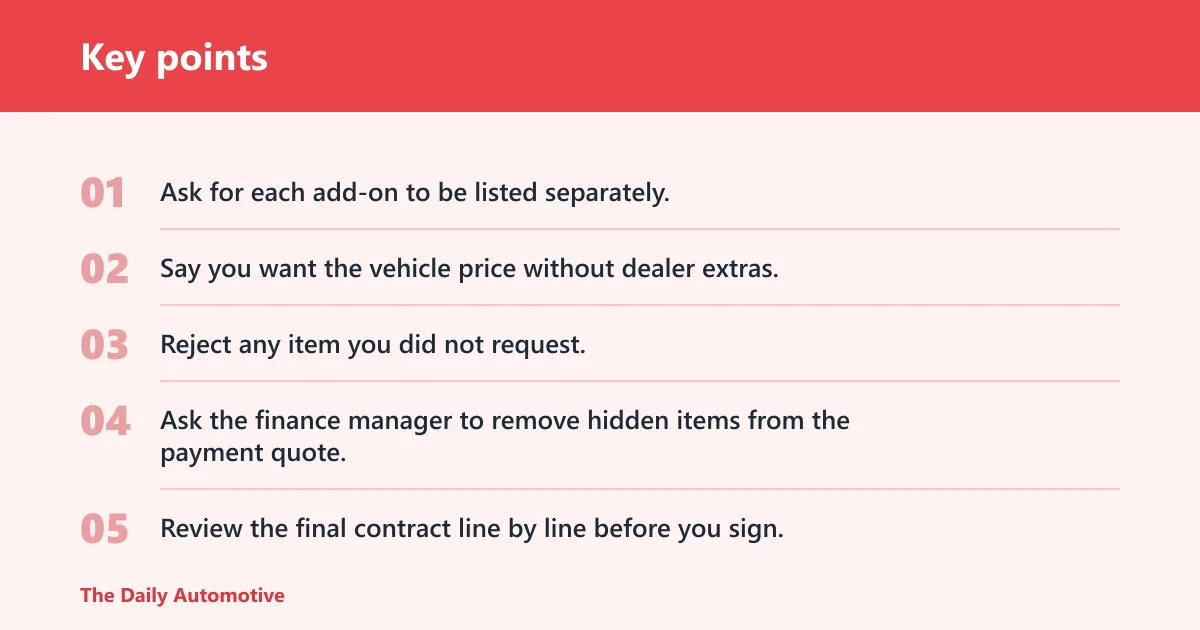
What to say before the contract is signed
- Ask for each add-on to be listed separately.
- Say you want the vehicle price without dealer extras.
- Reject any item you did not request.
- Ask the finance manager to remove hidden items from the payment quote.
- Review the final contract line by line before you sign.
Say your salesperson circles back with a “protection package” that was never discussed during the test drive. A clean response is: “I want the car, not the package. Show me the vehicle price without dealer extras.” That keeps the discussion on the contract, not on the monthly payment pitch.
Why a dealer may still say no
Dealers may use pressure by saying the add-on is mandatory or already on the car. That does not make the charge unavoidable, but it does mean the dealer may refuse to proceed without the package. The legal issue turns on the facts. Forced add-ons can violate the FTC Act Section 5 and state consumer-protection laws, yet that does not guarantee the dealer will voluntarily rewrite the deal right away.
Consumer Reports has said unnecessary dealer extras can add over $4,000, which is why the safest move is to refuse before signing rather than trying to untangle the charge later.
What changes after signing?

After signing, the deal changes fast. A pre-installed product may already be on the vehicle, and a charge already embedded in the retail installment contract can be much harder to unwind. Some service contracts and GAP policies may be cancellable under their own terms, but that is not the same as being able to erase the charge immediately or get the dealer to undo the sale.
Do not treat a pre-installed item the same as a line item in the paperwork. A product can be installed, billed, and then disputed later only through the contract’s refund rules or state law. That is a narrower path than refusing it before signing.
Pre-installed products versus contract charges
If the item is pre-installed, the dealer may argue it is already on the car and no longer optional. That is exactly why the distinction matters. A charge inside the signed paperwork may be subject to cancellation rules; a physical product already added to the car may not be removable in the same way.
Suppose a used SUV has nitrogen in the tires, etched glass, and a paint package already listed on the buyer’s order. You can still refuse to accept the package before signing, but after signing your best outcome may be a partial refund under the contract terms rather than a clean removal of every charge.
When a service contract or GAP policy may be cancellable
Extended warranties are usually sold as vehicle service contracts, often for $2,000 or more. Those contracts may have their own cancellation rules, so compare the dealer’s offer with third-party coverage before you sign. GAP insurance can also be worth considering when you owe more than the car is worth, but it only matters while that loan balance is higher than the vehicle value.
Do not assume cancellable means free. A refund may be prorated, may be reduced by fees, and may take time to process. Read the cancellation section before you agree.
Which dealer add-ons are easiest to decline?
Paint protection, VIN etching, fabric protection, and nitrogen tire fill are among the easiest add-ons to decline because they are usually optional and rarely change the core deal. The value is weak at dealership pricing, and the charges are often padded. If the dealer will not remove them before signing, that is a good reason to walk away.
These products also tend to be marketed with vague claims about long-term protection. That is a poor reason to pay dealership pricing when the same goal can often be handled elsewhere for less, or skipped entirely.
Paint protection and VIN etching
Paint sealant is often priced much higher at the dealership, while outside cost is often about $50–$250. Dealers may sell it as rust or finish protection, but you should treat it as optional unless the contract says otherwise. VIN etching is shown at $200–$300 dealer pricing, while a DIY kit costs about $25, and the VIN is already stamped in multiple locations on the vehicle.
Paint and VIN etching are easy to reject because they are not required to buy the car. Ask the dealer to remove them from the invoice and the finance worksheet before you sign.
Fabric protection and nitrogen tire fill
Dealers may sell it for hundreds of dollars, while consumer spray products are often priced around $9–$12. Nitrogen tire fill is sometimes listed at a high dealership price, even though ordinary air is already mostly nitrogen and there is no proven fuel-economy or tire-life benefit for normal driving.
For both products, the right response is short and direct: “No thanks, remove it.” If the dealer says the charge is already applied, separate the price discussion from the vehicle itself and ask whether the product can be deleted from the paperwork before you continue.
Which add-ons may be worth considering?
Extended warranty coverage and GAP insurance are the two dealer add-ons that may deserve a closer look, but only after you compare them against outside options and your own risk. The service contract may be overpriced at the dealership, and GAP only matters if you owe more than the car is worth. Neither one should be bought on pressure alone.
The same rule applies to both: compare the dealer offer with third-party pricing and the contract terms. If the dealer will not itemize the quote, you do not have enough information to decide.
Extended warranty versus third-party coverage
Dealer extended warranties are often presented as protection against repair bills, but they are usually vehicle service contracts sold in the finance office. That matters because the same coverage may be available elsewhere at a different price or with different exclusions. Ask for the contract length, covered systems, deductible, and cancellation terms in writing.
If the dealership quotes a service contract and will not separate the cost from the monthly payment, stop the conversation. Hidden pricing makes comparison shopping impossible.
When GAP insurance can make sense
GAP insurance may make sense when the loan balance is higher than the car’s value, which can happen early in a loan or on a long term with little down payment. It only matters during the period when you are upside down. Once the balance drops below the vehicle value, the need usually fades.
If you are leasing, GAP is often discussed differently than on a purchase, so read the lease or loan paperwork carefully. The key question is not whether GAP exists, but whether you actually need it and whether the dealership’s rate beats a third-party quote.
How to handle F&I office pressure
The finance office is where many buyers lose the most money. That is where add-ons are commonly presented, where pricing can be buried in the payment, and where a manager may try to sell a package after you think the car deal is done. Stay calm, ask for itemized pricing, and refuse anything that is not clearly listed.
If the dealership says an add-on is mandatory, ask whether the vehicle can be sold without it. If the answer is no, you can walk away. That is often the cleanest way to protect yourself from a padded deal.
How to decline add-ons in the finance office
- Pause before signing any final contract.
- Ask the finance manager to print a line-item breakdown.
- Cross out every product you did not request.
- Refuse to focus on the monthly payment alone.
- Leave if the dealer will not remove the charge.
A common first-timer mistake is agreeing to a lower monthly payment without checking what was added to get there. A $400 nitrogen charge or a $600 paint sealant package can disappear inside the payment math, but it is still money you are paying. The fix is simple: compare the total out-the-door price, not the monthly number.
How to respond if the dealer says an add-on is mandatory
Say, “If it is mandatory, show me the written policy and the total price without it.” That response keeps the burden on the dealer to explain the charge. If the charge is still not removed, ask for the final worksheet and leave with the paperwork unfinished.
The goal is not to win an argument. It is to avoid being boxed into a signed contract with charges you did not want.
Frequently asked questions
What does no dealer add ons mean?
It means you want to buy the vehicle without dealer-installed extras or finance office products. In practice, that means no paint protection, VIN etching, fabric protection, nitrogen fill, or similar add-ons unless you specifically agree to them in writing. Ask for the deal to be itemized so you can verify that nothing is hidden in the payment.
How to avoid dealer markup
Ask for the out-the-door price, not just the monthly payment, and request a separate line for every fee and add-on. Markup is easier to spot when the paperwork is itemized. If the dealer keeps moving the price into the payment calculation, stop and ask for a clean written quote.
Which dealer add-ons can you refuse?
You can usually refuse optional dealer add-ons such as paint protection, VIN etching, fabric protection, nitrogen tire fill, extended warranties, and GAP insurance before you sign. The harder issue is whether the dealer will still sell the car without them or whether a pre-installed item is already part of the deal.
Are dealer add-ons required to buy the car?
Not as a general rule. Optional add-ons are not required by themselves, but a dealer may still refuse to sell the car unless you accept a package. That is why the best time to reject them is before signing, when you still have room to walk away from the deal.
Can the dealer force you to buy paint protection or VIN etching?
Dealers may pressure you and say these products are required, but they are described as optional products. You can refuse to pay for them before signing, and if the dealer will not remove them, you may need to walk. After signing, a pre-installed charge is usually harder to unwind than a line item you rejected up front.
Which add-ons are actually worth paying for at a dealership?
Only the ones you have compared carefully against outside pricing and outside contracts. GAP insurance may make sense if you owe more than the car is worth, and a service contract can be worth considering if the terms are strong and the price is competitive. The dealership is not the default best place to buy either one.
How do you decline add-ons in the finance office?
Use a short refusal and ask for a revised itemized worksheet. Say, “Remove every product I did not request, and show me the total without those charges.” Do not let the discussion stay at the monthly payment level, because that is where hidden extras are easiest to miss.
What should you do if the dealer says an add-on is mandatory?
Ask for the policy in writing, then decide whether the vehicle is still worth it to you. If the dealership will not sell without the package, you are not dealing with a removable add-on anymore; you are dealing with a store condition. At that point, walking away is often the smartest answer.
Products related to this article
Sponsored / affiliate links. As an Amazon Associate I earn from qualifying purchases. I may earn additional commission from eligible campaigns.
 Auto Car Dent Repair Puller Head Paintless-Dent Repair Removal Kit for Slide Hammer Pulling Tab Adapter Pulling Tabs Car Aluminum-alloy Puller Head Adapter Screw Glue-tabs for Slide Hammer and
 Fast Inflation Car Tire Pump air Compressor air Pump for Bike Motorcycle Ball Toys Portable 12V air Pump for car Tires