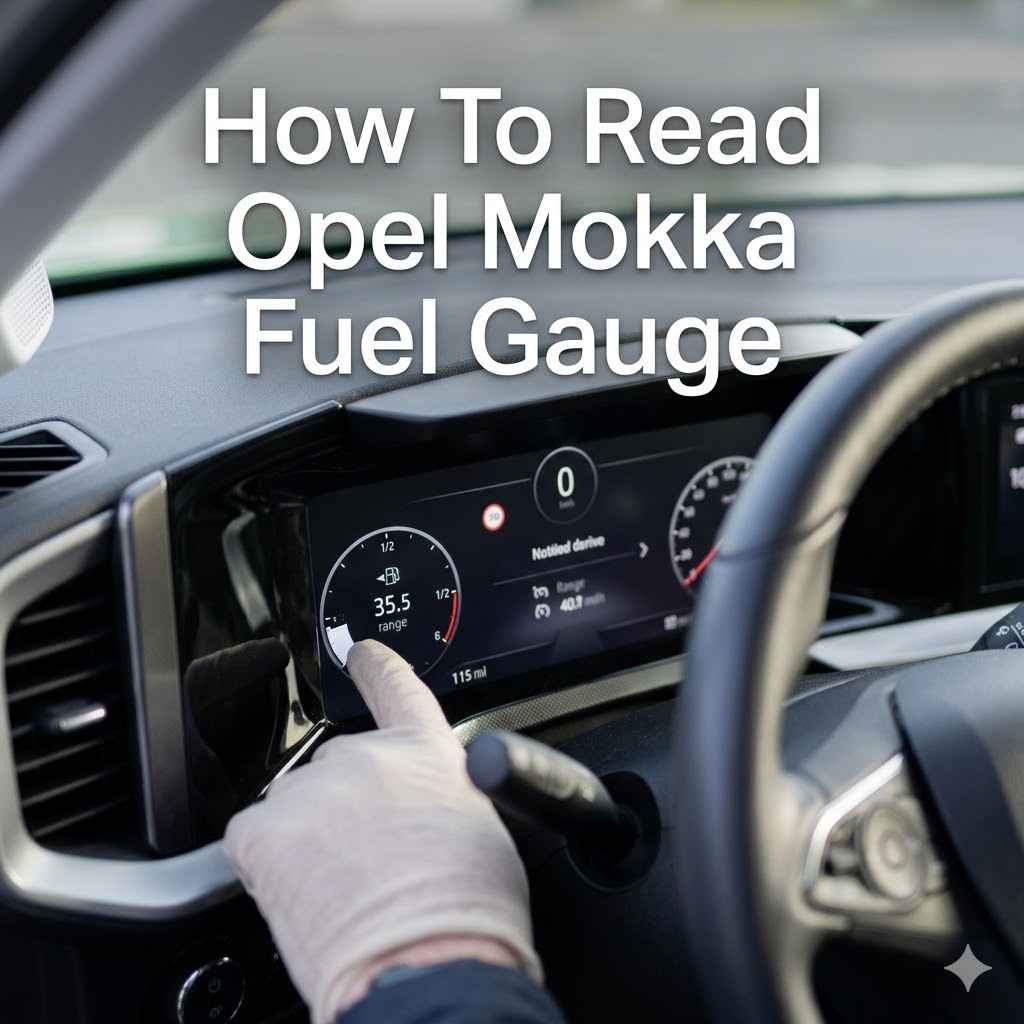
How To Read Opel Mokka Fuel Gauge
Getting a new car is exciting! Sometimes, though, some things can seem a little tricky at first. For instance, if you’re wondering how to read the fuel gauge on a new Opel Mokka, you’re not alone.
Newer cars have different ways of showing information, and it’s easy to feel a bit lost. But don’t worry! This guide will make it super simple.
We’ll go through it step-by-step so you’ll know exactly what your car’s fuel level means in no time. Let’s get your fuel questions answered.
Understanding Your Opel Mokka Fuel Gauge
Knowing how to accurately read your Opel Mokka’s fuel gauge is important for planning your drives and avoiding those stressful moments of running low on fuel. This section will help you get familiar with the basic symbols and indicators you’ll see on your dashboard. We’ll explain what each part of the gauge means, so you can confidently interpret your car’s fuel status at a glance.
This knowledge empowers you to make informed decisions about refueling stops.
The Basics of the Fuel Gauge
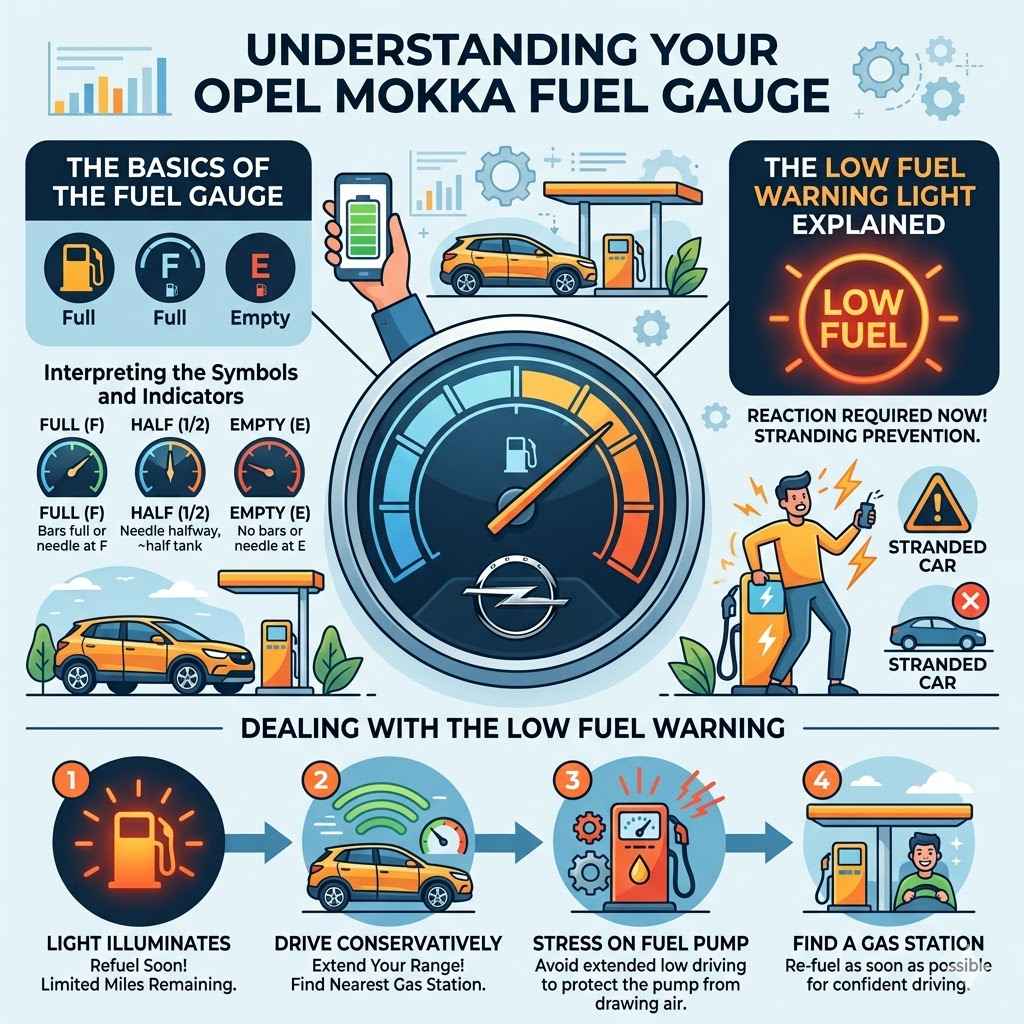
The fuel gauge on your Opel Mokka is designed to give you a clear picture of how much gasoline is left in your tank. It usually looks like a small drawing of a fuel pump with a needle or a series of bars. These bars or the needle move to show you the fuel level.
When the needle is pointing towards the ‘F’ or the bars are all lit up, your tank is full. As you drive and use fuel, the needle will move down or the bars will disappear, indicating that the fuel level is dropping. The ‘E’ mark or no bars lit means the tank is empty.
Most gauges also have a low fuel warning light. This light, often shaped like a fuel pump, will turn on when the fuel level gets very low, giving you a visual alert to find a gas station soon.
Interpreting the Symbols and Indicators
Your Opel Mokka’s fuel gauge is more than just a needle or bars; it uses specific symbols to communicate information. The primary symbol is the fuel pump icon. On the gauge itself, you’ll typically see an ‘F’ for Full and an ‘E’ for Empty.
The space between these points is divided into sections, usually indicating quarters of a tank.
For example, if the needle is halfway between ‘F’ and ‘E’, you have about half a tank of fuel. If it’s closer to ‘F’, you have more fuel. If it’s closer to ‘E’, you have less.
Pay attention to the specific markings on your gauge as they might vary slightly between different Mokka models or trims.
Beyond the main gauge, a small light often illuminates when you’re running critically low. This is the low fuel warning light. It’s crucial to react when this light comes on, as it means you have a limited amount of fuel remaining, usually enough for just a few more miles.
The Low Fuel Warning Light Explained
The low fuel warning light is your car’s way of shouting “Refuel now!” It’s a bright indicator, often red or orange, that you’ll see on your dashboard. When this light appears, it means the fuel in your tank has reached a minimal level.
The exact amount of fuel left when the light comes on can differ slightly depending on the car. However, it’s generally enough to get you to the nearest gas station if you drive conservatively. Don’t ignore this warning; it’s there to prevent you from getting stranded.
Driving with the low fuel light on for extended periods can sometimes put stress on your fuel pump, as it might start to draw air instead of fuel. It’s always best practice to seek a gas station as soon as you see this light illuminate.
How to Read the Fuel Gauge on a New Opel Mokka Precisely
Now that you know the basic components, let’s get into the details of how to read the fuel gauge on a new Opel Mokka with precision. This involves understanding not just the needle’s position but also how different driving conditions might affect your fuel consumption and therefore how quickly the gauge moves. We will also cover how to interpret the digital displays that accompany the gauge.
Understanding the ‘F’ and ‘E’ Markings
The ‘F’ and ‘E’ markings are your primary reference points on the fuel gauge. F’ stands for Full, meaning your fuel tank is completely filled. ‘E’ stands for Empty, indicating that your fuel tank has very little to no fuel left.
Most fuel gauges have markings between ‘F’ and ‘E’ to represent different fuel levels. These are often in quarter increments (1/4, 1/2, 3/4), though some may have more detailed divisions. If the needle points directly at ‘F’, you have a full tank.
If it points halfway between ‘F’ and ‘E’, you have approximately half a tank.
It’s important to note that the gauge is an estimate. The needle might not always move in a perfectly linear fashion due to the shape of the fuel tank and the movement of fuel as you drive, especially on hills or during hard acceleration and braking.
Interpreting the Needle or Digital Display
Your Opel Mokka might have either an analog needle gauge or a digital display, or a combination of both. With an analog gauge, the needle’s position tells you the fuel level. As fuel is consumed, the needle moves from the ‘F’ side towards the ‘E’ side.
If you have a digital display, it might show the fuel level as a series of bars, like a battery indicator, or as a percentage. These bars will deplete as fuel is used, similar to the needle dropping on an analog gauge. A percentage display is very straightforward, showing exactly how much fuel you have left as a number.
Many modern cars, including the Opel Mokka, will also display the estimated remaining driving range in miles or kilometers on the digital display. This figure is calculated based on your current fuel level and recent driving style. It’s a helpful tool, but remember it’s an estimate that can change.
Factors Affecting Fuel Gauge Accuracy
While fuel gauges are generally reliable, several factors can momentarily affect their accuracy. The most common factor is the physical movement of the car. When you park on a steep incline or decline, the fuel can slosh to one side of the tank, making the gauge appear higher or lower than it truly is relative to the overall volume.
Sudden acceleration or hard braking can also cause the fuel level to shift within the tank, leading to temporary fluctuations in the gauge reading. This is normal and not indicative of a problem with the gauge itself.
In very rare cases, issues with the fuel level sensor or the sending unit within the fuel tank can cause inaccurate readings. If you notice consistently strange or erratic behavior from your fuel gauge, it’s worth having it checked by a mechanic.
Advanced Fuel Gauge Features and Tips
Beyond the basic readings, your Opel Mokka may offer more sophisticated features related to fuel management. Understanding these can help you optimize your fuel usage and driving habits. We will explore how to use the trip computer and gain insights into your fuel efficiency.
Using the Trip Computer for Fuel Economy
The trip computer in your Opel Mokka is a powerful tool for monitoring your fuel usage. It can show you a wealth of information, including your average fuel consumption, instantaneous fuel consumption, and the estimated remaining driving range.
To access these features, you typically use buttons on your steering wheel or stalks. You’ll want to familiarize yourself with your Mokka’s manual to find the exact controls. The average fuel consumption figure is particularly useful for understanding your car’s efficiency over longer periods.
By observing the instantaneous fuel consumption, you can see how your driving style directly impacts fuel use. For example, you’ll notice that accelerating rapidly or driving at high speeds increases this number significantly, while gentle acceleration and steady cruising decreases it.
Understanding Range Estimation
The estimated driving range, often displayed in miles or kilometers, is calculated by the car’s computer. It takes the amount of fuel currently in your tank and divides it by your recent average fuel consumption rate. This gives you an idea of how far you can travel before needing to refuel.
It’s important to remember that this is an estimation. If you suddenly encounter heavy traffic, start driving uphill for an extended period, or accelerate more aggressively, your actual range will decrease faster than the displayed number might suggest. Conversely, if you switch to steady highway driving after city traffic, the range might increase slightly.
Treat the range estimation as a guide, not a definitive limit. Always aim to refuel when the low fuel warning light comes on, or when the range drops to a level you’re uncomfortable with, rather than pushing it to the absolute limit.
Tips for Maximizing Fuel Efficiency
To get the most out of every tank of fuel in your Opel Mokka, adopting a few smart driving habits can make a big difference. One of the most impactful is smooth acceleration and braking. Avoid sudden stomps on the gas pedal or slamming on the brakes.
Instead, gradually increase your speed and anticipate stops by easing off the accelerator early.
Another key factor is maintaining a steady speed, especially on highways. Cruise control can be your best friend here, as it helps the car maintain a consistent speed without constant adjustments from your foot. Also, ensure your tires are properly inflated.
Underinflated tires create more resistance, making your engine work harder and consume more fuel.
Regular maintenance is also vital. Keeping your engine tuned, air filters clean, and using the recommended grade of oil will ensure your Mokka runs as efficiently as possible. Finally, reduce unnecessary weight in your car; extra items add to the overall load your engine has to carry, thereby increasing fuel consumption.
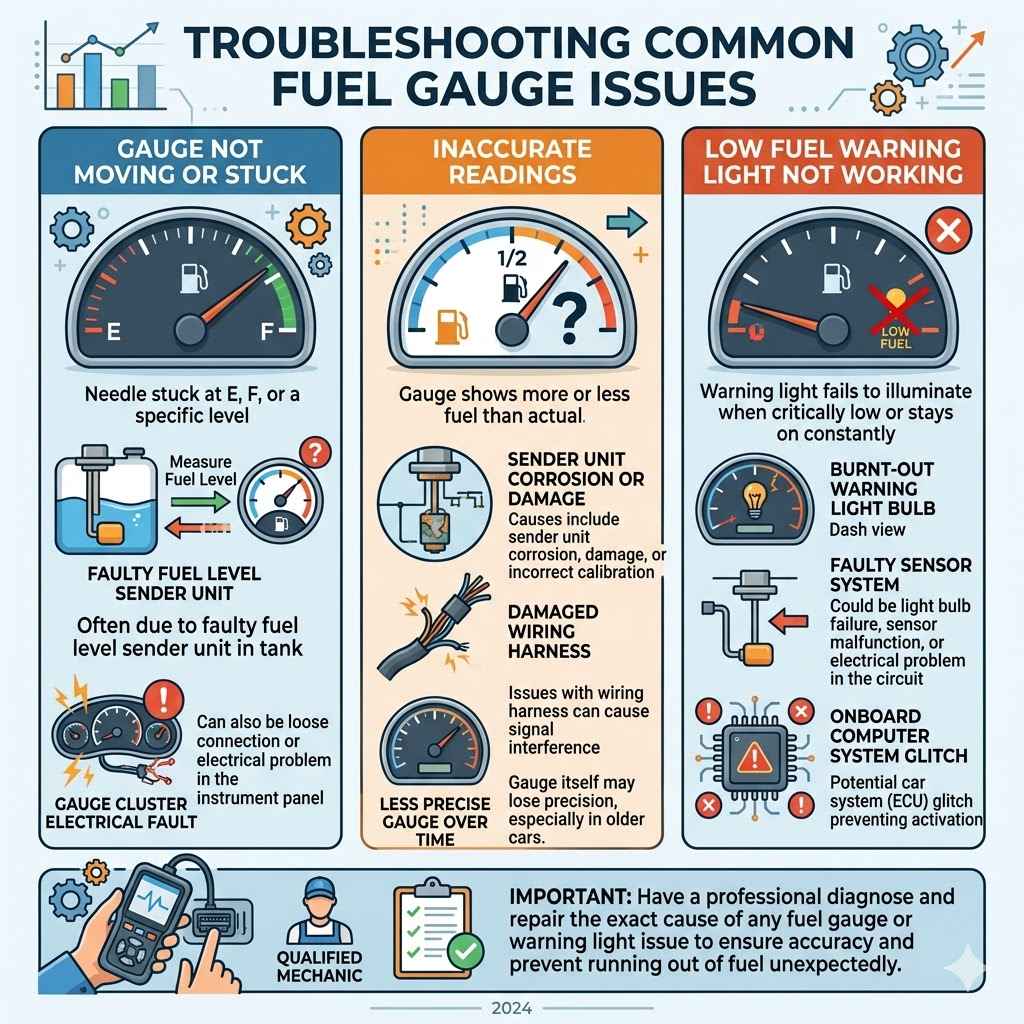
Troubleshooting Common Fuel Gauge Issues
Occasionally, you might encounter a problem with your Opel Mokka’s fuel gauge. Understanding common issues and their potential causes can help you identify when something might be wrong and what steps you can take. This section will cover some typical problems owners might face and how to address them.
Gauge Not Moving or Stuck
If your fuel gauge needle is stuck at a certain level and doesn’t move even after driving a considerable distance, or if it doesn’t move at all from the ‘E’ or ‘F’ position, there might be an issue. The most likely culprit is a faulty fuel level sender unit located inside the fuel tank. This unit’s job is to measure the fuel level and send that information to the gauge.
Another possibility is a problem with the gauge cluster itself, where the needle or digital display is controlled. Sometimes, a loose connection or an electrical fault within the instrument panel can prevent the gauge from functioning correctly.
If the gauge is consistently showing full when it’s not, or completely empty when there’s fuel, it’s a clear sign that something needs attention. It’s advisable to have this checked by a qualified mechanic to diagnose the exact cause.
Inaccurate Readings
Inaccurate fuel gauge readings, where the gauge shows more or less fuel than is actually in the tank, can be frustrating. As mentioned earlier, parking on inclines can cause temporary inaccuracies, but persistent incorrect readings are more concerning.
This could again point to issues with the fuel level sender unit. If the sender unit is corroded, damaged, or not calibrated correctly, it will send incorrect signals. Similarly, problems with the wiring harness connecting the sender to the gauge can lead to signal interference and inaccurate readings.
Sometimes, especially with older cars, the gauge itself might become less precise over time. If the readings seem wildly off, or if the low fuel warning light comes on too late or not at all, it’s important to get it inspected to avoid running out of fuel unexpectedly.
Low Fuel Warning Light Not Working
The low fuel warning light is a critical safety feature. If it fails to illuminate when your fuel level is critically low, or if it stays on constantly, this needs immediate attention. A non-functioning warning light poses a significant risk of the car running out of fuel at an inconvenient or dangerous time.
The issue could be with the light bulb itself within the instrument cluster, or it could be related to the same sensor system that tells the gauge how much fuel you have. The sensor might be faulty, or there could be an electrical problem in the circuit that activates the warning light.
In some cases, the car’s onboard computer system might have a glitch that prevents the warning light from activating. Regardless of the cause, if you suspect your low fuel warning light isn’t working correctly, it’s best to have it diagnosed and repaired by a professional mechanic as soon as possible.
Frequently Asked Questions
Question: How much fuel is left when the low fuel light comes on in my Opel Mokka?
Answer: The exact amount of fuel left when the low fuel light comes on can vary slightly, but it’s typically enough to drive for about 30 to 50 miles, or roughly 5 to 8 liters. It’s always best to find a gas station as soon as you see the light.
Question: Can I trust the estimated driving range shown on my Opel Mokka’s display?
Answer: The estimated driving range is a helpful guide, but it’s an estimation based on recent driving. Your actual range can change depending on your driving style, speed, and road conditions. It’s wise to refuel before the range gets very low.
Question: Why does my fuel gauge sometimes read differently when parked on a hill?
Answer: When your car is parked on a hill, the fuel inside the tank sloshes to one side. This can make the fuel level sensor read a higher or lower amount of fuel than is actually present in the tank.
Question: How often should I check my Opel Mokka’s tire pressure for better fuel economy?
Answer: It’s recommended to check your tire pressure at least once a month and before long trips. Properly inflated tires improve fuel efficiency and tire wear.
Question: Is it bad to drive with the low fuel warning light on for a long time?
Answer: Yes, driving for extended periods with the low fuel light on is not recommended. The fuel pump might start to draw air, which can cause it to overheat and potentially fail, leading to costly repairs.
Summary
Mastering how to read the fuel gauge on a new Opel Mokka is straightforward. You now know how to interpret the ‘F’ and ‘E’ markers, the needle or digital display, and the low fuel warning light. Understanding these basics ensures you’re always aware of your fuel status, helping you plan your trips effectively and avoid unexpected stops.