
How to Review Your Auto Policy After Moving to a New State
Review your auto policy within about 30 days of establishing residency, then update your address, garaging ZIP, state-required coverages, and registration details before the next renewal or claim. Skip that audit, and you can end up underinsured, misrated, or denied payment if the insurer decides the car was garaged or registered in the wrong state. This checklist walks you through the move-date policy review, from minimum limits and added endorsements to documents you should confirm with the DMV and carrier.
Do you need new car insurance after moving?
Usually, yes. A move to a new state is a policy update event because your insurer rates the car on where it is garaged, what the new state requires, and whether the company writes business there. Your current policy may still protect interstate driving during the move, but the policy often needs rewriting once residency changes.
What stays in force during interstate travel
A standard auto policy typically covers you in all 50 states and Canada, so driving to your new state does not automatically void coverage at the state line. The bigger risk is delay: if the move changes residency, garaging, registration, or required coverages, the old declarations page may no longer fit the car’s real use.
When the old policy may need rewriting
If the insurer does business in the new state, it may rewrite the existing policy with a new rating address, state forms, and limits. If it does not, you will need a new carrier before the old policy runs out. That is why the move should trigger a policy review before your next claim, ticket, or DMV filing.
How state minimums change your coverage
State minimum liability coverage varies by state and is usually written as bodily injury per person / bodily injury per accident / property damage, such as 25/50/25 or 30/60/15. When you move, your old limits may no longer satisfy the new state, and some states also require PIP, UM/UIM, or other coverage that was optional before.
Matching liability limits to the new state
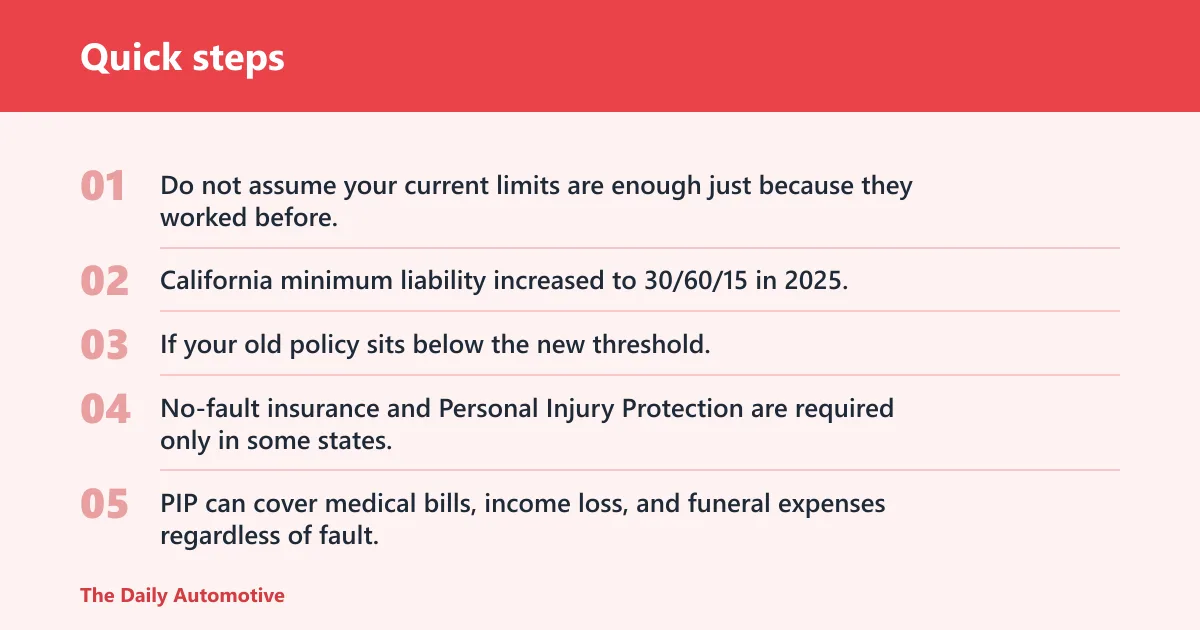
Do not assume your current limits are enough just because they worked before. California minimum liability increased to 30/60/15 in 2025, and Virginia minimums rose to 50/100/25 effective Jan 1, 2025. If your old policy sits below the new threshold, the carrier may need to adjust the policy before renewal or registration.
When PIP or no-fault rules come into play
No-fault insurance and Personal Injury Protection are required only in some states. PIP can cover medical bills, income loss, and funeral expenses regardless of fault. That matters when you move from an at-fault state to a no-fault state, because the coverage you had before may not satisfy the new filing rules.
Whether to keep higher limits after the move
You do not have to settle for the state minimum just because you moved. Many drivers shop with higher limits like 100/300/50, especially when the car is newer, the commute is heavier, or assets need more protection. Higher limits can also make sense if the new state’s minimum is low but repair and medical costs are not.
Garaging address and policy details
Your garaging address is a rating item, not a mailing footnote. The new ZIP code can change premium, underwriting rules, and eligibility, so it must be updated with the insurer. The same review should catch the driver’s license number, commute pattern, and where the car actually sleeps at night.
Updating the new ZIP code
Tell the insurer where the vehicle is kept most nights, even if the mailing address is different. Temporary housing can be tricky, but the rating address should reflect the actual garaging location. A mismatch can produce a mispriced policy or a claim review if the insurer believes the car was rated for one place and kept in another.
Checking the driver’s license number
Driver’s license changes matter because the new state may issue a different number. That number may need to be added to the policy after residency is established. If a license record on the policy is stale, an adjuster or underwriter may have to reconcile it before paying a claim or issuing new documents.
Confirming vehicle use, commute, and garaging location
Review how the car is used now. A remote worker may no longer have the same commute exposure, while a student or military family may split time between two addresses. Keep the policy description honest about annual mileage, principal garaging, and who drives the car, because those details affect both rating and eligibility.
Policy audit table

| Item | Why it matters | What to verify | Who to call | When it must be done |
|---|---|---|---|---|
| Garaging address | New ZIP code can change price and underwriting eligibility. | Actual nighttime parking location and whether it matches the rating address. | Auto insurer | As soon as residency or garaging changes. |
| State minimums | The new state may require different liability limits or forms. | Bodily injury, property damage, and any state-specific minimums. | Auto insurer | Before the policy is rewritten, renewed, or used for registration. |
| PIP/UM-UIM | Some states require PIP or UM/UIM, and the old policy may not fit. | Whether no-fault, PIP, or UM/UIM is required in the new state. | Auto insurer | Before the first claim, renewal, or DMV filing. |
| Registration | Registration often depends on in-state insurance and residency proof. | State filing rules, insurance proof, and local deadlines. | State DMV | Within the new state’s filing window; some are as short as 10 to 30 days. |
| Driver’s license number | The policy may need the new license number after residency changes. | License status, issue date, and whether the insurer updated the record. | DMV and auto insurer | After residency is established and when the new license is issued. |
| Financed/leased vehicle coverage | Lenders and lessors often require collision and comprehensive. | Contract minimums, deductibles, and any lender-specific insurance rules. | Lender or lessor, then insurer | Before changing limits or dropping any physical damage coverage. |
| Policy effective date | Prevents a gap between the old policy and the new one. | Start date on the rewritten policy and end date on the old one. | Auto insurer | Before moving day or before the old policy expires. |
What if your carrier does not write in the new state?
If your carrier does not write policies in the new state, the move may require a rewritten policy with a different company. That is common enough that it should be part of the first call, not an afterthought. The important question is whether the carrier can transfer the policy cleanly or whether you need a fresh application.
When a rewritten policy is enough
Some national carriers can keep the same customer file but issue a new-state policy form, declarations page, and rating profile. That can preserve continuity and reduce paperwork. Even then, the old policy terms may not carry over word for word, so read the new declarations page carefully.
When you need a new insurer
If the company does not operate in the new state, you will need new quotes before the old policy ends. Start with coverage structure, not price alone. Match liability limits, collision and comprehensive deductibles, UM/UIM choices, and any PIP or medical payments option so the quotes are truly comparable.
How to compare quotes on equal terms
Compare the same limits, deductibles, and endorsements on each quote. A cheaper quote can hide a lower liability cap or strip out roadside assistance. Also check financial strength and service quality through AM Best ratings, J.D. Power studies, and the NAIC complaint index, because a low premium is no use if the carrier handles claims badly.
How to avoid a lapse in coverage

A lapse in coverage can trigger fines, registration issues, and higher future rates. The safest move is to overlap policies or line up the new-state policy before the old one expires. The exact filing order can vary by carrier and state, but the goal is the same: no day without active insurance.
Timing the old and new policies
Coordinate the effective date so the new policy starts before or on the day the old one ends. If the insurer needs proof of the new address, registration, or license first, ask what document it needs to activate the rewrite. Do not let the policy wind down while you wait for DMV paperwork.
Coordinating registration and insurance proof
Vehicle registration must match the state of residence, and it is often tied to proof of in-state insurance. Deadlines can be as short as about 10 to 30 days, depending on the state. Texas gives new residents 30 days to register a vehicle and 90 days to get a Texas license. California requires registration within 20 days for new residents. Florida requires a Florida license within 30 days for certain new residents.
What a coverage gap can cost
A gap can lead to a denied or delayed claim, a registration hold, or a later surcharge for prior lapse. A common first-timer mistake is letting the old policy end two days before the new one begins because a DMV appointment slipped. That two-day gap can matter more than the entire drive to the new state.
Frequently asked questions
Do I need to change my car insurance when I move to a new state?
Usually yes. Moving changes your garaging address, state minimums, and sometimes the insurer itself. Even if the policy continues during the drive, the coverage often needs to be rewritten after residency changes so the declarations page, limits, and state forms match the new address and use.
How soon after moving do I need new auto insurance?
As soon as practical, and well before your current policy ends. Many states tie registration and licensing to residency, and the move timeline can run from roughly 30 to 90 days depending on the state. The safe approach is to update the insurer right after establishing residency.
Will my current car insurance cover me while I drive to my new state?
Usually, yes. A standard auto policy typically covers you in all 50 states and Canada, so crossing state lines does not by itself end coverage. The problem comes later if the policy is not updated to reflect your new residence, garaging address, or required state coverages.
What should I tell my insurance company after I move?
Give the insurer your new address, garaging ZIP, new driver’s license number if issued, vehicle use, commute status, and whether the car is financed or leased. Also ask whether the policy must be rewritten for the new state and whether any limits, PIP, or UM/UIM changes are required.
What happens if I have a gap in coverage during a move?
A gap can lead to fines, registration trouble, and a higher premium later. It can also create a problem if you file a claim during the lapse. Overlap the old and new policies when possible, and do not assume a short gap will be ignored by the insurer or DMV.
Can moving lower or raise my car insurance rate?
Yes. Rates can fall if the new area has lower claim frequency or different repair costs, and they can rise if the ZIP code, state minimums, or rating rules are more expensive. Your premium may also change if the new state requires PIP, higher liability limits, or different forms.
Products related to this article
Sponsored / affiliate links. As an Amazon Associate I earn from qualifying purchases. I may earn additional commission from eligible campaigns.