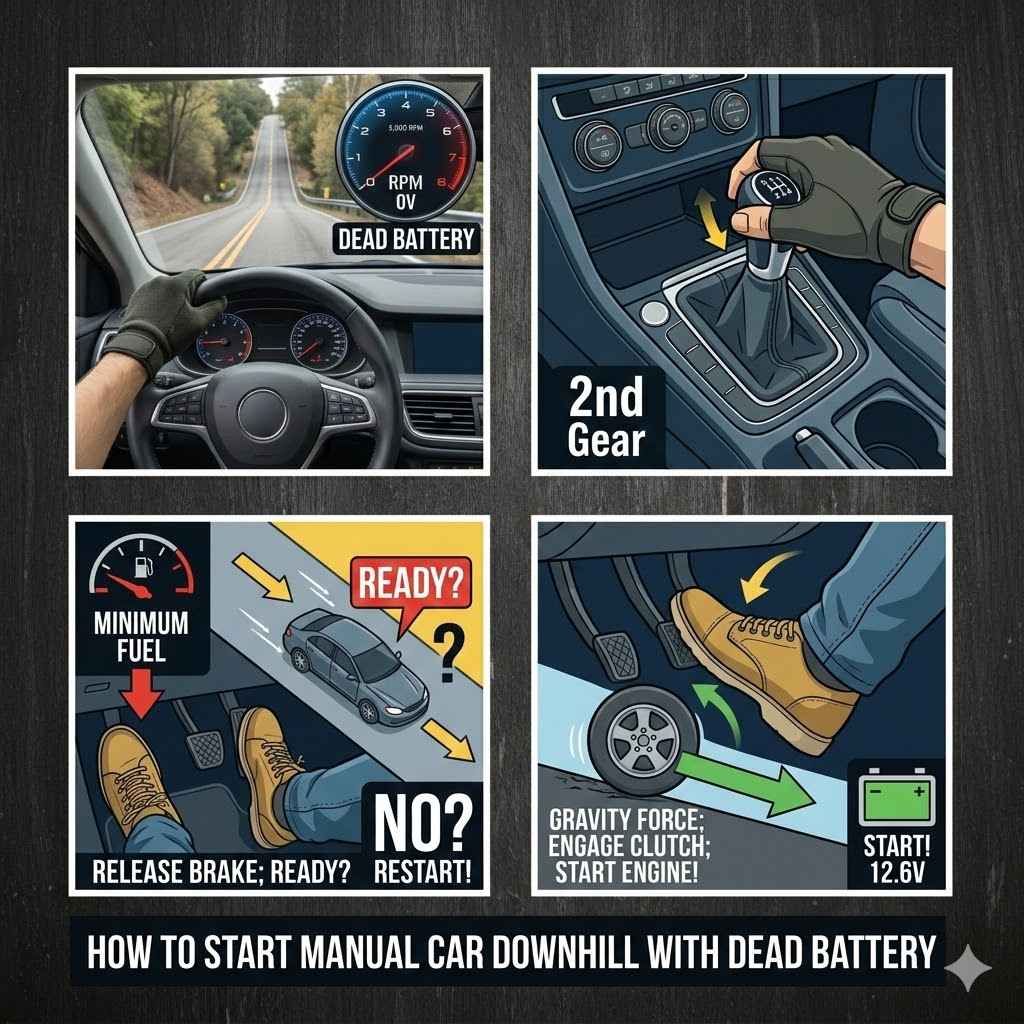
How to Start Manual Car Downhill with Dead Battery
Sometimes, your car battery can die at the worst possible moment. If you drive a manual transmission car and find yourself on a hill with a dead battery, you might feel a bit stuck. It’s a common worry for new drivers.
The good news is that getting your car rolling again is simpler than you might think. We’ll walk you through exactly how to get your manual car moving downhill even with a battery that won’t start the engine.
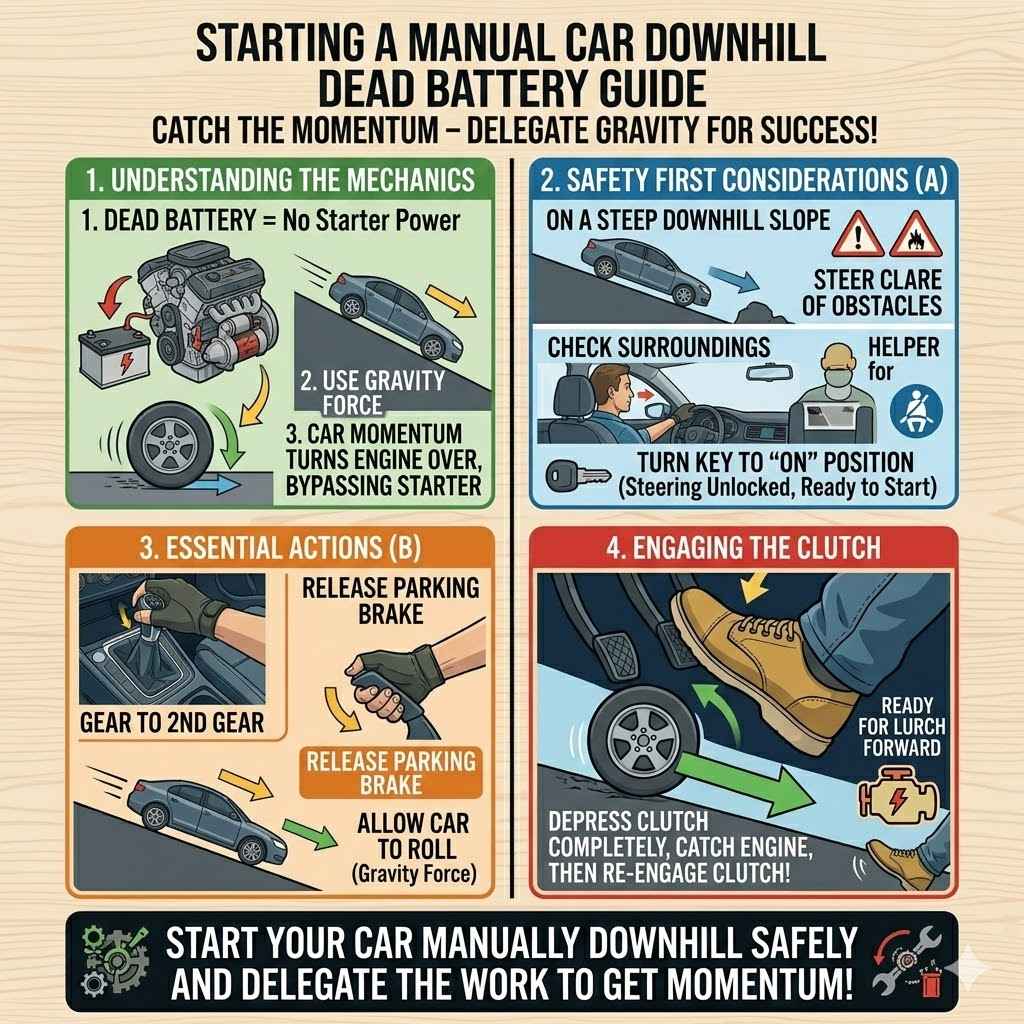
Starting a Manual Car Downhill Dead Battery Guide
This section will cover the essential steps for initiating a manual car start on a downhill slope when the battery is completely dead. We will explain why this method works by using gravity and the car’s momentum. You will learn the importance of each action to ensure a safe and successful start.
This guide aims to make a potentially stressful situation manageable for any driver.
Understanding the Mechanics
When your car battery is dead, the starter motor cannot turn the engine over. The starter motor is what usually gets your engine going. It’s an electric motor that uses power from the battery to spin the engine’s crankshaft.
Without enough battery power, this crucial step can’t happen. This is where using gravity comes into play when you’re on a hill.
Gravity is a force that pulls everything towards the center of the Earth. When your car is on a downhill slope, gravity pulls your car forward. We can use this forward motion to turn the engine over manually, bypassing the need for the starter motor and the dead battery to get the engine running.
It’s a clever way to use physics to your advantage in a bind.
This process is often called “push starting” or “rolling starting” a car. It’s a technique that has been around for decades, especially with manual transmission vehicles. It requires careful coordination and a good understanding of how your car’s clutch and gears work together.
Knowing these basics makes the process much less intimidating.
Safety First Considerations
Before you attempt to start your car downhill with a dead battery, safety is the number one priority. Make sure you are on a hill that is steep enough to gain momentum but also long enough and clear enough to allow you to safely get the car started and slow down. You do not want to start this process on a busy road or a very short incline.
Ensure there are no obstacles or traffic in front of you or coming from behind. Check your mirrors and be aware of your surroundings. Having a helper to push the car or to watch for traffic can be very beneficial, especially if you are inexperienced.
However, this is a process you can manage alone if needed, with careful planning.
Always have your hazard lights on to alert other drivers of your situation. Wear your seatbelt. Keep your steering wheel unlocked and free to move.
The steering wheel will only unlock when the ignition is in the “on” position or when the engine is running, so you’ll need to turn the key to the “on” position before you start rolling.
Be prepared for the car to lurch forward once the engine catches. Make sure your foot is ready to press the clutch pedal as soon as the engine starts. This allows you to regain full control and avoid stalling again immediately.
It’s a good idea to have your transmission in neutral before you begin, so the car rolls freely until you are ready to engage a gear.
How to Start Manual Car Downhill with Dead Battery Step-by-Step
This section outlines the precise actions you need to take to successfully start your manual car downhill when the battery is dead. We will break down each step clearly, focusing on the coordination required between using the clutch, gears, and steering. Following these instructions will help you gain confidence and execute the process smoothly.
Preparing the Vehicle
First, turn the ignition key to the “on” position. This is crucial because it unlocks the steering wheel and allows the dashboard lights to illuminate. It also primes the fuel pump.
Do not try to crank the engine; just turn the key to the “on” or “accessory” position.
Ensure your car is in neutral. This is important so the car can roll freely down the hill. You will shift into a gear later.
Release the parking brake completely. If you are on a steep hill, you might need a helper to block the wheels before you release the brake, but typically, the slope is enough to get you moving.
Check your surroundings. Make sure the path ahead is clear of any obstructions. Look in your mirrors to ensure no vehicles are rapidly approaching from behind.
If you have a helper, they can stand behind the car and give you a push once you are ready.
Fasten your seatbelt. Turn on your hazard lights. These simple steps ensure you are prepared and visible to others, making the process as safe as possible.
It’s about being ready for the car to start moving and then to catch the engine.
Engaging the Gear and Releasing the Clutch
Once the car is rolling downhill and gaining a bit of speed, you will need to engage a gear. For most manual cars, second gear is the best choice. It’s low enough to help start the engine but high enough to prevent the engine from over-revving too quickly once it catches.
Push the clutch pedal all the way down. Now, quickly shift the gear lever into second gear. This is where the magic happens.
As the wheels turn the transmission, the transmission will turn the engine’s crankshaft.
Hold the clutch pedal down for a moment as the car picks up speed. Then, slowly and smoothly release the clutch pedal. This action connects the spinning wheels to the engine.
As the engine begins to turn, it should eventually catch and start running on its own.
It might take a few tries, so don’t get discouraged if it doesn’t work the first time. If the car isn’t starting to turn over, you may need to press the clutch back in and try releasing it again. You want to do this as the car is rolling at a decent speed.
What to Do When the Engine Starts
As soon as you feel the engine ignite and start running, immediately press the clutch pedal back down. This is crucial to prevent the engine from stalling again or over-revving. It gives you control over the engine speed.
Once the clutch is pressed down, you can gently press the accelerator pedal a little to keep the engine running smoothly. You don’t need much. Just enough to maintain a steady idle.
Shift the gear into neutral. You can then release the clutch pedal again. The car should now be running on its own power.
Your hazard lights can be turned off once you are safely off the main road or in a stable position.
If the engine stalls again, you can repeat the process if you are still on a suitable hill and have enough space. However, it is strongly recommended to get your battery checked and charged or replaced as soon as possible after successfully starting the car. Relying on this method repeatedly can be inconvenient and potentially unsafe.
Troubleshooting and Common Issues
This section addresses typical problems that can arise when attempting to start a manual car downhill with a dead battery and provides solutions. We will cover why the car might not be starting and what adjustments you can make. This will help you overcome any hurdles you might encounter during the process.
Car Not Rolling Freely
If your car isn’t rolling downhill even when in neutral with the parking brake off, there could be a few reasons. The hill might not be steep enough. You might need a bit more incline to get enough momentum.
Another reason could be that the parking brake is not fully released. Double-check that the parking brake lever or pedal is completely disengaged. Sometimes, the brake pads can stick slightly to the rotors or drums.
A gentle tap on the brake pedal with the engine off might help release them.
In rare cases, the transmission could be partially engaged, or there might be significant drag from the drivetrain. If you suspect this, it’s best to get a mechanic to look at your car before attempting this method again, as it could indicate a more serious issue. For a simple dead battery scenario, usually, the hill and the neutral gear are sufficient for free rolling.
Engine Not Catching
If the car is rolling well, but the engine isn’t catching when you release the clutch, you might not be getting enough speed. Try to let the car pick up more momentum before releasing the clutch. A faster rolling speed gives the engine more “help” to turn over.
Ensure you are fully releasing the clutch pedal. If you feather the clutch, it might not effectively connect the wheels to the engine. A quick, smooth release is key.
Also, make sure you are in second gear. If you are in a higher gear, like fourth or fifth, the engine might be too difficult to turn over. If you are in first gear, the engine might catch too abruptly and stall again.
It’s also possible that other components are failing. If the spark plugs are fouled, the fuel system has issues, or there’s a problem with the ignition timing, the engine might not start even with the help of gravity. In such cases, the dead battery might be a symptom of a larger electrical problem.
Stalling After Starting
If the engine starts but immediately stalls, it’s usually because you released the clutch too quickly or too aggressively, or you didn’t press the clutch back in fast enough. When the engine catches, it’s at a very low RPM (revolutions per minute).
The moment the engine fires up, you need to instantly push the clutch pedal back down. This disconnects the engine from the wheels and allows you to control its speed with the accelerator. If you forget this step, the engine can either stall from being too slow or over-rev if you’re going too fast downhill.
Once the clutch is down, gently use the accelerator to bring the RPMs up to a stable idle speed. Then, you can shift into neutral and release the clutch again. Practicing this sequence of events, even in your mind, can help make it more automatic when the moment arrives.
Why This Method Works and When to Use It
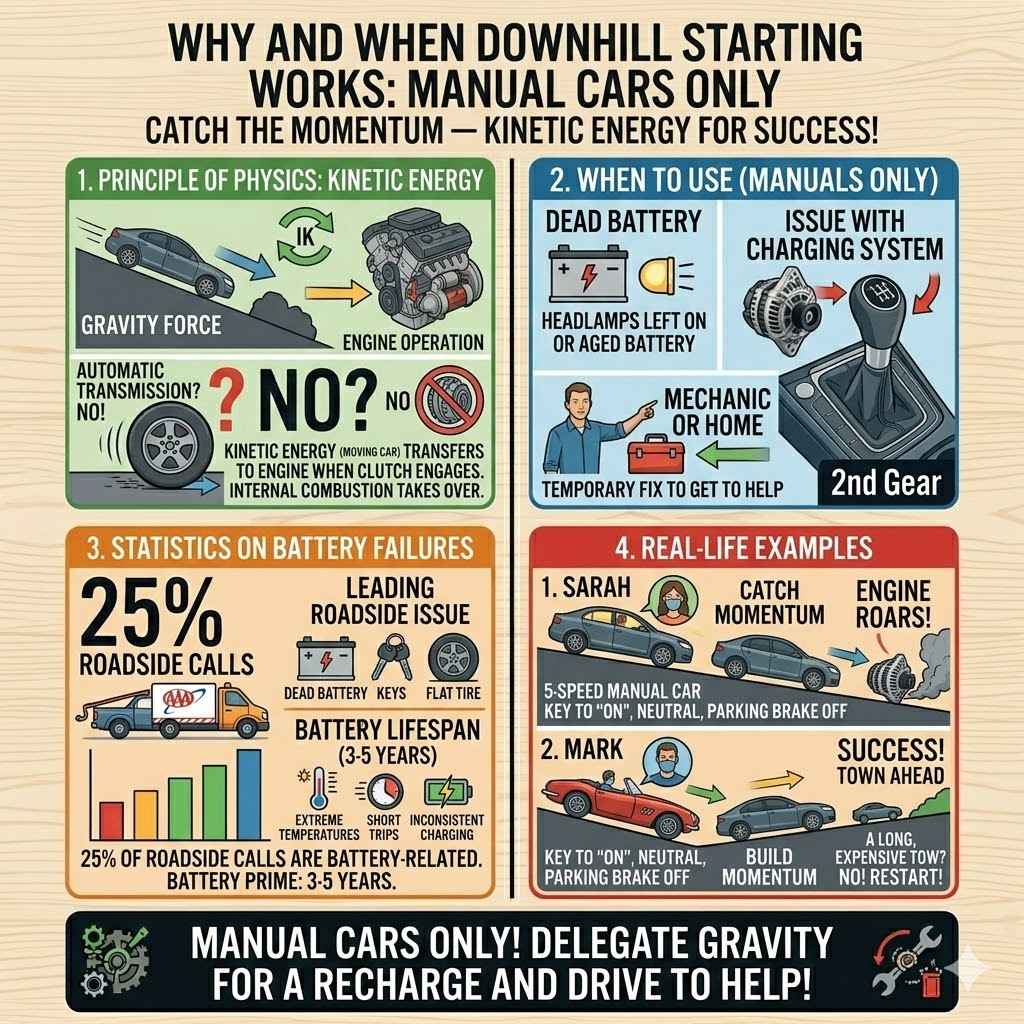
This method is effective because it utilizes a fundamental principle of physics: kinetic energy. When the car rolls downhill, it gains kinetic energy. This energy is transferred to the engine through the drivetrain when the clutch is engaged.
The engine’s internal combustion process then takes over, sustaining its operation.
It’s a practical solution for manual transmission vehicles when the battery is too weak to turn the starter motor. This situation commonly arises if headlights were left on, the battery is old, or there’s an issue with the charging system. It’s a temporary fix to get you to a mechanic or home.
This technique is not applicable to automatic transmission cars because their transmissions are designed differently and cannot be “bump-started” in the same way. The torque converter in an automatic transmission requires the engine to be running to circulate fluid and operate correctly. Therefore, this advice is strictly for manual gearboxes.
Real-Life Example Scenarios
Imagine Sarah, a new driver, was parked on a slight incline after a long day. She forgot to turn off her interior lights, and by the next morning, her battery was completely dead. She drives a 5-speed manual car.
She remembered seeing something about “push starting” cars. She found a gentle slope in a quiet side street, turned her key to “on,” put the car in neutral, released the parking brake, and let the car roll. As it gained a little speed, she shifted into second gear and smoothly released the clutch.
The engine coughed, sputtered, and then roared to life. She immediately pressed the clutch, gave it a little gas, shifted to neutral, and was able to drive to the nearest auto shop for a battery check.
Another scenario involves Mark, who was on a road trip and his car battery died while parked on a moderate hill. He was in a remote area with no immediate help. His car is a classic manual sports car.
He followed the steps: key to “on,” neutral, parking brake off, then shifted into second gear. He let the car roll, building momentum, and then released the clutch. The engine caught, and he was able to get to the next town to replace his old battery.
The successful start saved him from a potentially long and expensive tow.
Statistics on Battery Failures
Car battery failures are a common roadside issue. According to AAA, they are one of the leading causes of service calls. In a survey, approximately 25% of all roadside assistance calls are battery-related.
This highlights how often drivers might find themselves in a situation where a dead battery needs to be addressed.
The lifespan of a car battery typically ranges from 3 to 5 years. Factors like extreme temperatures, frequent short trips, and inconsistent charging can shorten this lifespan. This means a significant portion of vehicles on the road are nearing or past their battery’s prime, increasing the chances of encountering a dead battery.
Frequently Asked Questions
Question: Can I start an automatic car downhill with a dead battery?
Answer: No, you cannot start an automatic transmission car using the downhill rolling method. The design of automatic transmissions requires the engine to be running to function properly, unlike manual transmissions.
Question: What gear should I use when rolling starting a manual car downhill?
Answer: Second gear is generally recommended. It provides a good balance between enough resistance to turn the engine over and avoiding over-revving once the engine starts.
Question: How much of a hill do I need to start my car downhill?
Answer: You need a hill steep enough to get the car rolling at a decent pace, but not so steep that it becomes dangerous. A moderate incline is usually sufficient.
Question: What if my car is an all-wheel drive (AWD) manual?
Answer: Starting an AWD manual car downhill with a dead battery is possible, but it might be more challenging due to increased drivetrain resistance. Second gear is still a good starting point, but you might need more speed.
Question: How long can I rely on this method to start my car?
Answer: This method is a temporary solution. You should get your battery tested and charged or replaced as soon as possible to avoid future issues.
Summary
Starting a manual car downhill with a dead battery is a practical skill. By using gravity and the car’s momentum, you can get your engine running. Remember to prioritize safety, ensure the car is in neutral, turn the key to ‘on,’ gain speed downhill, engage second gear, and smoothly release the clutch.
When the engine starts, press the clutch in, give it some gas, and shift to neutral.