How To Turn On A Car With A Bad Ignition Switch (Safe Steps)
A car with a bad ignition switch is started the way its maker documents it: the right key fully inserted, the steering column unlocked, a charged battery and, on push-button cars, the fob in the spot the manual names. This guide does not give hotwiring, screwdriver or wire-bypass steps; the Hyundai manual cited below warns against altering the immobilizer system, and NHTSA recall records show why a failing switch is a safety issue. It covers the manual-based checks, the GM recalls on record and when to stop and call for service.
How To Turn On A Car With A Bad Ignition Switch
Best Fob Battery Pick
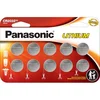 |
Panasonic CR2032 3.0 Volt Lithium Coin Cell Batteries, 10 Pack, $6.49 A related buy for push-button cars whose key fob or smart key takes a CR2032, the size named in the 2019 Chevrolet Malibu and 2020 Hyundai Kona manuals.
|
As an Amazon Associate we earn from qualifying purchases. Spec-based pick from the listing, not a hands-on test.
The steps below run from the simplest check to the point where the manuals say to stop. Examples come from the 2020 Chevrolet Tahoe/Suburban owner manual, the 2019 Chevrolet Malibu owner manual and the 2020 Hyundai Kona owner’s manual; your own manual has the exact wording for your car.
Step 1: Check The Basics
- Gear position: the Tahoe and Malibu manuals say the engine will not start unless the shift lever is in P (Park) or N (Neutral).
- Brake pedal on push-button cars: the Kona manual says pressing the button without the brake pedal does not start the engine; the button cycles OFF, ACC, ON, OFF instead.
- Crank time: the Tahoe and Malibu manuals say to wait at least 15 seconds between tries; the Kona manual says not to hold START more than 10 seconds and to wait 5 to 10 seconds.
- Battery drain: the Tahoe manual says a key left in ACC or ON with the engine off could drain the battery so that the vehicle may not start.
Step 2: Try The Spare Key
The 2020 Tahoe manual describes its theft-deterrent system this way: if the engine does not start and the security light stays on, turn the ignition off and try again; if it still does not start and the key appears undamaged, try another ignition key. The manual adds that it may be necessary to check the fuse, that a start with the other key suggests the first key may be faulty, and that no start with the other key means the vehicle needs service.
The Kona manual covers a blinking immobilizer indicator: turn the ignition switch to LOCK/OFF, then to ON again, and remove metal objects such as a key chain and any other smart key near the smart key before trying again. If the system repeatedly fails to recognize the key, the manual recommends contacting the Hyundai dealer.
For what a replacement key or a new lock cylinder involves, see our lock cylinder cost guide and whether a car ignition can be rekeyed.
Step 3: Free The Steering Column Lock
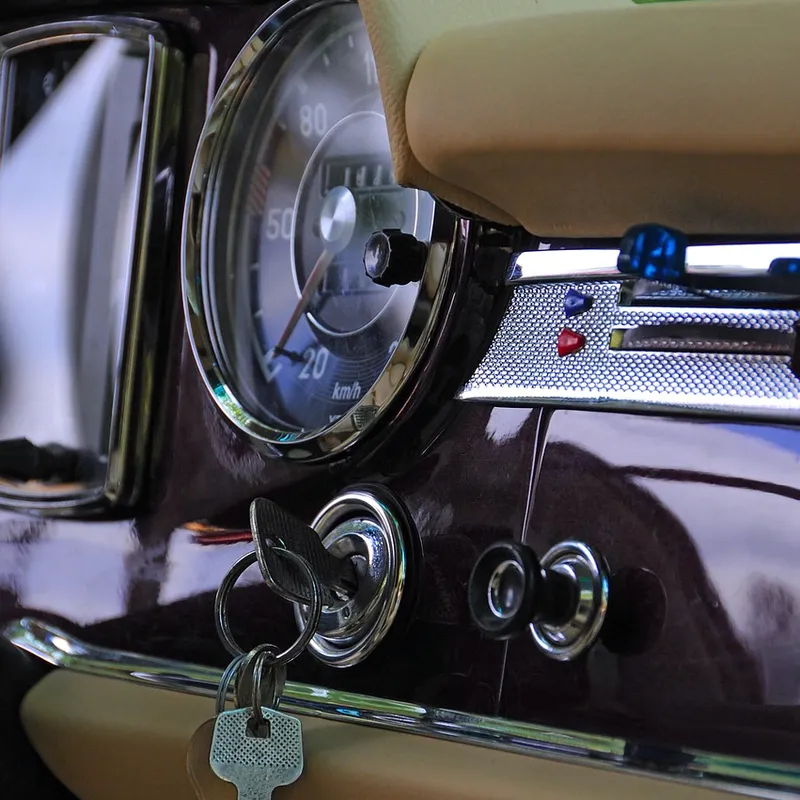
The Tahoe manual lists a bound steering lock as one cause of a key that will not turn: a vehicle with a locking steering column can bind with the front wheels turned off center, which may prevent key rotation out of LOCK/OFF. Its fix is to move the steering wheel from right to left while turning the key to ACC/ACCESSORY, and if that does not work the vehicle needs service. For a keyless-access Tahoe the manual gives the same left-to-right wheel movement while attempting to start.
The same manual has a caution that applies to every attempt: use the correct key, make sure it is all the way in, or pushed all the way in toward the steering column when turning off the vehicle, and turn it only with your hand. For more on this symptom, read how to start a car with the steering wheel locked and easy fixes when the key will not work.
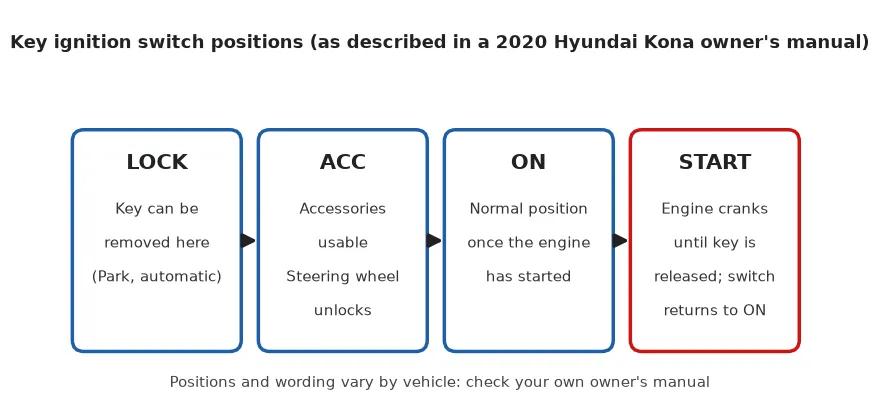
Step 4: Push-Button Cars: Put The Fob Where The Manual Says
On a push-button car there is no key to turn, and the 2019 Malibu manual ties start problems to the transmitter. It says the transmitter must be in the vehicle, that the display may show NO REMOTE DETECTED or REPLACE BATTERY IN REMOTE KEY when the transmitter battery is weak or the signal is disturbed, and gives this start procedure:
- Open the center console and place the transmitter in the transmitter pocket with the buttons facing the rear of the vehicle.
- With the vehicle in P (Park) or N (Neutral), press the brake pedal and press ENGINE START/STOP.
- Replace the transmitter battery as soon as possible.
The Malibu manual names a CR2032 or equivalent battery, and the Kona manual lists CR2032 for its smart key. The Tahoe manual says that if a keyless-access vehicle will not change ignition modes and the transmitter looks undamaged, try another transmitter or place the transmitter in the front cupholder. The Kona manual says that with a weak smart key battery the engine can be started by pressing the Engine Start/Stop button with the smart key, in the direction shown in a picture in that manual. More on dead fobs: starting a car with a dead fob and replacing a Chevy key fob battery.
Step 5: Stop And Call For Service
The manuals are specific about when to stop. The Tahoe manual says “See your dealer if the key can be removed in any other position” than LOCK/OFF, and says the vehicle needs service when the steering-wheel movement or a second key does not solve a no-start. The Malibu manual says its shift-lock release works unless the battery is uncharged or below 9 volts, and in that case tells owners to try charging or jump starting the battery. The Kona manual says not to push or tow the vehicle to start the engine. For prices, our cylinder cost guide lays out what changes the cost.
Can You Bypass A Bad Ignition Switch?
This page does not publish bypass, hotwire, screwdriver or wire-splicing steps. People ask the question, but the maker sources point the other way:
- The Kona manual says that if an improperly coded key or other device is used, the engine’s fuel system is disabled, and that owners should not attempt to alter the immobilizer system or add other devices to it because electrical problems could result that may make the vehicle inoperable.
- The Tahoe manual says a keyless-access vehicle is automatically immobilized when the transmitter leaves it, that only a correctly matched transmitter will start it, and that a damaged transmitter may leave you unable to start the vehicle.
- The Malibu manual cautions that adding electrical parts or accessories could change the way the engine operates and that resulting damage would not be covered by the vehicle warranty.
The documented alternatives are the ones above: a spare key or second transmitter, the steering-wheel movement, the transmitter pocket and a dealer visit. Our guide to Chevy ignition switch wiring covers what the terminals do and why immobilizers make a swap more than a wiring job, and can a locksmith make a car key without the key covers the replacement-key route.
Signs Your Ignition Switch Is Bad
The manuals and recall records describe these situations. They file them under steering column lock, immobilizer, transmitter-battery and recall headings, which is why the steps above come first.
| What you notice | What the source says | What to do |
|---|---|---|
| Key will not turn out of LOCK/OFF | Tahoe manual: steering can bind with the front wheels turned off center | Move the wheel right to left while turning the key to ACC; if that fails, service |
| No start and the security light stays on | Tahoe manual: there is a problem with the theft-deterrent system | Turn off and retry, try the other key, check the fuse, then service |
| Immobilizer indicator blinks | Kona manual: the system does not recognize the key coding | LOCK/OFF then ON again, remove metal objects and extra keys, then dealer |
| Push-button car shows a remote or fob message | Malibu manual: transmitter battery weak or signal disturbed | Use the transmitter pocket, then replace the battery |
| Key comes out in a position other than LOCK/OFF | Tahoe manual: see your dealer | Dealer service |
| Engine shuts off while driving | NHTSA records: key moved out of the run position (certain GM models) | See the recall section and the driving section below |

Ignition Switch Recalls: What NHTSA Records Say
NHTSA records show several GM campaigns in which the ignition could leave the run position. The summaries below come from the NHTSA campaign records, including NHTSA recall record 14V047, and apply only to the model years each record lists.
| Campaign | Vehicles named | Units on record | Cause per NHTSA | Remedy per NHTSA |
|---|---|---|---|---|
| 14V047 | 2003-2011 Chevrolet Cobalt and HHR, Pontiac G5 and Solstice, Saturn Ion and Sky (exact years per model in the record), including cars that may have received service-part switches | 2,190,934 | Key ring weight, road conditions or a jarring event may move the switch out of run, turning off the engine | Dealers replace the ignition switch free of charge |
| 14V355 | 2005-2009 Buick LaCrosse, 2006-2011 Buick Lucerne, 2000-2005 Cadillac DeVille, 2006-2011 Cadillac DTS, 2006-2014 Chevrolet Impala, 2006-2007 Chevrolet Monte Carlo | 3,141,731 | Same key ring weight and jarring cause | Two key rings and a key-slot insert or a cover over the key head |
| 14V346 | 2010-2014 Chevrolet Camaro built December 3, 2008 to May 23, 2014 | 464,712 | A driver’s knee may hit the key and knock it out of run | Key blade removed from the flip key, two new keys and two key rings per key |
| 14V394 | 2003-2014 Cadillac CTS and 2004-2006 Cadillac SRX (build dates in the record) | 554,328 | Same key ring weight and jarring cause | Two key rings and a key-slot insert or a cover over the key head |
| 14V400 | 1997-2008 Chevrolet Impala, Monte Carlo and Malibu, Oldsmobile Alero and Intrigue, Pontiac Grand Am and Grand Prix (exact years per model in the record) | 5,877,718 | Same key ring weight and jarring cause | Two key rings and a key-slot insert or a cover over the key head |
NHTSA states the consequence plainly: if the key is not in the run position, the air bags may not deploy in a crash, increasing the risk of injury. For 14V355 and 14V346 the records add that a key knocked out of run causes or could cause loss of engine power, power steering and power braking. The interim advice in the key-ring records (14V047, 14V355, 14V394 and 14V400) is to remove everything from the key ring except the ignition key (and the key fob if there is one) until the repair is done; for the Camaro record (14V346) it is to adjust the seat and steering column to leave clearance between the knee and the key.
The 14V047 record points owners to NHTSA’s Vehicle Safety Hotline and to www.safercar.gov. Safety-critical: if your vehicle is on one of these lists and the recall repair has not been done, ask a dealer about it before relying on the ignition. The wiring side of the same recalls is covered in our Chevy ignition switch wiring guide.
If The Engine Shuts Off While Driving
Safety-critical. The Tahoe and Malibu manuals warn that turning off a vehicle that is moving may cause loss of power assist in the brake and steering systems and disable the airbags, and the Kona manual warns of the same loss of power assist for steering and brakes. The Tahoe manual lists these steps for a vehicle that must be turned off in an emergency while driving:
- Push the key all the way in toward the steering column, then turn the key to ACC/ACCESSORY.
- Brake using firm and steady pressure; do not pump the brakes repeatedly.
- Shift the vehicle to N (Neutral) and steer to a safe location.
- Come to a complete stop, shift to P (Park), turn the ignition to LOCK/OFF and set the parking brake.
For a push-button car the Malibu manual says to press and hold ENGINE START/STOP for longer than two seconds, or press it twice in five seconds, if the vehicle cannot be pulled over and must be shut off while driving. If the engine stalls while moving, the Kona manual says not to move the shift lever to P, and that if traffic and road conditions permit you may shift to N and press the Engine Start/Stop button to try to restart.
What This Guide Does Not Cover
- Wiring, hotwiring or any bypass of the ignition or immobilizer; ask a dealer or a licensed locksmith.
- Repair prices; ask a dealer or shop for an estimate.
- Vehicles whose manuals were not read for this guide; your own owner’s manual has the exact procedure for your car.
Frequently Asked Questions
Can I still start a car with a bad ignition switch?
The manuals cited here describe a spare key or second transmitter, moving the steering wheel to free a bound column lock, and the transmitter pocket on push-button cars. If those fail, the Chevrolet Tahoe manual says the vehicle needs service.
Can a heavy key ring turn the engine off?
NHTSA’s recall records for certain GM models say the weight on the key ring and road conditions or some other jarring event may cause the ignition switch to move out of the run position, turning off the engine. For those models NHTSA’s interim advice is to leave only the ignition key on the ring until the recall repair is done.
What should I do if the key will not turn?
The 2020 Chevrolet Tahoe/Suburban manual says the steering can bind with the front wheels turned off center, which may prevent key rotation. Move the steering wheel from right to left while turning the key to ACC/ACCESSORY. If that does not work, the manual says the vehicle needs service.
How do I start a push-button car when the fob battery is weak?
The 2019 Chevrolet Malibu manual says to open the center console, place the transmitter in the transmitter pocket with the buttons facing the rear, then press the brake pedal and ENGINE START/STOP with the car in P or N. It adds that the transmitter battery should be replaced as soon as possible.
Can I start the car without the correct key?
The 2020 Hyundai Kona manual says that if an improperly coded key or other device is used, the engine’s fuel system is disabled, and it warns against altering the system. The Chevrolet Tahoe manual says only a correctly matched transmitter will start a keyless-access vehicle. Ask a dealer about a replacement key.
Products related to this article
Sponsored / affiliate links. As an Amazon Associate I earn from qualifying purchases. I may earn additional commission from eligible campaigns.