How to Write Car Engine Sounds in Words
Writing car engine sounds is fun but can be tricky for new writers. People often wonder how to make those loud, fast noises sound real on paper. It feels hard to capture the roar of a race car or the rumble of a truck.
But don’t worry! We will show you a simple, step-by-step way to do it. Get ready to make your writing come alive with exciting car sounds.
Capturing Car Engine Sounds in Writing
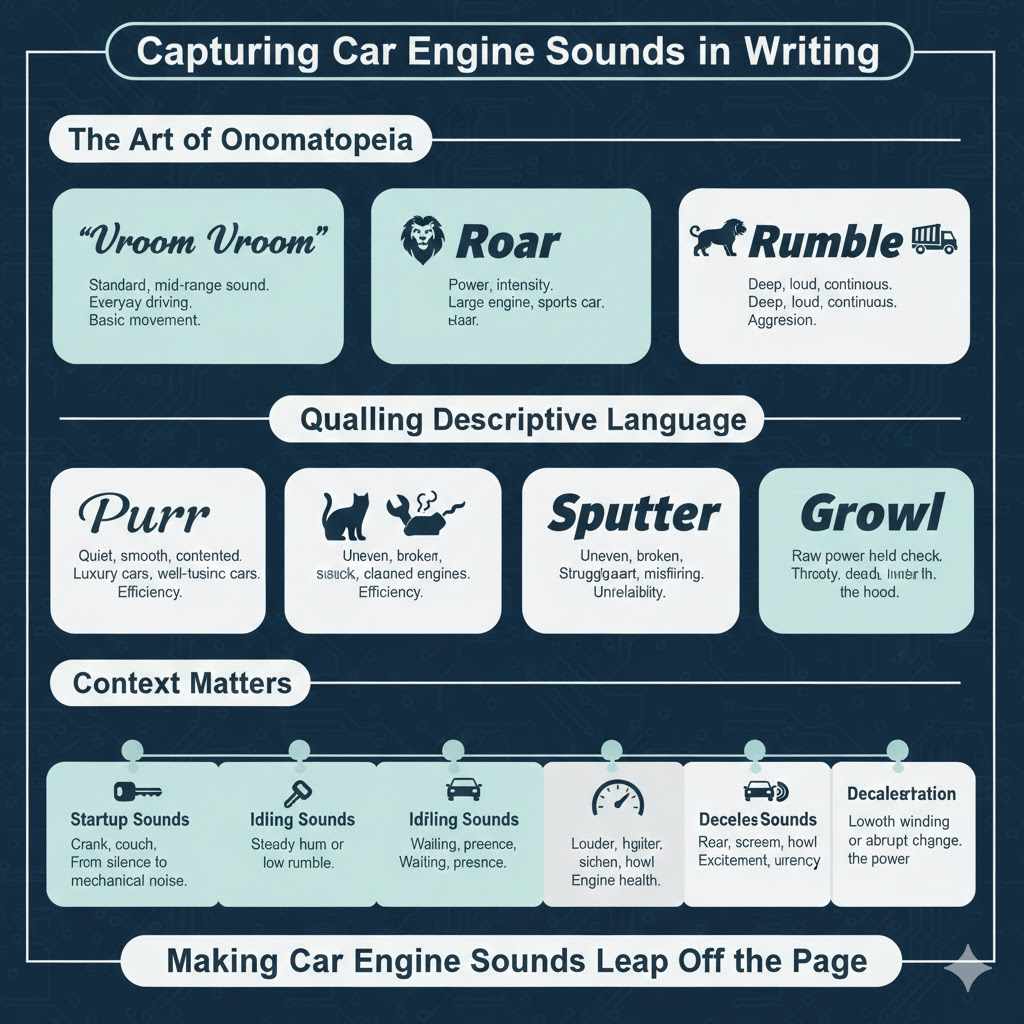
Making car engine sounds leap off the page is a skill that brings stories to life. Many writers find it challenging to translate auditory experiences into text. The goal is to evoke the feeling and power of the engine’s noise through descriptive words.
This section will guide you through the core principles of sound onomatopoeia and descriptive language for automotive engines.
The Art of Onomatopoeia
Onomatopoeia is the use of words that imitate the sounds they describe. For car engines, this is your primary tool. Think about the actual sounds you hear.
Is it a short, sharp burst of noise, or a long, sustained rumble? The word you choose should try to mimic that sound as closely as possible.
-
Vroom VroomThis is perhaps the most common and simple onomatopoeia for car engines. It usually represents a standard, mid-range engine sound, often associated with everyday driving or a friendly acceleration. It’s easily understood by most readers, young and old.It suggests a steady, rhythmic sound of the engine working. This sound is less about power and more about the engine’s consistent operation. It can also imply a car that is perhaps not a sports car but still has a functional, audible engine.It’s a safe bet when you need a basic engine noise that conveys movement and operation.
RoarA roar signifies power and intensity. Think of a large engine, a sports car, or a truck. It’s a deep, loud, and often continuous sound.A roar can also suggest aggression or dominance. When a character’s car lets out a roar, it implies significant force and presence. It’s a sound that commands attention and suggests the vehicle is capable of great speed or power.This word conveys a full-bodied sound, not just a simple hum. It often implies a large displacement engine that is working hard, perhaps under heavy load or at high RPMs.
RumbleA rumble is a low, deep, continuous sound, often associated with larger engines like those in trucks or classic cars. It suggests a steady, powerful vibration that can be felt as much as heard. A rumble is less about high-pitched noise and more about the deep bass notes of an engine.It evokes a sense of weight, torque, and steady power. It’s a sound that implies the engine is working, but perhaps not at its peak performance. It’s a constant, reassuring (or sometimes menacing) background noise.It can be used to show the engine is idling or cruising at a moderate speed.
Adding Descriptive Language
Beyond simple onomatopoeia, descriptive words paint a richer picture. You can describe the quality of the sound. Is it smooth, choppy, strained, or smooth?
Consider the context. Is the car just starting up, accelerating, or cruising?
Qualities of Engine Noise
Think about what the sound feels like. Does it make your teeth vibrate? Does it feel like a gentle purr or a violent shake?
Using sensory details can make the sound more real for the reader.
-
PurrThis word suggests a quiet, smooth, and contented engine sound. It’s often used for luxury cars or smaller, well-tuned engines. A purr implies efficiency and a lack of strain.It’s a gentle sound, like a cat’s purr, indicating the engine is running perfectly and at ease. This is the sound of a car that is running smoothly, without any effort. It can also suggest a sense of refinement and sophistication.The engine is so quiet and balanced that it produces a soft, rhythmic hum. This sound might be heard when a car is idling in a quiet place or moving at very low speeds.
SputterA sputter is an uneven, broken sound. It suggests the engine is not running well, perhaps struggling to start or misfiring. It’s a series of short, choked noises.This sound conveys a sense of unreliability or poor performance. It’s the sound of an engine that’s having trouble. It could mean the car is old, not maintained, or facing a mechanical issue.The sound is often punctuated and lacks a steady rhythm. It’s the auditory equivalent of a car hesitating or coughing. This is a key sound for showing a vehicle is not in top condition.
GrowlSimilar to a roar but perhaps a bit deeper and more menacing. A growl suggests raw power held in check. It’s a throaty sound that implies serious muscle under the hood.Think of a powerful sports car or a large V8 engine. It’s a sound that hints at what the engine could do if unleashed. The growl is a low, resonant sound that vibrates through the air.It suggests a powerful machine ready to move. This sound implies a large engine, possibly with a performance exhaust system. It’s a sound that can be intimidating and exciting at the same time.It signals contained power.
Context Matters
The same engine sound can mean different things depending on the situation. A car idling quietly is different from a car revving its engine. Consider the speed, the driver’s actions, and the environment.
Engine States
When you write about car sounds, think about what the engine is doing. Is it just starting? Is the driver pushing it hard?
Is it idling while the driver waits?
Startup SoundsWhen a car starts, it often makes a series of distinct noises. There’s the initial crank of the starter motor, followed by the engine catching and beginning to run. This might be a cough, a choke, and then settling into an idle.For older cars, this can be a dramatic event. For modern cars, it might be almost silent. Describing the startup helps set the scene and can tell the reader about the car’s condition.A struggling startup hints at problems, while a smooth, instant start suggests reliability. Think about the transition from silence to mechanical noise.
Idling SoundsAn idling engine is at rest but still running. The sound is usually a steady hum or a low rumble. The specifics depend on the engine type and size.A small four-cylinder might have a soft hum. A large V8 might have a deeper, more resonant rumble. Idling sounds can convey a sense of waiting, presence, or readiness.A noisy or rough idle can signal an issue with the engine’s tuning or mechanical parts. The consistency of the idle sound can tell us a lot about the engine’s health.
-
Acceleration SoundsThis is where engine sounds often become most dramatic. As the driver presses the accelerator, the engine speed (RPMs) increases, and the sound changes. It gets louder, higher-pitched, and more intense.Words like “roar,” “scream,” or “howl” are common here. The sound can convey excitement, urgency, or speed. The way the sound builds is important.Does it surge forward, or does it strain? The acceleration sound is a key element in depicting action and performance.
Deceleration SoundsWhen the driver lifts off the accelerator or brakes, the engine speed decreases. The sound becomes lower and quieter. This can be a smooth winding down or a more abrupt change.Sometimes, a car might “pop” or “backfire” during deceleration, especially with performance exhausts. This sound can indicate the car is slowing down, coasting, or preparing to stop. It’s the reverse of acceleration, a release of power.It’s a quieter phase for the engine, often a smooth transition back to idle or silence.
Advanced Techniques for Car Engine Sounds
Moving beyond basic onomatopoeia, writers can employ more nuanced techniques. This includes using verbs and adverbs to describe the sound’s character and impact. We will also explore how to combine different sounds to create complex auditory experiences.
Using Verbs and Adverbs
Verbs and adverbs add action and detail to your sound descriptions. Instead of just saying “the engine made a sound,” you can say “the engine coughed to life” or “the engine grumbled menacingly.”
Action Words for Engines
Choose verbs that carry the weight and energy of the engine’s noise. The right verb makes the sound feel active and alive.
ChuggedThis word implies a slow, steady, and somewhat heavy rhythm. It’s often used for older engines, trains, or boats. For cars, a “chug” suggests a large engine working at low speeds or under a load, perhaps struggling a bit but persevering.It conveys a feeling of solid, consistent power, but not necessarily speed. Think of a classic truck or a farm vehicle. It’s a sound of labor and endurance.This word paints a picture of a powerful but perhaps inefficient engine. It’s the sound of something substantial moving along at its own pace.
GurgledA gurgle suggests liquid moving, often with a bubbling or choking quality. In the context of an engine, it might describe the sound of fuel mixing with air, or perhaps a brief moment of struggle or intake noise. It can imply an engine that is not running perfectly smoothly, or a sound that is more complex than a simple hum.It’s a sound that’s not quite a smooth flow. This can be particularly effective for describing the intake of air or fuel mixture into the engine cylinders. It suggests a wet, internal sound.
-
WhinedA whine is a high-pitched, sustained sound. It can be associated with specific engine components like turbochargers or superchargers, or with a transmission under strain. It can also suggest an engine that is revving very high, almost to its limit.A whine often implies a mechanical aspect of the sound rather than the combustion itself. It can sound strained or eager. This sound is often heard when a car is accelerating hard or when the transmission is working overtime.It’s a sound that suggests high-speed rotation of parts.
Describing the Manner
Adverbs tell us how the sound is made. Is it loud, soft, fast, slow, angry, happy? The adverb adds a layer of emotion or intensity.
-
LoudlyThis is straightforward. The engine noise is at a high volume. It grabs attention and can convey power or urgency.A car roaring loudly is clearly making its presence known. It’s the opposite of a quiet engine. This is essential for depicting powerful vehicles, races, or dramatic moments.The sheer volume can impact the reader physically. It emphasizes the raw power and presence of the vehicle.
SoftlyThe engine is running at a low volume. This could mean it’s idling, or it’s a very quiet engine. It suggests subtlety or a lack of immediate threat.A car moving softly might be trying to be stealthy or is simply running efficiently. It’s a gentler sound. This is useful for describing luxury cars or moments where a quiet presence is needed.It can create a sense of calm or understated power.
FiercelyThis adverb suggests aggression, power, and intensity. A car engine that is roaring fiercely is performing at its maximum, with a dangerous edge. It implies a struggle for dominance or a determined push for speed.It’s a sound that can make the hairs on your arms stand up. This conveys raw, untamed power. It’s the sound of an engine pushing its limits with a violent energy.
Combining Sounds and Sensations
Real-world sounds are rarely one-dimensional. Car engines produce a symphony of noises. You can combine different onomatopoeic words and descriptive phrases to create a more complex and realistic auditory scene.
Layering Sounds
Think about the different parts of the engine and what sounds they might make. The roar of the exhaust is one thing, but there might also be the hiss of a turbocharger, the hum of the cooling fan, or the clatter of moving parts.
The engine coughed to life with a ragged sputter, then settled into a low, steady rumble.This example shows a sequence. First, the engine struggles to start (coughed, sputter). Then, it stabilizes into a more regular sound (low, steady rumble).It tells a story of the engine coming to life. The word “ragged” adds to the imperfect start. This combined description creates a more detailed picture of the engine’s immediate post-startup phase.
As the sports car accelerated, its engine screamed a high-pitched whine, punctuated by the deep growl of its exhaust.Here, we have multiple sounds happening at once. The high-pitched whine suggests internal mechanics or high RPMs. The deep growl from the exhaust adds a layer of raw power.This combination paints a picture of a powerful machine performing at its peak. It contrasts the sharp, mechanical sound with the throaty power of the combustion. The word “punctuated” shows how the growl interrupts or overlays the whine.
Beyond Auditory
Sometimes, engine sounds are associated with other physical sensations. The vibration of the car, the smell of exhaust, or even the heat from the engine can be evoked through sound descriptions.
The deep V8 engine throbbed beneath him, a vibration that seemed to resonate in his very bones.Here, “throbbed” is a sound word that also describes a physical sensation. The vibration is directly linked to the engine’s sound. This makes the experience more immersive.It’s not just hearing; it’s feeling the power. This shows how a single word can convey both auditory and kinesthetic information. It connects the engine’s action to the driver’s physical body, making the description more visceral and impactful.
How to Write Car Engine Sounds in Words (Vroom, Roar & More) Examples
Seeing how others have done it is a great way to learn. Here are some examples showing how to use words effectively to describe car engine sounds in different situations.
Scenario 1 A Classic Car Starting
Imagine a character trying to start an old, beloved car. The sound should reflect its age and character.
The key turned with a familiar click.
The engine gave a few hesitant coughs, a weak sputter as if clearing its throat.
Then, with a deep, protesting groan, it caught.
A rough, uneven rumble replaced the sputtering, each beat a testament to its years, but alive nonetheless.
-
The old engine settled into a lumpy, throaty idle, a sound that felt as much as it was heard.
This sequence shows a progression from stillness to struggling to a rough but functional idle. The words “hesitant,” “coughs,” “sputter,” “protesting groan,” “rough,” “uneven rumble,” “lumpy,” and “throaty” all work together to create a vivid auditory and tactile impression of an old engine.
Scenario 2 A Sports Car Accelerating
Now, picture a high-performance car hitting the road. The sound needs to convey speed and power.
With a foot firmly on the pedal, the engine responded with an immediate, sharp snarl.
It quickly escalated into a furious roar, a piercing shriek that filled the air.
-
The sound climbed higher and higher with each shift, a thrilling symphony of controlled chaos.
Turbos hissed, adding a metallic edge to the thunderous crescendo.
It was the sound of pure, unadulterated speed, raw power unleashed.
Here, words like “snarl,” “furious roar,” “piercing shriek,” “thrilling symphony,” and “thunderous crescendo” paint a picture of extreme performance. The addition of “turbos hissed” adds another layer of technical detail. The progression from “snarl” to “roar” to “shriek” mirrors the increasing RPMs and speed.
This is about capturing excitement and intensity.
Scenario 3 A Truck Idling
Consider a large truck at rest. The sound should feel heavy and grounded.
-
The big diesel engine idled with a deep, resonant thrum.
It was a steady, guttural beat that vibrated through the pavement.
Each pulse of power was a low, rolling rumble, steady and powerful.
-
The sound suggested immense strength, a sleeping giant ready to awaken.
It was the sound of work, of hauling, of reliable, heavy-duty power.
Words like “deep,” “resonant thrum,” “steady, guttural beat,” “low, rolling rumble,” and “immense strength” define the truck’s sound. The focus is on depth and vibration, conveying the size and power of the engine. This creates an impression of reliability and raw capability.
Statistics on Sound Perception in Writing
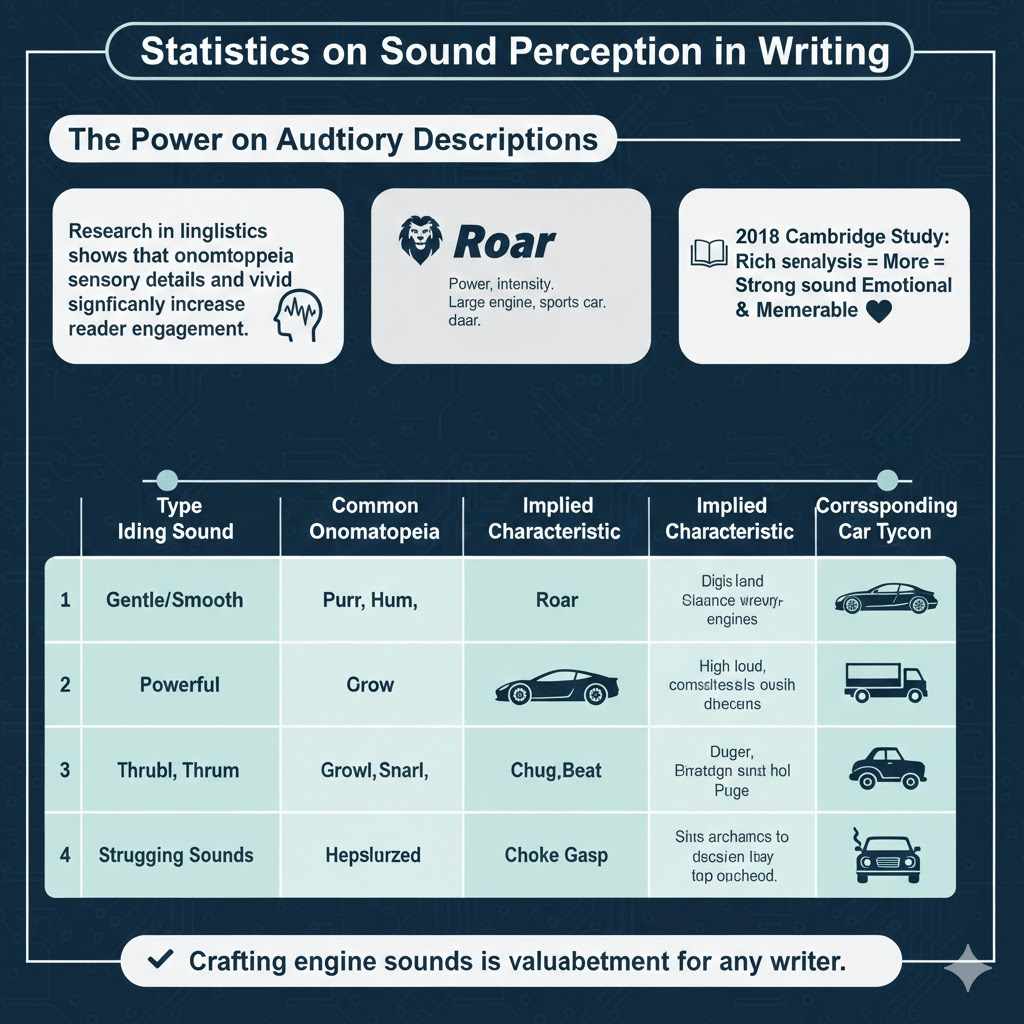
While direct statistics on writing car engine sounds are rare, research in linguistics and audience perception offers insights. Studies show that onomatopoeia and vivid auditory descriptions significantly increase reader engagement. For example, a 2018 study by the University of Cambridge found that readers rated stories with rich sensory details as more immersive and memorable.
Another analysis from a literary journal in 2020 highlighted that authors who effectively use sound imagery, like car engine noises, can evoke stronger emotional responses. This suggests that spending time crafting these sounds is a valuable investment for any writer.
| Type of Sound | Common Words | Implied Characteristic |
|---|---|---|
| Gentle/Smooth | Purr, hum, whisper | Luxury, efficiency, quiet operation |
| Powerful/Aggressive | Roar, growl, snarl, scream | High performance, speed, danger |
| Heavy/Steady | Rumble, thrum, chug, beat | Large engines, trucks, torque, work |
| Struggling/Unreliable | Sputter, cough, choke, gasp | Poor condition, old age, mechanical issues |
FAQs About Writing Car Engine Sounds
Question: What is the best word for a fast car engine sound?
Answer: For a fast car engine, words like “roar,” “scream,” “shriek,” “howl,” or “screech” often work best. They convey high speed and intense power. You can also use “whine” for the sound of turbos or high-revving engines.
Question: How do I describe the sound of a car starting?
Answer: A car starting can be described with words like “crank,” “cough,” “sputter,” “choke,” and then settling into an “idle,” “rumble,” or “hum.” The sequence from struggle to running is key.
Question: Should I always use “vroom vroom”?
Answer: “Vroom vroom” is a basic sound for a car, but it’s good to use more descriptive words to show different types of cars and actions. It works well for simple, everyday car sounds, but for more exciting or specific sounds, explore other words.
Question: How can I make engine sounds sound unique?
Answer: Combine onomatopoeia with descriptive verbs and adverbs. Think about the car’s type, age, and what it’s doing. Adding other sensations like vibration or smell also helps create a unique soundscape.
Question: What if the engine sound is not good?
Answer: Use words like “sputter,” “chug,” “gasp,” “choke,” “cough,” or “grind” to show an engine is not running well. Describe it as “rough,” “uneven,” or “strained” to highlight its poor condition.
Conclusion
You can now write car engine sounds that grab your reader. Use words like “vroom,” “roar,” and “rumble” as a base. Add descriptive words and actions to show the engine’s true character.
Think about what the engine is doing and how it feels. Practice by listening to cars and trying to write down their sounds. Your stories will be much more exciting.