Industrial Steam Cleaner for Cars: Elevate Auto Detailing with Ease
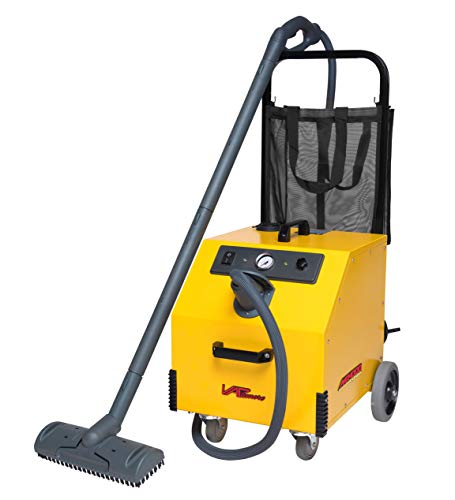
Choose an industrial steam cleaner for cars by matching output to the work done most often: about 1–2 liters suits interiors and spot cleaning, while larger twin-tank units can suit longer detailing sessions. Pick the wrong size, and you lose time to refill breaks or risk trim, leather, and sensitive plastics. This guide compares runtime, refill downtime, heat-up, pressure, and surface-specific risk so you can choose the right machine fast.
What specs matter for car detailing?
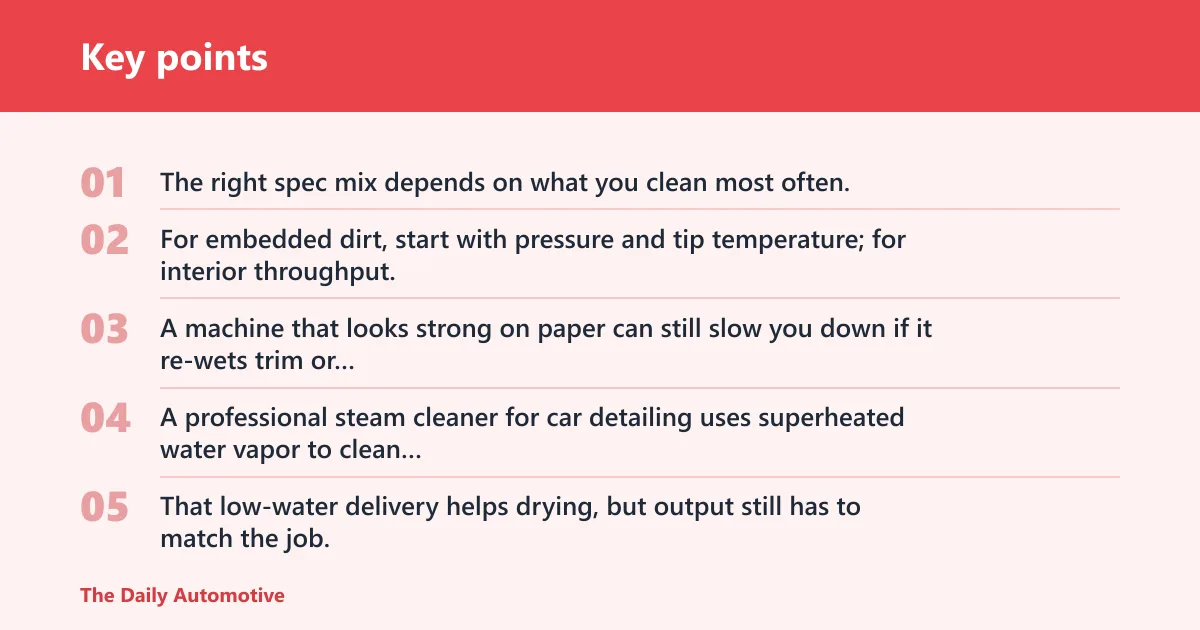


The right spec mix depends on what you clean most often. For embedded dirt, start with pressure and tip temperature; for interior throughput, start with boiler size, refill method, and how dry the steam stays at the surface. A machine that looks strong on paper can still slow you down if it re-wets trim or pauses for refills.
PSI, temperature, and drying
A professional steam cleaner for car detailing uses superheated water vapor to clean interior and exterior vehicle surfaces with limited moisture. That low-water delivery helps drying, but output still has to match the job. Higher pressure helps lift embedded particles from seams, grilles, pedals, and textured plastics; lower-pressure consumer units often need more passes and more wipe work.
For pressure, a common professional range is 55 to 75 PSI. Aqua Pro Vac recommends that band for detailing, and it is a practical target for upholstery, vents, and door jambs. Pressure alone is not enough. Surface heat and steam dryness decide whether soil lifts cleanly or turns into a wet smear.
Boiler temperature versus nozzle tip temperature
Boiler temperature and nozzle tip temperature are not the same spec, and the difference matters. The same source says boiler temperature should be 290–320°F, while nozzle tip temperature should be 240–280°F. The boiler number tells you what the machine is generating internally; the tip number is closer to what the surface actually sees.
That distinction matters because a hot boiler does not guarantee hot steam at the brush. Hose length, condensation, and pauses at the trigger all reduce delivered heat. If you are cleaning a sticky door pull or a stained seat seam, the tip temperature is the number that better predicts cleaning speed and how much wiping follows.
Boiler size, refill downtime, and dry steam
Boiler capacity drives real workflow. Larger boilers can reduce refill interruptions, and common professional units often fall in roughly the 1.5L to 5L range. Single-tank machines may need cool-down before refilling, which creates dead time right when a job is already open and trim pieces are exposed.
Dry steam matters for the same reason. Higher dryness lowers re-wetting risk and supports faster drying, especially on delicate interiors, headliners, and stitched leather. Aqua Pro Vac also notes that steam can cut water use to 1–2 gallons, which is one reason detailers prefer it for fast interior turnaround instead of wetting a cabin that then needs long drying time.
Suppose a dealership prep bay needs ten interiors turned in one morning. A compact unit may clean well, but if it pauses for frequent refill and cool-down cycles, the bottleneck is no longer soil removal. It is waiting.
Steam cleaner vs carpet extractor
Steam is faster when you need targeted cleaning, heat, and low moisture. A carpet extractor is better when the job is about liquid recovery, such as wet spills, pet accidents, and water damage. In interior work, the two tools solve different problems, and the best workflow often uses both.
When steam is the faster choice
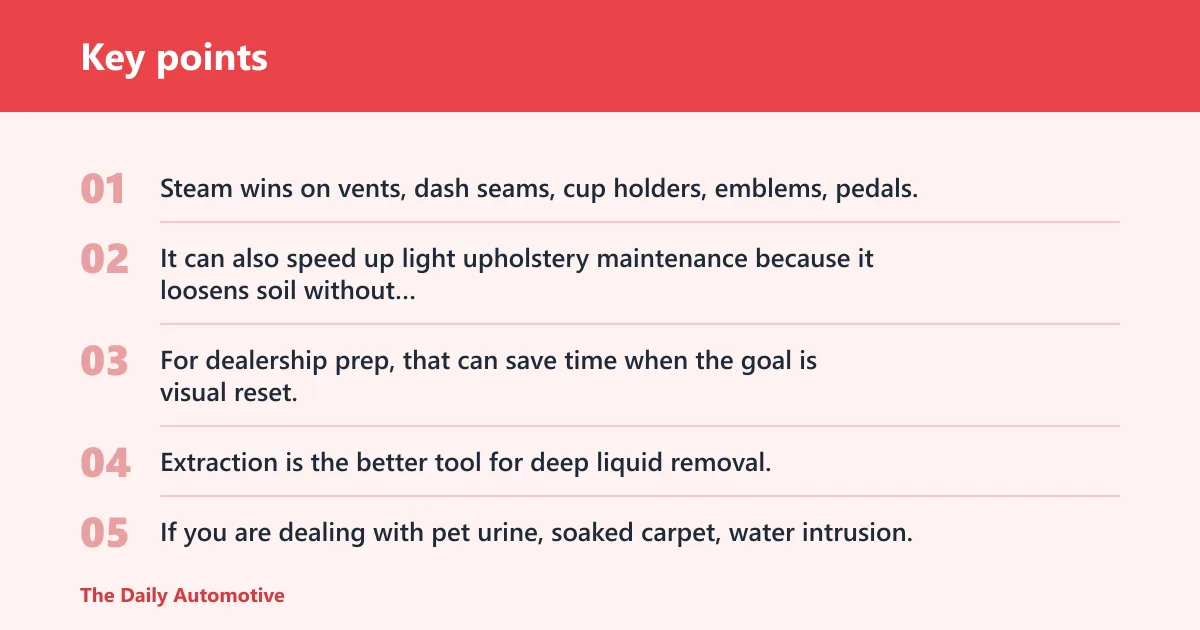
Steam wins on vents, dash seams, cup holders, emblems, pedals, and other small areas where grime sits in crevices. It can also speed up light upholstery maintenance because it loosens soil without soaking the fabric. For dealership prep, that can save time when the goal is visual reset, not deep moisture removal.
When extraction does the better job
Extraction is the better tool for deep liquid removal. If you are dealing with pet urine, soaked carpet, water intrusion, or a mat that holds a lot of liquid, recovery matters more than heat. Steam can pre-treat the soil, but extraction removes the moisture load that steam alone cannot pull out.
A common first-timer mistake is chasing a urine odor with steam only. That can spread the contamination and re-wet the backing. The better sequence is pretreat, extract, then use steam sparingly on adjacent trim and hard surfaces, not on the soaked area as the main cleaning method.
How the two tools work together
Steam and extraction pair well in a full interior workflow. Steam loosens edges, seams, and stains; extraction removes liquid and suspended soil from fabric. On a heavily used sedan, that combination can shorten dwell time and reduce repeat passes, especially when the carpet has both dry dust and a wet spill.
| Detailing job | Right steam cleaner spec band | Required attachment | Expected dry time | Use extraction instead when |
|---|---|---|---|---|
| Leather seats | 55–75 PSI, dry steam, tip heat in the 240–280°F zone | Detail brush with microfiber bonnet | Short; wipe dry immediately | Leather is heavily soaked, dyed transfer is broad, or stitching is already failing |
| Fabric upholstery | Moderate-to-high pressure with a larger boiler for longer runs | Triangle brush or detail brush | Moderate; depends on pile and ventilation | The fabric is wet through, stained by liquid, or has odor from urine or spilled drinks |
| Vents | Lower moisture, good tip temperature, steady pressure | Jet nozzle plus extension wand | Very short | Only if the vent cavity has liquid buildup from HVAC drain issues |
| Engine bays | Controlled output, not maximum pressure, with dry steam | Jet nozzle | Short, but drying needs airflow | There is heavy grease buildup that needs chemical pretreatment first |
| Headliners | Low-moisture output and very light contact | Microfiber bonnet on a gentle brush | Very short if used correctly | The headliner is sagging, delaminating, or adhesive is already weak |
| Pet accidents | Steam only as a prep tool, not the main cleaner | Jet nozzle for nearby hard surfaces | Long without extraction | The area is wet, contaminated, or odor has reached the pad or backing |
| Dealership prep | Fast heat-up, continuous fill, low downtime | Mixed kit with brush, wand, and bonnet | Short to moderate | The job is mostly liquid recovery, flood cleanup, or odor removal |
Which accessories do you actually need?
The accessory kit matters because the machine only works as fast as the attachment matches the surface. For auto detailing, the core set is simple: detail brushes, jet nozzles, triangle brushes, microfiber bonnets, and extension wands. Each one changes contact, reach, and how much wiping follows the steam pass.
Brushes, nozzles, and wands
Detail brushes are for seams, switches, and textured trim. Triangle brushes spread contact across wider upholstery areas and are useful when you need more coverage with less hand movement. Jet nozzles concentrate steam for vents, emblems, hinges, and narrow gaps where you want force rather than surface coverage.
Extension wands help reach deep into footwells, under seats, and across engine bays without forcing your wrist into awkward angles. That matters more than people expect. A good wand can cut fatigue and make each pass more controlled, which is important when you are working near soft-touch plastics or stitched leather.
Microfiber bonnets and wear
Microfiber bonnets help lift softened soil while reducing direct contact on delicate finishes. They are especially useful on leather, coated plastics, and lightly soiled headliners. Replace them often enough that embedded grit does not become the thing that scratches the surface you are trying to clean.
Accessory wear is a cost item, not an afterthought. Brushes flatten, bonnets lose absorbency, and seals wear out on high-use machines. If a unit looks inexpensive up front but replacement parts are hard to find, its real cost rises every time an attachment fails before the boiler does.
Can you steam clean leather seats?
Yes, but only with controlled moisture, brief contact, and immediate wipe-down. Leather seats can handle steam better than many people expect, but adhesive-backed trim, perforations, and stitching can be damaged by heat or over-wetting. Dry steam and a soft brush or bonnet make the difference between cleaning and stressing the material.
Safe use on leather, plastics, and trim
Steam works well on leather bolsters, coated plastics, steering column trim, and vinyl surfaces when you keep the nozzle moving and avoid soaking one point. Use the least aggressive attachment that lifts the dirt. A detail brush with a microfiber bonnet is usually safer than a bare jet on finished interior surfaces.
Where heat can damage a surface, the risk is often not the leather itself but the materials around it. Glue can loosen under a hot, wet blast. That matters on door panels, roof trim, and stitched panels where the top layer is held together by adhesive or foam backing.
Headliners and other low-risk methods
Headliners need a very light touch. Steam can help remove marks from a headliner, but too much moisture can weaken the adhesive and cause sagging. If a stain is old, wide, or already tied to adhesive failure, stop using steam as the main method and move to a safer spot-clean approach.
Think of steam as a precision tool. It is useful where moisture must stay low, especially in the cabin, but it is not the correct answer for every finish. On a stained headliner edge, a safer cleaner and minimal agitation may beat repeated steam passes that only increase the risk of delamination.
How does workflow affect speed?
Workflow decides whether a steam cleaner saves time or becomes a bottleneck. Heat-up time, refill interruptions, continuous fill, and mode switching all affect usable cleaning minutes. For mobile detailers and high-volume bays, these factors can matter more than the biggest pressure number on the label.
Heat-up time and refill interruptions
Heat-up time is the gap between powering on and having usable steam. The FALCON lists a 10-minute ready time, which is quick enough for many interior jobs. Longer start times are harder to justify when you are juggling multiple vehicles or moving between rinse, extract, and steam tasks.
Refill downtime can matter just as much. A machine with a larger boiler spends more time working and less time waiting. The FALCON has a 1-gallon boiler, while larger professional units are often built for longer runs or multi-tank operation. If refilling means a cool-down first, the lost time can wipe out the benefit of higher output.
Continuous fill and hot water injector functions
Continuous fill systems reduce downtime because they let the machine keep working without the same refill interruption pattern. That is useful in high-volume detailing where you are moving from one interior to the next. Some entry commercial units do not include it, so check whether the boil system is sized for your actual daily load.
A hot water injector can help switch between steam and purge modes on some commercial units. That matters when a workflow changes fast, such as moving from seat seams to a rinse-style purge of the line. In practice, it is a convenience feature that supports speed and consistency rather than a cleaning upgrade by itself.
Mobile detailing and bay throughput
Say your van carries one machine for dealership prep, odor cleanup, and wheel well detailing. If the boiler cools before refilling, the work stops. If the unit can refill without a long wait, you keep moving. That is why output has to be matched to the day’s queue, not just to the strongest spec sheet.
Cost, warranty, and service support
Price should be judged against usable cleaning time, refill downtime, and service support. A machine that costs less up front can still cost more per job if it pauses often, needs frequent accessories, or has weak parts support. For pro buyers, warranty coverage matters as much as output.
Price bands and value
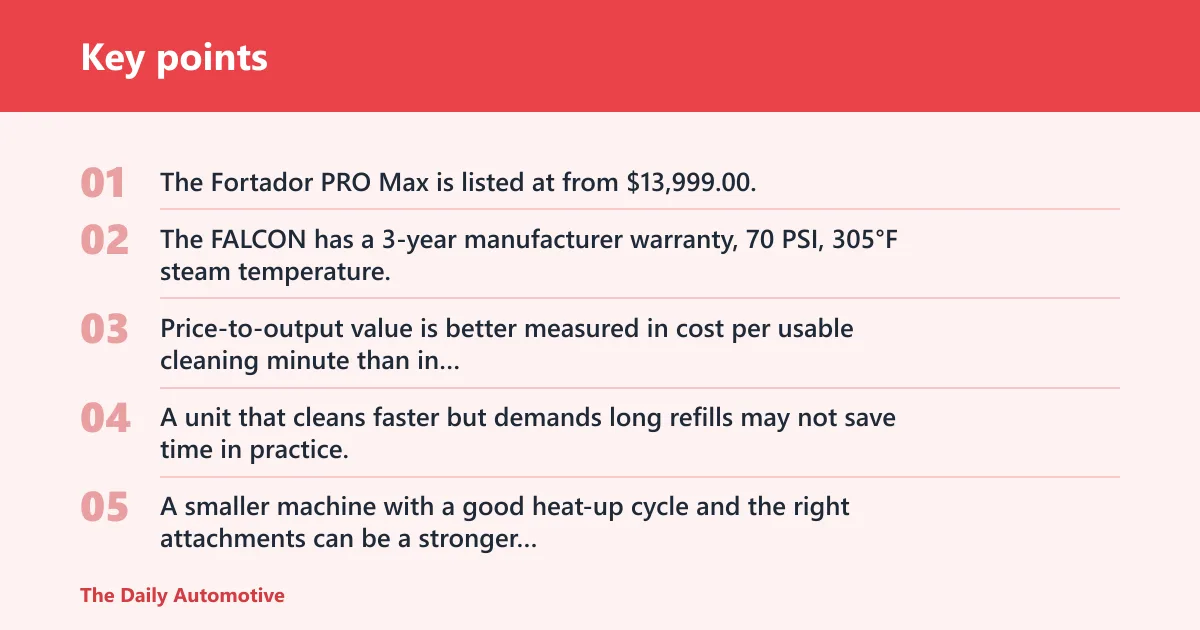
Professional machines span a wide range. The Fortador PRO Max is listed at from $13,999.00, which places it in the premium commercial bracket. The FALCON has a 3-year manufacturer warranty, 70 PSI, 305°F steam temperature, and a 1-gallon boiler, so it sits in a much more accessible category while still covering serious detailing needs.
Price-to-output value is better measured in cost per usable cleaning minute than in headline power. A unit that cleans faster but demands long refills may not save time in practice. A smaller machine with a good heat-up cycle and the right attachments can be a stronger buy for interior-focused work.
Diesel steam cleaners for mobile businesses
Diesel steam cleaners can make sense for mobile detailing when fuel availability and on-site power are real constraints. Their appeal is throughput and autonomy, not magic output. The tradeoff is practical complexity: fuel handling, service needs, and the question of whether the added cost pays back in your route mix.
The Fortador PRO Max also includes built-in vacuum for shampoo and extraction, which suits operators who want one platform for multiple steps. That is useful when the business needs both steam and recovery in the same van. Even then, the decision should come down to job mix, service access, and whether the machine will be used often enough to justify the price.
Warranty, parts, and descaling
Warranty terms are not a footnote on pro gear. Manufacturer coverage, parts access, and service support decide how long a commercial unit stays productive. A strong warranty gives more confidence when the machine is expected to run often, and it matters most when downtime would cancel scheduled work.
Long-term upkeep also matters. Descaling is part of owning a boiler machine, especially where water quality is hard on heating components. If the service process is awkward or replacement parts are hard to source, a good machine can become a slow machine. That risk is easy to miss when comparing only pressure and price.
Frequently asked questions
What PSI and temperature should a steam cleaner have for car detailing?
The same source gives those ranges, and they suit most interior and light exterior detailing jobs. Tip temperature matters too, because the surface only sees what arrives at the nozzle, not what the boiler produces.
Is a steam cleaner or carpet extractor better for car interiors?
Use steam for targeted cleaning, seam work, and low-moisture interior refreshes. Use an extractor when the job involves liquid removal, soaked fabric, pet urine, or water damage. In many interiors, the best workflow uses steam to loosen soil and extraction to pull moisture and residue out of the material.
Can you steam clean leather seats in a car?
Yes, if you keep the steam dry, move quickly, and wipe immediately after contact. Leather seats can tolerate careful steam cleaning, but perforations, adhesives, and adjacent trim can be damaged by excess heat or moisture. A soft brush or microfiber bonnet is the safer choice for most leather surfaces.
What is the difference between boiler temperature and nozzle tip temperature?
Boiler temperature is the heat inside the machine. Nozzle tip temperature is the steam temperature at the point of contact. That difference matters because hose length, condensation, and trigger pauses reduce heat before the steam reaches the surface. For detailing, tip temperature is the more useful real-world number.
How long does a professional car steam cleaner take to heat up?
Heat-up time varies by machine, but the FALCON lists a 10-minute ready time. That is fast enough for many detailers who need to move from setup to interior work without a long wait. In high-volume use, shorter heat-up times reduce dead time and help keep the bay moving.
How much does a professional auto detailing steam cleaner cost?
Professional pricing ranges widely, from several thousand dollars to premium commercial systems at much higher levels. The Fortador PRO Max is listed at from $13,999.00. When comparing cost, include refill downtime, accessories, warranty coverage, service access, and how many usable cleaning minutes the machine delivers per job.
Products related to this article
Sponsored / affiliate links. As an Amazon Associate I earn from qualifying purchases. I may earn additional commission from eligible campaigns.