Interior LED Lights for Cars: Strip vs. Fiber-Optic Kits
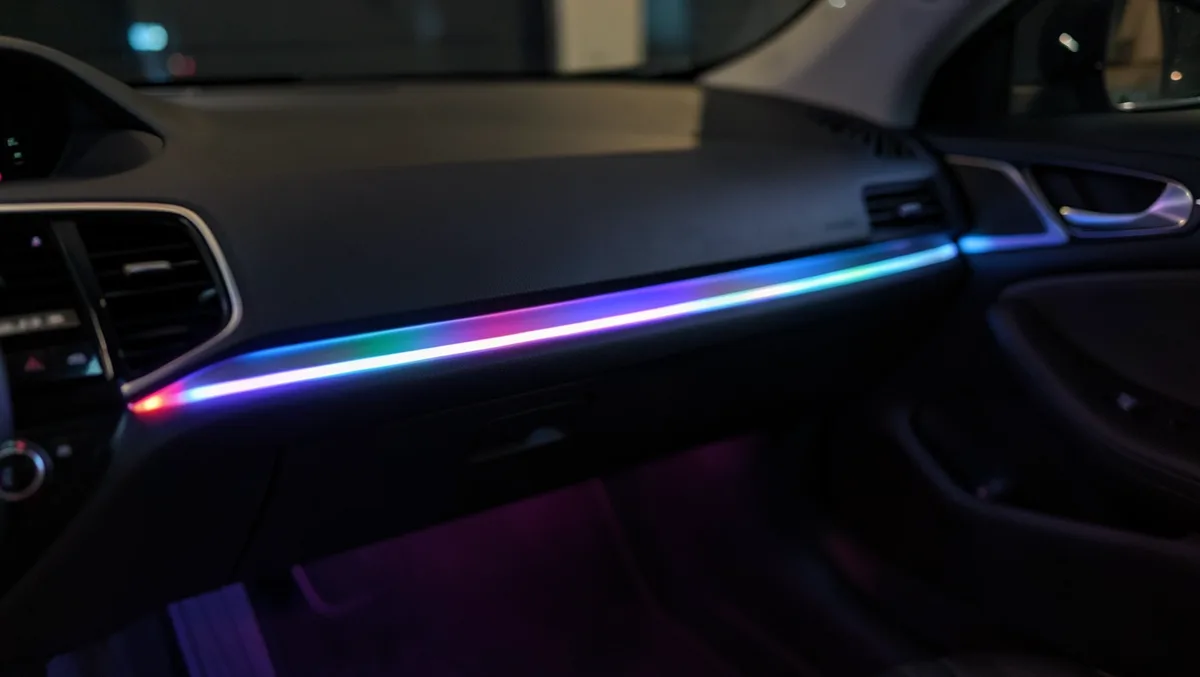
Interior LED lights for cars come in two basic types: flexible RGB strips that mount in the footwells and under the dash, and thin fiber-optic (acrylic) kits that tuck into the dash and door seams for a factory-look glow.
Both power through a 12V accessory socket or a hardwired fuse tap, and most current kits sync colors to music through a phone app. Below we compare three current picks — a footwell strip kit, a full-cabin fiber-optic kit, and a budget sound-reactive strip — so you can match the type to how you actually want the cabin to look, then cover how they’re powered and which colors stay street-legal.
Strip Lights vs. Fiber-Optic Ambient Kits: Which Type Fits Your Car?
Adhesive RGB strip kits — like the Govee and Nilight kits below — are the cheapest and fastest way in. You peel the backing, tuck the strip under the seat rail or dash edge, and plug into the 12V socket. They throw a visible glowing line, which looks great pointed into a footwell but can look a little like an add-on if it’s run across the top of the dash.
Fiber-optic kits (also sold as “acrylic ambient” lighting) use a thin light-diffusing cable instead of a visible LED strip. The cable itself doesn’t contain any LEDs — light is injected at one end from a small driver box and travels the length of the fiber — so it can be pressed into the seam between the dash and the door panel for a continuous line that reads as factory ambient lighting rather than a strip stuck on top of the trim. They cost more and take longer to route through the panels, but the finished look is noticeably cleaner.
| Type | Best Install Spot | Finished Look | Typical Price |
|---|---|---|---|
| RGB adhesive strip | Footwells, under seats, cupholders | Visible glowing strip | $10–$20 |
| Fiber-optic / acrylic | Dash seam, door panel seam | Continuous factory-style line | $30–$50 |
Govee Car Led Lights
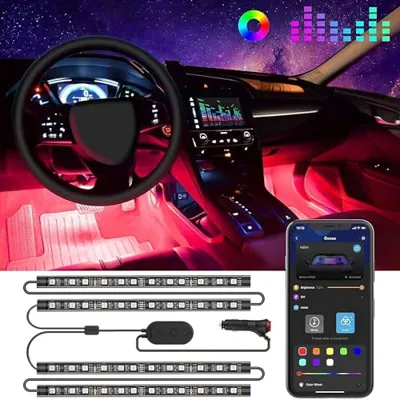
The Govee Car LED Lights are a two-line footwell strip kit built around app control rather than a physical remote. Everything — color, brightness, DIY patterns, music sync — runs through the Govee Home app over Bluetooth, so there’s no remote to lose in the glovebox.
Pros:
- App control handles color, brightness, and mode switching from your phone.
- 16 million colors through the RGB strip, plus a DIY mode for custom combinations.
- Music mode uses the phone’s microphone to pulse the lights with the beat.
- 2-line design spreads light more evenly than a single strip.
- Plugs straight into the 12V socket — no wiring into the fuse box required.
Cons:
- Ties up the 12V accessory socket, so you’ll need a splitter if you also charge a phone there.
- Strips are visible hardware, not the flush look of a fiber-optic kit.
The DIY mode is the feature worth calling out — instead of cycling preset colors, it lets you build and save your own combination, which is the difference between a kit that looks the same as every other Govee install and one that’s actually your own setup. Because the whole thing runs off the 12V socket, installation is genuinely a five-minute job: run the strips along the seat rails, plug in, pair the app, done. It also means these lights stop working the moment you remove the key or the socket loses power, which is worth knowing if you were hoping for a light show while parked with the engine off.
Jushope Acrylic Interior Car LED Ambient Lighting Kit (8-in-1)
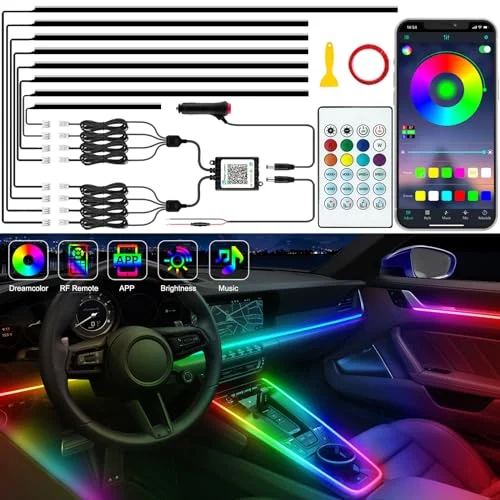
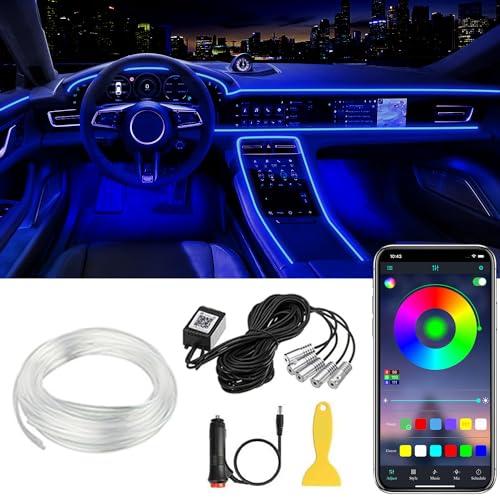
This is the fiber-optic option from the comparison above — an 8-piece acrylic light run rather than adhesive LED strips. Instead of a visible strip stuck to the trim, the acrylic fiber routes into the gap between the dash and the door panel, so the finished install looks closer to factory ambient lighting than an aftermarket kit.
Pros:
- Dreamcolor chasing — each point along the fiber can shift color independently instead of the whole run changing at once.
- 16 million colors and 213 modes, controlled through app, RF remote, or the built-in microphone for music sync.
- Acrylic diffusion gives a soft, even glow rather than visible individual LED points.
Cons:
- Routing the fiber into panel seams takes longer than sticking down a strip — budget closer to an hour, not five minutes.
- Always check the fiber lengths against your own dash and door layout before buying; longer or shorter runs of this same kit exist for different cabin sizes.
Because the fiber itself doesn’t hold any electronics, it can be trimmed and tucked into curved factory gaps that a rigid strip can’t follow, which is why this style is the one most often mistaken for a factory option. Music sync works off the same wireless app used for color control, so the setup doubles as both a static ambient light and a reactive one without switching hardware.
Nilight 48 Leds Multicolor Music Car Strip Light Under Dash Lighting Kit
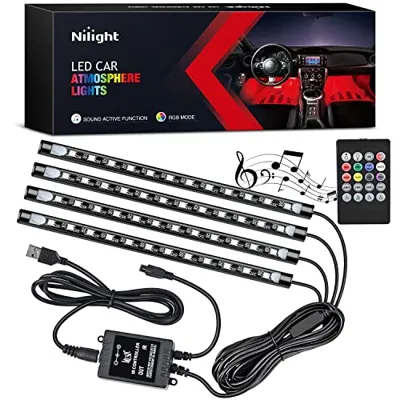
The Nilight 48 LEDs Multicolor Music Car Strip Light is the budget pick of the three — four short USB-powered strips with a sound-active mic built into the control box, so the lights react to whatever’s playing without needing an app at all.
Pros:
- Sound-active function reacts to music through a built-in microphone — no app or Bluetooth pairing required.
- Wireless remote switches colors and modes without touching the control box.
- USB powered, so it can run off a car’s USB port instead of the 12V socket.
- 2-year warranty, longer than most kits in this price range.
Cons:
- No phone app — color and mode control is limited to what the remote offers.
- Needs a free USB port; older cars without one will need a USB power adapter.
Because the microphone lives in the control box rather than a phone, the sound-reactive mode keeps working with the phone left in a pocket or plugged in elsewhere — useful if the driver’s phone is already tied up running navigation. The tradeoff for skipping an app is a smaller color and pattern menu than the Govee or Jushope kits above, which is exactly why this one is the budget pick rather than the featured one.
How Are Interior Car LED Lights Powered and Installed?
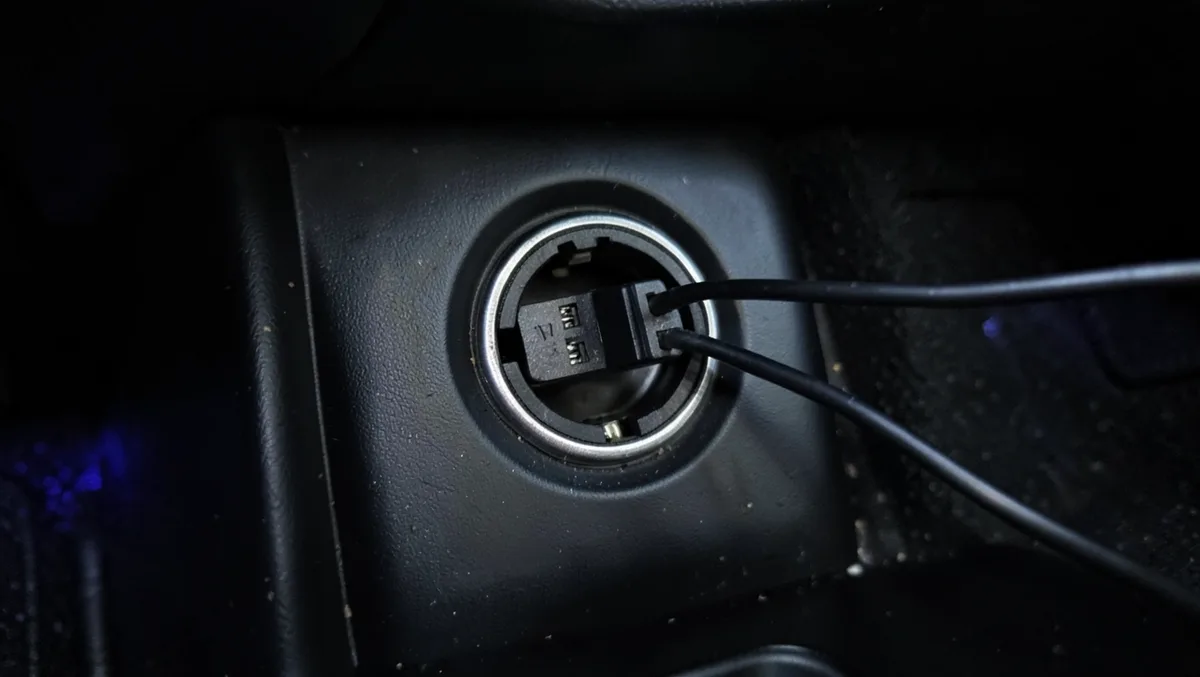
Most interior LED kits use one of three power sources, and the choice affects both installation time and whether the lights turn off automatically with the car:
- 12V accessory socket: the fastest option — plug in and go, fully reversible, no tools needed. Downside: it occupies the socket, and on many cars it stays powered with the key out, so lights left on can run down the battery overnight if you forget.
- Fuse-tap hardwire: an add-a-fuse adapter taps into an existing circuit in the interior fuse box, usually the accessory or dome-light circuit. It takes longer to install and needs the fuse box location for your specific model, but the lights then switch on and off automatically with the ignition and there’s no cable running across the floor.
- USB port: simplest of all for kits like the Nilight above, but limited to whatever the port can supply and to cars that have a spare USB port to give up.
All three options draw very little current — a full interior strip kit typically pulls well under 1 amp, so parasitic battery drain isn’t a real concern as long as the lights actually turn off when you’re not driving. The socket and USB options are the ones to watch, since they can stay live even with the engine off.
Keep the lighting itself inside the cabin — footwells, under the dash, in cupholders — and avoid red or blue if any of it could be visible through the glass at night, since several states restrict colors that spill outside the car. For the full state-by-state color rules, see our guide to legal interior LED colors; if you’re specifically looking at exterior-visible underglow instead of interior ambient lighting, our underglow legality guide covers that separately.
Frequently Asked Questions
How Do Interior LED Lights Enhance Car Ambiance?
Interior LED lights add color and depth to the cabin that factory lighting doesn’t provide — a soft glow in the footwells, along the dash, or in the cupholders. Most current kits let you set a static color, cycle through patterns, or sync to music, so the effect can range from a subtle accent to a full light show depending on the mode you pick.
What’s the Difference Between LED Strips and Fiber-Optic Ambient Kits?
LED strips are adhesive strips with visible LEDs along their length, best suited to footwells and under-seat mounting. Fiber-optic (acrylic) kits use a light-diffusing cable with no visible LEDs, so they can be tucked into dash and door seams for a continuous, factory-look line. Strips are cheaper and faster to install; fiber-optic kits cost more and take longer but look more integrated.
Can I Control Car LED Lights With My Phone?
Yes — most app-controlled kits, including the Govee and Jushope kits above, connect over Bluetooth to a free phone app for color, brightness, and mode changes. Kits without an app, like the Nilight strip, rely on a physical wireless remote instead, which trades some convenience for one less thing that needs pairing.
What Is Music Mode in Car LED Lights?
Music mode syncs the lights to whatever audio is playing, using either a phone’s microphone (app-based kits) or a small microphone built into the kit’s own control box (kits without an app). The lights pulse and shift color with the beat rather than holding a static pattern.
Are Car LED Lights Easy to Install?
Adhesive strip kits are the easiest — peel, stick, and plug into the 12V socket or a USB port, usually a five-minute job. Fiber-optic kits take longer because the acrylic cable has to be routed into panel seams by hand. A fuse-tap hardwire install, an option for either type, adds time up front but means the lights switch off automatically with the ignition instead of staying powered.
Do Interior LED Lights Drain My Car Battery?
Not meaningfully — a full interior LED kit typically draws well under 1 amp, far less than accessories like a phone charger. The real risk isn’t the current draw, it’s leaving lights powered from a 12V socket or USB port that stays live with the key out; a fuse-tap install tied to the ignition circuit avoids that entirely by turning off with the car.
Conclusion
Interior LED lights for cars come down to a straightforward choice: an adhesive strip kit like the Govee or Nilight for a fast, cheap footwell glow, or a fiber-optic kit like the Jushope for a slower install that reads as factory ambient lighting. Whichever type you pick, run it off the 12V socket for the easiest install or a fuse tap for a cleaner, ignition-linked one — and keep any light visible through the glass to white or amber so it stays street-legal wherever you drive.
Products related to this article
Sponsored / affiliate links. As an Amazon Associate I earn from qualifying purchases. I may earn additional commission from eligible campaigns.