Neon Lights for Cars: LED Strip vs Real Neon Tube Guide
For most DIY car owners, LED Strip is the better pick: it costs less, handles vibration and weather better, and comes off more easily if local lighting rules change. Choose Real Neon Tube only for a show build with sheltered mounting and a larger budget. Bad wiring, weak sealing, or the wrong color can mean broken lights, battery drain, failed inspections, and a wasted install; this guide compares durability, cost, legality, and install risk in plain terms.
| Factor | LED Strip | Real Neon Tube | Winner |
|---|---|---|---|
| Upfront cost | Lower kit price, fewer support parts | Tube, transformer, and hardware add cost | LED Strip |
| Install complexity | 12V compatible, cut points and splice options | Glass handling plus high-voltage wiring | LED Strip |
| Vibration resistance | Flexible housing handles road shock better | Glass tube is fragile and vibration-sensitive | LED Strip |
| Weather resistance | IP65 and IP67 options suit exterior use | Needs more protection from water and debris | LED Strip |
| Power draw | Low-voltage accessory load | Transformer or inverter adds draw and heat | LED Strip |
| Authentic neon look | Close from a distance, more uniform on newer kits | Gas-filled glow is the real thing | Real Neon Tube |
| Repairability | Sections and connectors are easier to replace | Breakage usually means tube replacement | LED Strip |
| Legality risk | Still depends on color, placement, and flash patterns | Same restrictions, plus more install constraints | LED Strip |
| Total ownership risk | Lower chance of failure and lower replacement cost | Higher chance of breakage and higher fix cost | LED Strip |
What each option is in car terms
LED Strip
For cars, LED Strip usually means a flexible silicone or PVC housing with a 12V vehicle-power setup. The strip may be sold for interior ambient lighting, underglow, or both, and many kits include cut points, splice leads, and adhesive backing or clips. A common choice is IP65 or IP67 if the strip will be outside the cabin.
Real neon tube
Real Neon Tube is typically a glass tube filled with gas and lit by a high-voltage transformer or inverter. That setup can produce the classic neon glow, but it brings fragility, mounting limits, and more heat in the power hardware. It is a poor match for rough daily driving and exposed underbody use.
How the two systems differ under daily driving
Vibration and impact sensitivity
Road vibration is one area where the gap can widen quickly. LED Strip bends with the body and usually tolerates constant movement better, while glass tubing can crack from repeated shock, curb strikes, or loose mounts. A common beginner mistake is mounting a real neon tube where it can flex; one sharp pothole can crack the glass and leave part of the glow out.
Heat, water ingress, and weather exposure
Underbody lighting sees spray, grit, heat soak, and freeze-thaw cycles. IP65 is commonly used for splash resistance, while IP67 adds temporary immersion protection, which can matter if the mounting point may sit in standing water. Real Neon Tube needs more shelter from moisture and debris, and its power hardware adds another place for heat to build.
Repairability and replacement risk
LED Strip usually fails in smaller pieces, such as a connector, a section of adhesive, or a shorted segment, so repair can be more contained. Real Neon Tube tends to fail more catastrophically: a cracked tube often means replacing the tube and checking the transformer, mounts, and wiring at the same time. That raises downtime and cost.
Led neon strip and real neon tube
The table above is the shortest version of the call. This section adds the hidden costs and failure modes that show up after the install, not while you are shopping.
Upfront cost and hidden hardware
LED Strip usually starts with the lower sticker price because it can run on 12V vehicle power without a transformer. Real Neon Tube needs the tube itself, a high-voltage transformer or inverter, and sturdier mounting hardware, which can push the total cost well beyond the tube price alone.
Install complexity and power draw
Strip kits often use cut points and splice methods that match the car’s layout, and they can be wired with a fuse tap and inline fuse. Real Neon Tube asks for more planning because the glass tube must be protected from damage and the power conversion hardware needs a safe, dry location. That extra hardware also adds current draw and heat loss.
Brightness control, authenticity, and total ownership risk
LED Strip usually offers stronger control over brightness, color changes, and remote or app functions. Real Neon Tube wins on authenticity at night, but the more authentic glow comes with more breakage risk, more limited mounting locations, and more replacement expense if a tube fails. For most daily drivers, ownership risk matters more than the look in a parking lot.
Which option works better for interior ambient lighting?
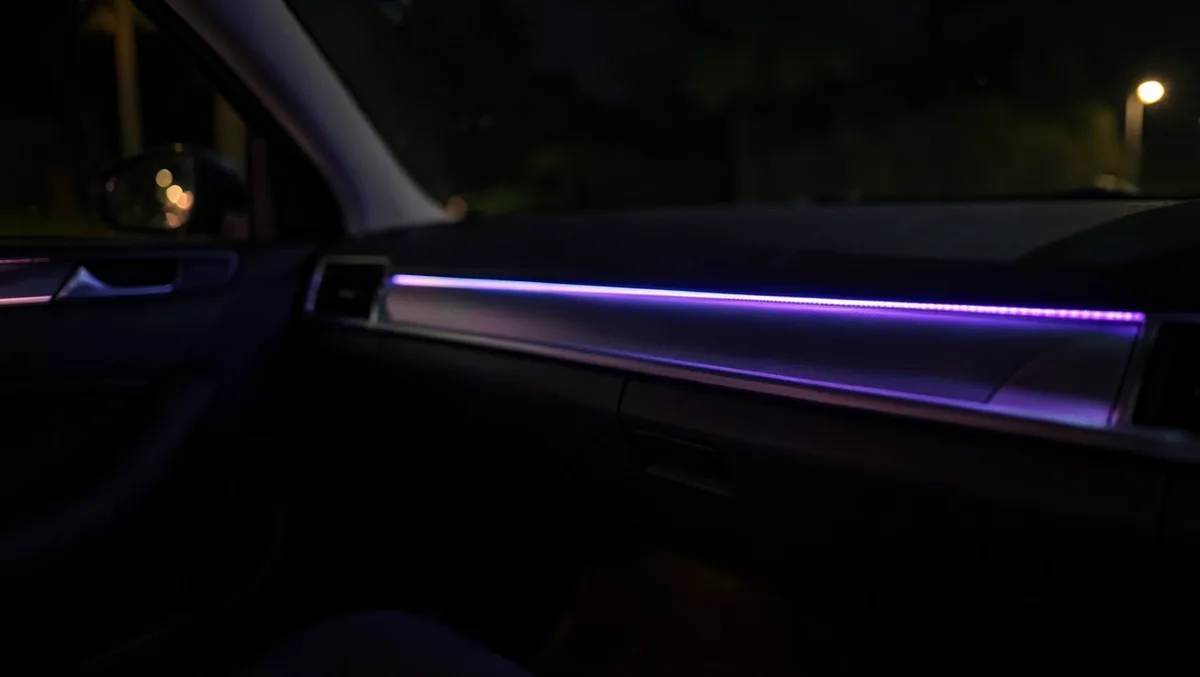
LED Strip is the better fit for interior ambient lighting. It is easier to hide behind dash trim, in footwells, and along door sills, where low-glare output matters more than raw brightness. Real Neon Tube is bulky, fragile, and out of place inside a cabin where knees, shoes, and luggage can hit it.
Dash, footwell, and door-sill placement
Interior ambient lighting should stay low, indirect, and out of the driver’s line of sight. Door-sill and footwell placement work well because they hide the source while washing the cabin with light. Dash-mounted lighting needs extra care, since glare can distract or reflect in the windshield.
Low-glare output and wire concealment
LED Strip gives more flexibility for hidden routing. A thin strip can tuck behind trim and run through existing gaps if the wire is concealed cleanly. Poor wire routing makes even a good kit look cheap, and loose leads can rattle or snag.
USB versus 12V power options
Some interior kits use USB, while others use 12V accessory power. USB is convenient for small cabin accents, but 12V is often the better long-term choice if the install should run with the ignition or be tied to a fuse tap. Follow the vehicle manual and keep lighting out of airbag zones and the driver’s view.
Which option works better for underglow?
For underglow, LED Strip is the practical pick again. Exterior mounting under the chassis exposes the kit to spray, road debris, salt, and vibration, so a flexible strip with an IP rating is far more suitable than a glass tube. Real Neon Tube can look striking, but the car environment punishes it.
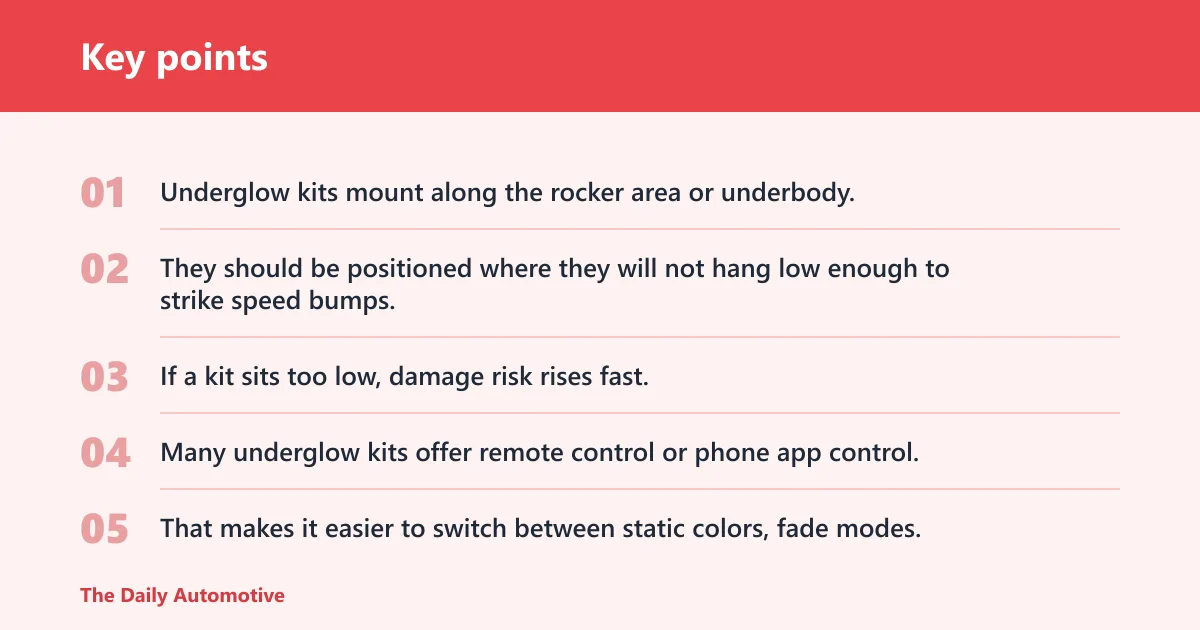
Exterior mounting under the chassis
Underglow kits mount along the rocker area or underbody, often as paired left and right bars or strips. They should be positioned where they will not hang low enough to strike speed bumps, curbs, or road debris. If a kit sits too low, damage risk rises fast.
Remote and app control variants
Many underglow kits offer remote control or phone app control. That makes it easier to switch between static colors, fade modes, and color-changing effects, but it does not change legal limits. A flashy control app does not make a front-facing, traffic-visible install legal.
Static and color-changing modes
Static modes are usually easier to live with on the street because they draw less attention and are simpler to inspect. Color-changing and flashing patterns can look impressive at a meet, but they increase the chance of running into local restrictions. If the car is driven on public roads, the safest assumption is that flashing colors and forward-facing effects may be limited or banned.
Road-legal restrictions by jurisdiction
Laws vary by jurisdiction. Common restrictions include red or blue forward-facing lights and flashing patterns, and some rules also limit setups that are visible from the front or resemble emergency equipment. Check local rules before mounting anything under the car, because the same kit can be fine at a show and illegal on the street.
What should you know about installation hardware?
Good hardware matters as much as the light source. The mount must survive heat, road spray, and repeated vibration, and the power connection must be fused correctly so a short does not turn into a wiring problem.
Adhesive mounting system limits
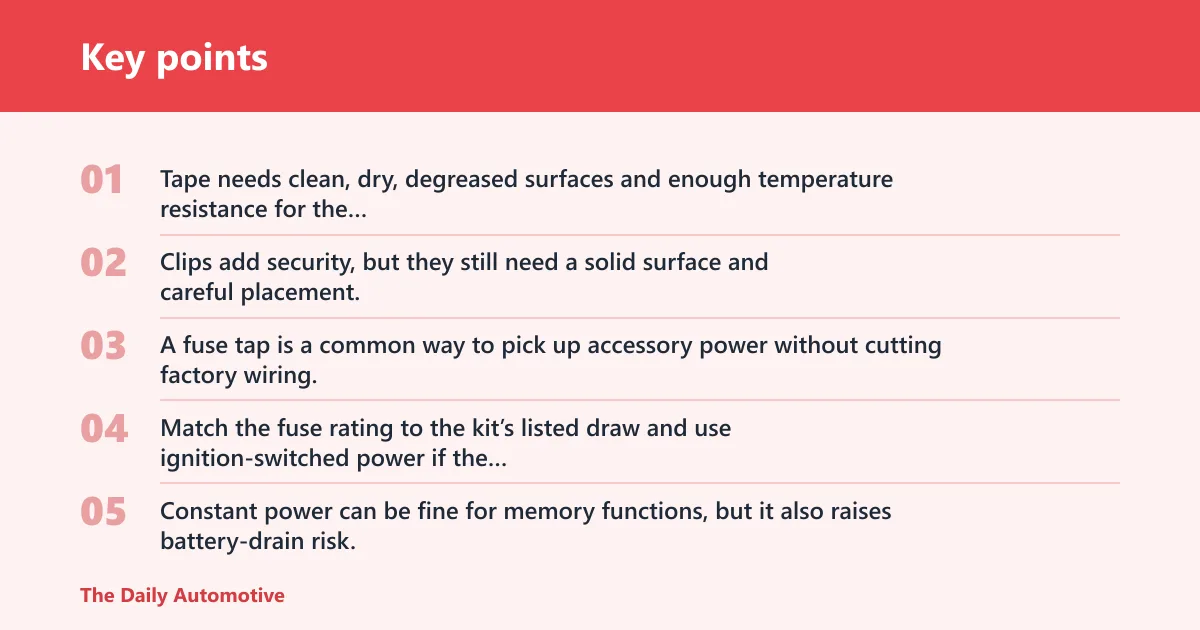
Many strip kits use 3M-style tape or clips. Tape needs clean, dry, degreased surfaces and enough temperature resistance for the mounting location; otherwise it can peel at the edges and fail in heat or winter cold. Clips add security, but they still need a solid surface and careful placement.
Fuse tap and inline fuse basics
A fuse tap is a common way to pick up accessory power without cutting factory wiring, and an inline fuse protects the new circuit close to the source. Match the fuse rating to the kit’s listed draw and use ignition-switched power if the lights should shut off with the key. Constant power can be fine for memory functions, but it also raises battery-drain risk.
Cut points, splice methods, and wire routing
LED strips usually include marked cut points, and some kits allow soldered splices or sealed connectors after trimming. Route wires away from moving suspension parts, hot exhaust pieces, and sharp edges. Say your strip reaches the rear footwell but the connector sits under a seat track; one seat slide can crush the wire if it is not clipped properly.
Voltage converter or inverter needs for real neon
Real Neon Tube generally needs a voltage converter or inverter to step 12V vehicle power up to the higher voltage the tube requires. That adds heat, complexity, and another failure point, which is why authentic neon is a poor default choice for daily street use. The converter also needs dry, secure mounting away from splash zones.
Choose LED Strip if… / Choose Real Neon Tube if…
Choose LED Strip if you want the better daily-driver option, need easier removal later, or plan to mount lighting outside the cabin. Choose Real Neon Tube only if the car is a sheltered show build, the budget allows for the transformer and replacement risk, and the install can stay protected from vibration and water.
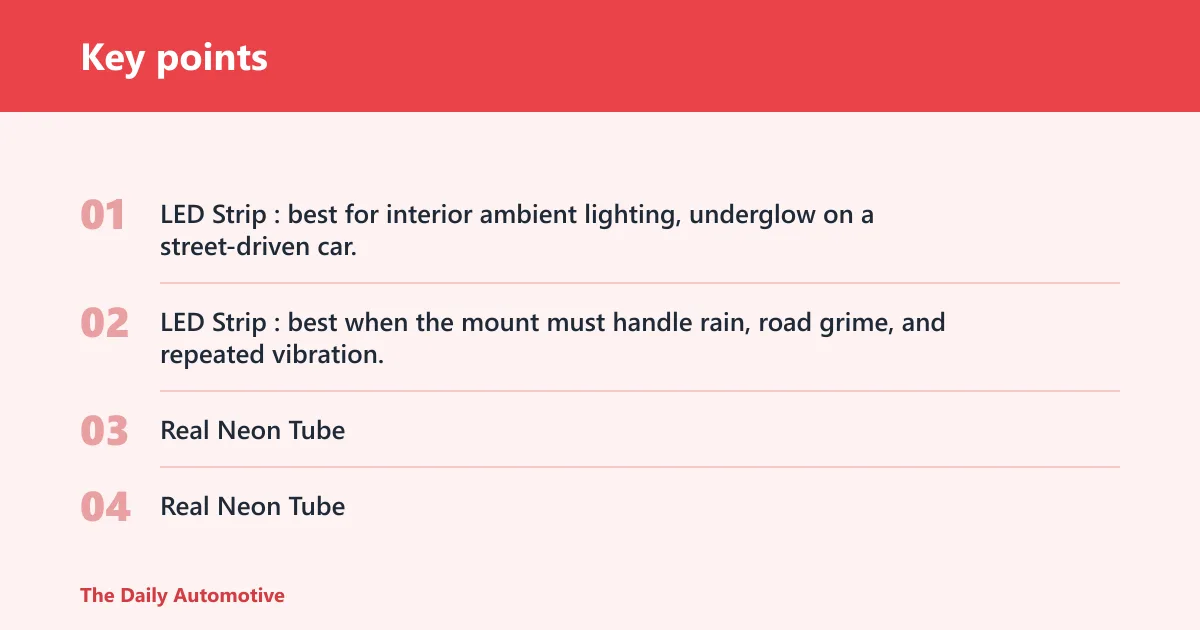
- LED Strip: best for interior ambient lighting, underglow on a street-driven car, and owners who want lower cost and easier service.
- LED Strip: best when the mount must handle rain, road grime, and repeated vibration.
- Real Neon Tube: best when authenticity matters more than practicality and the car spends most of its time parked or trailered.
- Real Neon Tube: best only when the installer can protect the tube, transformer, and wiring from impacts and moisture.
Suppose a sedan owner wants footwell lighting that turns on with the ignition, stays dim enough for night driving, and can be removed later if inspection rules change. LED Strip fits that job. Now picture a weekend-only show car with sheltered mounting and a custom electrical setup; Real Neon Tube can make sense there, but the risk is still higher.


Frequently asked questions
Are LED strip lights better than real neon tubes for cars?
For most car owners, yes. LED Strip is better because it is cheaper, easier to install, more vibration-resistant, and less likely to fail from weather exposure. Real Neon Tube still wins on authentic glow, but that advantage rarely outweighs the extra hardware, fragility, and repair risk on a driven car.
Which lasts longer, LED neon strip or glass neon tube?
LED Strip usually lasts longer in daily driving because it tolerates vibration and small impacts better. Glass tubing can look great, but it is more likely to crack, and the transformer can add another failure point. Longevity still depends on sealing, mounting quality, and whether the wiring is fused correctly.
Can I install neon lights under my car myself?
Yes, if you are working within the vehicle manual and you understand basic 12V wiring. A self-install is more realistic with LED Strip than with Real Neon Tube. For underglow, use secure mounts, weather-rated parts, and a fused power source; do not work under a vehicle supported only by a jack.
Are neon lights for cars street legal?
Sometimes, but the rules vary by jurisdiction. Common restrictions involve flashing modes, front-facing visibility, and certain colors such as red or blue. Exterior underglow is often more restricted than interior ambient lighting, so check local law before wiring the kit and again before driving at night.
How much do LED strip lights cost compared with real neon tubes?
LED Strip usually costs less up front and less over time. Real Neon Tube adds the tube, transformer or inverter, mounting hardware, and a higher chance of replacement if the glass breaks. Total cost matters more than the sticker price, especially if the install is exposed to weather.
Will car neon lights drain my battery?
They can, especially if the kit is wired to constant power or left on with the engine off. LED Strip usually draws less power, but any accessory can drain the battery if it runs too long. An ignition-switched circuit, the right fuse, and a working charging system reduce the risk.
What tools do I need to install car neon lights?
Basic jobs usually call for trim tools, wire strippers, crimpers or soldering gear, heat-shrink tubing, a multimeter, and cleaning supplies for surface prep. For underglow, add jack stands on level ground, because you should never rely on a jack alone. For any electrical work, follow the vehicle manual and disconnect the battery when required.
Products related to this article
Sponsored / affiliate links. As an Amazon Associate I earn from qualifying purchases. I may earn additional commission from eligible campaigns.