
Is Audi a German Car Explained Clearly
Many people wonder, Is Audi a German Car? Explained Clearly is a question that comes up a lot, especially for car fans who want to know where their favorite vehicles come from. Sometimes, it’s not as simple as it sounds because big companies own many car brands.
This can make things a little confusing if you’re just starting to learn about cars. Don’t worry, though! We will break it down step by step so you know exactly where Audi stands.
Get ready to find out the clear answer to this common question.
Audi’s German Roots And Global Reach
This section will look closely at Audi’s history and its strong ties to Germany. We’ll explore how the company started and grew into the well-known brand it is today. Understanding Audi’s origins helps us appreciate its engineering and design heritage.
We will also touch upon how its global presence affects its manufacturing and brand identity, making sure the answer to “Is Audi a German Car? Explained Clearly” is straightforward and easy to grasp for everyone interested in automobiles.
The Founding Of Audi And Early History
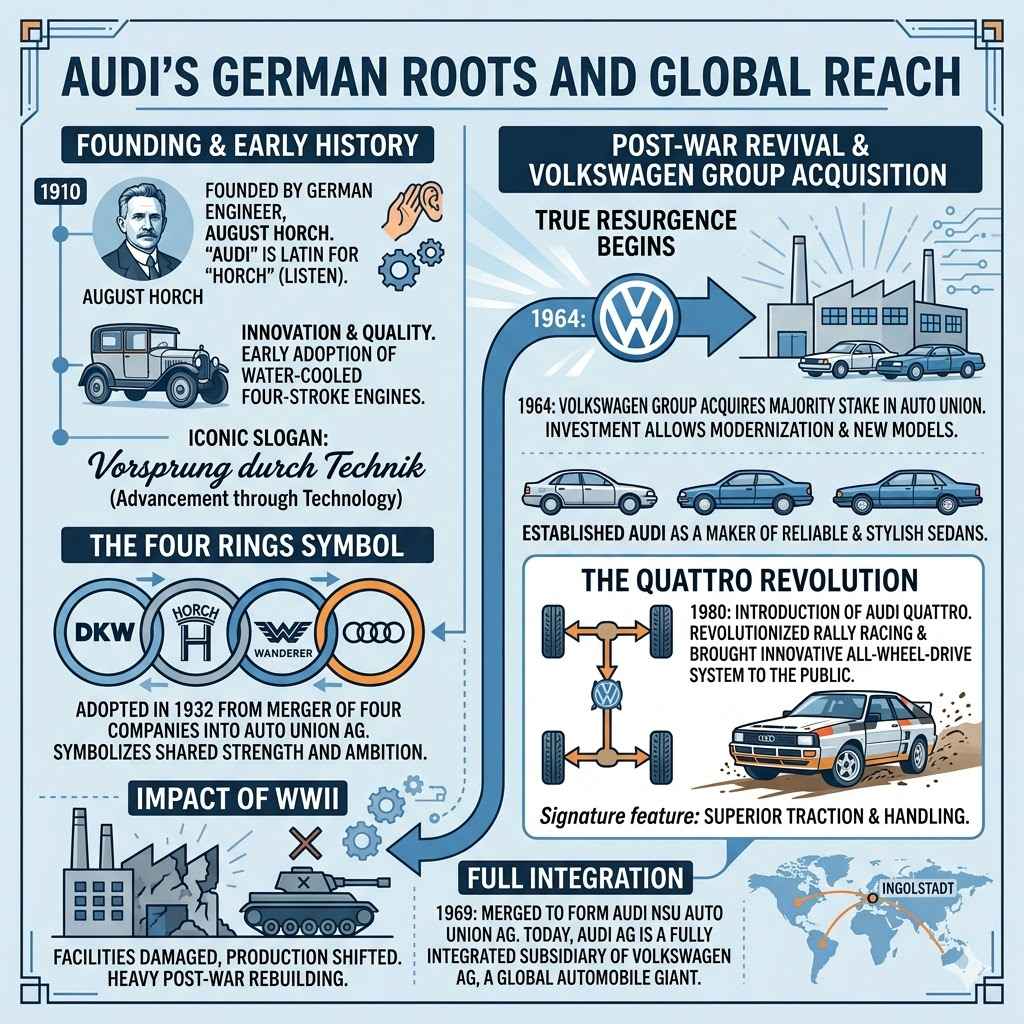
Audi was founded by August Horch, a German engineer, in 1910. He had previously started another car company but left to form Audi. The name “Audi” is actually the Latin translation of his last name, “Horch,” which means “listen.” This gave the company its iconic slogan, “Vorsprung durch Technik,” meaning “Advancement through Technology.”
The early years of Audi were marked by innovation and a focus on quality. The company quickly gained a reputation for producing reliable and well-engineered vehicles. Early Audi models were known for their advanced features for the time.
This set a high standard for what the brand would become.
Early Innovations Audi was one of the first car manufacturers to produce cars with water-cooled, four-stroke engines. This was a significant technological step forward that improved engine performance and durability. The company also experimented with different chassis designs, aiming for better handling and comfort.
The Four Rings Symbol The famous Audi rings symbol was adopted in 1932 when Audi merged with three other German car manufacturers: DKW, Horch, and Wanderer. This merger formed the Auto Union AG. The four rings represent the union of these independent companies, symbolizing their shared strength and ambition.
Impact of World War II Like many German industries, Audi’s production was heavily affected by World War II. The company’s facilities were damaged, and production shifted to support the war effort. After the war, the company had to rebuild from the ground up.
The Post-War Revival And Volkswagen Group Acquisition
After World War II, the Auto Union AG was dissolved. Production of Audi cars resumed in Ingolstadt, Germany, in the 1950s. For a time, the brand was produced under license by Daimler-Benz, but this arrangement was temporary.
The true resurgence began when the Volkswagen Group acquired a majority stake in Auto Union in 1964.
This acquisition marked a pivotal moment for Audi. Volkswagen’s investment allowed Audi to modernize its factories and develop new models. The brand quickly regained its footing in the competitive automotive market.
The focus remained on producing premium vehicles with advanced technology and sophisticated design.
Modern Audi Models Emerge With the backing of Volkswagen, Audi began to introduce models that would define its future. The Audi 100, launched in 1968, was a success and helped establish Audi as a maker of reliable and stylish sedans. This car demonstrated the brand’s ability to compete with established luxury automakers.
The Quattro Revolution A significant milestone was the introduction of the Audi Quattro in 1980. This car revolutionized rally racing and brought Audi’s innovative all-wheel-drive system to the public. The Quattro system provided superior traction and handling, especially in challenging conditions. It became a signature feature of many Audi vehicles.
Full Integration into Volkswagen Group By 1969, Auto Union AG had merged with NSU Motorenwerke AG and was renamed Audi NSU Auto Union AG. Eventually, the company became fully integrated into the Volkswagen Group. Today, Audi AG is a subsidiary of Volkswagen AG, one of the world’s largest automobile manufacturers. This relationship is key to understanding Audi’s current status and production capabilities.
Is Audi a German Car? Explained Clearly
This section directly addresses the core question: Is Audi a German Car? Explained Clearly, we will confirm Audi’s German origins and its current position within a global automotive giant. We will discuss the implications of being part of the Volkswagen Group while maintaining its distinct German identity.
This will provide a comprehensive answer for anyone curious about Audi’s heritage and manufacturing.
Audi’s Manufacturing Locations And German Identity
Audi is unequivocally a German car brand. Its headquarters are in Ingolstadt, Bavaria, Germany. The vast majority of its research and development, design, and engineering are based in Germany.
This German heritage is deeply embedded in Audi’s brand identity and engineering philosophy, which emphasizes precision, quality, and advanced technology.
While Audi is a German company, like many global automakers, it has manufacturing plants in various countries. This allows for efficient production and distribution to markets worldwide. However, the core of Audi’s engineering, design, and strategic direction remains firmly rooted in Germany.
German Headquarters and R&D Centers Audi’s primary operational base is in Germany. This includes its main administrative offices, major design studios, and key engineering facilities. The development of new technologies and vehicle platforms often begins in these German centers, reflecting a strong commitment to German engineering excellence.
Global Production Network Audi operates production facilities in countries like Mexico, China, and Hungary, in addition to its German plants. These international factories build specific models for regional markets or to optimize production costs. For instance, vehicles destined for the North American market are often manufactured in Mexico.
Maintaining German Standards Globally Even with international production, Audi strives to maintain its high-quality standards across all its manufacturing sites. This is achieved through strict quality control measures, transfer of German manufacturing expertise, and consistent adherence to Audi’s design and engineering specifications. The goal is to ensure every Audi, regardless of where it is built, reflects the brand’s commitment to premium quality.
The Volkswagen Group Influence
Being part of the Volkswagen Group (VW Group) significantly influences Audi’s operations, but it does not change Audi’s identity as a German car manufacturer. The VW Group is a massive conglomerate that owns many automotive brands, including Volkswagen, Porsche, Skoda, SEAT, and Lamborghini. This ownership structure allows for shared resources, technologies, and platforms, leading to cost savings and faster development cycles.
Audi benefits from this association through access to cutting-edge research and development, pooled purchasing power, and shared engineering expertise. However, each brand within the VW Group maintains its distinct identity, target market, and design language. Audi continues to operate as a premium brand with its unique engineering principles and styling.
Platform Sharing A common practice within the VW Group is platform sharing. This means that multiple models from different brands might be built on the same underlying vehicle architecture. For Audi, this often involves sharing platforms with Volkswagen and Porsche models. This strategy reduces development costs and speeds up the introduction of new vehicles.
Technological Synergy The VW Group fosters technological synergy among its brands. Innovations developed by one brand can be adapted and implemented across others. This can accelerate the adoption of advanced technologies like electric powertrains, autonomous driving systems, and sophisticated infotainment, benefiting Audi and its customers.
Brand Differentiation Within the Group Despite shared resources, Audi maintains its position as a premium and luxury brand. Its design, performance, and interior appointments are distinct from mainstream Volkswagen models or other brands within the group. This allows Audi to cater to a specific segment of the automotive market while benefiting from the collective strength of its parent company.
Exploring Audi’s Engineering And Design Philosophy
This section delves into what makes an Audi an Audi. We will explore the engineering principles and design elements that are characteristic of the brand. Understanding these aspects helps to solidify why Audi is recognized as a premium German automobile manufacturer, consistently delivering vehicles that blend performance, luxury, and cutting-edge technology.
The “Vorsprung durch Technik” Ethos
Audi’s long-standing slogan, “Vorsprung durch Technik” (Advancement through Technology), is more than just a marketing phrase; it’s the guiding philosophy that shapes every Audi vehicle. This ethos means a constant pursuit of innovation and the integration of the latest automotive technologies into their production cars. Audi aims to be at the forefront of automotive engineering, offering features that enhance performance, safety, and the overall driving experience.
This commitment to technology is evident in everything from their powertrains and chassis dynamics to their digital cockpits and driver-assistance systems. Audi invests heavily in research and development to ensure its vehicles are not just advanced for their time but also set new benchmarks for the industry.
Cutting-Edge Powertrains Audi is known for its sophisticated engine technology. This includes efficient turbocharged engines, advanced diesel engines (TDI), and its range of high-performance RS models. The brand has also been a pioneer in electrification, with its e-tron line of fully electric vehicles pushing the boundaries of electric performance and range.
Quattro All-Wheel Drive System The legendary Quattro all-wheel-drive system is a cornerstone of Audi’s engineering. It provides exceptional grip, stability, and traction in various driving conditions, from rain and snow to dry roads. This system enhances both performance and safety, making it a highly sought-after feature by many Audi buyers.
Advanced Safety Features Audi consistently incorporates advanced safety technologies into its vehicles. This includes a comprehensive suite of driver-assistance systems like adaptive cruise control, lane-keeping assist, automatic emergency braking, and surround-view cameras. These technologies aim to prevent accidents and protect occupants, reflecting Audi’s commitment to passenger safety.
Design Language And Interior Excellence
Audi’s design language is characterized by clean lines, a sophisticated aesthetic, and a focus on aerodynamic efficiency. The exterior styling is often described as understated elegance, avoiding excessive ornamentation in favor of a refined and timeless look. The iconic Singleframe grille has become a recognizable element of Audi’s design, evolving over the years but always maintaining its distinctive presence.
Inside the cabin, Audi is renowned for its luxurious and technologically advanced interiors. The focus is on creating a driver-centric environment that is both comfortable and intuitive to use. High-quality materials, precise craftsmanship, and innovative features contribute to the premium feel of every Audi.
Exterior Aesthetics Audi vehicles typically feature sharp creases, sculpted body panels, and a sleek profile. The lighting technology, particularly the LED headlights and taillights, plays a significant role in defining the car’s visual identity, often featuring intricate designs that are both functional and striking. The overall design aims for a balance of sportiness and elegance.
Virtual Cockpit And Infotainment The Audi Virtual Cockpit is a prime example of the brand’s commitment to interior technology. This fully digital instrument cluster can be customized by the driver, displaying navigation, media, and vehicle information in high resolution. The MMI (Multi Media Interface) infotainment system is equally advanced, offering intuitive control over vehicle functions and connectivity features.
Material Quality And Craftsmanship Audi interiors are known for their superior material quality, including premium leather, finely grained wood, and brushed aluminum accents. The fit and finish are exceptionally high, with every component feeling solid and well-assembled. This attention to detail contributes significantly to the perception of luxury and quality associated with the Audi brand.
Performance Variants And Driving Dynamics
Audi offers a range of performance variants that showcase the brand’s engineering prowess. The “S” models represent a step up in performance from the standard models, offering more power, sportier suspension tuning, and subtle styling enhancements. At the pinnacle of Audi’s performance lineup are the RS models, which are developed by Audi Sport GmbH.
These RS models are designed to deliver exhilarating performance with track-inspired capabilities while still retaining a level of everyday usability. The driving dynamics are carefully calibrated to provide a thrilling yet controlled experience, often leveraging advanced chassis technology and powerful engines.
Audi S Models The S models, such as the S4 or S7, offer enhanced performance compared to their standard counterparts. They typically feature more powerful engines, sport-tuned suspension systems, and upgraded braking components. These cars provide a noticeable increase in acceleration and handling responsiveness without compromising too much on comfort.
Audi RS Models The RS models, like the RS6 Avant or RS Q8, are the ultimate expression of Audi’s performance engineering. These vehicles are designed for maximum exhilaration, featuring bespoke engines producing immense horsepower, advanced all-wheel-drive systems tuned for dynamic driving, and specialized suspension and braking systems. They offer supercar-like performance in a practical package.
Driving Experience Tuning Audi’s engineers meticulously tune the driving dynamics of all their vehicles, with a particular focus on the S and RS models. This involves optimizing steering feel, suspension stiffness, throttle response, and gear shifts to create a cohesive and engaging driving experience. The goal is to provide a perfect balance between sporty handling and refined comfort, allowing drivers to enjoy both spirited drives and daily commuting.
The Global Market Position Of Audi Cars
This section examines where Audi stands in the global automotive market. We will look at its competition, its sales performance, and its standing as a luxury German brand. Understanding Audi’s market position helps to illustrate its success and the global recognition of its German engineering and design.
Audi’s Place Among Premium Competitors
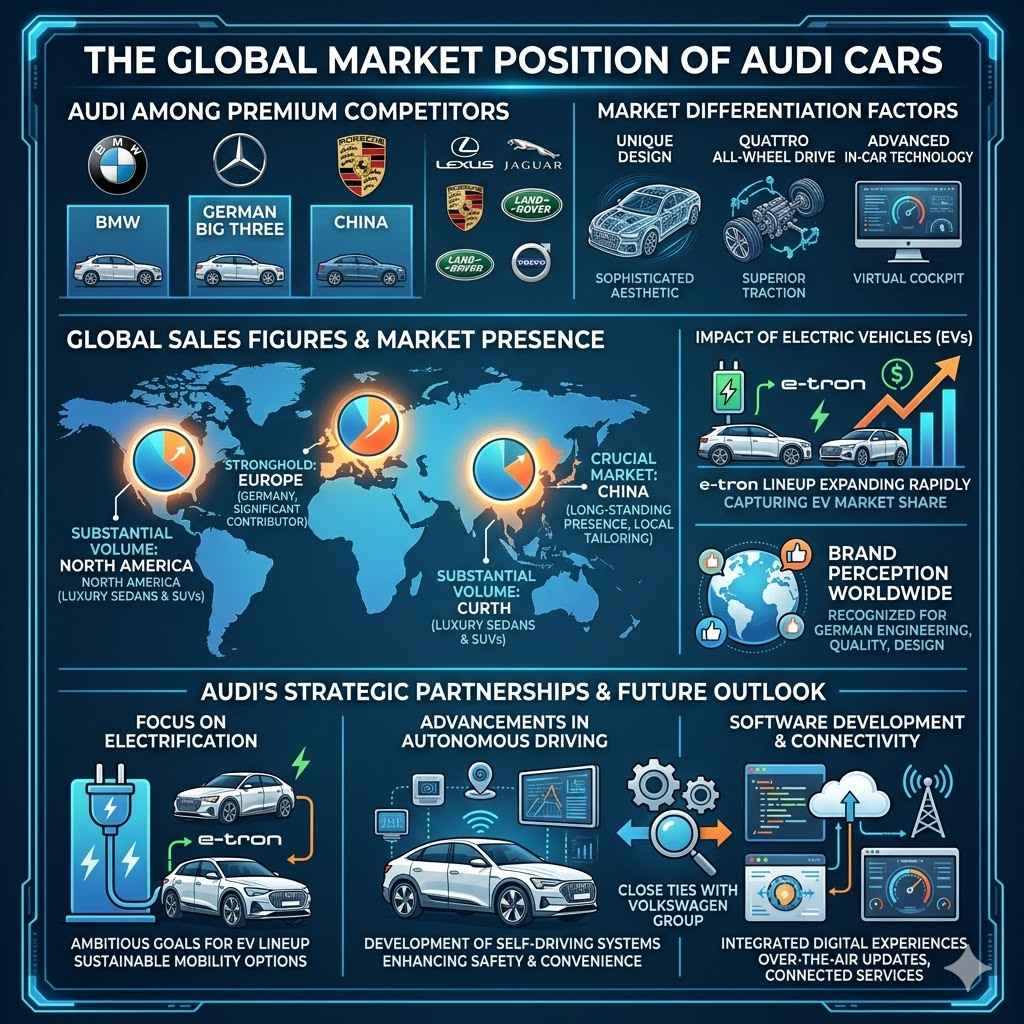
Audi competes directly with other major luxury automotive brands, primarily from Germany. Its main rivals include BMW and Mercedes-Benz, forming what is often referred to as the “German Big Three.” These brands are known for their high-quality vehicles, advanced technology, and strong brand prestige. Audi also competes with other international luxury marques.
The competition among these premium brands is fierce. Each brand constantly strives to innovate and offer superior products to attract discerning customers. Audi differentiates itself through its unique design language, its emphasis on Quattro all-wheel drive, and its advanced in-car technology.
Key Competitors Besides BMW and Mercedes-Benz, Audi also contends with brands like Lexus, Audi’s Japanese counterpart known for reliability and refined interiors, and occasionally with performance-oriented brands like Jaguar and Porsche. The luxury SUV segment also brings in strong competition from brands like Land Rover and Volvo.
Market Differentiation Factors Audi often emphasizes its sophisticated interior design and its technology integration, such as the Virtual Cockpit. The prevalence of Quattro all-wheel drive across its lineup is also a significant selling point, especially in regions with challenging weather conditions. The brand’s sporty yet elegant aesthetic appeals to a broad range of luxury car buyers.
Sales Performance And Growth Audi has consistently been one of the top-selling premium automotive brands globally. Its sales figures demonstrate strong customer demand for its vehicles across various segments, from sedans and SUVs to sports cars. The brand’s strategy of offering a wide range of models, including electric vehicles, has helped it maintain a competitive edge.
Global Sales Figures And Market Presence
Audi maintains a significant global market presence, with vehicles sold in virtually every major automotive market worldwide. The brand has a particularly strong foothold in Europe, China, and North America. These regions represent its largest sales territories, where its reputation for quality and luxury is well-established.
Audi’s sales performance is a reflection of its product appeal and its effective marketing strategies. The company continually adapts its offerings to meet the evolving demands of different markets, introducing new models and technologies to stay ahead of the curve.
Regional Sales Highlights Europe remains Audi’s traditional stronghold, with Germany being its home market and a significant contributor to overall sales. China has emerged as a crucial market, where Audi has a long-standing presence and strong brand loyalty, often tailored to local preferences. North America, including the United States and Canada, also represents a substantial sales volume, driven by demand for its luxury sedans and SUVs.
Impact of Electric Vehicles (EVs) The growing popularity of electric vehicles has presented both challenges and opportunities for Audi. The brand has invested heavily in its e-tron lineup, aiming to capture a significant share of the burgeoning EV market. The success of its electric models is crucial for its future growth and market position.
Brand Perception Worldwide Audi is recognized globally as a premium brand associated with German engineering, quality, and sophisticated design. This strong brand perception allows it to command premium pricing and maintain customer loyalty. The brand’s consistent delivery of high-quality vehicles has solidified its reputation on the international stage.
Audi’s Strategic Partnerships And Future Outlook
Audi’s future outlook is closely tied to its strategic decisions, including its partnerships and its adaptation to new automotive trends. As the industry shifts towards electrification, autonomous driving, and new mobility services, Audi is actively positioning itself for the future. Its relationship with the Volkswagen Group provides a strong foundation for these transitions.
The brand is committed to developing innovative solutions and expanding its range of sustainable mobility options. This includes a continued focus on electric vehicles, advanced driver-assistance systems, and the integration of digital technologies into its vehicles.
Focus on Electrification Audi has set ambitious goals for its electric vehicle lineup. The e-tron brand is expanding rapidly, with new models being introduced across different segments. The company aims for a significant portion of its sales to come from electric vehicles in the coming years, showcasing its commitment to a sustainable future.
Advancements in Autonomous Driving Audi is actively involved in the development of autonomous driving technologies. This includes research into self-driving systems and the integration of advanced sensors and software. The aim is to enhance safety and convenience for drivers, potentially transforming the driving experience in the long term.
Software Development And Connectivity In the modern automotive landscape, software plays an increasingly vital role. Audi is investing in its own software development capabilities to create more integrated and intuitive digital experiences for its customers. This includes advanced infotainment systems, connected services, and over-the-air updates, ensuring vehicles remain up-to-date and feature-rich throughout their lifecycle.
Frequently Asked Questions
Question: Is Audi a luxury car brand?
Answer: Yes, Audi is considered a premium or luxury car brand. It competes with other high-end automakers known for their quality, performance, and advanced features.
Question: Who owns Audi?
Answer: Audi is owned by the Volkswagen Group, a German automotive manufacturing company.
Question: Are all Audi cars made in Germany?
Answer: No, while Audi is a German brand and many of its cars are manufactured in Germany, it also has production facilities in other countries like Mexico and China to serve global markets.
Question: Is Audi better than BMW or Mercedes-Benz?
Answer: “Better” is subjective and depends on personal preferences. Audi, BMW, and Mercedes-Benz are all excellent luxury brands with their own strengths in design, performance, and technology.
Question: What does the Audi logo with four rings represent?
Answer: The four rings represent the merger of four independent German car manufacturers in 1932: Audi, DKW, Horch, and Wanderer, which formed Auto Union AG.
Summary
Yes, Audi is indeed a German car. Its origins are firmly in Germany, with its headquarters and significant research and development still based there. While it is part of the global Volkswagen Group and has production sites worldwide, Audi maintains its distinct German identity for engineering, design, and quality.