Best Leather Car Keychains: D-Ring, Stitching & Hardware
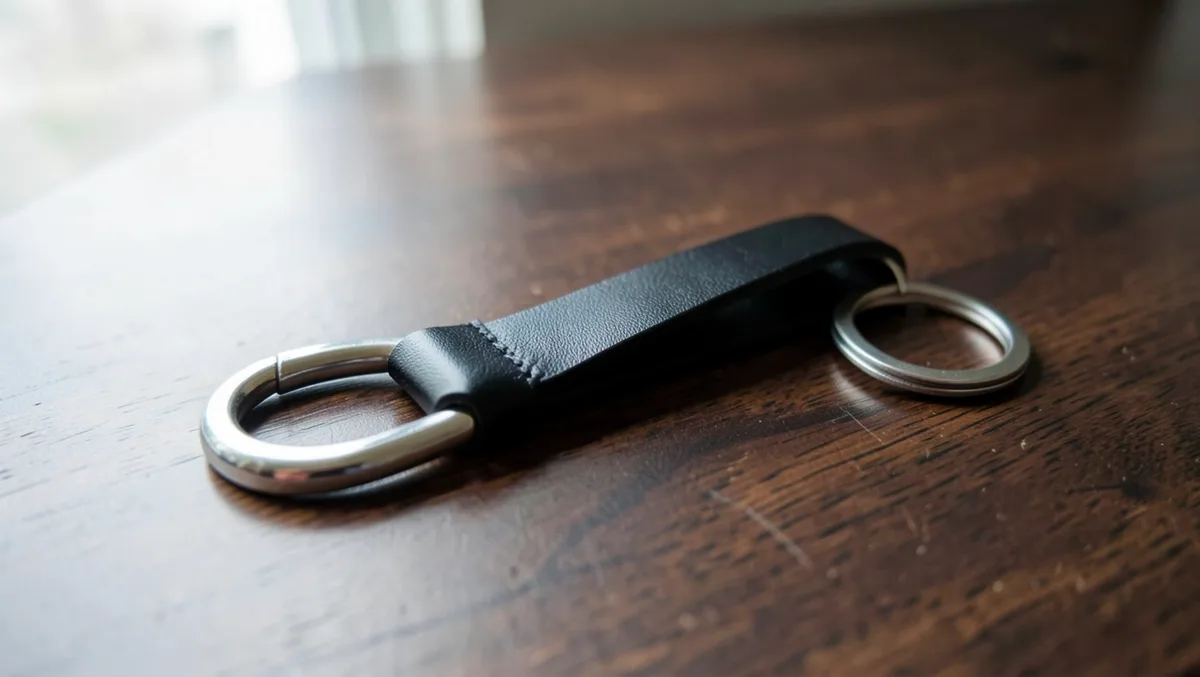
The best leather car keychains use a solid D-ring or screw-fastened clasp, tight stitching, and finished edges; skip cheap spring clips and exposed raw edges. Weak hardware or loose seams can drop keys, fray fast, and make a gift look worn before the month ends. This guide compares leather keychains by attachment hardware, leather grade, stitch work, edge finish, and the first parts that wear out, so you can choose one for daily use and gifting.
Quick comparison
| Product | Badge | Best for | Price | ||
|---|---|---|---|---|---|
 |
SICOPERT Leather Keychain for Men and Women, Car Key Chain,SICOPERT | Our pick | Top-grain cowhide · titanium alloy · black | $22.99
Price as of 29 Oct 2026
|
View |
 |
Elegatto Premium Braided Leather Keychain | Full-GrainElegatto | Upgrade pick | Braided leather · stainless steel · gold tone | $40.00
Price as of 29 Oct 2026
|
View |
 |
TACOMA Genuine Leather Car Keychain Fit for BMW M Key ChainTACOMA | Also great | Genuine leather · zinc alloy · black | $11.98
Price as of 29 Oct 2026
|
View |
 |
PPhtony Braided Leather Key Fob Car Keychain Ring WovenPPhtony | Budget pick | Braided PU leather · metal ring · 3-pack | $4.99
Price as of 29 Oct 2026
|
View |
The main trade-off is simple: D-ring and screw-fastened designs are easier to live with every day, while split rings and braided or decorative builds can be smaller or dressier but may be less convenient in repeated clip-on, clip-off use.
Finish matters too. Hardware that resists scuffing and seams that stay even will age better in a pocket, while shiny finishes and softer edges can show wear sooner. A clean edge also keeps lint and grit from chewing at the fold line.
How we chose
We compared the listings using manufacturer specs, stated materials, hardware type, stitch details, edge work, and published buyer feedback. We also looked at customization options, price, and whether the build favors daily carry, gifting, or bulk orders.
- Attachment hardware: D-ring, split ring, clasp, or snap.
- Leather type: full-grain, top-grain, genuine, vegetable-tanned, or PU.
- Build details: stitch consistency, edge finishing, and hardware finish.
- Use case: commuter carry, gift box presentation, branding, or low-cost multi-pack buying.
SICOPERT top-grain keychain: best for daily carry
SICOPERT is the safest first look for drivers who want a practical keychain with everyday attachment hardware. The listing calls out top-grain cowhide, a titanium alloy D-ring, a split ring, and a screw, plus a mini screwdriver and gift box.
That hardware mix is useful because it gives you more than one attachment path. A D-ring is easier to clip and unclasp than a split ring in many car-key setups, and the screw detail suggests the assembly is meant to stay together rather than feel disposable.
The drawback is that the listing does not spell out stitch density, edge finishing, or the exact leather thickness, so buyers who care most about fine finishing should check the photos and ask for close-up edge images before ordering.
Elegatto braided keychain: best for gift presentation
Elegatto fits buyers who want a more decorative look without leaving real leather behind. The listing says it uses full-grain leather with stainless steel hardware, and it includes a gift box and velvet pouch.
That makes it a strong pick for gifting, especially if you want the hardware and packaging to do some of the visual work. Full-grain leather also tends to develop patina rather than a flat, plastic-looking wear pattern, which many buyers prefer for a premium feel.
The trade-off is obvious: braided construction can look refined, but the listing gives less detail on stitch reinforcement and edge treatment than a flat, stitched build. If the keychain will live in a pocket every day, inspect how the braid ends are secured.
TACOMA genuine keychain: best for budget carry
TACOMA is the lower-cost option here and is best for buyers who want a simple carry piece without spending much. The listing identifies genuine leather, zinc alloy metal parts, and compatibility with a horseshoe buckle or spring hitch.
That attachment flexibility is useful for different car-key layouts. If you want a familiar, low-bulk setup, this kind of hardware can work well, especially when the keychain is mostly about function rather than presentation.
The honest drawback is that “genuine leather” is a broad label, and the listing does not specify stitch construction or edge polish. That matters, because split-grain and lower-grade genuine leather can wear sooner at the corners and around the hole or ring area.
PPhtony braided keychain: best for bulk buys
PPhtony is the clear bulk-buy choice. It is a three-pack made with braided PU leather and a metal ring, and the listing also mentions a rust-proof design in the features.
That makes it useful for spare keys, giveaways, or low-risk gifting when price matters more than long-term patina. PU leather can be easy to keep uniform across several pieces, which helps when you want matching colors or a simple branded handout.
The drawback is durability. PU usually gives up natural aging behavior and can show surface wear or edge cracking sooner than full-grain or top-grain leather, especially if the keychain rides in a pocket every day.
Leather keychain build checklist
This checklist compares the materials and construction details that matter most when you are choosing for daily use, gifts, or bulk orders. The durability, pocket comfort, and gift appeal notes are a simple rubric, not a lab score.
| Leather type | Stitch construction | Hardware style | Finish | Daily-use pros | Likely failure point | Best buyer segment |
|---|---|---|---|---|---|---|
| Full-grain cowhide | Even lockstitch with reinforced ends | D-ring or screw-fastened clasp | Nickel-plated or antique brass | Strong wear pattern, develops patina, holds shape well | Surface scuffs show first, especially on lighter dyes | Commuters, premium gifts |
| Top-grain cowhide | Dense, even stitching with edge backstitching | D-ring, split ring, or swivel snap | Matte black or nickel-plated | Balanced look and feel, usually smoother in pocket carry | Edge wear if cut lines are rough or poorly sealed | Daily carry, mid-price shoppers |
| Split-grain genuine leather | Basic straight stitch with minimal reinforcement | Split ring | Gold-plated or rose gold | Lower cost, easy to personalize | Fraying, hole stretch, and faster edge wear | Budget gifts, short-term use |
| Vegetable-tanned leather | Dense stitch spacing with strong edge finishing | D-ring or lobster clasp | Antique brass | Good patina, firm hand feel, classic aging | Can darken or mark if exposed to moisture often | Gift buyers, leather purists |
| PU leather | Machine stitch, often decorative | Split ring or swivel snap | Matte black or rose gold | Low cost, consistent color, easy bulk ordering | Surface peeling and edge cracking over time | Bulk orders, event giveaways |
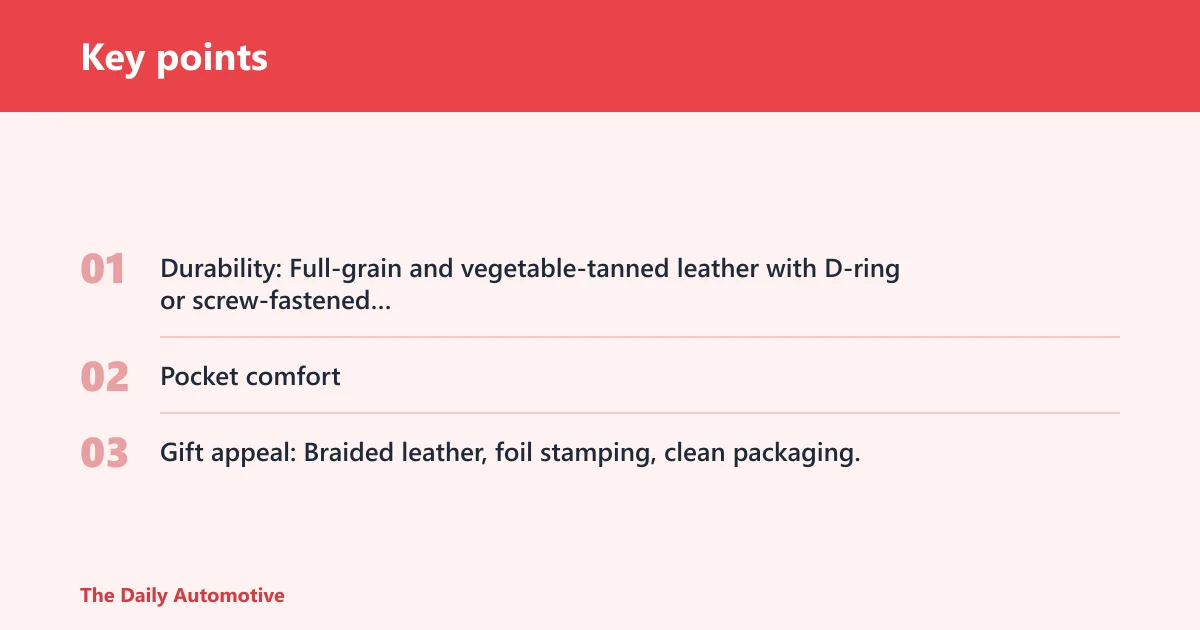
Simple rubric
- Durability: Full-grain and vegetable-tanned leather with D-ring or screw-fastened hardware, even stitching, and polished edges rate best for daily carry.
- Pocket comfort: Top-grain leather with smooth edges and a flat D-ring usually feels easier in a jeans pocket than bulky clasps or sharp-edged hardware.
- Gift appeal: Braided leather, foil stamping, clean packaging, and matched hardware finishes tend to read as more polished at first glance.
What makes a leather car keychain durable?
Durability comes from the parts that carry stress, not from the marketing copy. A leather car keychain lasts longer when the attachment hardware is secure, the stitches are evenly spaced, the thread resists abrasion, and the edges are smooth enough to avoid fraying in a pocket.
Daily carry exposes weak points fast. The hole around the ring can stretch, a clip can loosen, and a rough cut edge can start shedding fibers long before the leather body itself fails.
Say your keychain rides beside a metal house key and a remote fob in the same pocket. If the edge finish is rough, the leather can start scuffing at the fold line first, then the thread at the attachment point follows.
Is a D-ring better than a split ring for car keys?
For many car-key setups, yes. A D-ring is usually easier to clip onto a belt loop, bag hook, or secondary ring, while a split ring needs more fingertip effort and can be slower to open and close. That makes the D-ring a better default for frequent attachment changes.
Split rings still make sense when you want the smallest, most familiar setup and do not plan to swap keys often. They can be secure, but the ring tension and repeated scraping against the key can wear the finish around the attachment point faster.
Suppose you clip your keys on and off a work bag twice a day. A D-ring with a solid closure is often the lower-friction choice, while a split ring can feel fiddlier when you are in a hurry.
Custom leather keychain: best for gifts
Custom leather keychains are the best fit when the purchase is really about presentation, branding, or a name-based gift. On the supplied product data, customization options across the market include laser engraving, debossing, foil stamping, and UV printing, and some suppliers also support changes to plating color, thickness, dimensions, and size.
For gift orders, personalization should not come at the expense of build quality. Check the available personalization area, the hardware finish, and whether the edge work looks clean enough to hold up after the gift is opened and used.
The drawback is that customization can hide weak finishing if you only look at the front face. A good logo does not fix loose stitching or a rough edge.
What to look for in custom work
Laser engraving gives a crisp look and usually works well on clean leather surfaces. Debossing presses the design into the material for a subtler effect, while foil stamping adds shine that suits formal gifts. UV printing can add color, but it should be paired with solid edge finishing so the whole piece feels complete.
What should you look for in stitching and hardware?
Look for even stitch density, reinforced ends, and thread that matches the leather without looking like decorative filler. Tight, consistent stitches help hold the stress at the key attachment point, while loose or uneven stitches often show up first as edge lift or seam gap.
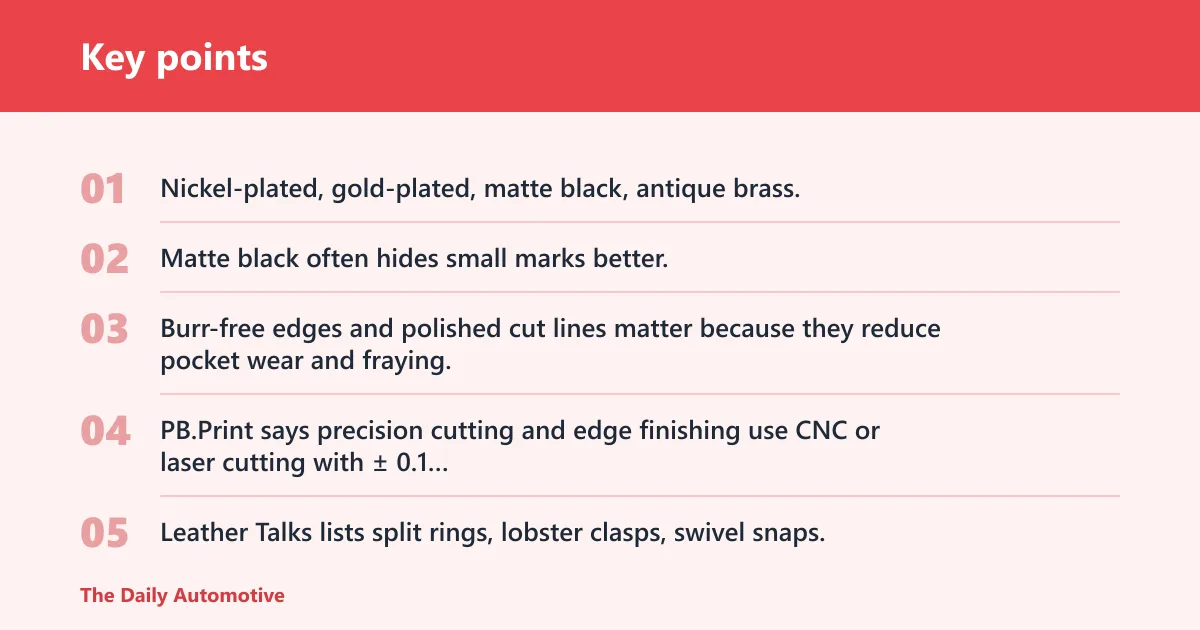
Hardware deserves the same attention. Nickel-plated, gold-plated, matte black, antique brass, and rose gold each age differently, and finish choice affects both scratch resistance and how quickly scuffs show. Matte black often hides small marks better, while plated finishes can show wear at the high-contact edges sooner.
Burr-free edges and polished cut lines matter because they reduce pocket wear and fraying. PB.Print says precision cutting and edge finishing use CNC or laser cutting with ± 0.1 mm tolerance, which is the kind of detail buyers should ask about when they want a neater edge profile.
Attachment styles that matter most
Leather Talks lists split rings, lobster clasps, swivel snaps, and D-rings as common styles. D-rings are the best daily-driver default for most car keys. Lobster clasps and swivel snaps are useful when you want faster detachment from a bag or loop, while split rings are the familiar minimal option.
For load-bearing durability, the weak point is usually the moving part, not the leather body. A clasp that loosens or a ring that loses tension can become the first failure mode.
Which one should you buy?
Choose the D-ring leather keychain if you want the easiest daily attachment and removal, especially for a commuter key set that is clipped on and off often. Choose a split-ring or simple clasp setup if you want the smallest, most familiar carry and do not mind a little extra effort when attaching keys.
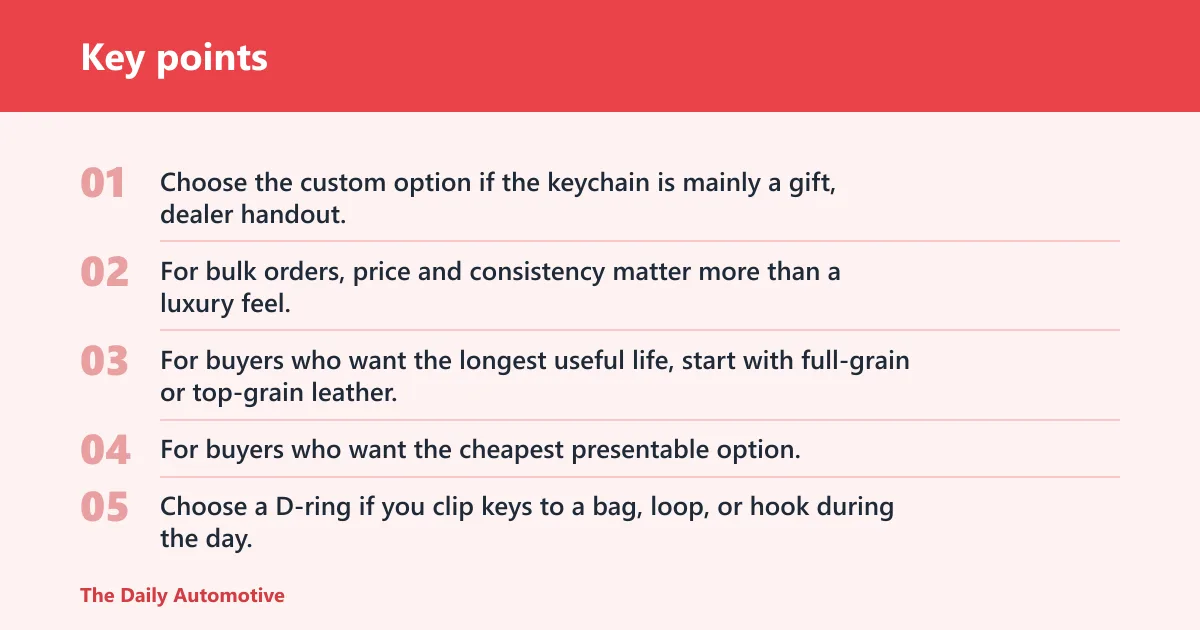
Choose the custom option if the keychain is mainly a gift, dealer handout, or branded item. For bulk orders, price and consistency matter more than a luxury feel, so PU or genuine leather can make sense when the goal is a clean, repeatable look rather than the best aging.
For buyers who want the longest useful life, start with full-grain or top-grain leather, ask about stitch density and edge finishing, and prefer a D-ring or screw-fastened clasp over a flimsy spring clip. For buyers who want the cheapest presentable option, a simple PU or genuine leather piece can work if the edges are clean and the hardware is not too flimsy.
Choose D-ring if…
Choose a D-ring if you clip keys to a bag, loop, or hook during the day. Choose it if you want fast on-off use, fewer fumbling moments, and a setup that feels solid without adding much bulk. Choose it again if the listing shows good edge finishing and tight stitching.
Choose split ring if…
Choose a split ring if you want a familiar key-fob feel and minimal hardware. Choose it if you rarely remove keys from the keychain and want the simplest possible carry. Choose it if the listing does not offer a D-ring, but the ring itself looks thick enough to resist quick tension loss.
Choose custom if…
Choose custom engraving, debossing, foil stamping, or UV printing if the keychain is meant to be given, branded, or matched to a set. Choose custom work if you care about the front face and packaging, but still confirm the leather type, hardware finish, and edge work before ordering.
How do you clean and condition it?
Wipe the keychain with a dry cloth after use, especially if it picks up hand oils or road dust. Avoid prolonged sun exposure and moisture, because both can change the finish and shorten the clean look of the leather and hardware.
Condition every 6–12 months, and follow the maker’s care instructions for the leather type. Vegetable-tanned leather may darken and age differently from top-grain or PU, so the care routine should match the material rather than using one generic method for all of them.
A common first-timer mistake is leaving a leather keychain in a hot glove box for weeks, then conditioning it right after. Heat and moisture do different kinds of damage, so prevention matters more than rescue.
Frequently asked questions
What stitching is best on a leather keychain?
Look for even stitch density, straight lines, and reinforced ends near the hardware. Tight machine stitching can work well if the thread is durable and the seam does not wander. Decorative stitching is less important than clean, consistent construction that does not gap at the stress point.
Which hardware finish lasts longest on daily-use keychains?
There is no universal winner, but matte black often hides scuffs better, while nickel-plated and antique brass are common durable choices. The finish that lasts longest is the one that resists scratching and loosening in your specific use case. Plating quality and contact wear matter more than color alone.
Should I choose genuine leather or full-grain leather?
Choose full-grain if you want the most predictable long-term wear and natural patina. Choose genuine leather only if price matters more and you are fine with a broader quality range. Full-grain usually gives you a clearer picture of how the keychain will age under daily use.
How do I clean and condition a leather keychain?
Use a dry cloth for routine cleaning, keep it out of prolonged sun, and avoid moisture where possible. Condition every 6–12 months, following the maker’s instructions for that leather type. Do not soak it or use harsh cleaners that can damage the finish or hardware plating.
Products related to this article
Sponsored / affiliate links. As an Amazon Associate I earn from qualifying purchases. I may earn additional commission from eligible campaigns.