Lightning Bolt Decals for Cars: Sizes, Colors & Buying Guide
For lightning bolt decals, a common rule of thumb is about 6–10 inches for mirrors, fenders, or glass, and about 12–24 inches for doors, quarters, or hoods; use matte for a lower-key paint-matched look, gloss for stronger contrast, and cast vinyl if easier removal is desired. Pick the wrong size or finish, and the decal can look awkward, fade fast, or leave residue when you remove it. This guide covers size, color, finish, placement, durability, and removal so you can buy the right bolt for your car.
Quick picks by need
The safest top pick is the 12-inch black AK Wall Art decal for bold side-panel visibility, because it gives you a larger format without forcing a custom order. Smaller smooth-surface decals fit glass, while reflective and holographic options solve different jobs: night visibility versus styling that stands out in daylight.
- Best for rear quarter glass: SoCoolDesign 4 x 8 in silver decal, because that shape fits long glass better than a square sticker.
- Best for small accents: OLIKIUS 2-inch pack of six, because tiny bolts suit trim, phones, helmets, and other gear.
- Best for night visibility: The reflective 4-inch pack of nine, because reflective vinyl improves night visibility and works best on clean surfaces.
- Best for a louder decorative look: The holographic one pair, because the color shift draws attention on smooth panels and glass.
| Need | Best fit | Why it fits | Main tradeoff |
|---|---|---|---|
| Rear quarter glass | 4 x 8 in or similar long shape | Matches narrow glass better than a small square | Can feel oversized on compact hatch glass |
| Small accents | 2-inch decals | Works on trim, gear, and tight spaces | Low visual impact from a distance |
| Night visibility | Reflective vinyl | Reflects headlights and stands out after dark | Looks less subtle in daylight |
| Decorative styling | Holographic vinyl | Creates a shifting color effect on smooth surfaces | May show wear sooner on rough panels |
What size lightning bolt decal should you get?
Choose size by placement first, not by the picture on the listing. Small bolts suit trim and accessories, medium bolts fit doors and body panels, and longer decals work better on windows and banner areas. A single-size pack is fine when you know the target surface; multi-size packs help when you want matching bolts in more than one spot.
Small sizes for trim and accessories
Small decals are the best match for mirror caps, phone cases, helmets, toolboxes, key covers, and other gear. The 2-inch pack of six is a clear example of this category, and it makes sense when you want several placement options without committing to one large graphic.
Very small decals also help when the surface is curved or interrupted by trim edges. A tiny bolt is easier to align, and it is less likely to dominate the body line.
Medium sizes for doors and body panels
Medium decals are the most useful choice for doors, front fenders, and lower body panels. The 5-inch sticker pack and the 4 x 8 in silver decal sit in this range, and both are more practical than a tiny accent when you want the bolt to read clearly from a few steps away.
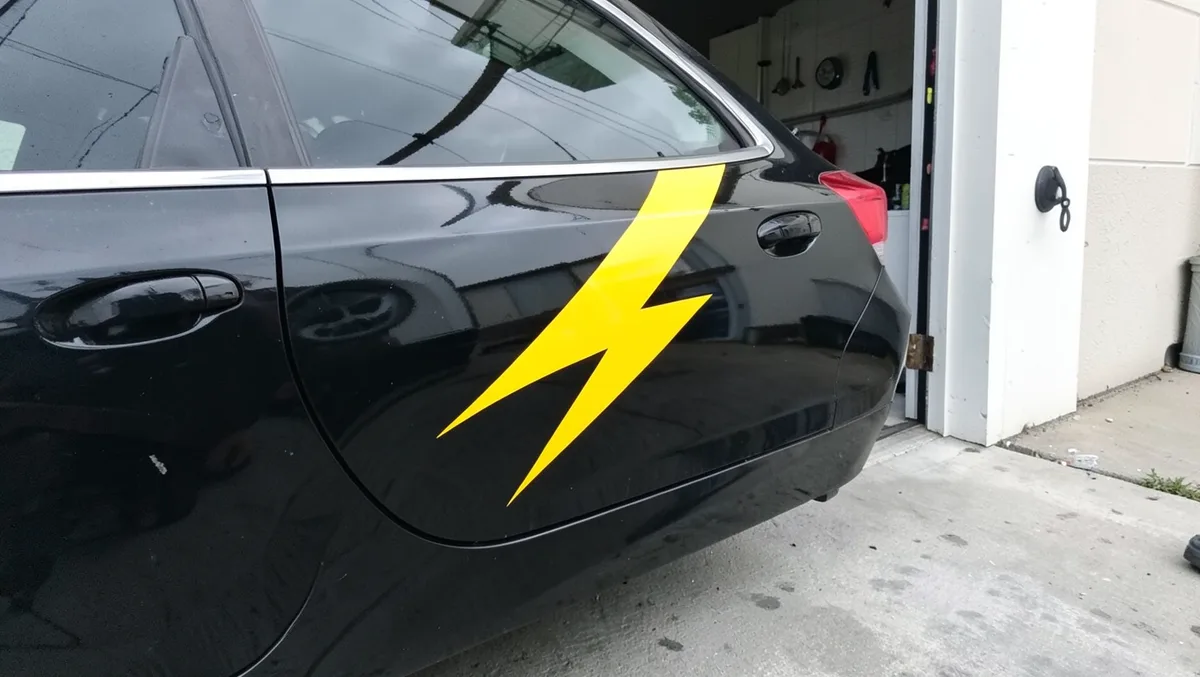
Say your car has a dark door panel and you want the bolt to read as a deliberate accent instead of a faint detail. A medium decal gives enough visual weight without turning the panel into a billboard.
Larger sizes for windows and banner areas
Larger decals fit rear quarter glass, side windows, and windshield banner areas better than narrow accent pieces. The 12-inch black decal is built for that larger visual field, and longer shapes are easier to place when the surface itself is long and flat.
Use larger sizes when you want the shape to stay legible at speed or across a parking lot. Keep them out of places where they interfere with the driver’s view, airbag zones, or local visibility rules.
Single decal or multi-pack: which fits your use
A single decal makes sense when you want one exact placement and no extras. A multi-pack is better when you want matching bolts on both sides of the car, or when you expect one placement to be tricky and want a spare.
The reflective option comes in a pack of nine, which favors multiple placements or shared use across vehicles and gear. The Inner Strength option includes two sizes, which helps if you want one large placement and one smaller accent without mixing products.
What color and finish works best on your car?
Choose color by contrast and body color, then choose finish by the look you want. Light paint usually needs a darker or stronger contrast color. Dark paint often benefits from white, silver, reflective, or holographic finishes. Metallic paint can work with either subtle matte contrast or a color-shift decal when the goal is a more dramatic effect.
Light paint versus dark paint
On light paint, black or darker bolt decals usually read best because they stand out without needing a huge size. On dark paint, white, silver, or reflective finishes are easier to see and usually look more intentional than a dark decal that disappears into the body color.
Matte white on smooth glass is a straightforward choice when the goal is clean contrast rather than shine. Black vinyl works well when you want the bolt to look like part of the panel rather than an add-on.
Metallic paint and color-shift finishes
Metallic paint can handle bolder finishes because the base color already has movement. A holographic decal can work well here if the goal is a visual accent that changes as light moves across the car. It is best on smooth surfaces, where the finish can read cleanly.
For a subtler result, a matte or solid-color vinyl decal usually looks more controlled on metallic paint than a highly reflective or color-shifting film.
Reflective vinyl for night visibility
Reflective vinyl is the better choice when night visibility matters. It reflects headlights and helps the bolt stand out after dark, which makes it a practical option for safety-oriented decals, trailer markings, or any placement where visibility matters more than style.
The reflective option in this set uses 4-inch decals and comes in a pack of nine. That format fits repeat placements well, but reflective film is most effective on clean surfaces and can look more functional than decorative.
Holographic vinyl for a louder look
Holographic vinyl is the better choice when the goal is visual impact. It shifts color in the light, which makes it more eye-catching than a plain solid decal. The holographic product here measures 1.57 inches by 7.87 inches and is sold as one pair.
That look works best on smooth body panels, glass, or other flat surfaces. It may show wear more clearly on rough plastic or textured trim, so it is not the first choice for every car part.
Where should you place the decal?
Place the decal where the surface is smooth, visible, and easy to clean. Rear quarter glass, side windows, bumper trim, and lower body panels are the common choices. Windshield banner areas can work too, but they need extra care because visibility rules matter there more than anywhere else.
Rear quarter glass and side windows
Rear quarter glass is one of the cleanest placements for a lightning bolt decal because the shape of the glass often matches a long, narrow sticker. Side windows also work well when the decal is sized correctly and the glass is clean and dry.
For a glass placement, vinyl is the default choice because it adheres well to smooth surfaces and can be removed with minimal residue when the adhesive type allows it. Clean glass is not optional here; adhesion drops fast on dusty or damp surfaces.
Bumper trim and lower body panels
Bumper trim and lower panels suit smaller or medium decals, especially on cars that have a strong horizontal line. These areas can handle a subtle bolt on dark paint or a reflective accent on a safety-oriented build.
Keep the decal off textured plastic unless the listing specifically says it fits textured surfaces. Smooth metal and glass are safer bets than rough cladding.
Windshield banner area and visibility limits
The windshield banner area is best reserved for decals that do not block the driver’s view. Larger lightning bolts can fit there visually, but the placement must stay within local laws and should not enter airbag zones or the area that affects forward visibility.
Suppose a bolt is sized for the banner area but drops too low once applied. That is a removal job, not a compromise. Reposition it before the adhesive fully sets.
Glass, metal, and plastic compatibility
Vinyl decals are generally suitable for glass, metal, and some plastics when the surface is clean, dry, and smooth. That broad fitment is why vinyl is the default recommendation for general car use, windows, helmets, and similar hard surfaces.
Printed or cut vinyl both can work, but the surface matters more than the artwork. Textured plastics, dirty glass, and waxy panels reduce sticking power fast.
How durable should the vinyl be?
For general car use, weatherproof outdoor vinyl is the better baseline because it is built for sun, rain, and repeated exposure. Durability depends less on the graphic and more on the adhesive type, the surface prep, and how often the car sees car washes, road salt, or direct sun.
Weatherproof outdoor vinyl for general use
Weatherproof vinyl is the safest starting point for outdoor use because it is meant to stay attached on a clean, dry surface. That matters on cars that live outside, see weather swings, or get washed often.
The SoCoolDesign decal uses Oracal 651 vinyl and is described as suited for indoor and outdoor use. The AK Wall Art decal is listed as outdoor-grade vinyl for flat, non-textured surfaces, which is the right sort of note to look for when you want a door or glass decal that holds up outside.
Sun, car washes, salt, and repeat cleaning
Sun exposure is the first thing that wears down a decal’s appearance. Repeated washing can also stress edges, especially if brushes catch a corner. Winter road salt adds another layer of abuse, since salt and grime work at the edges and around any lifted area.
In rough conditions, reflective and holographic finishes can show wear faster than a plain solid vinyl because their surface effect is easier to disturb. That does not make them bad choices; it just means they are better when appearance matters more than long-term abuse resistance.
Permanent versus removable adhesive
Removable adhesive is the safer pick when you expect to change the look later, move the decal, or sell the car. Permanent adhesive makes more sense for long-term placement, but it can leave more residue and demand more care during removal.
For buyers who change graphics often, a more removable cast vinyl option is usually easier to live with than a harder-set adhesive. Check the listing if you want a clear statement about removable versus permanent backing.
Printed decals versus contour-cut shapes
Contour-cut decals follow the bolt outline and usually look cleaner on a car than a sticker with a large clear or printed background. Printed decals can work too, but the extra background can make the piece feel larger than the actual design.
That difference matters on small placements, where extra background can crowd the panel. If you want the bolt to look crisp against paint or glass, contour-cut is usually the cleaner buy.
Lightning bolt decal selection matrix
This matrix turns the common choices into one decision page. Read across each row: placement first, then size, then finish, then background color. The last two columns help you judge durability risk and how difficult removal is likely to be if you later change the design.
| Placement | Recommended size range | Best finish | Best background color | Durability risk | Removal difficulty |
|---|---|---|---|---|---|
| Rear quarter glass | 4 to 8 inches | Reflective or matte | White on dark glass, black on light trim | Low to moderate, if the glass stays clean | Low to moderate |
| Windshield banner area | 12 to 24 inches | Matte or reflective, if legal | High-contrast color that remains readable | Moderate, because sun and wiper area wear faster | Moderate |
| Bumper trim | 2 to 5 inches | Matte or solid color | White on dark trim, black on silver trim | Moderate to high on textured plastic | Moderate |
| Doors or quarter panels | 5 to 12 inches | Gloss for contrast, matte for subtle styling | Black on light paint, white or silver on dark paint | Low on smooth paint, higher near wash edges | Low to moderate |
| Small gear or accessories | 2 inches | Matte, printed, or holographic | Any strong contrast color | Low on hard indoor surfaces | Low |
How to read the matrix
Choose the placement first, then reject any size that feels too small to read or too large to sit naturally on the panel. If the surface is exposed to sun, repeated washing, or salt, move toward weatherproof vinyl and a simpler finish. If you want the bolt to disappear into the body color, choose matte. If you want it to pop, choose gloss, reflective, or holographic depending on the goal.
How do you apply it without bubbles?
Start with a clean, dry, smooth surface and work slowly. Most bubbles come from rushed placement, not from the decal itself. A squeegee or even a firm card helps press the vinyl down in controlled passes so air can escape before the adhesive locks in.
Prep the surface first
Wash the area, dry it fully, and remove wax, dust, and road film. Vinyl sticks best to a clean surface, and moisture under the decal is a common reason for failed adhesion. If the panel is textured or oily, choose a different placement.
- Clean the target area with a safe cleaner.
- Dry it completely.
- Position the decal without removing the backing yet.
- Check alignment from a few steps back.
- Press it down only after the placement looks right.
Use a squeegee or card
Apply pressure from the center outward with a squeegee, credit card, or similar flat tool wrapped in a soft cloth if needed. That motion pushes trapped air toward the edges instead of locking it in under the vinyl.
A common first-timer mistake is pressing one corner down first and then stretching across the panel. That traps air and makes the decal harder to smooth out later.
Align before you press
Dry-fit the decal before you commit. Hold it in position, check it against the panel line, then lower it slowly. If the bolt is slanted on a straight door seam, the whole car can look off even if the decal itself is fine.
For a pair of bolts, check symmetry before removing the backing. Matching left and right placement is easier when the first side is measured from a body line instead of guessed by eye.
When to stop and reapply
If the decal lands crooked or catches a crease, stop before it sets fully. Gentle heat can help with repositioning in some cases, but once the adhesive grabs hard, the safer path is often removal and a fresh application rather than forcing a bad fit.
Mistakes to avoid
The most expensive mistake is choosing size without thinking about the surface. A big bolt on a small rear quarter window can look crowded, while a tiny accent on a long door panel can look accidental. Finish and color matter just as much as size, and both should match the paint and the use case.
- Choosing a size that fights the panel shape.
- Ignoring contrast between the decal and the paint color.
- Putting a decal in a visibility area without checking local laws.
- Using strong removal chemicals before confirming the adhesive type.
- Applying vinyl to a dirty, damp, or textured surface.
Say your car has dark paint and you buy a black decal in a very small size. The bolt may vanish except in bright sun, which defeats the purpose of choosing a visible graphic in the first place.
Our picks by need
Best for bold visibility: AK Wall Art lightning bolt

- Large 12-inch size for bold visibility
- Outdoor-grade vinyl for flat, non-textured surfaces
- Application instructions and transfer tape included
The 12-inch black AK Wall Art decal is the clearest pick when you want a larger, high-visibility bolt on flat paint or glass. Its outdoor-grade vinyl and included transfer tape suit straightforward placement, and the size works well on doors, quarters, or a larger side window.
The drawback is fitment. A 12-inch bolt is too large for many trim pieces and curved spots, so it rewards careful measuring before application. It is also listed for flat, non-textured surfaces, which limits where it belongs.
Best for smooth glass accents: Decaltor lightning bolt

- Matte white vinyl with pointed lightning design
- Sized for windows, laptops, and similar smooth surfaces
- Fade-resistant with no printed background panel
The 5-inch matte white Decaltor decal is the cleanest small-to-medium choice for windows, laptops, and similar smooth surfaces. Matte white gives strong contrast without the shine of a gloss graphic, and the pointed bolt shape reads clearly on glass.
The drawback is scale. Five inches is small for a door or hood, so it is better for accent work than for a full side-panel statement. It also leans decorative rather than safety-focused.
Best for multiple small placements: OLIKIUS lightning bolt pack

- Pack of six stickers for multiple uses
- Vinyl material with self-adhesive backing
- Works on metal surfaces
The 2-inch OLIKIUS pack of six is the most flexible option for small accents on car phone mounts, helmets, bumpers, or other compact surfaces. Because it includes multiple stickers, it is the easiest choice when you want to experiment with placement or mirror the look across more than one item.
The drawback is visibility. At 2 inches, it is not meant to carry a large panel by itself, and it will disappear at a distance on busy bodywork. It also makes more sense on metal than on rough or textured plastic.
Best for silver contrast and outdoor use: SoCoolDesign lightning bolt

- Made with Oracal 651 vinyl
- Designed for indoor and outdoor use
- Includes easy-to-follow application instructions
The SoCoolDesign 4 x 8 in silver decal sits in the useful middle ground between accent and statement piece. Its Oracal 651 vinyl and outdoor-ready listing make it a solid candidate for side glass, a narrow door section, or another smooth panel where silver will contrast with darker paint.
The drawback is that silver will not stand out as much on light metallic paint, and the 4 x 8 in shape can feel stretched on tiny trim. It is best when the placement has enough length to support the design.
How to choose
Start with placement, then size, then finish. If the decal is for glass, long side windows, or a banner area, choose a longer shape and check visibility rules first. If it is for trim or gear, use a small decal that will not overpower the surface. If the paint is dark, choose white, silver, reflective, or holographic for contrast; if the paint is light, black usually gives the cleanest read.
For durability, default to weatherproof vinyl on clean, dry, smooth surfaces. Reflective vinyl is the better buy when night visibility matters. Holographic vinyl is the better buy when style matters more than utility. If you want easier removal later, look for removable or cast vinyl rather than assuming every decal comes off the same way.
Removal usually starts with gentle solvents, citrus oil cleanup, isopropyl alcohol cleanup, or heat-assisted lifting, depending on the adhesive. Use the least aggressive method that works, and keep the surface safe for the paint underneath.
Frequently asked questions
What size lightning bolt decal should I get for my car?
For mirrors, fenders, or glass, 6–10 inches is a practical range. For doors, quarters, or hoods, 12–24 inches gives the bolt enough visual weight to read from a distance. Smaller sizes are better for trim and accessories, while larger sizes suit windows and banner areas.
Are reflective lightning bolt decals better for night visibility?
Yes. Reflective vinyl improves night visibility because it reflects headlights, which makes the bolt easier to notice after dark. It is best on clean surfaces and works especially well for safety-oriented decals or placements where being seen matters more than a subtle daytime look.
What color lightning bolt decal looks best on my car?
Use contrast as the rule. Black usually works best on light paint, while white or silver often works best on dark paint. Metallic paint can handle reflective or holographic finishes if you want more movement, but matte finishes are better when you want a quieter look.
Will lightning bolt decals damage car paint when removed?
Usually not, if the vinyl was applied correctly and removed carefully. Clean removal often uses gentle solvents, citrus oil cleanup, isopropyl alcohol cleanup, or heat-assisted peeling. Problems are more likely when the decal has baked in from heat, been left on too long, or was applied over damaged paint.
Can I use lightning bolt decals on windows or only on body panels?
You can use them on both, as long as the surface is smooth, clean, and dry. Glass is often an easier fit than textured plastic, and larger decals often suit windows better. Just keep windshield placement within local laws and avoid any spot that blocks the driver’s view.
How do I apply a lightning bolt decal without bubbles?
Clean and dry the surface first, then align the decal before you press it down. Use a squeegee or card to push air outward in slow passes. If the decal lands crooked or starts trapping air, stop and reset it before the adhesive fully bonds.
Are holographic lightning bolt decals legal on cars?
Legal use depends on placement and local rules, not on the finish alone. Holographic vinyl is decorative, but it can still cause problems if it is placed where it blocks visibility, reflects light in a distracting way, or conflicts with windshield rules. Check local laws before placing it near forward view areas.
How long do vinyl lightning bolt decals last outdoors?
Outdoor life depends on the vinyl type, surface prep, sun exposure, washing frequency, and road salt. Weatherproof vinyl is the safer baseline for outdoor use, but repeated heat, brushing from car washes, and winter grime can shorten its good-looking life well before the adhesive actually fails.
Products related to this article
Sponsored / affiliate links. As an Amazon Associate I earn from qualifying purchases. I may earn additional commission from eligible campaigns.