Exterior Car Lights: Rock Lights vs. Underglow Kits Compared
Choose Rock Lights if you need trail visibility, wheel-well illumination, and stronger weather resistance; choose Underglow Kits if you want a low-mounted show effect and can handle stricter road-law risk. Pick the wrong one and you can waste money on a kit that is dim where you need light, hard to wire, or illegal on public roads. This guide compares legality, install effort, durability, and the use cases that matter for trucks, SUVs, Jeeps, and show builds.
| Decision factor | Rock Lights | Underglow Kits | Winner |
|---|---|---|---|
| Trail visibility | Sealed pods aimed at the ground near tires and obstacles | Continuous strips or bars that wash the vehicle’s outline | Rock Lights |
| Road-use risk | Lower when used as white or amber work lighting and kept off-road | Higher when used with bright colors, flash modes, or on public roads | Rock Lights |
| Wet-climate durability | Individual sealed pods are easier to isolate if one fails | Strip adhesives, connectors, and long exposed runs need more care | Rock Lights |
| Show effect | RGB versions can work, but the pattern is localized | RGBIC, app control, and music-sync modes favor show lighting | Underglow Kits |
| DIY difficulty | More mounting points, but usually shorter visible runs | Longer routing, more strip alignment, and more adhesive dependence | Rock Lights |
Rock lights vs. underglow: the core trade-off
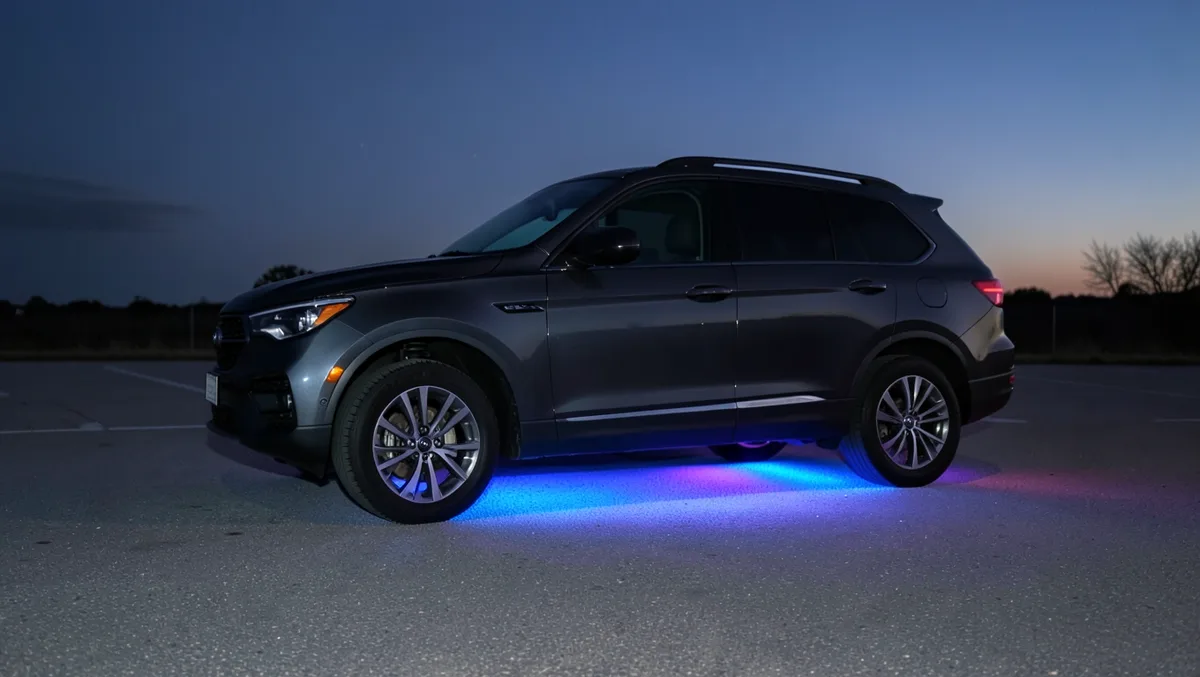
Rock Lights are sealed pods mounted in wheel wells, on frame rails, or under the vehicle so the light lands where tires meet rocks, ruts, and washouts. Underglow Kits use strips or bars along rocker panels or the chassis to trace the body line. Rock lights are ground-lighting tools; underglow is a silhouette-lighting tool.
That placement changes what you can actually see at night. Rock lights throw useful light into the pocket beside the tire, while underglow spreads attention across the vehicle’s outline and the pavement below it.
Where each system mounts
Rock lights usually sit high enough to stay protected but low enough to light the obstacle zone. The pods are compact and can be aimed toward the ground, which is why they are common on lifted trucks and trail rigs.
Underglow kits sit lower and longer. That helps create a continuous band of light, but it also puts more of the system in the path of spray, debris, and road grime.
How usable light differs on the ground
Rock lights are usually the better tool for ground detail because they put light where the driver needs to place a tire. Underglow can make the underside of the vehicle visible, but it usually does less to reveal rocks, edges, and holes at the tire contact patch.
Why rock lights help with trail detail
Wheellightexpress describes rock lights as aimed at the ground where tires meet obstacles, which matches their job well. A white or amber pod near each wheel can make it easier to read terrain texture, see a line around a rut, and spot loose rock before you commit the tire.
Say your Jeep is creeping through a muddy cut at low speed. White pods in the wheel wells will show the edge of the rut and the front tire’s placement more directly than a strip mounted along the rocker panel.
Why underglow is usually a silhouette system
The same source says underglow wraps the whole chassis in a steady glow. That is useful when the goal is presence, not task lighting. It can help the vehicle stand out in a lot or at a meet, but it is not the cleanest way to read obstacles under the tire path.
Notorious Auto Protection also frames underglow as a common appearance choice rather than a trail-visibility choice. That difference matters when you are deciding whether the light should help you drive or mainly define the vehicle’s shape.
Comparison matrix: where each kit fits best
The better choice changes with the use case. A lifted truck on dirt needs tire placement light first. A street sedan or show SUV needs a cleaner outline, app control, and color effects more often than ground detail.
| Use case | Rock Lights | Underglow Kits | Recommended setup |
|---|---|---|---|
| Night wheeling | Best fit for obstacle visibility | Poor fit unless the goal is display lighting | Rock Lights |
| Daily driving | Good only if used carefully and kept within local rules | Better for a controlled visual effect, but road-law risk is higher | Rock Lights, white or amber |
| Show builds | Useful as an accent, especially with RGB | Best fit for a clean silhouette and color effects | Underglow Kits |
| Wet-climate ownership | Better long-term bet if wiring is protected well | More exposed adhesive and connector maintenance | Rock Lights |
| DIY installation difficulty | Moderate | Moderate to harder, depending on strip length and routing | Rock Lights |
Night wheeling
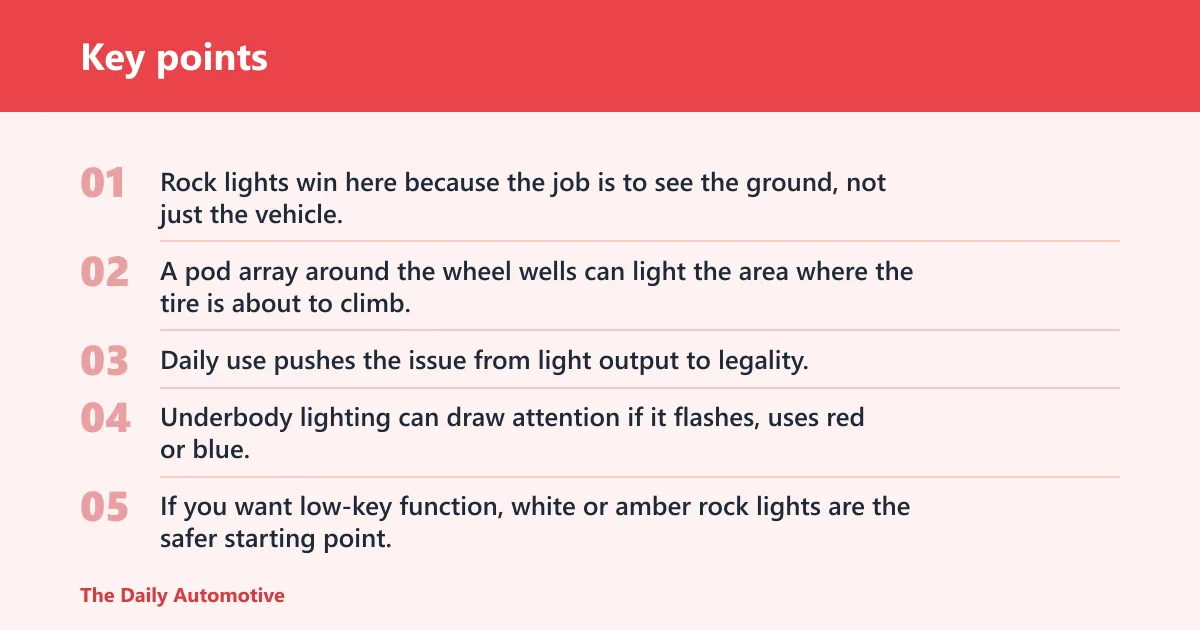
Rock lights win here because the job is to see the ground, not just the vehicle. A pod array around the wheel wells can light the area where the tire is about to climb, which helps with line choice and wheel placement.
Daily driving
Daily use pushes the issue from light output to legality. Underbody lighting can draw attention if it flashes, uses red or blue, or stays on while driving on public roads. If you want low-key function, white or amber rock lights are the safer starting point.
Show builds
Underglow kits are built for the look of a continuous glow, and RGBIC effects make that easier to control. The underglow kit is described as RGBIC and supports a DC 12-24V power supply; it is also described as using a two-line design. That kind of feature set is aimed at visual control, not trail duty.
The Yielinth app-controlled kit lists 29 preset modes, and the YUGUANG kit advertises more than 16 million colors with a 150-degree illumination angle. Those details point to show-oriented use, especially when app control and scene changes matter more than hard-wearing trail output.
Wet-climate ownership
Waterproof ratings matter more than most buyers expect. Nilight’s kit is listed with IP68 waterproofing, while OPT7 Aura has an IP67 waterproof rating. Those claims matter for splash, mud, and winter road spray, but they do not erase the need to seal connectors and protect adhesive from constant moisture.
Rock lights usually have an edge because each pod is self-contained. If one pod or lead fails, you are often dealing with a smaller repair than you would with a long strip that has to stay stuck, sealed, and clean at every section.
DIY installation difficulty
Rock lights usually ask for more individual mounting decisions, but they can be simpler to live with after installation. Underglow often means longer cable routing, more surface prep, more chances for adhesive failure, and more strain on exposed connectors.
Suppose a truck owner chooses a four-strip underglow kit and mounts it in winter. Road salt and slush can work into the edges of the strip or the connectors, which means the install quality matters as much as the waterproof rating on the box.
What to know about legality and road use
Public-road rules vary by state, which is where many buyers can run into trouble. The issue is usually not just whether the lights exist, but how they behave: color, flash patterns, whether they are visible from outside the vehicle, and whether they are used while driving.
Color and flash patterns that create problems
Red and blue output can be a problem because those colors are commonly reserved for emergency or enforcement-style lighting. Flash modes and sound-active effects can also create trouble if the lights are visible on the road or distract other drivers.
App control and RF remote control make operation easy, but convenience does not change the law. A kit with music sync or scene modes can still be the wrong choice for public roads if local rules ban animated lighting while driving.
Why public-road rules vary by state
Some states are stricter about underbody lighting than others, and some care about whether the lights are on only when parked. That is why the safest approach is to check your state code and local enforcement rules before you wire the kit to a switch you plan to use on-road.
Waterproof ratings, wiring, and durability
IP67 and IP68 are the waterproof numbers buyers will see most often for exposed underbody lights. IP67 is commonly used on some underglow kits, while IP68 is a higher water-resistance claim that can matter if the vehicle sees heavy spray, puddles, mud, or repeated washdowns.
App control, RF remotes, and music-sync modes
Underglow kits more often include app control, Bluetooth operation, RF remote control, RGBIC lighting, and sound-active or music sync modes. Those features are helpful when the goal is color changes, scene selection, and synchronized effects, not ground detail.
Rock lights can also come in RGB variants for show use, but many buyers still prefer white or amber because that keeps the light useful when the trail gets rough. For mixed use, a white pod set up front and an RGB underglow kit lower on the chassis can separate function from show duty.
Adhesive failure, corrosion, and connector protection
Strip-based systems are more exposed to adhesive failure because the mounting surface has to stay clean, flat, and dry. Connector corrosion is another long-term pain point if the harness sits in spray or gets packed with grit after winter driving.
Protective loom, secure grounding, and sealed connectors matter on both systems, but underglow usually gives moisture more places to attack. Individual pods are not immune, yet they are less dependent on a long adhesive run staying perfect.
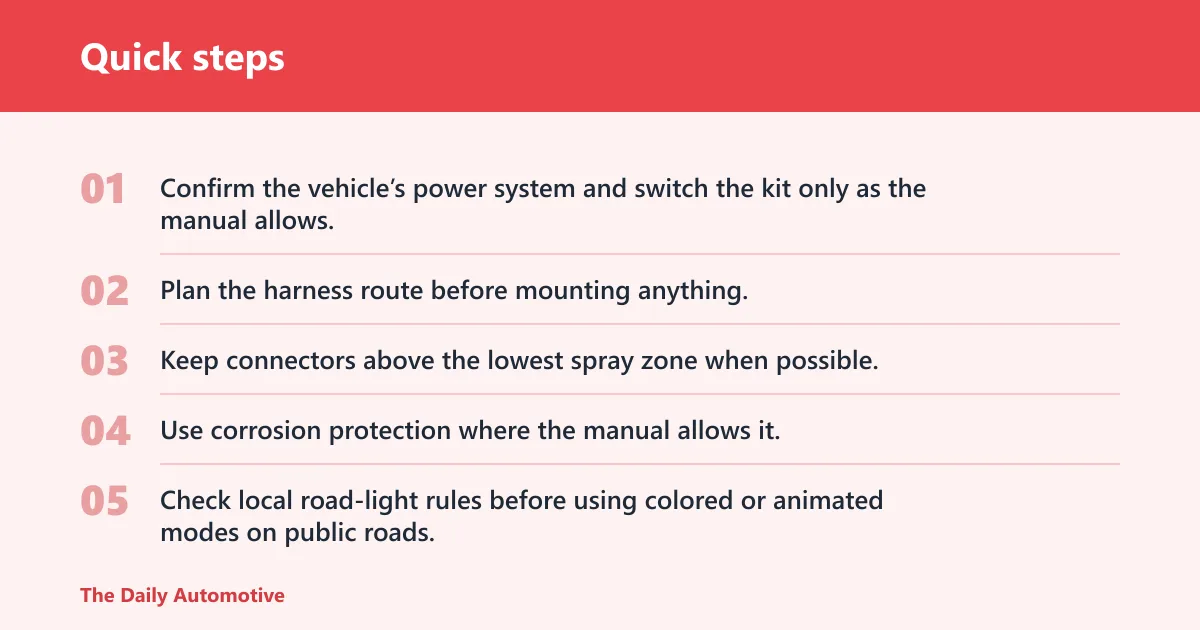
- Confirm the vehicle’s power system and switch the kit only as the manual allows.
- Plan the harness route before mounting anything.
- Keep connectors above the lowest spray zone when possible.
- Use corrosion protection where the manual allows it.
- Check local road-light rules before using colored or animated modes on public roads.
Choose Rock Lights if… / Choose Underglow Kits if…
Choose Rock Lights if you drive a lifted truck, Jeep, or trail rig and want light aimed at the ground where the tires work. They also make more sense if you want white or amber illumination, lower road-law risk, and a setup that is easier to justify in wet or muddy conditions.
Choose Underglow Kits if the main goal is a clean silhouette, RGB color control, app or RF remote operation, and music-sync effects for a show build. They fit best when the vehicle spends more time parked for display than crawling over obstacles, and when you are willing to manage the legal limits carefully.
A mixed setup makes sense when the vehicle has two jobs. White rock lights can handle trail or work lighting, while underglow handles show duty when the vehicle is parked. That split is often the smartest answer for owners who want both visibility and presentation without forcing one kit to do everything.


Frequently asked questions
Are rock lights better than underglow for off-road use?
Yes, for most off-road buyers. Rock lights are aimed at the ground where tires meet obstacles, so they give you more usable detail at the wheel path. Underglow is usually better for appearance than for reading terrain, which is why it is a weaker fit for trail duty.
Can underglow kits be used on trucks and SUVs?
Yes. Trucks and SUVs often have enough underbody space for strips or bars along the rocker panels or chassis. The bigger issue is not fitment but exposure: lift height, road spray, and connector protection can make the install more demanding than on a low car.
What is the difference between rock lights and underglow?
Rock lights are sealed pods mounted in wheel wells or under the vehicle to light the ground near the tires. Underglow kits use strips or bars along the chassis or rocker panels to create a continuous glow around the vehicle’s outline. One is task lighting; the other is silhouette lighting.
Which is more legal on public roads: rock lights or underglow?
Neither is automatically legal everywhere. Public-road rules vary by state, and problems often come from red or blue colors, flash patterns, and using the lights while driving. If road use matters, check your local code and keep the system out of prohibited modes on public roads.
Do rock lights give better ground visibility than underglow?
Usually yes. Rock lights are pointed at the ground where the tire needs to go, so they reveal ruts, rocks, and edges more directly. Underglow can light the area below the vehicle, but it is not usually placed or aimed as precisely for trail reading.
What waterproof rating should I look for in underbody lights?
Look for at least IP67 for exposed underbody use, and consider IP68 if the vehicle will see heavier splash, mud, or winter road spray. The rating does not replace good wiring practice, sealed connectors, or smart mounting, but it does give you a better baseline for wet climates.
How many rock lights or underglow strips do I need?
That depends on vehicle size and the goal. A small car may only need a short strip set, while a truck or SUV often needs more coverage to look balanced or to light all four sides. For trail use, many buyers prioritize the four wheel zones first; for show use, they often size the kit to trace the full chassis evenly.
Products related to this article
Sponsored / affiliate links. As an Amazon Associate I earn from qualifying purchases. I may earn additional commission from eligible campaigns.