Undercarriage Lights for Cars: Installation and Legal Colors
For most street-driven cars, the safest underglow choices are often white or amber, but state and city laws vary, and mounting should keep the LEDs hidden from the front, rear, and sides. Red and blue are the colors most likely to trigger a stop. Bad color choice or exposed mounting can mean a citation, a failed inspection, or a complaint about glare. This guide explains legal color rules, hidden mounting locations, and the mistakes that usually get undercarriage lights for cars flagged.
What undercarriage lights


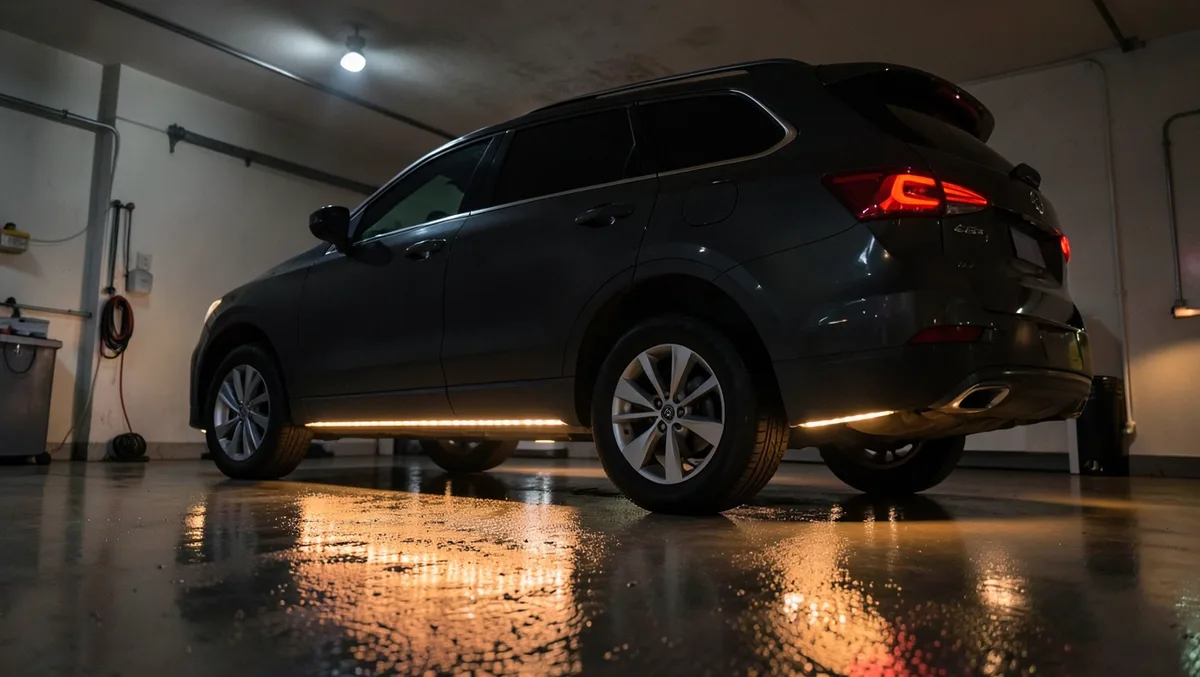
Undercarriage lights are LED or neon lighting installed underneath a vehicle. They create a glow on the pavement, often along the lower rocker area, wheel openings, or bumper edges. Many kits use a 12V automotive electrical system and a controller module so scene, brightness, or on-off behavior can be adjusted from the cabin or a phone.
Common kit types
Single-color strip kits are the simplest. They use one fixed color in flexible adhesive strips, with basic wiring and the lowest legal risk when the chosen color is compliant.
RGB strip kits let you pick different colors and basic fade or flash modes. That flexibility is useful for parked display use, but it raises street-use risk because color changes and flashing patterns draw attention fast.
RGBIC tube kits use individually addressable sections, which can create chasing or gradient effects. They look cleaner than loose strip installs, but the controller complexity and motion effects can make them a poor fit for public roads.
Pod-based accent kits use small LED pods for wheel-well or point accents. They can be easier to aim at specific areas, but they also make it easier to create uneven brightness, hot spots, and visible points of light.
Are undercarriage lights legal on cars?
Yes, sometimes, but the answer depends on state and local vehicle lighting laws, not the kit alone. Most states restrict underglow use on public roads when the lights are active, and some states allow it only with strict limits on color, visibility, brightness, and motion effects.
Public-road use versus parked or show use
That split matters. A car can be acceptable at a parked meet or show and still be illegal on the street if the same lights are visible while moving. Rules vary by state, city, and enforcement practice, so the same setup can be treated differently depending on where and how it is used.
Federal safety limits that still apply
Federal rules do not replace state law. They set a floor for safety. Added lighting must not reduce the effectiveness of required lighting equipment under FMVSS-related guidance, and it must not be installed in a way that creates distraction or glare. That means a legal color still can be a bad install if it interferes with factory lights.
Picture a car with a bright strip near the front bumper edge. The color is amber, but the beam spills into the headlamp area and reflects off wet pavement. Even if the color itself is allowed, the glare and interference can still draw enforcement attention.
What colors are legal for underglow lights?
White, amber, and yellow are often the safest starting points in many places, but they are not automatically legal everywhere. Red and blue are the biggest problem colors because they can mimic emergency vehicles. Some places focus on color alone, while others also limit visibility, brightness, or use while moving.
Why emergency-like colors cause problems
Red and blue are often treated more strictly because they can look like police, fire, or other emergency lighting from a distance. Even when a kit offers those colors for show use, public-road use can trigger a stop if the pattern is visible or the effect reads as official equipment.
Changing colors can create the same issue. A kit that cycles from blue to red may be treated more harshly than a fixed white strip, because the moving color effect can resemble warning or enforcement lighting.
How flashing and changing colors affect legality
Flashing, strobing, chasing, and motion effects are often restricted on public roads. If a controller can create a rapid scene, that feature may be fine for a show lot and a problem on the street.
Where should they be mounted?
Mount underglow where the light stays hidden, protected, and hard to see from outside the vehicle. The common mounting zones are the lower rocker area, wheel wells, and bumper edges, but the exact placement should follow the product manual and the vehicle’s underbody layout. The goal is a glow on the pavement, not a visible strip from curb height.
Placement checks that matter
Keep the kit tucked inboard enough that road debris cannot strike it easily. Mounting too low increases the chance of scraping, water entry, and torn wiring. Mounting too far outward increases visibility from the side and makes the strip or tube easier to spot from directly outside the car.
Use brightness and beam pattern as part of placement, not as an afterthought. A narrow beam can look cleaner and reduce spill, while a diffuse beam can wash onto the body panels and pavement in a way that is harder to control. Wet pavement reflects more light, so a setup that looks mild in dry conditions can look much brighter at night after rain.
Suppose a kit is mounted along the lower rocker but angled outward. The LEDs are hidden from casual view in daylight, yet at night the side glow is obvious through the wheel opening. That can be enough to violate a rule that bars underbody lighting visible from directly outside the car.
Undercarriage lights checklist
Use this as a buying and setup filter before you drill, stick, or wire anything. It separates legal risk from visual appeal so you can decide whether a kit belongs on a parked show car, a street car, or neither.
| Color choice | Mounting position | Flashing mode | Visibility from outside | Parked/show use | Public-road use | Risk level |
|---|---|---|---|---|---|---|
| White or amber | Hidden along rocker panels, tucked inboard | Off or steady only | Low, no direct strip view | Usually better fit if local rules allow | Possible only where state law permits and brightness is controlled | Lower |
| Yellow | Protected underbody mount | Off or steady only | Low to moderate | Often acceptable as display lighting in some places | Depends on local rules and visibility limits | Moderate |
| Red | Any exposed underbody mount | Any motion or flash mode | High | May be allowed only off-road or on private property | High citation risk in many areas | High |
| Blue | Any exposed underbody mount | Any motion or flash mode | High | May be allowed only off-road or on private property | High citation risk in many areas | High |
| Any color with chasing or strobing | Visible from outside or near factory lamps | Flashing, strobing, motion | High | Better reserved for show use where allowed | Often restricted | High |
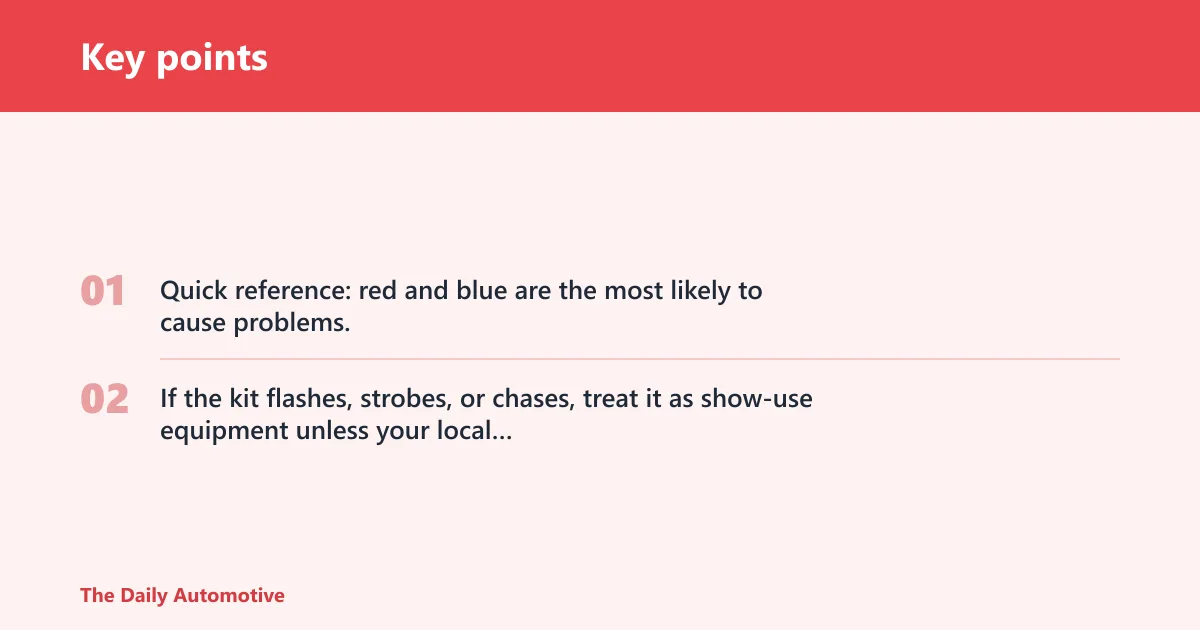
Quick reference: red and blue are the most likely to cause problems, white and amber are the first colors to check, and yellow sits in the middle depending on the state. If the kit flashes, strobes, or chases, treat it as show-use equipment unless your local rules clearly say otherwise.
How do you install underglow safely?
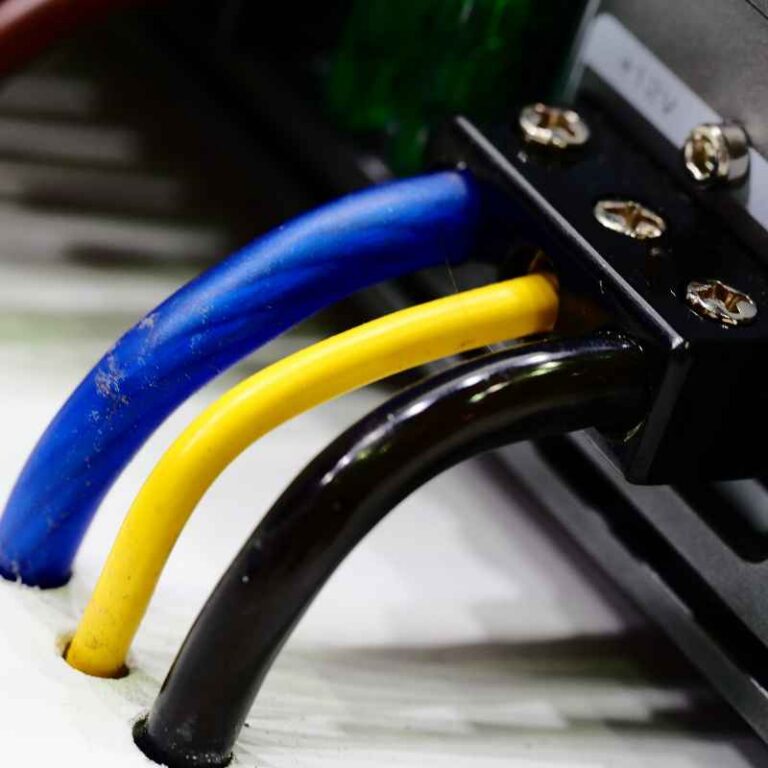
Use the vehicle’s 12V automotive electrical system and keep the controller, wiring, and mounts protected from road spray and impact. The safest installs use secure mounting hardware, clean routing, and a plan for fusing, strain relief, and water protection. Loose adhesive, exposed wiring, and wet connectors are the failure points that cause the most trouble.
Wiring paths and controller placement
Place the controller module where it is shielded from splash and heat, not hanging low under the car. Keep wiring away from moving suspension parts, exhaust heat, and sharp edges. Follow the product manual for power and ground routing, and do not improvise a path that leaves a cable exposed below the floorpan.
Use brackets, screws, or the supplied adhesive pads only where the surface is clean and the hardware can survive underbody exposure. Adhesive failure is common when the surface is dirty, oily, or constantly hit by water. If a strip sags, the beam angle changes and the lights become easier to see from outside the car.
Battery drain and fuse protection
Will underglow lights drain the battery? They can, especially if they are left on with the engine off or tied to a circuit that stays live too long. A 12V accessory feed with proper switch control helps, but the actual draw depends on the kit, the controller, and how long it runs. Use the product manual’s fuse guidance and do not exceed the vehicle’s electrical limits.
Special tools and common mistakes
Do I need special tools to install underbody lights? Usually not many, but a clean install often needs basic hand tools, trim tools, wire protection, and a way to secure the cable. The real requirement is patience and access. If the kit is installed poorly, the legal issue may be the visible light; the mechanical issue is the broken mount or corroded connector.
A common first-timer mistake is mounting a tube where it looks centered from standing height, then discovering the strip is plainly visible from the curb. Another is skipping sealing on a connector, which lets water in, corrodes the pins, and causes the lights to flicker or fail after the first wet week.
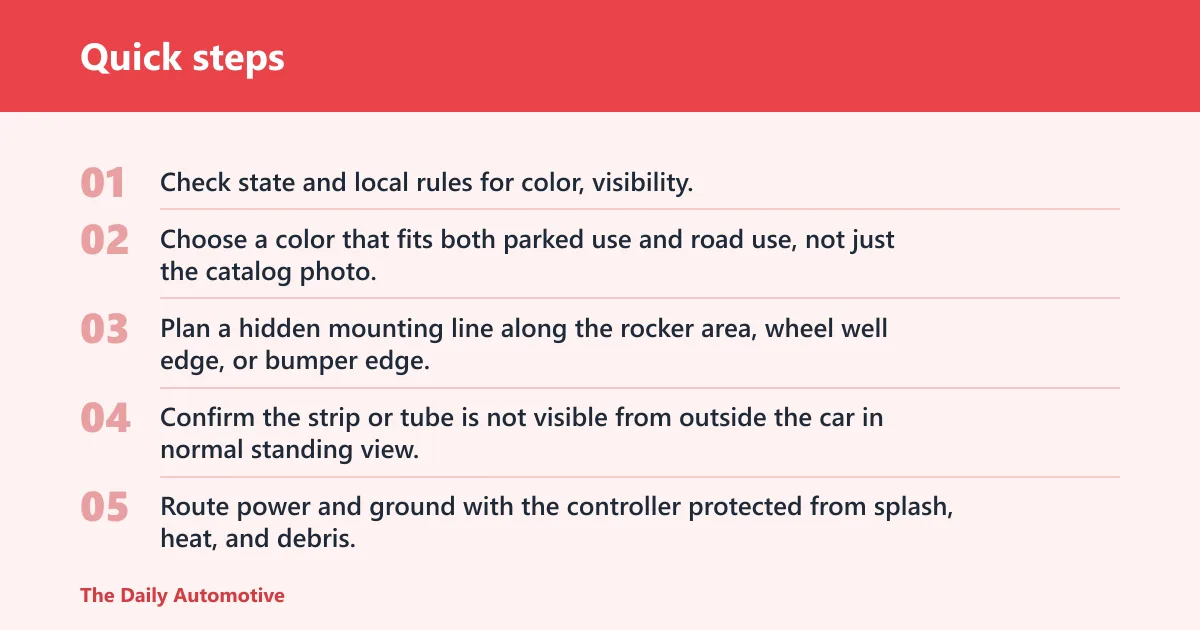
- Check state and local rules for color, visibility, and motion effects before buying anything.
- Choose a color that fits both parked use and road use, not just the catalog photo.
- Plan a hidden mounting line along the rocker area, wheel well edge, or bumper edge.
- Confirm the strip or tube is not visible from outside the car in normal standing view.
- Route power and ground with the controller protected from splash, heat, and debris.
- Secure the kit with hardware or adhesive that can survive underbody exposure.
- Test for glare, beam spill, and reflection on dry and wet pavement.
- Keep flashing, strobing, chasing, or motion scenes off public roads unless local law clearly allows them.
- Verify the lights do not interfere with required factory lighting.
- Recheck the mount after the first drive and after the first wash or rain event.
Frequently asked questions
Can I drive with underglow lights on public roads?
Only if your state and local rules allow it and the lights meet visibility limits. If the car is being inspected or stopped by enforcement, the key questions are whether the lights are visible, distracting, or set to a restricted mode.
Where should underglow lights be mounted on a car?
Mount them under rocker panels, near wheel wells, or along bumper edges where the glow reaches the pavement without exposing the strip or tube. The best mount stays protected from road debris, avoids direct outside visibility, and keeps the beam away from factory lamps and the driver’s view.
Do underglow lights need to be covered while driving?
Some places require them to be hidden or switched off on public roads, while others focus on visibility from outside the car. Check the exact local rule before assuming the kit can stay on.
Will underglow lights drain my battery?
They can. Any accessory on the 12V automotive electrical system can draw power, and a controller that stays active can add to that load. Drain becomes more likely if the lights are left on with the engine off or if the kit is wired without proper switching or fuse protection.
Products related to this article
Sponsored / affiliate links. As an Amazon Associate I earn from qualifying purchases. I may earn additional commission from eligible campaigns.