Best Lithium Battery for Car Audio: 3 Top Picks Compared
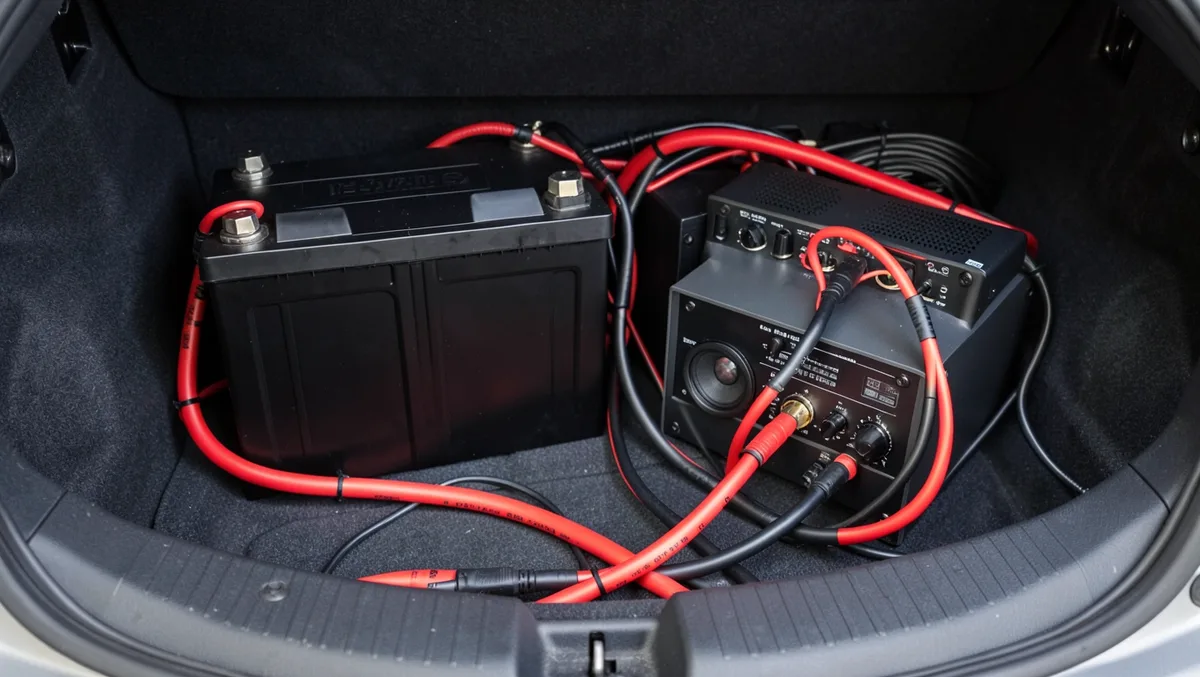
A lithium battery built for car audio uses LiFePO4 or lithium titanate (LTO) cells instead of lead-acid or AGM plates, and that changes how the electrical system needs to be wired, not just how much weight you save. The XS Power Titan8 below delivers 5,000 watts and 1,000 amps from a 20Ah pack that weighs a fraction of an AGM battery with similar output, while the CHITOLI and Limitless Lithium picks cover different capacity and size needs. Before buying one, it helps to know that a lithium battery cannot simply replace a lead-acid battery in the same wiring without a compatible charger or isolator.
Lithium vs. Lead-Acid: What Changes in Your Wiring
LiFePO4 and LTO batteries hold a much flatter voltage curve than lead-acid, which is why they stay steady under the heavy current draw a competition amplifier needs, but that same chemistry means they cannot be charged the same way. A vehicle’s alternator voltage is often close enough to a LiFePO4 battery’s charge voltage to top off an already-charged pack, but dumping a fully depleted lithium battery straight onto an alternator, or wiring it in parallel with a lead-acid starting battery with no isolation, risks overcurrent that neither the alternator nor the battery’s BMS (battery management system) is built to absorb safely. Most lithium car audio installs use a DC-DC charger or a lithium-rated isolator between the two batteries instead of a basic solenoid isolator sized for lead-acid; see our guide on whether you need a battery isolator for car audio for how that is wired.
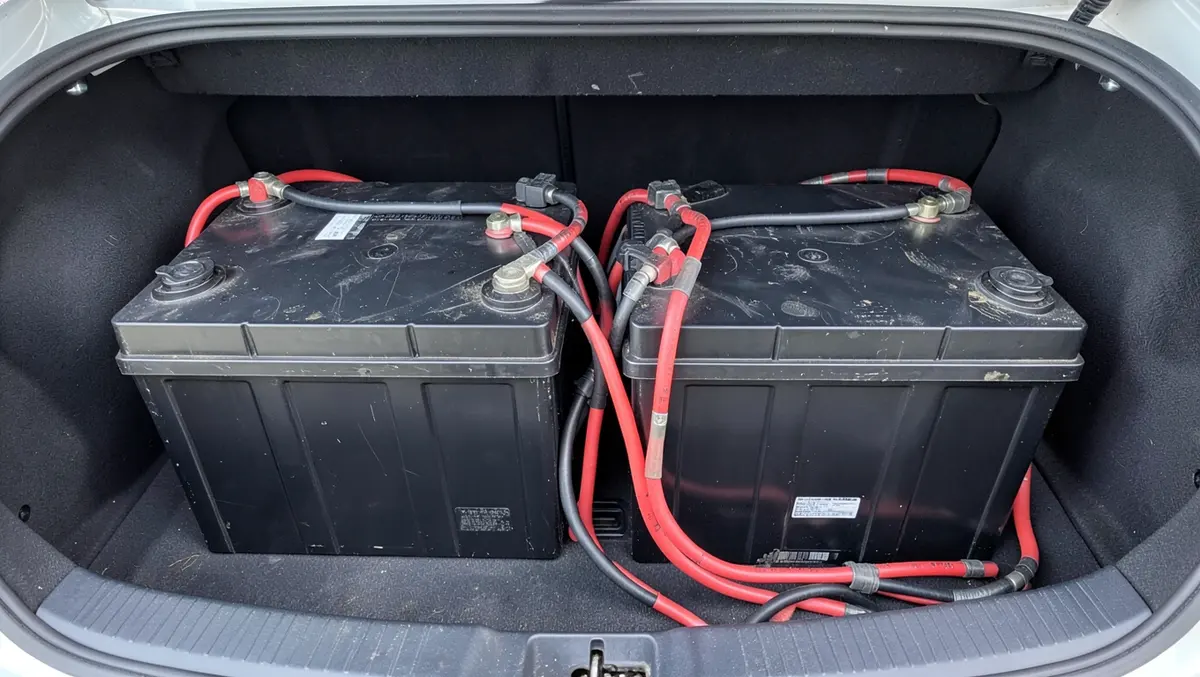
The good news is that LiFePO4 and LTO are considered the safest lithium chemistries for this use. Unlike the lithium-cobalt cells in phones and laptops, they do not enter thermal runaway under normal fault conditions, which is why every reputable car audio lithium battery ships with a built-in BMS that manages overcharge, overdischarge, short-circuit, and over-temperature protection rather than relying on the chemistry alone. One nuance that trips up new installs: most LiFePO4 BMS units block charging, though not discharging, below about 32°F, so a battery mounted in an unheated trunk in a cold climate may simply refuse to take a charge until it warms up, something a lead-acid battery never does.
1. XS Power Titan8 RSV-S6-30Q: Best High-Power Lithium Pick
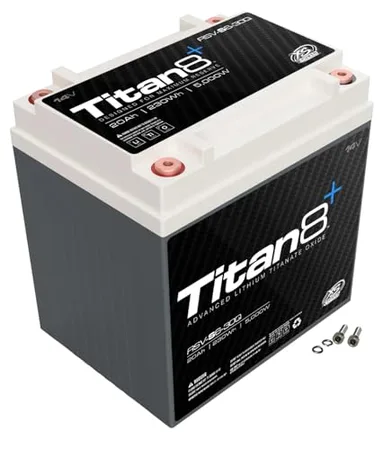
The XS Power Titan8 RSV-S6-30Q is a 14-volt lithium titanate (LTO) battery built specifically for car audio and racing, rated for 1,000 max amps and 5,000 watts from a 20Ah cell that XS Power lists as roughly equivalent to a 60Ah AGM battery in output. LTO cells charge and discharge faster than LiFePO4 and tolerate a wider temperature range, which is why XS Power uses this chemistry in its top-tier lithium line instead of the AGM technology used in its D-series batteries.
Pros:
- High power-to-weight ratio: 1,000A and 5,000W from a 20Ah cell, far lighter than an AGM battery with comparable output.
- LTO chemistry: faster charge and discharge cycling and a wider safe operating temperature range than LiFePO4.
- Direct-fit hardware: M6 terminal hardware included for installs replacing an AGM Group 31-style battery.
Cons:
- Price: costs roughly double a similar-output AGM battery.
- Charging setup required: a standard AGM battery charger is not rated for LTO cells.
Because LTO cells have a different charge profile than AGM, installers pairing the Titan8 with an existing AGM main battery typically add a DC-DC charger or lithium-rated isolator rather than wiring the two chemistries directly in parallel.
To check current pricing, click here.
2. CHITOLI 12V 100Ah LiFePO4 (2-Pack): Best for High Capacity
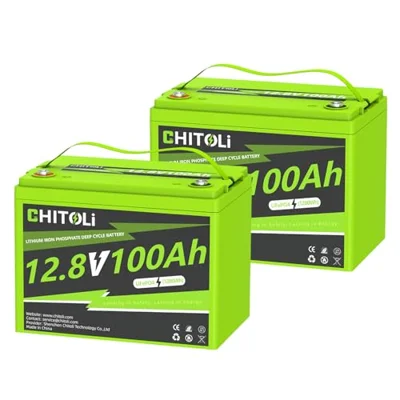
The CHITOLI 2-pack pairs two 12V 100Ah Group 24 LiFePO4 batteries, each with a built-in 100A battery management system (BMS), for setups that need sustained amp-hour capacity rather than a single huge burst rating. At 22.6 lbs per battery, the pair weighs a fraction of an equivalent lead-acid bank and can be wired in parallel for more capacity or in series for higher voltage.
Pros:
- Automotive-grade LiFePO4 cells with a built-in 100A BMS for overcharge, overdischarge, and short-circuit protection.
- Lightweight at 22.6 lbs per battery, and two ship in the pack for parallel or series wiring.
- Rated for up to 15,000 deep-discharge cycles, far beyond a typical AGM battery’s 300 to 500 cycles.
Cons:
- Case size: the Group 24 case may not fit every factory battery tray without a mounting adapter.
- Upfront cost: a two-battery pack costs more than a single battery even though total capacity is higher.
Because these are true deep-cycle LiFePO4 cells rather than starting batteries, they suit RV, marine, and home energy storage duty as well as a secondary car audio bank. Check the current listing for the exact BMS protection specs before wiring them into a high-draw system.
To check current pricing, click here.
3. Limitless Lithium Nano OEM Elite 27AH: Best Compact Pick
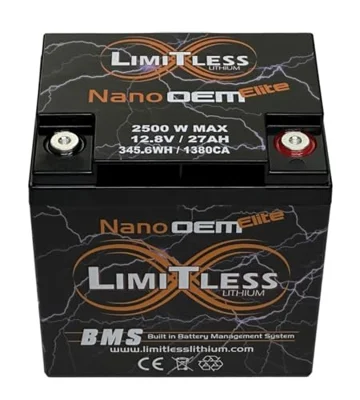
The Nano OEM Elite is a compact 12.8V, 27Ah lithium battery rated for 2,500 watts max and 1,380 cranking amps in a case built for motorcycle and powersports applications, but its size and output also make it a workable secondary battery for smaller car audio setups that do not need the Titan8’s full 5,000-watt ceiling. It ships with a left-positive terminal layout and a built-in BMS with overvoltage protection that disconnects above 15.3 volts.
Pros:
- Compact size fits where a full Group 31 or Group 24 battery will not.
- Built-in BMS with overvoltage disconnect at 15.3V protects the cell during charging.
- Expandable: compatible with other Limitless LiFePO4 batteries for larger setups.
Cons:
- Lower ceiling: 2,500W is well below the Titan8 or larger LiFePO4 packs, not suited to a high-power SPL build.
- Case and terminal layout are motorcycle-oriented and may need an adapter bracket in some vehicles.
If your system needs more sustained output than this covers, Limitless Lithium’s larger Retro Pro line, up to 56Ah and roughly 16,000 watts burst, is built for full-size car audio installs instead.
To check current pricing, click here.
Frequently Asked Questions
What Is The Best Lithium Battery For Car Audio?
For maximum output, the XS Power Titan8 RSV-S6-30Q is the strongest pick here at 5,000 watts and 1,000 amps from a 20Ah LTO cell. For higher amp-hour capacity instead of raw burst power, the CHITOLI 100Ah LiFePO4 pack is the better fit.
How Does A Lithium Car Battery Improve Audio?
Lithium batteries hold a flatter voltage curve under heavy current draw than lead-acid or AGM, so amplifiers get more consistent power at high volume instead of the voltage sag that causes clipping. See our full wiring guide for how to set one up correctly.
Can Lithium Batteries Be Used For Camping?
Yes. The CHITOLI 100Ah LiFePO4 batteries reviewed here are deep-cycle cells built for RVs, trolling motors, and other camping equipment, not just car audio, and their built-in BMS handles the same overcharge and short-circuit protection either way.
How Many Cycles Does A Lithium Battery Last?
LiFePO4 batteries like the CHITOLI are rated for up to 15,000 deep-discharge cycles, compared to roughly 300 to 500 cycles for a typical AGM battery. LTO cells such as the Titan8 typically last even longer, though car audio use rarely deep-cycles them the way a house battery would.
Do You Need A Special Charger For A Lithium Car Audio Battery?
Yes. LiFePO4 and LTO batteries need a charger or isolator matched to their voltage profile rather than a standard lead-acid or AGM charger, and most installs add a DC-DC charger between the lithium battery and the vehicle’s factory battery instead of wiring the two directly in parallel.
Conclusion
Choosing the right lithium battery for car audio comes down to whether you need maximum burst power, sustained capacity, or a compact secondary battery. The XS Power Titan8 RSV-S6-30Q delivers the highest output here at 5,000 watts from a 20Ah LTO cell, while the CHITOLI 100Ah LiFePO4 pack trades peak wattage for far more capacity and up to 15,000 charge cycles. The Limitless Lithium Nano OEM Elite covers smaller setups that do not need either extreme, though Limitless Lithium’s larger Retro Pro line exists for full-size builds that outgrow it.
Whichever battery you pick, remember that a lithium car audio battery is not a drop-in replacement for AGM or lead-acid: pair it with a lithium-compatible charger or isolator, expect the BMS to block charging in freezing temperatures, and never wire it directly in parallel with a lead-acid battery without isolation. Get that part right and a lithium battery will outlast and outperform an equivalent AGM setup by a wide margin.
Products related to this article
Sponsored / affiliate links. As an Amazon Associate I earn from qualifying purchases. I may earn additional commission from eligible campaigns.
 2-Pack 12V 100Ah LiFePO4 Lithium Battery Group 31 Built-in 100A BMS, Low-Temp Protection Up to 15000 Deep Cycles Rechargeable Battery for RV, Marine, Solar System, Van, Trailer, Home Energy Storage
 12V BCI Group 47 LiFePO4 Lithium Car Battery | 1200CCA Lightweight Lithium Battery | 10-Year Lifespan | BMS Protection | Size H5 For Car Start-Stop