
R-1234yf Recharge Kit review: is it worth buying?
An R-1234yf recharge kit is usually worth considering only if the system is still cooling but seems to be fading and still holds pressure; if it blows warm air, cycles fast, or needs repeated top-offs soon after, a shop diagnosis is the better next step. Done badly, you can waste the kit, miss a leak, or overfill an expensive A/C system.
Verdict


This guide gives a step-by-step DIY check, shows which symptoms point to a top-off, and explains when professional service is the better call. For a weak system, the kit can be a reasonable stopgap. For repeat loss, empty-system symptoms, or hybrid and EV fitment questions, it is usually a sign to stop and diagnose.
Pros and cons
Pros
- Useful for a mild low-charge condition on a compatible vehicle.
- The reusable gauge and hose make low-pressure-side charging more straightforward.
- The snap-lock coupler is easier to attach than a loose, fussy fitting.
- Some formulas add leak sealer for small rubber-seal seepage.
Cons
- The gauge cannot tell you whether the system has a slow leak, a bad compressor, or another fault.
- Leak sealer can be a bad fit for later service and does not repair major leaks.
- An empty system or repeated loss usually needs diagnosis, not another can.
- Compatibility matters more on hybrids and EVs, where the wrong product can be the wrong buy.
📊 The kit is marketed for vehicles that use R-1234yf refrigerant. Source: A/C Pro R-1234yf Ultra Synthetic A/C Recharge Kit.
Specs at a glance
| Item | What it tells you |
|---|---|
| Refrigerant type | Marketed for vehicles that use R-1234yf refrigerant. |
| Product type | Automotive A/C refrigerant recharge kit. |
| Service point | Attaches to the low-pressure port. |
| Hose | Used to measure the system and recharge through the low side. |
| Gauge | Reusable universal gauge for charge status on the low side. |
| Coupler | Easy-install snap-lock coupler. |
| Leak sealer | Claims help for common rubber-seal issues, including O-rings, gaskets, and hoses. |
| Additives | Some formulas may include anti-wear additives. |
| Compatibility claim | Claims compatibility with hybrid and electric vehicles. |
| Effect claim | Claims colder, drier air on compatible systems. |

Who it is for
This is for drivers with a mild cooling loss on a car confirmed to use R-1234yf, especially when the air is still cool but not as cold as it should be. It can also suit someone who needs a temporary top-off before a service visit, rather than a full repair.
It is not for a system that is blowing warm air, loses charge again quickly, or has signs of a larger leak. It also is not a blind buy for hybrids and EVs; the exact vehicle and the kit claim both need checking first.
Who should skip it
- Drivers with empty-system symptoms.
- Anyone who already topped off once and lost cooling again.
- Owners who suspect a hose, compressor, condenser, or service-port leak.
- Hybrid and EV owners who have not confirmed exact refrigerant and service requirements.
What works
The basic value is simple: R-1234yf automotive refrigerant in a recharge kit can restore cooling when the system is only a little low. The low-pressure-port connection, hose, gauge, and coupler are the right pieces for that job, and the reusable gauge makes the process less guesswork-driven than a plain can.
A common first-timer mistake is adding refrigerant because the cabin air is warm on a hot day. Suppose a compact SUV still blows cool air at idle but warms up in traffic. That pattern can fit a low charge, so a careful top-off may help. If the air turns cold again, the system may have been marginal rather than empty.
What the gauge actually tells you
The gauge shows low-side charging status, which helps you avoid blindly dumping refrigerant into the system. It does not prove the compressor is healthy, the expansion device is working, or the charge is correct under every operating condition. Low-side pressure alone cannot rule out a leak, airflow problem, or control fault.
That limit matters. If the gauge looks acceptable but the vents still blow warm, the issue may be outside simple recharge territory. A usable gauge is helpful. A diagnostic tool it is not.
What does not
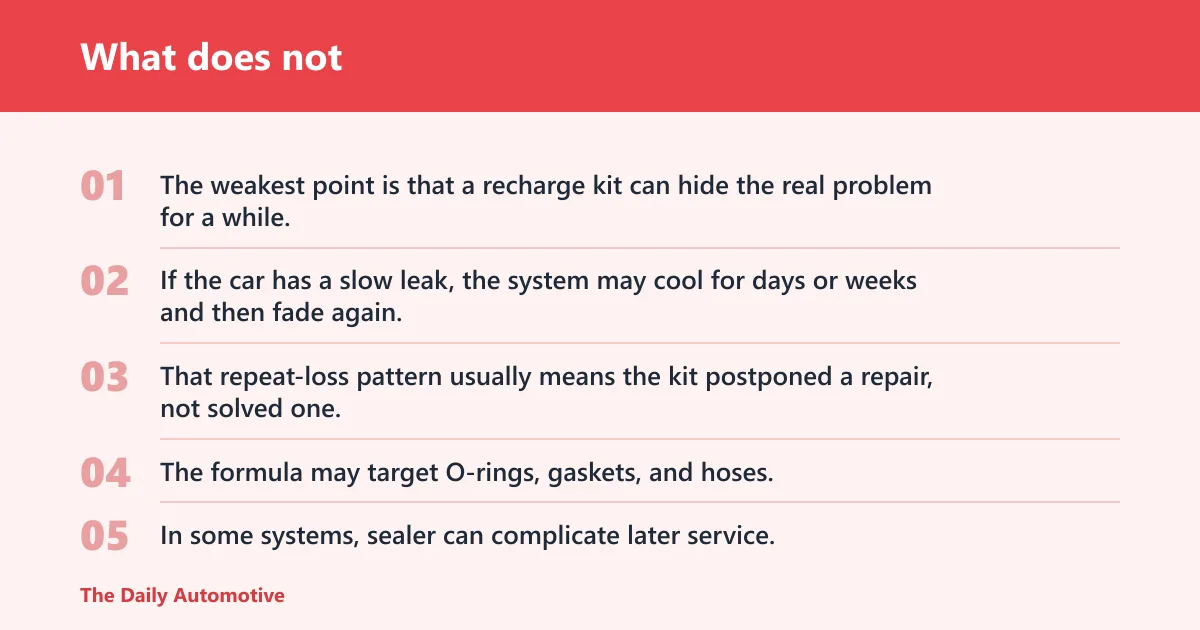
The weakest point is that a recharge kit can hide the real problem for a while. If the car has a slow leak, the system may cool for days or weeks and then fade again. That repeat-loss pattern usually means the kit postponed a repair, not solved one.
Leak sealer is another limit. The formula may target O-rings, gaskets, and hoses, but that is not the same as fixing a major leak. In some systems, sealer can complicate later service, which is a poor trade if the vehicle already needs diagnosis.
Leak sealer and additive caution
Anti-wear additives sometimes appear in recharge formulas, but compatibility still matters more than the label. If the vehicle manual or service information calls for a specific refrigerant service method, or if the system has a known fault, extra additives do not make the kit the right answer.
For modern systems, the safer view is plain: use sealer only when the problem is a small rubber-side seepage, not when the compressor, condenser, or linework may be at fault.
Is an R-1234yf recharge kit worth it for a weak car AC?
Yes, but only for a weak system that still cools somewhat and likely needs a small top-off. If the vents are cooler than outside air, the system may still hold enough pressure for a recharge kit to help. If the system is warm, empty, or unstable, the kit is usually the wrong first move.
Think in patterns, not labels. Mild cooling loss points to a possible low charge. Strongly reduced cooling, rapid cycling, or repeated loss points toward a leak or another fault. The kit is a top-off tool, not a cure for every weak-air complaint.
DIY decision matrix
| Symptom pattern | Likely meaning | Next step |
|---|---|---|
| Mild low cooling | System may be a little low on R-1234yf and still serviceable through the low-pressure port. | Buy kit |
| Intermittent cooling | Could be a borderline charge or a small leak that returns after use. | Use for top-off only |
| Empty-system symptoms | Likely major leak, loss of charge, or another fault that a can cannot solve. | Stop and diagnose |
| Suspected leak | Sealer may help a tiny seep at O-rings, gaskets, or hoses, but not a larger failure. | Top off only if the leak is small; otherwise stop and diagnose |
| Hybrid and EV compatibility check | Exact vehicle requirements and kit claim must both line up before charging. | Stop and diagnose unless compatibility is confirmed |
Use this simple check before buying
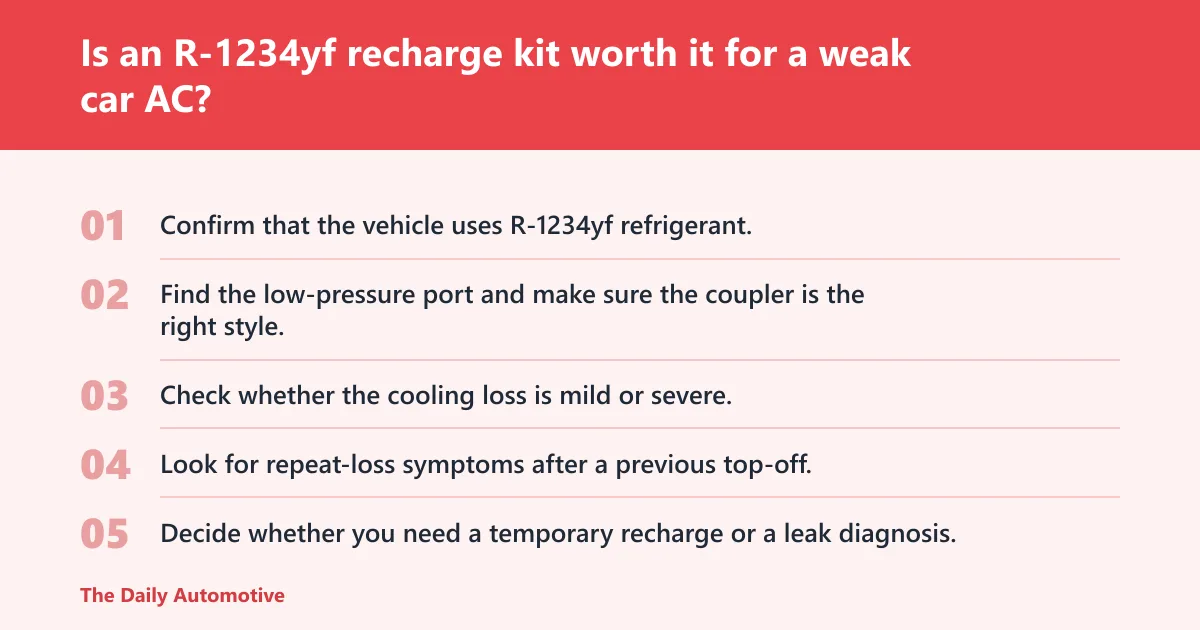
- Confirm that the vehicle uses R-1234yf refrigerant.
- Find the low-pressure port and make sure the coupler is the right style.
- Check whether the cooling loss is mild or severe.
- Look for repeat-loss symptoms after a previous top-off.
- Decide whether you need a temporary recharge or a leak diagnosis.
Can I use an R-1234yf recharge kit on a hybrid or EV?
Sometimes, but only if the exact vehicle specification and the kit claim both say yes. Hybrid and electric vehicle compatibility is important because these systems can have different service needs, even when they still use a low-pressure port and similar recharge hardware. Do not assume every R-1234yf kit fits every electrified vehicle.
If compatibility is unclear, stop and verify before attaching the hose. That check matters more on modern vehicles than on older conventional cars, where the refrigerant label alone is often enough to guide the purchase.
How do I know if my car uses R-1234yf before buying a kit?
Check the under-hood A/C label, the owner’s manual, or the service information for the refrigerant type. Many newer systems use R-1234yf, but the correct answer is vehicle-specific. If the label does not match the kit, do not guess.
You are looking for more than a generic “A/C refrigerant” note. You need the exact refrigerant type and enough information to confirm the low-pressure-port service method. That step prevents the wrong can, the wrong coupler, and the wrong expectation.
Will a recharge kit fix an AC leak or only top off refrigerant?
It usually only tops off refrigerant unless the leak is tiny and limited to rubber parts the sealer can reach. A recharge kit may buy time, but it does not repair a cracked condenser, a failed compressor seal, or a major hose failure. A low charge from a leak is still a leak.
Say your sedan cools for two weeks after a refill, then fades again in the same July heat. That pattern points to repeat loss, not a one-time low charge. At that point, a diagnostic visit is the better spend.
Are recharge kits with leak sealer safe for modern AC systems?
Not always. Leak sealer is aimed at small rubber-seal issues such as O-rings, gaskets, and hoses, so it may help only where the loss is minor. In a modern system, that same sealer can complicate later service if the problem turns out to be larger than advertised.
The safer read is cautious, not hostile: sealer is a narrow tool. If the AC is truly low because of a small seep, it may help. If the system has major loss or unknown damage, sealer is the wrong bet.
What does the gauge on an R-1234yf recharge kit actually tell me?
The gauge tells you the low-side charging condition during the refill process. That is useful because it helps avoid overfilling and gives a rough read on whether the system is moving toward a usable charge. It does not, by itself, diagnose the entire AC system.
It cannot confirm compressor efficiency, condenser performance, blend-door issues, or whether a leak will return next week. If the gauge looks reasonable and the cabin still stays hot, stop treating the can as a diagnosis kit.
When should I stop and take the car to a shop instead?
Stop when the system is empty, blows warm air after a top-off, needs another can soon after the first, or shows signs of a larger leak. Those patterns point away from a small low-charge problem and toward a repair that likely needs evacuation, leak testing, and proper recharge.
A shop visit also makes more sense if the car is a hybrid or EV and the service requirements are not clear. A little uncertainty is cheaper than overcharging or using the wrong product on a modern system.
Is an R-1234yf kit better than paying for a professional recharge?
Only when the issue is mild and the goal is a temporary top-off. A professional recharge usually becomes the better buy when the system may need evacuation, leak testing, or a full diagnosis. That service costs more up front, but it can prevent repeat loss and wasted cans.
Cost per use favors the kit only if the system stays tight and the refill lasts. If the problem comes back, the professional service often wins because it attacks the cause instead of the symptom.
What works
This kit type works best as a low-side top-off for a compatible vehicle that is simply undercharged. The hose, reusable gauge, and snap-lock coupler make that task easier, and the claimed colder, drier air is plausible when the system was only slightly low to begin with.
It is also convenient for a careful owner who wants a temporary fix before a planned service appointment. That is the right mindset: convenience first, diagnosis second when the symptoms justify it.
What does not
It does not solve a dead system. It does not tell you why the charge dropped. It does not prove the compressor, fan control, pressure switch, or expansion side is working as it should.
It also does not make compatibility optional. The product claims hybrid and electric vehicle compatibility, but the vehicle still has to match the refrigerant and service method. If that match is uncertain, the safe answer is not to buy first and ask later.
Alternatives

Solstice YF Refrigerant R-1234yf – Automotive A/C Recharge Can – OEM Approved (1) is the simpler buy if you already know the system is R-1234yf and only need refrigerant, not the hose-and-gauge setup. Based on the spec sheet and review pattern, the drawback is obvious: it lacks the convenience of a full recharge kit, so you still need the right service tool to measure the low side correctly.
A/C Pro InterDynamics Certified Air Conditioner Gauge and Hose, R-1234yf is the better choice when you want the reusable gauge and hose as the main value, especially for a one-time low-side top-off. The drawback is that it is still only a service tool; if the refrigerant loss is repeatable, the kit can help you refill the system while the real fault remains untouched.
Should you buy it
Buy it if your car uses R-1234yf, the cooling loss is mild, and the system still behaves like a mostly healthy AC system that simply needs a top-off. Use it as a temporary fix if the cooling is intermittent but not empty. Skip it if the air is warm, the charge disappears quickly, or the vehicle’s compatibility is not confirmed.
The short version is simple: a recharge kit is a smart buy for a small, believable refrigerant loss. It is a poor substitute for diagnosis when symptoms point to a leak or another fault.
Frequently asked questions
Is an R-1234yf recharge kit worth it for a weak car AC?
Yes, if the AC is only mildly weak and still has enough pressure to accept a careful low-side top-off. If the system is blowing warm air, cycling strangely, or fading again soon after a refill, the kit is usually a short-term patch and not the best long-term buy.
Can I use an R-1234yf recharge kit on a hybrid or EV?
Only if the vehicle’s service information and the kit label both confirm compatibility. Hybrids and EVs can have different AC service requirements, so the exact match matters more than the marketing claim on the can or hose package.
How do I know if my car uses R-1234yf before buying a kit?
Check the under-hood label or owner’s manual for the refrigerant type. If it lists R-1234yf, the kit may fit the job; if it lists something else or the label is missing, verify before buying because the wrong refrigerant type is not a harmless mistake.
Will a recharge kit fix an AC leak or only top off refrigerant?
It mainly tops off refrigerant. Leak sealer may help small seepage at O-rings, gaskets, or hoses, but it will not repair a major leak or failed component. If the system loses cooling again quickly, the leak still needs diagnosis and repair.
Are recharge kits with leak sealer safe for modern AC systems?
They can be acceptable for minor rubber-side seepage, but they are not a universal fix. Sealer can complicate later service, and it is a poor fit for major leaks or unknown failures. Use it cautiously and only when the symptom pattern supports that choice.
What does the gauge on an R-1234yf recharge kit actually tell me?
The gauge gives a low-side charging reading so you can see whether the system is moving toward a usable refill. It cannot diagnose the full AC system, confirm every fault, or tell you whether a repeat leak is waiting around the corner.
When should I stop and take the car to a shop instead?
Stop if the system is empty, the air stays warm after a top-off, or the cooling loss returns soon. Those signs point to a problem that a recharge kit cannot solve by itself, and a shop visit is the better next step.
Is an R-1234yf kit better than paying for a professional recharge?
It is better only when the system needs a small, temporary top-off and the vehicle is clearly compatible. A professional recharge is the better buy when the system needs evacuation, leak testing, or a full diagnosis that prevents repeat loss and wasted refrigerant.
Products related to this article
Sponsored / affiliate links. As an Amazon Associate I earn from qualifying purchases. I may earn additional commission from eligible campaigns.