3 Best Bug Shields for Cars in 2026
The three best bug shields for vehicles in 2026 are a low-profile hood protector for a low-visibility fit, a full-coverage hood protector for stronger debris defense, and a heavy-duty truck shield for hard use. Pick the wrong profile and you can get wind noise, poor hood clearance, weak paint protection, or cracked plastic. This guide ranks the top picks by fit, appearance, coverage, and install method so you can choose the right one fast.
Quick comparison
| Product | Badge | Best for | Price | ||
|---|---|---|---|---|---|
 |
Husky Liners Hood Protector High Profile/Bug Shield | FitsHusky Liners | Our pick | Smoke · High Profile · 2021-2026 Suburban | $65.79
Price as of 19 Oct 2026
|
View |
 |
Auto Ventshade [AVS] Bugflector Hood Shield / Protector |Auto Ventshade | Also great | Dark Smoke · Medium Profile · Silverado 1500 | $59.99
Price as of 19 Oct 2026
|
View |
The low-profile pick is the one to beat if you want the cleanest look. The taller options give you more visible deflection, but they need more clearance and usually change the front-end look more clearly.
How we chose
The ranking below rests on five things that change the buying decision most: exact vehicle fitment, shield profile, debris coverage, mounting method, and material durability. We also weighed cleaning access, wind-noise risk, and whether a shield fits the vehicle segment it was built for.
One more filter matters: trim exclusions. A shield that fits a base model can still miss on a Sport, Raptor, or other special trim because hood shape, grille height, or mounting points change.
Best all-around pick: Husky Liners Aeroskin Hood Protector, because the low-profile, hood-hugging design gives a stealth look with vehicle-specific fitment and solid front-edge protection for drivers who want a subtle hood shield.
Husky Liners Aeroskin Hood Protector: best for stealth looks
Choose the Husky Liners Aeroskin Hood Protector if you want the least visual change to the vehicle and still want a shield that helps with bugs, light road grime, and front-edge wear. Its low-profile, skin-tight fit is the right answer for drivers who care more about appearance preservation than maximum bulk.
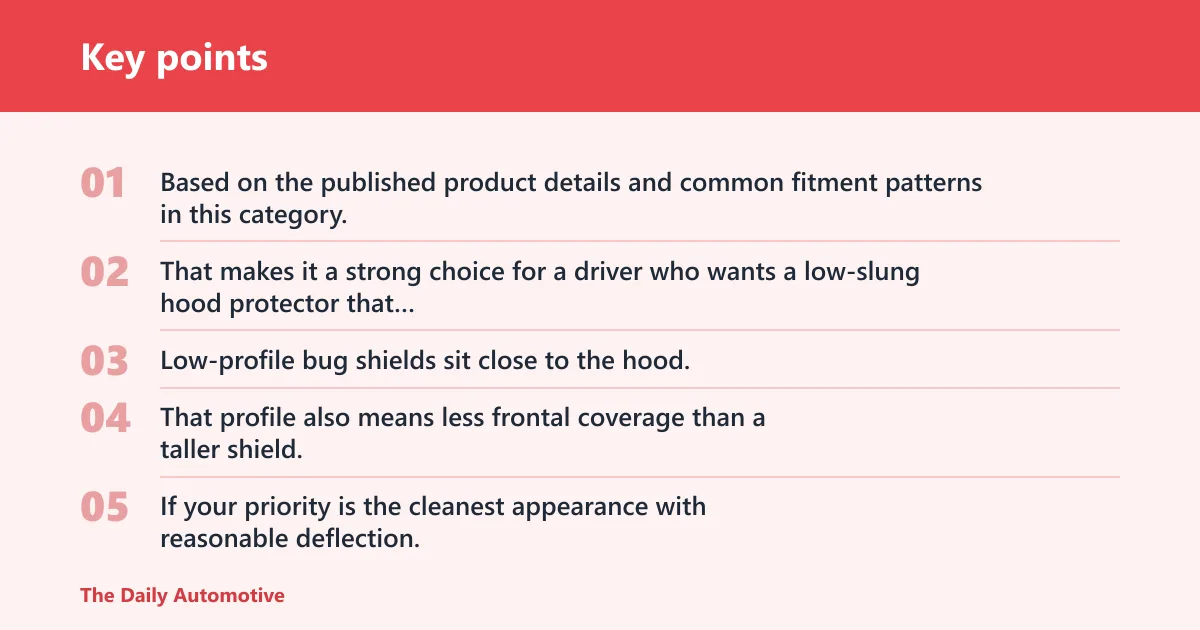
Based on the published product details and common fitment patterns in this category, the Aeroskin uses impact-modified acrylic construction and custom fitment by year, make, and model. That makes it a strong choice for a driver who wants a low-slung hood protector that stays out of sight.
Fit and profile
The main appeal is the hood-hugging shape. Low-profile bug shields sit close to the hood, which helps them disappear visually and cuts the “bolt-on add-on” look that some drivers want to avoid.
That profile also means less frontal coverage than a taller shield. If your priority is the cleanest appearance with reasonable deflection, this is the right tradeoff.
Material and durability
Impact-modified acrylic is a common choice for this style because it balances stiffness with crack resistance better than cheap brittle plastics. It can still scuff, and a low shield does not create magic paint armor, but it is a credible material choice for daily driving.
The durability question is partly about UV exposure too. Acrylic shields generally hold their shape well, but long-term sun and wash chemicals can still affect clarity and edge finish if the part is neglected.
Install and maintenance
Low-profile shields often use clips or adhesive, depending on the vehicle-specific design. Direct-fit mounting usually keeps the install cleaner than universal brackets, but alignment matters because a low shield that sits off-center is easy to notice.
Cleaning access is the main compromise. Dirt can collect at the hood edge, and washing under the lip is more awkward than with no shield at all. If you live where winter wash-off leaves grit and slush residue, check that you can still reach the hood seam without hassle.
Husky Liners Hood Protector: best for maximum coverage
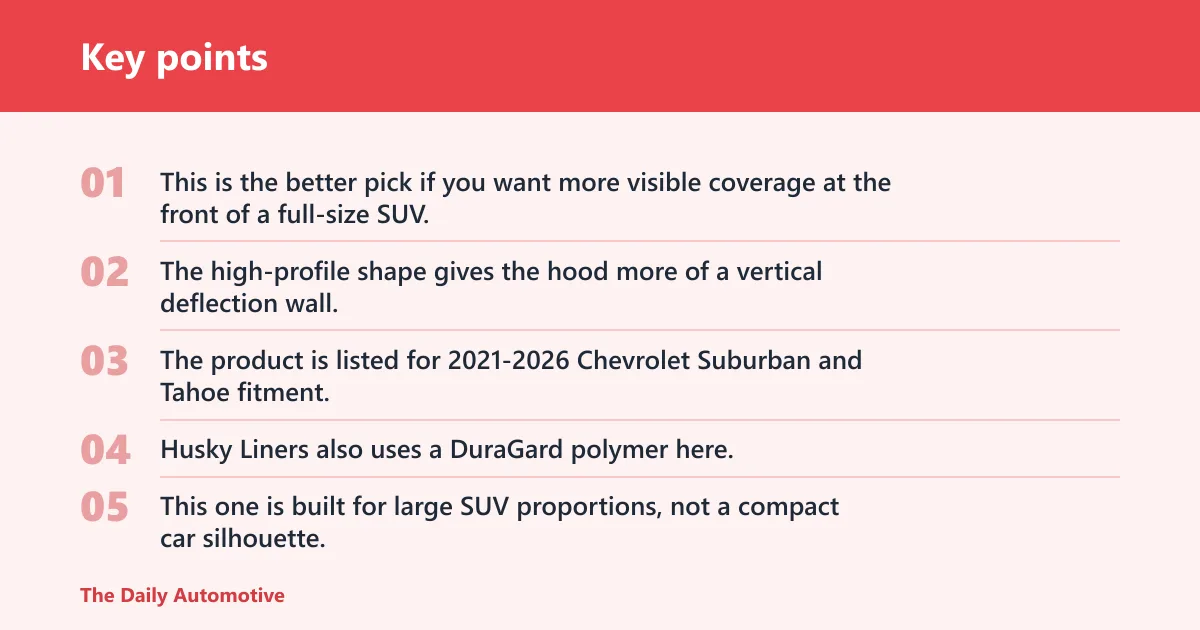
This is the better pick if you want more visible coverage at the front of a full-size SUV. The high-profile shape gives the hood more of a vertical deflection wall, which can help redirect bugs, slush, and small road debris higher than a low shield would.
The product is listed for 2021-2026 Chevrolet Suburban and Tahoe fitment, and the high-profile design is the key difference from the stealthier low-profile option. Husky Liners also uses a DuraGard polymer here, which is meant to resist cracking and chipping in regular use.
SUV fitment and visibility
This one is built for large SUV proportions, not a compact car silhouette. That matters because the front edge, hood height, and air flow over a Suburban or Tahoe are different from those on a sedan or crossover.
High-profile shields are easier to spot from the driver’s seat and from outside the vehicle. If you want maximum visible coverage, that is a plus. If you want the front end to look almost stock, it is a drawback.
Protection tradeoffs
High-profile bug shields generally provide more room to redirect airflow and more area to intercept insects and light debris. They are still not a substitute for full paint protection film, and they will not stop all rock damage.
They do make more sense if the vehicle sees a lot of interstate miles, rural roads, or wet-weather driving where grime hits the hood edge repeatedly. That is the use case where the extra profile earns its keep.
Cleaning access
The taller shape can trap more residue at the leading edge and make it more obvious after washing if dirt collects under the lip. That does not make the product bad, but it does mean you should expect a little more maintenance than with a low-profile shield.
For buyers who want maximum coverage and do not mind a more visible add-on, this is a reasonable trade.
Auto Ventshade Bugflector: best for trucks
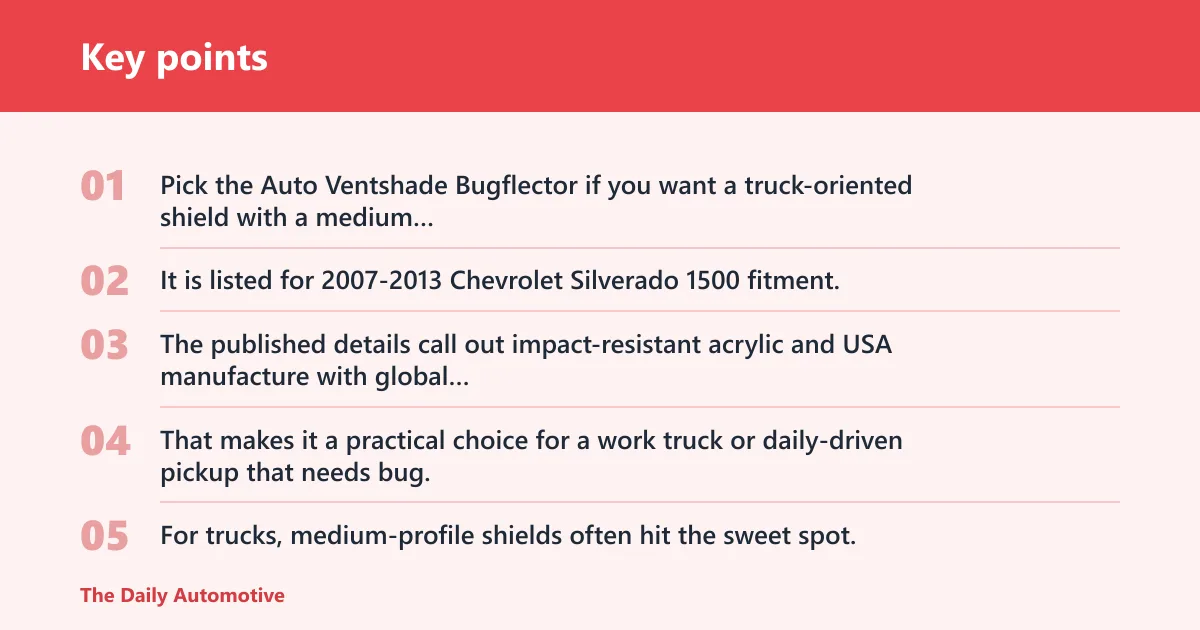
Pick the Auto Ventshade Bugflector if you want a truck-oriented shield with a medium profile and a direct fit for a specific full-size pickup. It is listed for 2007-2013 Chevrolet Silverado 1500 fitment, and that vehicle-specific shape is the point: it is designed to match the hood contour rather than force a generic look.
The published details call out impact-resistant acrylic and USA manufacture with global materials. That makes it a practical choice for a work truck or daily-driven pickup that needs bug, rock, and road-debris deflection without going to the tallest possible shield.
F-150 fitment and truck use
For trucks, medium-profile shields often hit the sweet spot. They sit higher than a stealth shield, but they usually do not look as bulky as a full high-profile shield.
That is the kind of trim exclusion that can sink a purchase if you skip the fit check.
Acrylic build and mounting
Acrylic remains the most common hard-shield material because it is light, rigid, and typically more resistant to impact than softer plastics. It is also easier to shape into a vehicle-specific contour.
Mounting method matters as much as material. Direct-fit hardware is usually cleaner than universal screw-on add-ons, while clip-and-adhesive designs can be easier to install but more sensitive to surface prep.
Highway use case
This is the pick for drivers who spend a lot of time at speed and want a little more frontal deflection than a low-profile piece gives. Highway airflow can make any shield more noticeable, so medium profile is a reasonable middle ground.
It still cannot stop every stone strike. It can, however, help with the constant stream of bugs, dust, and small debris that builds up on a truck grille and hood edge.
Bug shield decision matrix
The table below normalizes the three picks across the criteria that actually change the buying decision. Higher scores are better, with 5 meaning strongest performance for that criterion.
| Bug shield | Fit precision | Profile height | Debris coverage | UV resistance | Install complexity | Cleaning access | Appearance impact |
|---|---|---|---|---|---|---|---|
| Husky Liners Aeroskin Hood Protector | 5 | 1 | 3 | 4 | 3 | 4 | 1 |
| Husky Liners Hood Protector | 5 | 5 | 5 | 4 | 3 | 2 | 4 |
| Auto Ventshade Bugflector | 5 | 3 | 4 | 4 | 4 | 3 | 3 |
Stealth look: choose the Aeroskin; it has the lowest appearance impact and the cleanest hood line. Maximum coverage: choose the Husky Liners Hood Protector. Highway driving: choose the high- or medium-profile shield that matches your trim and leaves enough hood clearance. Truck use: choose the AVS Bugflector for the truck-specific fit. SUV use: choose the Husky high-profile shield if you want more visible protection.
Driving scenario guide
Say your SUV spends most of its time on interstate commutes and winter road spray is a problem. The high-profile Husky shield makes sense because you are trading a little more visibility for better upper-edge coverage.
Suppose your pickup sees gravel shoulder pull-offs and summer bug buildup more than city parking. The AVS Bugflector is the better match because the truck fit and medium profile balance deflection with a less bulky look.
A common first-timer mistake is choosing the cleanest-looking shield for a vehicle that actually needs more coverage. If the hood gets peppered by bugs or grit, a low profile may look right and protect less than you expect.
Which one should you buy?
If you want the shortest answer, start with the Husky Liners Aeroskin Hood Protector. It is the best all-around choice for drivers who want the front end looking close to stock while still adding real front-edge protection.
If your vehicle is a Tahoe or Suburban and you want more visible coverage, move to the Husky Liners Hood Protector. If you drive a full-size truck and want a truck-first fit, the Auto Ventshade Bugflector is the better call.
If appearance matters more than protection, the low-profile option is the right pick. If protection matters more than appearance, go taller. If you want the easiest visual fit decision, match the shield to the exact vehicle and trim first, then choose the profile second.
Also remember the wrong use case. If your real goal is maximum paint protection, a bug shield is the wrong tool. Paint protection film covers more surface area and handles chip defense better, while a deflector mainly changes how air, bugs, and light debris hit the front end.
Frequently asked questions
What are the 3 best bug shields for cars in 2026?
The strongest three choices here are the Husky Liners Aeroskin Hood Protector for stealth looks, the Husky Liners Hood Protector for maximum coverage, and the Auto Ventshade Bugflector for truck use. They differ by profile, fitment target, and how much front-end presence they add.
Are low-profile bug shields better than high-profile ones?
Neither is always better. Low-profile shields look cleaner and usually interfere less with the vehicle’s lines, while high-profile shields give more visible deflection and coverage. If you care most about appearance, low profile wins. If you care most about debris deflection, high profile usually has the edge.
Which bug shield fits my car, SUV, or truck?
Match exact year, make, model, and trim first. A shield may fit a Chevrolet Equinox or Tahoe but still exclude another trim, and a Ford F-150 fit may exclude the Raptor. Vehicle-specific compatibility matters more than brand name alone.
Do bug shields really protect against rocks and road debris?
They can help deflect insects, small debris, and some light impacts, but they do not stop all stone damage. Think of them as front-edge deflectors, not full armor. If chip prevention is your main goal, paint protection film does more work than a hood shield.
How hard is it to install a bug shield?
Most are straightforward, but the mounting style changes the job. Clips, adhesive, screws, and direct-fit mounting all exist, and a direct-fit design is usually the cleanest path. The hard part is usually not the hardware; it is lining up the part correctly and cleaning the mounting surface first.
What material is best for a hood bug shield?
Impact-modified acrylic is the most common strong choice because it balances stiffness, appearance, and durability. Some products also use polymers or TPE-style materials, which can help with flexibility and crack resistance. UV resistance matters too, because sun exposure can age cheaper plastics faster.
Products related to this article
Sponsored / affiliate links. As an Amazon Associate I earn from qualifying purchases. I may earn additional commission from eligible campaigns.