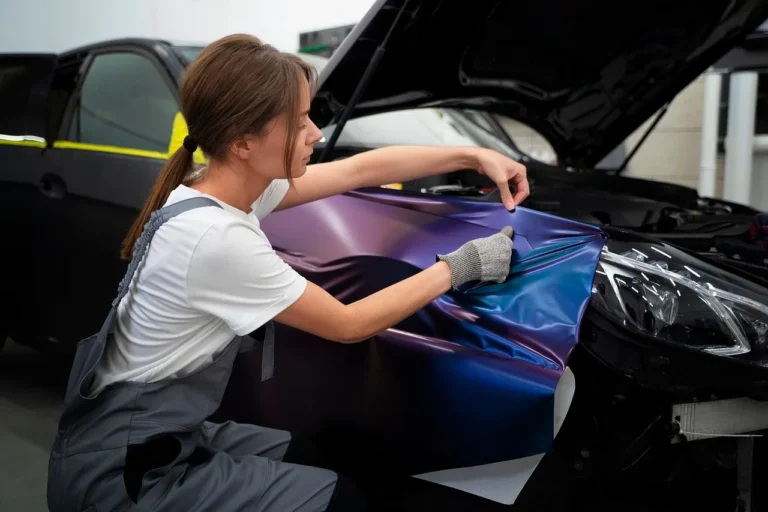
Best Water Spot Removers for Cars: Top 3 Picks Reviewed
Chemical Guys Heavy Duty Water Spot Remover Gel is the best all-around pick in this group for fresh mineral marks on paint and glass, Meguiar’s Water Spot Remover is the safer budget choice for light-to-moderate spots, and CARPRO Reload 2.0 is better treated as aftercare, not a remover. The right pick comes down to where the deposit sits, and whether it has etched the surface already.
Quick comparison
| Product | Badge | Best for | Price | ||
|---|---|---|---|---|---|
 |
CARPRO Reload 2.0 Silica + Siloxane Ceramic Spray Sealant –CARPRO | Our pick | 500mL (17oz) · Silica + Siloxane Ceramic Spray Sealant | $39.99
Price as of 19 Oct 2026
|
View |
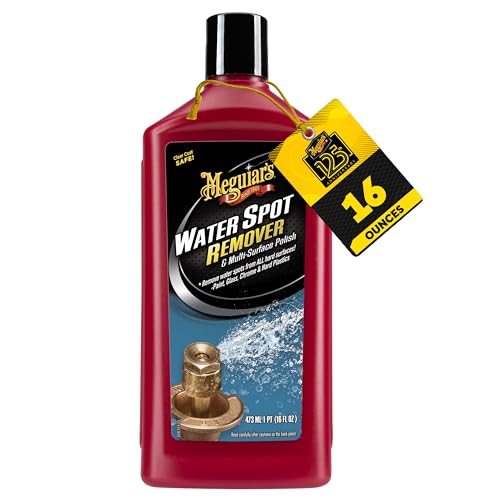 |
Meguiar’s Water Spot Remover, Water Stain Remover andMeguiar’s | Also great | 16 Oz · Water Spot Remover & Polish | $13.49
Price as of 19 Oct 2026
|
View |
 |
Chemical Guys, Heavy Duty Water Spot Remover Gel for GlassChemical Guys | Also great | 16 oz · Heavy Duty Water Spot Remover Gel | $19.97
Price as of 19 Oct 2026
|
View |
Hard water spots are calcium and lime deposits left behind by sprinkler water, wash water, or runoff. Fresh residue often comes off with the right chemistry. Etched spots need polish or correction, because the damage is in the clear coat, not just on it.
How we chose
This ranking follows failure mode first, not bottle strength. The main filters were spot severity, surface fit, odor and dwell-time behavior, and whether the product is a true remover or better used as maintenance after the spots are gone.
Surface compatibility mattered, too. Paint, glass, chrome, metal, ceramic coating, and matte finishes do not all tolerate the same chemistry or the same dwell time.
For the follow-up step, the question was whether a product can leave protection behind without creating more residue or gloss issues on the next wash.
What is the best water spot remover for cars?
The best choice depends on the spot, not the hype. For fresh to moderate mineral marks on paint and glass, Chemical Guys Heavy Duty Water Spot Remover Gel is the strongest fit among the listed products. Meguiar’s Water Spot Remover is the better low-risk option for lighter spots, while CARPRO Reload 2.0 belongs in the protection step after cleaning, not in the removal step.
That ranking changes when the surface changes. Clear coat, chrome, and glass can tolerate different approaches, and a ceramic-coated panel usually calls for the mildest effective cleaner first.
Quick picks
- Best for fresh to moderate spots: Chemical Guys Heavy Duty Water Spot Remover Gel.
- Best budget pick for light spots: Meguiar’s Water Spot Remover.
- Best for follow-up protection after removal: CARPRO Reload 2.0.
Formula type and fit
Chemical Guys uses a thick gel, which helps it cling to vertical panels and glass. Meguiar’s Water Spot Remover is a gel too, but the brand positions it more as a light-spot remover and polish. CARPRO Reload 2.0 is a silica and siloxane spray sealant, so its job is to reduce future spotting after the surface is already clean.
Cost per treatment estimate
| Product | Typical treatment assumption | Estimated cost per treatment |
|---|---|---|
| Chemical Guys Heavy Duty Water Spot Remover Gel | About 5-10 ml for a sedan panel set; 10-15 ml for a larger SUV footprint | About $0.62-$1.25 for a sedan and $1.25-$1.87 for an SUV, based on the listed $19.97 price and 16 oz bottle size |
| Meguiar’s Water Spot Remover | About 5-10 ml for a sedan; 10-15 ml for an SUV | About $0.13-$0.27 for a sedan and $0.27-$0.40 for an SUV, based on the listed $13.49 price and 16 oz bottle size |
| CARPRO Reload 2.0 | About 10-20 ml for a whole-vehicle maintenance layer after spot removal | About $0.61-$1.22 for a sedan and $1.22-$1.83 for an SUV, based on the listed $39.99 price and 500mL bottle size |
Those estimates are simple coverage math, not lab measurements. A sedan usually takes less product because there is less exposed horizontal surface, while an SUV needs more on roof, hood, and glass.
Can water spot remover be used on glass and chrome?
Yes, but only if the label names those surfaces and the spots are still deposits, not etching. Glass usually tolerates more aggressive cleaning than paint, while chrome often needs careful wipe-off and short dwell time because residue can leave visible streaking or dulling.
When a product says it is safe for paint and glass, that is not a blanket claim for matte paint, raw metal, or uncoated trim. Matte finishes deserve extra caution because glossy residue or burnishing is hard to reverse.
Is it safe on ceramic coating?
Sometimes, but “safe” means different things. A coating-safe water spot remover should be mild, low residue, and meant for coated vehicles. Even then, it should be used only long enough to clear the mineral film, because repeated strong acidic cleaning can shorten the life of the coating.
On a ceramic-coated panel, start with the least aggressive option that can still remove the spot. If a product is marketed for heavy mineral deposits, that does not make it the right first choice for a fresh coated surface.
Chemical Guys Heavy Duty Water Spot Remover Gel: best for fresh to moderate spots

This is the strongest fit in the list when the spot is still a mineral film on paint or glass. The thick gel clings to vertical panels, which helps on doors and side glass where spray formulas can run too fast. It is also the product here most clearly aimed at tougher hard-water staining.
The price works out well on a per-treatment basis, especially on a sedan. Based on the listed $19.97 price and 16 oz size, a normal application is inexpensive per panel even if you repeat the process carefully on a few sections. The drawback is simple: heavy-duty formulas demand tighter timing and more attention to residue.
Use it when the surface is paint, glass, or metal and the stain is still on the surface. Do not keep reapplying it to the same panel if the mark does not move; that usually means the deposit has already etched the clear coat and needs a different step.
Meguiar’s Water Spot Remover: best for light spots
This is the gentler budget option for light-to-moderate mineral marks. The product is sold as a gel formula and a multi-surface polish, and it is described as clear coat safe for paint, glass, and chrome. That makes it a practical first try when you want less risk than a stronger acid-heavy cleaner.
The drawback is reach. It is aimed at lighter spots, so severe neglected deposits may take more effort than the label suggests. Based on the listed $13.49 price for 16 oz, the cost per treatment is low, which makes it a reasonable starting point before you move to more aggressive correction.
It can be applied by hand or with a polisher, which is useful when the stain is spread across a hood or roof. If the mark remains after one careful pass, stop and inspect the surface rather than grinding away at it.
CARPRO Reload 2.0: best for aftercare
This is not a remover, and that matters. CARPRO Reload 2.0 is a silica and siloxane ceramic spray sealant, so it belongs after the mineral deposits are gone. Its job is to leave a slick, hydrophobic layer that helps water sheet or bead less aggressively on the next wash or storm.
The upside is broad surface use. The product is positioned to work on nearly all vehicle surfaces, wet or dry, which makes it useful after correction on paint and glass. The drawback is also obvious: it will not fix etched spots, and it should not be treated as a cleaner for stubborn staining.
At the listed $39.99 price for 500mL, its per-treatment cost is higher than the removers above, but it is doing a different job. Think of it as the maintenance layer that helps reduce repeat spotting after the vehicle is clean.
What if the spots are etched?
If the spot remains after a careful wipe with the right remover, or if the mark looks like a faint crater, haze ring, or dull patch in direct light, it may be etched into the clear coat. At that point, more remover is usually the wrong answer. You are dealing with surface damage, not surface residue.
That is the line where polish, clay, or professional correction makes more sense. Clay can remove bonded contamination that is sitting above the finish; polish is for actual clear-coat correction. If the etching is deep, a detailer may need to correct the panel rather than chase the same spot with acid.
How to tell residue from etching
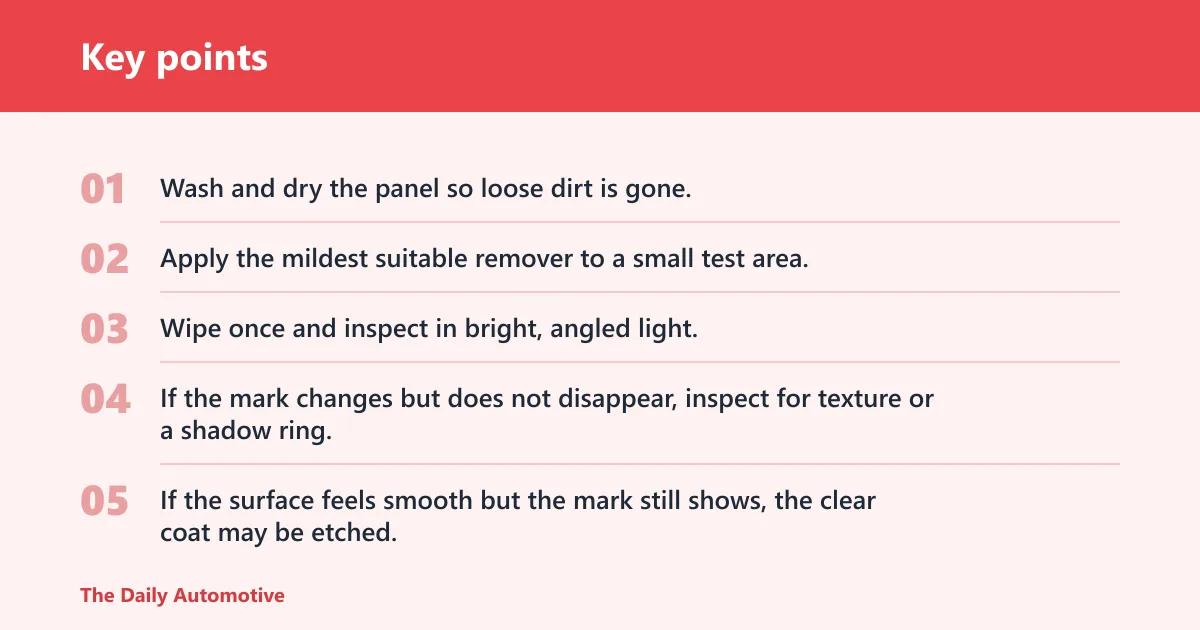
- Wash and dry the panel so loose dirt is gone.
- Apply the mildest suitable remover to a small test area.
- Wipe once and inspect in bright, angled light.
- If the mark changes but does not disappear, inspect for texture or a shadow ring.
- If the surface feels smooth but the mark still shows, the clear coat may be etched.
A common first-timer mistake is repeating the same strong cleaner on the same spot three or four times. That can haze clear coat without removing the root problem.
When to stop and switch tools
Stop with a remover if the stain is still visible after one or two careful passes. Move to polish when the spot is a visible ring in the clear coat. Move to professional correction when the defect is widespread, obvious across multiple panels, or located on a finish that you do not want to thin through repeated correction.
Water spot treatment matrix
| Spot severity | Surface | Recommended product or action |
|---|---|---|
| Fresh | Paint | Meguiar’s Water Spot Remover for the lightest marks; Chemical Guys Heavy Duty Water Spot Remover Gel if the film is more stubborn |
| Fresh | Glass | Chemical Guys Heavy Duty Water Spot Remover Gel, then rinse and inspect in angled light |
| Fresh | Ceramic coating | Start with the mildest effective remover; if the coating is sensitive or the panel is matte, test carefully and limit dwell time |
| Moderate | Paint | Chemical Guys Heavy Duty Water Spot Remover Gel, then protect the panel after correction |
| Moderate | Glass | Chemical Guys Heavy Duty Water Spot Remover Gel or Meguiar’s Water Spot Remover if the film is still light enough |
| Moderate | Chrome | Short dwell, gentle wipe, then rinse fully; do not let product dry on the surface |
| Etched | Paint | Stop using remover and move to polish or professional correction |
| Etched | Glass | Use glass-safe correction if appropriate, or consult a pro for deep mineral etching |
| Etched | Ceramic coating | Do not chase it with repeated acid; inspect for coating failure or clear-coat damage |
If you want the shortest rule: fresh spots get a remover, moderate spots get a stronger gel, and etched spots get correction. The wrong move is to keep treating etched damage as if it were still sitting on the surface.
Which one should you buy?
Choose Chemical Guys Heavy Duty Water Spot Remover Gel if you are dealing with stubborn fresh-to-moderate spots on paint or glass and want a thick formula that stays put. Choose Meguiar’s Water Spot Remover if the marks are lighter, you want a lower-cost option, or you need something you can use by hand or with a polisher.
Choose CARPRO Reload 2.0 only after the spots are gone and you want a hydrophobic maintenance layer on nearly all vehicle surfaces. If the car is ceramic coated, start mild and stop early; if the stain is etched, a remover is the wrong final step.
Say your sedan has sprinkler spots on the hood and front glass after one hot afternoon. A gel remover is the better first move because it can stay wet long enough to work, while a spray may run off before it has time to loosen the film.
Suppose the rear door glass still shows a white ring after a careful wipe and the paint around it looks dull in angled light. That is the point to stop calling it a spot and start thinking about etching, polish, or professional correction.
Frequently asked questions
Is a water spot remover safe on ceramic coating?
Only if the product is appropriate for coated surfaces and used carefully. A mild acidic blend is generally the safer route for ceramic-coated panels. Stronger products can still remove mineral deposits, but they also raise the risk of shortening coating life if left on too long.
What removes hard water spots from car paint?
Fresh hard-water spots on paint are usually removed with a gel or liquid remover designed for mineral deposits. If the stain is still visible after careful cleaning, it may have etched into the clear coat. At that point, polish rather than more remover is usually the better path.
How do I know if water spots are etched into clear coat?
If the spot survives a careful test with the right remover and still shows as a dull ring in angled light, it may be etched. Texture matters, too. If the panel feels smooth but the mark remains, the damage is likely in the clear coat rather than sitting on top of it.
Should I use a gel or spray water spot remover?
Use gel when you need more dwell time, especially on vertical panels or stubborn marks. Use spray when the residue is light and easy to cover quickly. A pH-neutral spray is often the safer maintenance choice, while stronger gels are better for heavier deposits that need more contact time.
What should I use after removing water spots to prevent them again?
Apply wax, sealant, or a ceramic maintenance layer after the surface is clean and dry. That helps water bead or sheet more predictably, which reduces the chance of new mineral marks sticking around. The key is protection plus quicker wash-up after sprinkler or wash-water exposure.
Will water spot remover damage my car’s paint?
It can if the product is too strong for the finish, left on too long, or used repeatedly on an etched area. The safest approach is to test a small area first, match the product to the spot severity, and stop once the residue is gone. If the spot does not move, change the method.
Products related to this article
Sponsored / affiliate links. As an Amazon Associate I earn from qualifying purchases. I may earn additional commission from eligible campaigns.