3 Best Spotless Water Filters for Car Washes (2026): We Compared
For most car washing, the best spotless water filter is a mixed-bed deionizing filter: choose a small single-cartridge unit for occasional driveway use, a refillable twin-canister setup for regular detailing, and a high-capacity system for frequent or multi-vehicle work. Skip the right filter, and mineral spots can force rework or towel drying. This guide compares three picks by water capacity, refill cost, and real wash volume.
Quick comparison
| Product | Badge | Best for | Price | ||
|---|---|---|---|---|---|
 |
20×4.5 inch Replacement Cartridges Spotless Car Wash WaterFilterFutureX | Our pick | 20×4.5" cartridge · 2-pack · mixed bed resin | $119.99
Price as of 25 Oct 2026
|
View |
 |
Adam’s Polishes Portable Spotless Water Deionizer –Adam’s Polishes | Upgrade pick | 1120-gal · with TDS meter · 20 lb resin | $712.49
Price as of 25 Oct 2026
|
View |
 |
iSpring WGB22BD Spotless Water System for Car Wash,iSpring | Budget pick | 1200-gal · 20" filter · with rolling cart | $419.99
Price as of 25 Oct 2026
|
View |
 |
VEVOR Deionized Filter for Spotless Car Wash System, 2 xVEVOR | Also great | 2×0.5L · color-changing resin · VEVOR-compatible | $27.90
Price as of 25 Oct 2026
|
View |
The main trade-off is simple: smaller 10-inch cartridges fit easily and cost less to start, but they exhaust sooner on hard water. Larger housings and refillable resin systems cost more at purchase and take more space, yet they stay useful longer and can lower cost per wash.
If you wash only now and then, the 10-inch route is the least complicated. If you detail often, capacity and maintenance rhythm matter more than sticker price.
How we chose
These picks were compared on car-wash fit, not aquarium priority. The useful questions are how long the resin should last in spot-free rinsing, whether the housing fits common RO/DI hardware, how obvious exhaustion is, and what ownership cost looks like after the first cartridge swap.
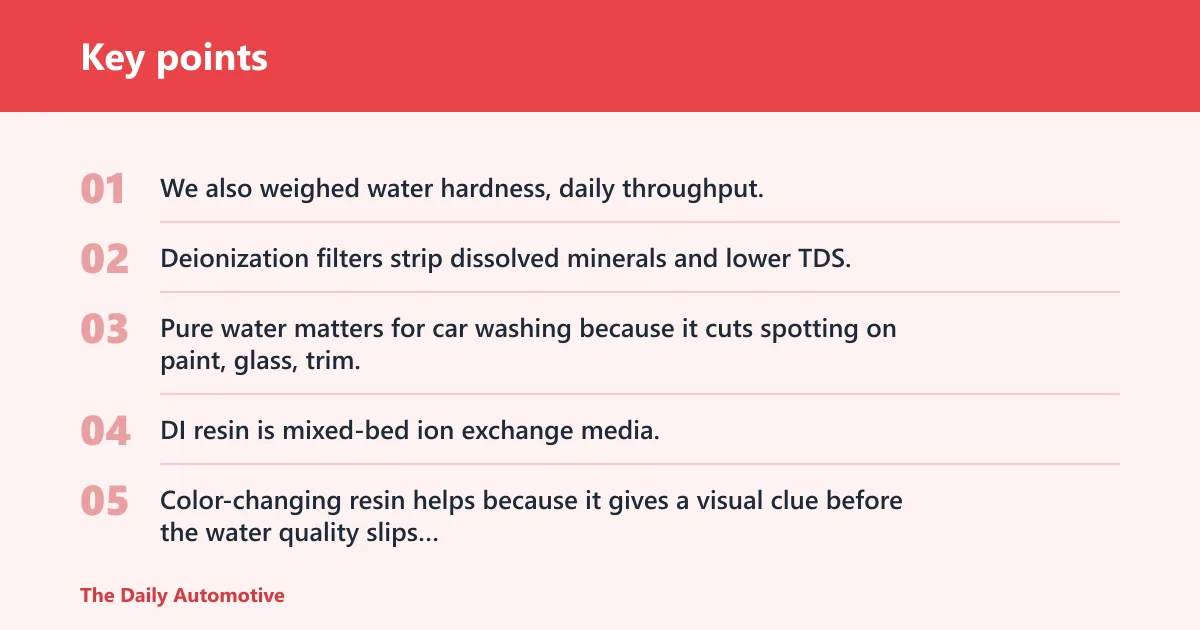
We also weighed water hardness, daily throughput, and whether the setup belongs at the hose bib, behind a pressure washer, or in a fuller RO/DI train with prefiltration before the DI stage.
Car-wash fit and rinse quality
Deionization filters strip dissolved minerals and lower TDS, which is what you want at the final rinse. Pure water matters for car washing because it cuts spotting on paint, glass, trim, and mirrors after air drying or blower drying.
Capacity and maintenance burden
DI resin is mixed-bed ion exchange media, so it trades dissolved solids for cleaner water until the bed is spent. Color-changing resin helps because it gives a visual clue before the water quality slips far enough to leave spots.
Housing compatibility and cartridge format
A 10-inch cartridge is the common consumer size and fits many RO/DI housings. A 4.5 x 20 filter format is a large-format DI cartridge used in spotless systems, and refillable cartridges matter when you want to replace resin instead of the whole shell.
Ownership cost and refill options
Disposable cartridges are simpler. Refillable cartridges can save money and cut waste. That matters more when you wash often, use hard water, or keep the system set up for a pressure washer, hose reel, or rolling cart.
| Pick | Expected water capacity range | Cartridge size | Refillable? | Common RO/DI housing compatibility | Likely maintenance trigger | Best-fit user type |
|---|---|---|---|---|---|---|
| FilterFutureX 20×4.5 inch Replacement Cartridges | Low to moderate, depending on inlet TDS and wash volume | 20×4.5 inch | No | Works with large-format RO/DI housings that accept 20×4.5 cartridges | Swap when TDS rises or the resin color changes through the bed | Occasional washers who want a larger cartridge than the basic 10-inch format |
| iSpring WGB22BD Spotless Water System | High, with 1200-gal resin capacity listed | 20-inch filter | No | Built as a spot-free car-wash system rather than a loose cartridge-only part | Replace when output TDS creeps up during a wash or the system reaches its rated capacity | Detailers and owners who wash multiple vehicles and want fewer changeouts |
| Adam’s Polishes Portable Spotless Water Deionizer | Moderate to high, with 1120-gal listed capacity | Portable deionizer tank | No | Garden-hose attachment, not a standard cartridge housing | Watch the included TDS meter and replace resin when zero-TDS output is no longer holding | Users who want a portable spot-free rinse setup with built-in monitoring |
20×4.5 inch replacement cartridges: best for occasional washes
The FilterFutureX 20×4.5 inch replacement cartridges fit the occasional-driveway category well because the format is familiar, the cartridge is large enough to be practical, and the 2-pack keeps replacement planning simple. The universal 20×4.5 inch standard size is the main advantage here, especially if you already use that housing format in a spot-free rinse setup.
This is the more straightforward choice if you want a disposable cartridge and do not want to build a larger system around it. The double-seal design is a useful detail because it helps reduce leak risk at the housing interfaces.
The drawback is the same one most replacement cartridges have: once the resin is spent, the whole cartridge comes out. That means less control over long-term cost than a refillable shell, and capacity will depend heavily on your inlet TDS and how many gallons you push through per wash.
iSpring spotless water system: best for higher-volume detailing
The iSpring WGB22BD fits higher-volume detailing better than a small cartridge because the published 1200-gal resin capacity gives you more margin before exhaustion. The rolling cart matters too, because a portable spotless system is easier to move around a driveway, shop bay, or multi-vehicle job.
Use this when throughput matters more than compact size. If you wash several vehicles in a week, the extra capacity can reduce interruptions and lower the odds of starting a rinse with a weak resin bed.
The drawback is cost and footprint. You are paying for a fuller system, not a simple cartridge swap, and that makes it less attractive if you only wash occasionally or only need spot-free water for one vehicle at a time.
Adam’s Polishes Portable Spotless Water Deionizer: best for monitored rinse setups
Adam’s Polishes Portable Spotless Water Deionizer makes sense if you want a hose-fed spot-free rinse setup with an included TDS meter and a published 1120-gal capacity. That meter is useful because TDS is the number that tells you whether the water is still close to the zero-TDS benchmark used for spotless rinsing.
It is a strong option for people who want a portable unit that tracks resin condition more directly than a plain cartridge changeout. The preloaded virgin high-grade resin and claimed zero TDS output at 100ppm input are the headline details.
The drawback is price. It is the priciest option in this comparison, and it is still a cartridge-style ownership model rather than a true refillable housing, so the savings come from convenience and monitoring rather than from cheaper resin refills.
Which one should you buy?
Choose the 20×4.5 cartridge if you wash a few vehicles a month, want a simple setup, and already use a large-format RO/DI housing. Choose the iSpring system if you want more gallons before exhaustion and need a setup that can keep up with repeated detailing sessions. Choose the Adam’s unit if you want built-in TDS monitoring and a portable hose-connected system with published capacity.
If your water is very hard, move up a size sooner. Hard water loads DI resin faster, so a small cartridge can go from acceptable to spent much sooner than the same cartridge on softer water.
Say your rinse water starts at a high TDS and you are washing a black sedan with full sun on the panels. A small cartridge may still make the first half of the wash look clean, then creep upward near the final rinse and leave faint spotting on the hood and glass.
Suppose you are running two SUVs and a truck back-to-back. The larger system is the better fit because you are less likely to interrupt the job to swap a spent resin bed before finishing the last rinse and blower pass.
What TDS should water be?
For spot-free car washing, the target is zero TDS, or as close to it as the system can hold. Once TDS starts to creep up, mineral load is getting through the resin bed and the chance of spots rises, especially on glass and dark paint.
A practical read on the number matters more than chasing an abstract purity claim. If the output meter no longer stays near zero during the final rinse, the resin is nearing exhaustion and replacement should move up the list.
What happens when TDS creeps up
When TDS rises during a wash, the water still looks clear, but it carries more dissolved solids than before. Those solids dry into visible spots, and on a warm panel they can leave a sharper outline that is harder to remove than a normal drying mark.
The failure case is not subtle. You may finish a panel, blow it off, and find that the rinse no longer leaves a true spot-free finish even though the water seems fine at the nozzle.
Do I need a deionization filter for car washing?
You need one if you want a true spotless rinse setup and your local water leaves mineral spots after drying. DI resin is the final polishing stage in many RO/DI systems, and it is the part that pushes water toward the zero-TDS benchmark that makes spot-free rinsing possible.
If your water is soft and your wash routine already ends with towel drying, you may not need a DI stage. If you wash in the sun, work on glass often, or want to reduce drying time on paint, DI makes more sense.
What size deionization filter fits a car wash setup?
The common answer is a 10-inch cartridge for a compact setup, or a 4.5 x 20 filter format when you want more capacity. A 10-inch cartridge fits many RO/DI housings, while the larger format is better when you want a bigger resin bed for car-wash duty.
Pick the size by wash volume, not by marketing language. A weekend driveway washer does not need the same cartridge as a detailer who runs several vehicles a day.
Matching size to throughput
Water hardness and daily throughput matter because they decide how quickly the resin bed is spent. The harder the water and the higher the gallons per day, the more useful a larger cartridge or a refillable housing becomes.
That is why a small cartridge can be fine for one sedan, while a larger system belongs on a shop cart or hose-fed detailing rig.
How do I know when DI resin is exhausted?
Color-changing resin is the easiest visual signal, but TDS is the better check. If the resin has changed color through the bed, or if output TDS begins rising from zero, the DI stage is no longer polishing water the way it should.
Some systems also show exhaustion through behavior: drying marks return, especially on dark panels and glass, and the final rinse stops looking clean without a towel follow-up.
Replacement timing cues
- Watch the color-changing resin indicator.
- Check the output with a TDS meter if your system has one.
- Replace or refill the resin when TDS no longer stays near zero during the rinse.
- Move sooner if inlet water is hard or wash volume jumps.
Is a refillable DI filter better than a replacement cartridge?
A refillable cartridge is usually better if you wash often and care about long-term cost. You replace only the mixed-bed resin, not the entire shell, which can lower waste and make repeated maintenance cheaper over time.
A replacement cartridge is better if you want simple ownership and do not want to open housings, measure resin, or manage refill media. The trade-off is higher recurring cost and more spent plastic.
Ownership-cost reality
Refillable cartridges can save money and reduce waste, but only if you use the system enough to justify the extra maintenance step. If your wash schedule is light, a sealed replacement cartridge may be the cleaner choice.
Can I use an RO/DI filter for pressure washing or detailing?
Yes, but the setup matters. An RO/DI system works best with a reverse osmosis pre-stage and a DI final polishing stage when you want pure water for spot-free rinsing, and that can feed detailing work, windows, and light rinse-only pressure washing.
DI alone can be enough for a car-wash setup when your inlet water is already manageable and you only need the final polish. For heavier mineral loads, RO ahead of DI extends cartridge life and keeps the DI stage from exhausting too fast.
Setup basics for a spotless rinse system
Put sediment and carbon prefiltration ahead of DI if your source water needs it, then route the hose so the final rinse is the only water hitting the panels. Keep the spotless system at the hose bib, near the pressure washer inlet, or on a cart where the hose path stays short and tidy.
A common first-timer mistake is putting the DI stage too early in the line and then using the same treated water for jobs that do not need it. That wastes resin and shortens the time before exhaustion.
Frequently asked questions
What is the best spotless water filter for car washing?
The best choice depends on wash volume, but a mixed-bed deionizing filter is the right type for spot-free rinsing. For occasional use, a 10-inch cartridge is simple. For frequent detailing, a higher-capacity system or refillable setup is the stronger fit because it stretches capacity and reduces changeouts.
How many gallons does a DI resin filter last for car washing?
There is no single gallon number that fits every setup because inlet TDS, water hardness, and flow rate change the result. A high-capacity unit may last far longer than a compact cartridge, while hard water can shorten service life sharply. TDS monitoring is the safer way to judge exhaustion.
What TDS should water be for spot-free car washing?
The target is zero TDS, or as close to zero as your system can hold. Once TDS starts to creep up, spots become more likely on paint and glass. If you want the cleanest result, check the output during the final rinse rather than assuming the resin is still fresh.
Products related to this article
Sponsored / affiliate links. As an Amazon Associate I earn from qualifying purchases. I may earn additional commission from eligible campaigns.
 2026 Upgraded Home High-Pressure Car Wash Water Gun, Adjustable Nozzle, for Garden Hose, Car Washing, Window/Patio Cleaning
 2026 Upgrade Crystal Coating for Car, Plastic Parts Crystals Coating, Plastics Parts Crystal Coating Plastic Restorer with Spong, Long Duration Refurbish Coatings Agent for Automotive Plastics (4)