Lucas Oil Heavy Duty Oil Stabilizer Review
Lucas Heavy Duty Oil Stabilizer is worth considering only for a worn, noisy, or oil-burning engine that can tolerate thicker oil; if your engine needs fast cold flow or a modern API/dexos spec, skip it. Used badly, it can slow lubrication and worsen cold starts. This guide explains when it helps, when it hurts, and which Lucas formula fits better.
Verdict and fit

It is commonly recommended for older engines with real wear symptoms, not for healthy late-model engines that depend on thin oil. Its value comes from thickening the sump oil enough to improve hot idle pressure, reduce light noise, and sometimes cut consumption. That same thickness can work against winter starts, VVT systems, and thin-oil specs.
Best-fit engines and symptoms
Lucas Heavy Duty Oil Stabilizer makes the most sense in a high-mileage engine, typically 75,000+ miles, when the complaint is light lifter tick, low hot idle pressure, seepage, or moderate oil use. It is generally used as a bandage for viscosity behavior, not as a repair for bearing wear, cam wear, or a failing oil pump.
When to skip it entirely
It is generally skipped when an engine calls for 0W-20, 0W-16, or another thin-grade spec and still runs quietly. Skip it in cold climates where winter starts matter, and skip it when a noise sounds like knock or severe valvetrain fault. In those cases, diagnosis comes before additives.
What does lucas Heavy Duty oil Stabilizer do?
Lucas Heavy Duty Oil Stabilizer is a 100% petroleum multi-use oil supplement. Lucas says it reduces friction, heat, and wear in any type of engine, claims it reduces oil consumption, claims it eliminates dry starts, and says it raises oil pressure. The practical effect is thicker oil, not a mechanical repair.
Claims versus likely real-world effect
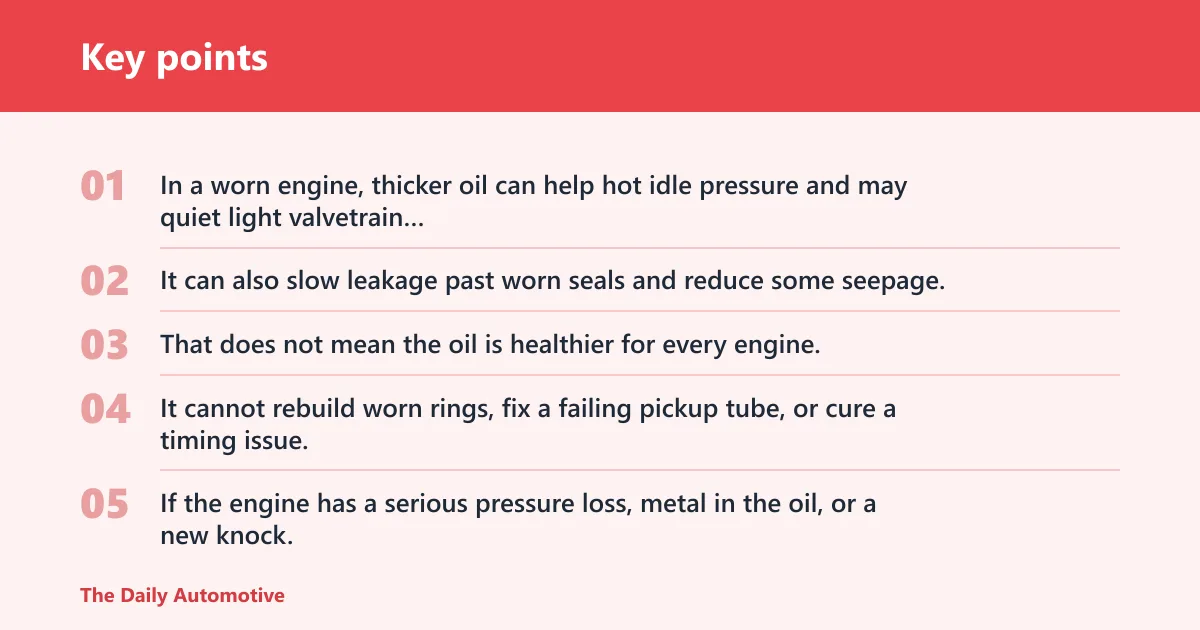
In a worn engine, thicker oil can help hot idle pressure and may quiet light valvetrain noise. It can also slow leakage past worn seals and reduce some seepage. That does not mean the oil is healthier for every engine; the right question is whether the engine can tolerate extra viscosity without hurting cold flow or spec compliance.
What it cannot do
It cannot rebuild worn rings, fix a failing pickup tube, or cure a timing issue. If the engine has a serious pressure loss, metal in the oil, or a new knock, the additive is the wrong first move. A thickener can hide symptoms while the underlying fault gets worse.
Which Lucas formula matches your engine?
The three Lucas versions do different jobs. Heavy Duty Oil Stabilizer is presented as a thickener for older, worn, or noisy engines. Pure Synthetic Oil Stabilizer is the synthetic-compatible option Lucas recommends for Ford Powerstrokes. Low Viscosity Oil Stabilizer is the better match for modern thin oils, hybrids, and VVT engines because it is designed to work with the oil already in the crankcase.
Heavy duty oil stabilizer
Use this when the engine already benefits from more viscosity. That means older pushrod engines, engines with light seepage, and some high-mileage gasoline or diesel engines that show low hot pressure or light oil burning. It is the least attractive choice for very thin factory fills.
Pure synthetic oil stabilizer
This is the Lucas option intended for synthetic oils. Lucas specifically recommends it for Ford Powerstrokes, and one stated use case is one quart per oil change for synthetic-compatible use in those applications. That does not make it a universal diesel fix; oil spec and model-year requirements still matter.
Low viscosity oil stabilizer
This is the safer choice for modern engines that already run thin oil. Lucas positions it for hybrids and VVT engines. If the owner’s manual calls for a low-viscosity grade, this version is the closer match because it is built to support the oil already in use rather than turn it into a much thicker blend.
How the thickener changes oil behavior
Thickening changes more than noise. It can raise hot idle oil pressure in a worn engine, improve overnight film retention, and reduce some oil consumption. It can also slow flow on cold start, which is why the same bottle that helps a tired truck can be a poor fit for a winter commuter.
Hot idle pressure
A review of a 2005 Chevrolet Silverado with a 5.3L V8 and 158,000 miles reported a 5-10 PSI increase in hot oil pressure after adding 1 quart of Lucas in a 6-quart system over 5,000 miles and 4 months. That kind of gain can help a worn engine, but pressure alone does not prove less wear.
Cold-start behavior and overnight film retention
Thicker oil tends to stay on parts longer after shutdown, which is why people often associate it with quieter first starts and less lifter tick. But cold oil also takes longer to move through galleries and up top end passages. In freezing weather, that tradeoff matters more than the noise reduction.
Additive package dilution and viscosity tradeoffs
Once you add a supplement, you are no longer running the oil blend the bottle on the shelf was designed to meet. That can dilute the additive package already built into the oil and move the finished blend away from the intended viscosity grade. It may still be compatible with conventional, synthetic, ATF, or mineral oil, but compatible does not mean ideal for every engine or every specification.
Pros and cons
Pros
- Can help worn engines with light noise or lifter tick.
- May improve hot idle pressure in tired engines.
- May reduce some oil consumption and seepage.
- Useful when the engine already prefers thicker oil.
Cons
- Can slow cold flow and worsen winter starts.
- Can conflict with thin-oil specs like 0W-20 or 0W-16.
- Can dilute the oil’s additive balance.
- May mask a real fault instead of solving it.
Should you use Lucas Heavy Duty oil Stabilizer?
Judge the engine first, not the bottle. The real question is simple: is the engine worn enough to use thicker oil without straying from the grade it was built for? If the answer is no, choose a different Lucas formula or leave the sump alone.
| Engine age/mileage | Symptoms | Climate | Oil spec | Recommended Lucas formula | Red flags |
|---|---|---|---|---|---|
| 2005-era pushrod V8, 150,000+ miles | Light lifter tick, lower hot idle pressure | Mild to warm | Conventional or wider-spec oil | Heavy Duty Oil Stabilizer | New knock, metal in oil, or severe pressure loss |
| Modern sedan, under 80,000 miles | Normal operation, no oil use | Any | 0W-20 | No additive | Need for fast cold flow and warranty compliance |
| Work truck with winter starts | Some tick only after sitting overnight | Cold winter | Factory thin-grade oil | Low Viscosity Oil Stabilizer or none | Thicker blend may slow start-up lubrication |
| High-mileage SUV | Moderate oil use between changes | Temperate | Conventional or synthetic blend | Heavy Duty Oil Stabilizer | Smoke, fouled plugs, or sudden consumption jump |
| VVT turbo car | Noise under load, possible timing issues | Any | Thin synthetic spec | Low Viscosity Oil Stabilizer or none | Thick oil can upset VVT response |
| Older small-block with seepage | Wet valve covers, drip at seals | Mild | Conventional or mineral oil | Heavy Duty Oil Stabilizer | Severe leaks need seal repair, not thicker oil alone |
| Synthetic-oil diesel | Normal wear, longer drain intervals | Varies | Synthetic diesel oil | Pure Synthetic Oil Stabilizer | Check diesel spec, emissions system needs, and fill volume |
| Hybrid with thin oil | Quiet, efficient operation | Mixed | 0W-16 or 0W-20 | Low Viscosity Oil Stabilizer or none | Thickening works against the engine’s design target |
Red flags that point to a different fix
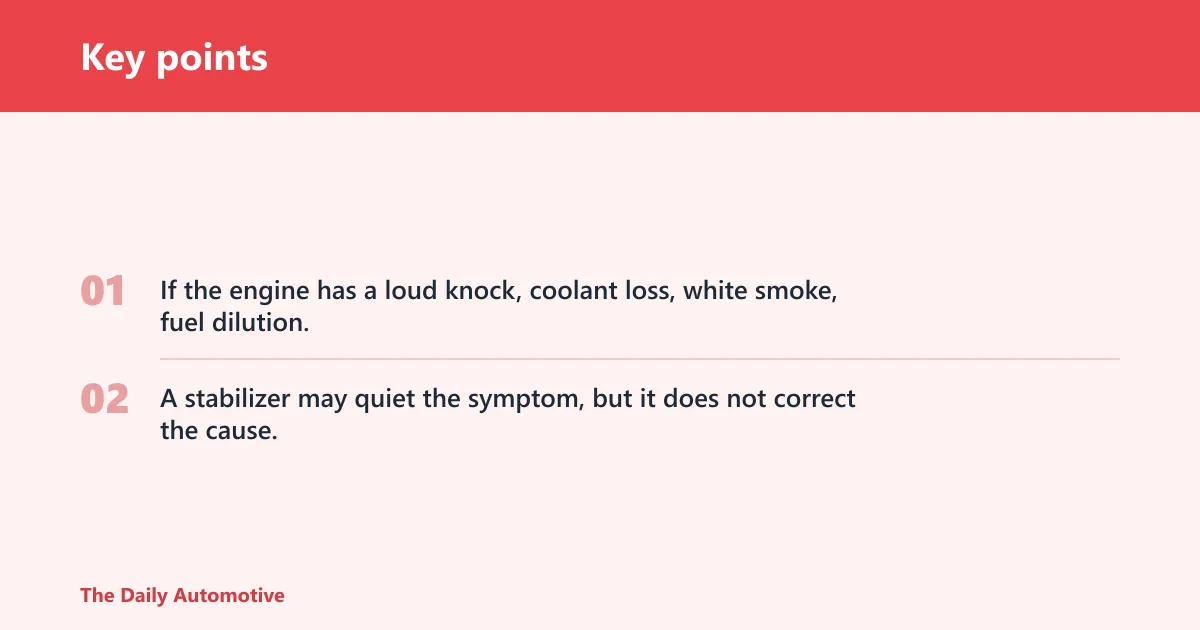
If the engine has a loud knock, coolant loss, white smoke, fuel dilution, or a sudden pressure drop, do not treat Lucas as the answer. Those are diagnostic problems. A stabilizer may quiet the symptom, but it does not correct the cause.
Who should use it, and who should avoid it?
This product suits owners of older, higher-mileage engines that already show wear-related symptoms and can accept a thicker oil blend. It does not suit owners of modern turbo cars, VVT engines, hybrids, or any engine built around a thin oil spec and quick cold flow. That difference matters more than odometer mileage alone.
Who it’s for
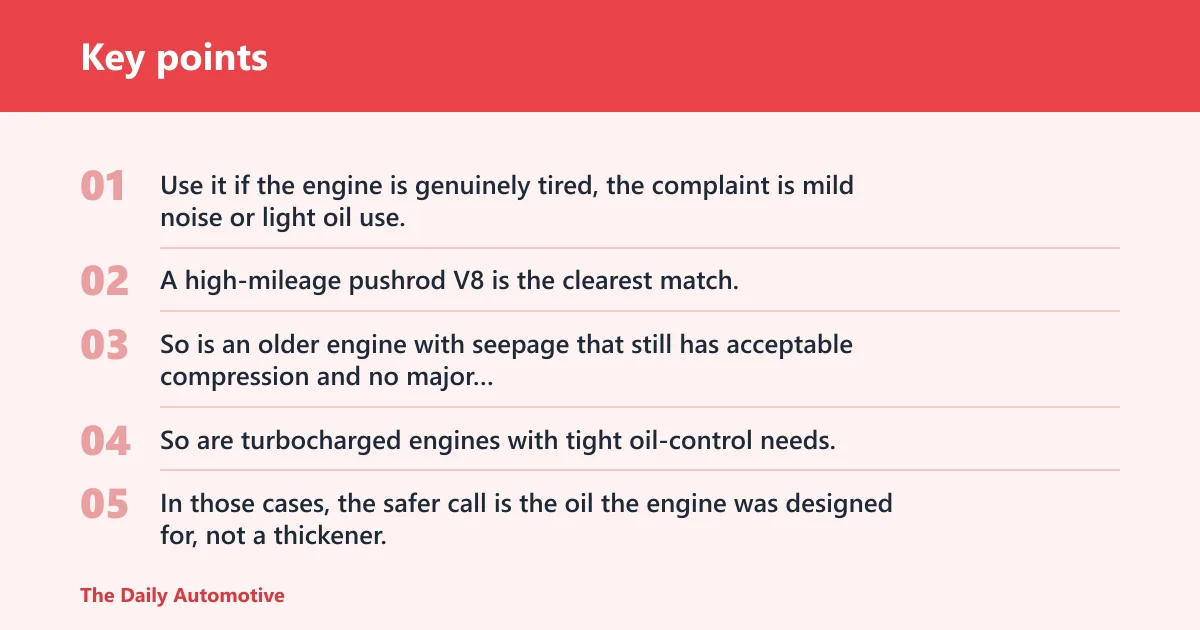
Use it if the engine is genuinely tired, the complaint is mild noise or light oil use, and the owner’s manual does not demand a tight thin-oil spec. A high-mileage pushrod V8 is the clearest match. So is an older engine with seepage that still has acceptable compression and no major fault codes.
Who should avoid it?
A modern 0W-20 sedan is a poor fit. So are turbocharged engines with tight oil-control needs, VVT engines that rely on fast oil movement, and hybrids that spend much of their life cold or lightly loaded. In those cases, the safer call is the oil the engine was designed for, not a thickener.
Say your 5.3L pickup has 180,000 miles, a slight hot idle tick, and a quart-per-5,000-mile oil use pattern. A small amount of Heavy Duty Oil Stabilizer may help noise and consumption. Change only one variable at a time, though. If the tick becomes louder after a winter cold snap, the thicker blend may be the wrong direction.
Suppose your 0W-20 sedan starts quietly in July but cranks longer in January after an additive change. That points to a viscosity mismatch, not a benefit waiting to appear later. Back out of the thickener and return to the correct oil before judging the engine.
How much Lucas Heavy Duty Oil Stabilizer should you use?
Start with restraint. Keep the finished oil within a sensible viscosity range and do not overfill the sump. The product should supplement oil, not replace so much of it that the level or the intended grade goes off target. If the engine already runs a thin-spec oil, use none at all or choose the low-viscosity version instead.
Conservative mix guidance
One review cited Lucas suggesting 20% stabilizer for routine use, and another cited 1 quart per oil change for synthetic-compatible use in Ford Powerstroke applications. Those figures are not a blanket instruction for every engine. For most owners, the safer approach is to add less than a full bottle first, then recheck fill level and behavior after a normal drive cycle.
Why not to overfill or chase pressure
More pressure is not automatically better. If the engine already meets spec and pressure is normal, thickening the oil can add drag, slow circulation, and create cold-start penalty without a real gain. Pressure changes should be read against the engine’s condition, not used as proof that the product fixed wear.
Frequently asked questions
Does Lucas Heavy Duty Oil Stabilizer really work?
It can work as a thickener in engines that are already worn enough to benefit from higher viscosity. In that setting, owners may see quieter operation, slightly higher hot idle pressure, or less consumption. It is far less appropriate for healthy late-model engines that were designed around thin oil.
Is Lucas Heavy Duty Oil Stabilizer safe for modern engines?
Not as a default choice. Modern engines that call for 0W-20, 0W-16, or similar thin oil need fast cold flow and specific additive balance. Thickening the oil can work against that design. For those engines, Low Viscosity Oil Stabilizer or no additive is the safer answer.
What are the problems with Lucas Oil Stabilizer?
The main problems are thicker cold oil, possible mismatch with the recommended oil spec, and additive dilution. It can also hide a real mechanical issue instead of solving it. If a noise sounds serious, the right move is diagnosis, not a heavier bottle.
Lucas heavy duty oil stabilizer vs synthetic oil stabilizer
Heavy Duty Oil Stabilizer is the general thickener for older or worn engines. Pure Synthetic Oil Stabilizer is the synthetic-friendly choice, and Lucas recommends it for Ford Powerstrokes. Use the formula that matches the oil type and engine design, not the one with the strongest marketing language.
Products related to this article
Sponsored / affiliate links. As an Amazon Associate I earn from qualifying purchases. I may earn additional commission from eligible campaigns.