Maintenance Package Review: Is It Worth It?
A prepaid maintenance package makes sense only when the contract total is lower than the cost of the same covered services paid one by one, with at least a 10% margin after fees and exclusions. If you miss the fine print, you can end up paying upfront for oil changes, tire rotations, or inspections you would have skipped anyway. This maintenance package review breaks down what these plans cover, what they leave out, and when they beat pay-as-you-go service.
This guide is part of our Car care and upkeep guide series.
Verdict: when prepaid maintenance pays off
The package works best when you will use most covered services, your mileage fits the term, and the contract does not force dealer-only service or add fees that wipe out the discount. It is usually weakest for low-mileage owners, stronger for leased vehicles, and most useful when posted service prices are plainly higher than the package price.
Bottom line by mileage pattern
High-mileage drivers and lease drivers are the most likely to come out ahead if the plan covers the exact services the vehicle needs. Low-mileage drivers often pay for visits they never use. If the package covers only routine service, judge it like any fixed-cost purchase: compare the full contract price against the cost of the same oil changes, rotations, filters, brake fluid, and inspections bought one at a time.
The fastest way to tell if the package is overpriced
Add the covered services at posted dealer prices, then subtract any items you would skip or buy elsewhere. If the package price plus fees is within 10% of that total, the savings are thin and exclusions can erase them fast. If the package is materially cheaper and the service schedule fits your ownership timeline, it can be the better buy.
What is a maintenance package?
A maintenance package is a prepaid service schedule. You pay a fixed amount up front or in installments for routine items at set intervals, usually over a term length or mileage cap. Value depends on what is covered, where you can redeem it, whether it transfers to the next owner, and which exclusions still trigger extra charges.
Prepaid service schedule and term limits
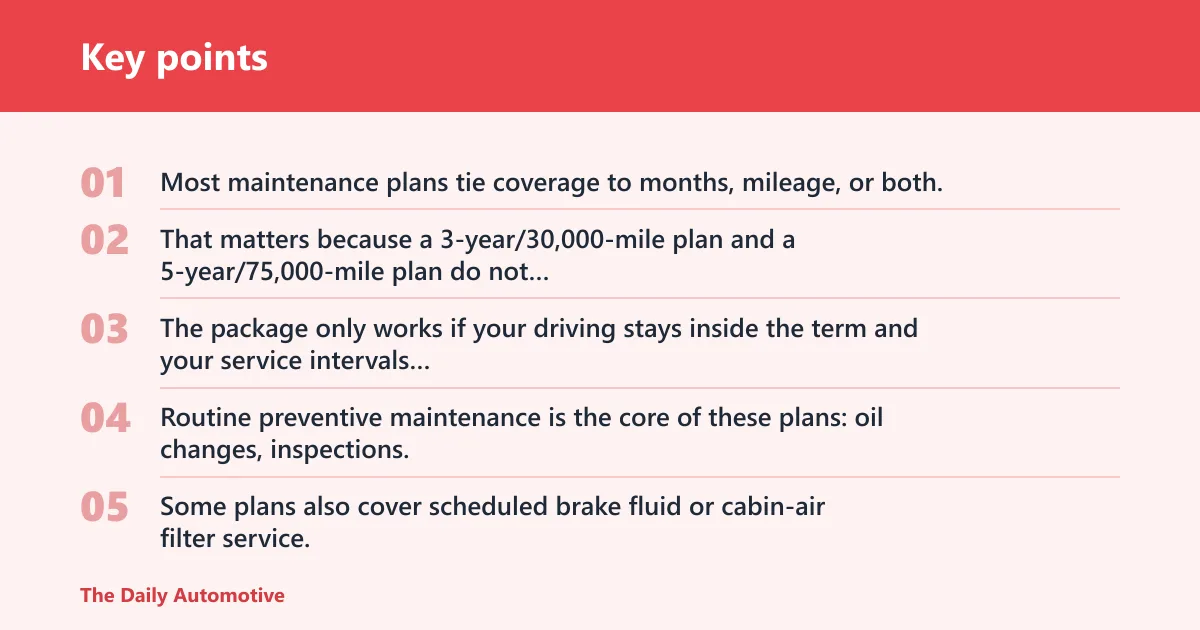
Most maintenance plans tie coverage to months, mileage, or both. That matters because a 3-year/30,000-mile plan and a 5-year/75,000-mile plan do not cover the same ownership window. The package only works if your driving stays inside the term and your service intervals match the included visits.
What is usually covered?
Routine preventive maintenance is the core of these plans: oil changes, inspections, fluid checks, filter replacements, and often tire rotations. Some plans also cover scheduled brake fluid or cabin-air filter service. Read the offer as a maintenance checklist with prices attached, not as open-ended protection.
Common exclusions and wear items
Packages often exclude wear items and parts that fail from age or use, such as brake pads, wiper blades, light bulbs, tires, alignment work, and any post-failure repair. That line matters because corrective maintenance restores equipment after a fault is found, while reactive maintenance is also called unplanned maintenance. Those costs usually sit outside prepaid service.
Transferability and cancellation terms
Transfer rules affect resale value. A transferable plan can help a private-sale buyer see remaining service value, while a nontransferable plan ends with the original owner. Cancellation terms also matter: some contracts refund only unused time, some subtract administrative fees, and some prorate by miles used. Those details belong in the price comparison.
Pros and cons of prepaid maintenance
Prepaid service has one main advantage: cost certainty for scheduled work. Its main weakness is that you may pay for service you would not have bought, or for coverage that excludes the items you end up needing. The value comes from matching the contract to your actual service pattern.
Pros
- Fixed cost for covered routine maintenance.
- Predictable service intervals and easier budgeting.
- Can help if dealer prices are high for common items.
- May transfer to a later owner, improving resale appeal.
Cons
- Coverage gaps for wear items and corrective maintenance.
- Unused visits can make low-mileage ownership expensive.
- Dealer-only rules can block lower-priced independent shops.
- Fees, exclusions, and filing rules can reduce real savings.
What maintenance items are usually covered?
Most plans cover the scheduled work that keeps a vehicle on track: oil changes, tire rotations, inspections, and some fluid and filter replacements. Coverage can end sooner than buyers expect, especially when the contract limits service to a dealer network or excludes premium fluids, synthetic-upcharge items, and wear parts.
Oil changes and filter replacements
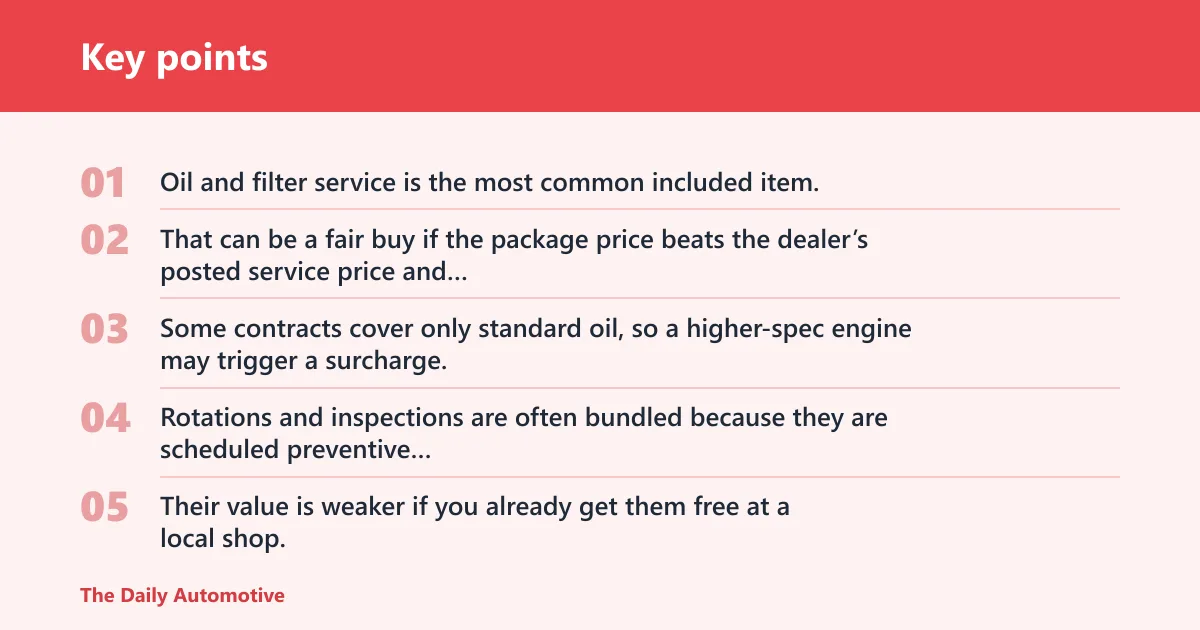
Oil and filter service is the most common included item. That can be a fair buy if the package price beats the dealer’s posted service price and if the plan allows the oil grade your vehicle needs. Some contracts cover only standard oil, so a higher-spec engine may trigger a surcharge.
Tire rotations and multi-point inspections
Rotations and inspections are often bundled because they are scheduled preventive maintenance and easy to price in advance. Their value is weaker if you already get them free at a local shop, through a tire retailer, or through another service agreement. Check whether the inspection is only a visual checklist or a paid diagnostic visit.
Brake fluid, cabin filters, and other add-ons
Brake fluid service, cabin filters, engine air filters, and spark plugs may appear in some contracts but not others. The price can shift quickly if the package includes only one filter and leaves the rest as add-ons. These items deserve special attention because they often become surprise charges.
Dealer-only vs independent-shop eligibility
Dealer-only eligibility narrows your options and can erase savings if the dealer charges more than local shops. Independent-shop eligibility is more flexible, but the plan still needs a usable claims process and clear approval rules. For a maintenance plan, service access and inspection standards matter as much as headline price.
Maintenance package worksheet
This worksheet uses sample pay-as-you-go prices to show the break-even math. Replace the figures with your dealer quote, your local shop quote, and the exact package price. The decision is simple: if the package total is not at least 10% cheaper than the same services paid one by one, it is usually a weak buy.
| Ownership profile | Oil changes | Rotations | Filters | Brake fluid | Inspections | Pay-as-you-go total | Sample package price | Package wins? |
|---|---|---|---|---|---|---|---|---|
| Low-mileage commuter | 2 × $85 = $170 | 2 × $35 = $70 | 1 × $40 = $40 | 0 × $120 = $0 | 2 × $45 = $90 | $370 | $425 | No |
| Average driver | 4 × $85 = $340 | 4 × $35 = $140 | 2 × $40 = $80 | 1 × $120 = $120 | 4 × $45 = $180 | $860 | $725 | Yes |
| High-mileage driver | 6 × $85 = $510 | 6 × $35 = $210 | 3 × $40 = $120 | 1 × $120 = $120 | 6 × $45 = $270 | $1,230 | $950 | Yes |
The low-mileage commuter loses because the package costs more than the same service bought individually. The average driver wins by a meaningful margin. The high-mileage driver wins more clearly because the plan absorbs more routine visits, and the fixed cost spreads across more service events.
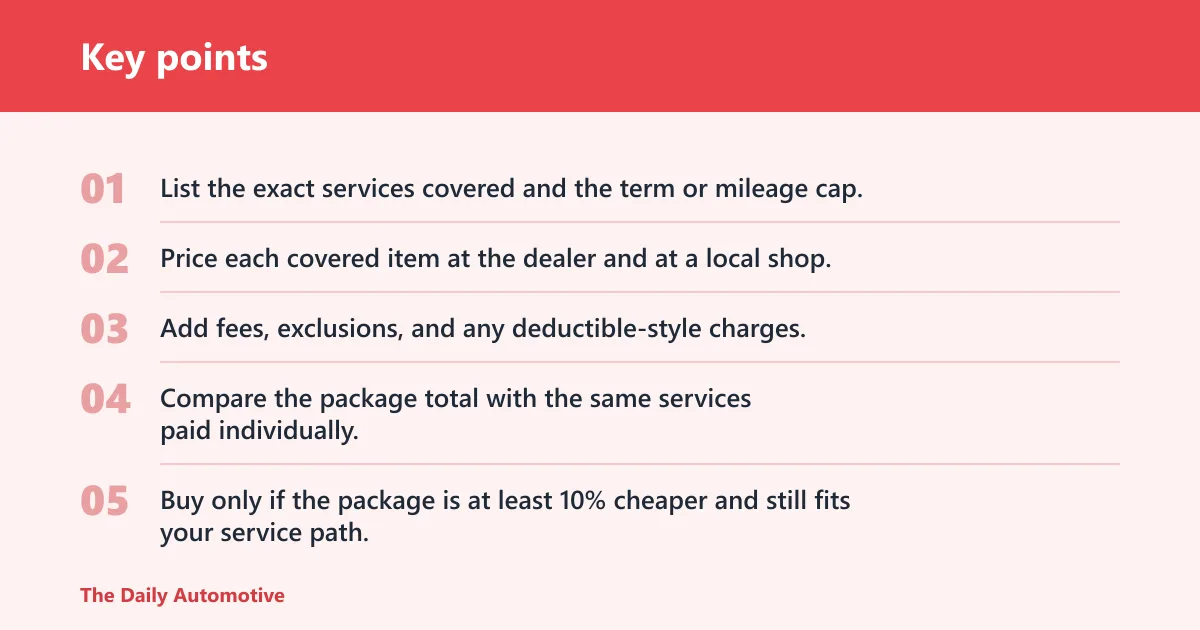
- List the exact services covered and the term or mileage cap.
- Price each covered item at the dealer and at a local shop.
- Add fees, exclusions, and any deductible-style charges.
- Compare the package total with the same services paid individually.
- Buy only if the package is at least 10% cheaper and still fits your service path.
How does it differ from repair coverage?
A maintenance package pays for routine service. Repair coverage pays for faults, failed parts, or other corrective maintenance after something breaks. Those are different financial products, and many buyers mix them up. A service plan can still leave you exposed to diagnostic time, parts replacement, and unplanned downtime costs.
Routine service versus corrective maintenance
Oil changes, inspections, and rotations belong to preventive maintenance. Repair coverage starts when something has failed and the vehicle needs corrective maintenance to return to service. That is the line most contracts use, and it is why a prepaid maintenance plan should never be treated as repair protection.
Warranty overlap and duplicate coverage
Manufacturer warranties can already cover some service-related claims, and that can make a maintenance package redundant for part of the ownership period. It can also create false value if the plan pays for items you would have received under warranty terms anyway. Check whether the package duplicates included service intervals during the warranty window.
Unexpected repairs the package will not pay
Most plans will not pay for brakes, tires, alignments, batteries, belts, hoses, or any failure-related repair unless the contract says so. That means a prepaid plan can still leave surprise bills. The package may also exclude fluids or filters outside the standard schedule, which is where many owners see extra charges.
How do I compare dealer and third-party maintenance plans?
Compare them on service eligibility, network restrictions, transfer rules, cancellation terms, and claim friction. Dealer plans often fit the exact maintenance schedule but may cost more and limit you to one service network. Third-party plans can be cheaper, but they may require approval, documentation, or reimbursement steps that slow down service.
Service eligibility and network restrictions
Dealer plans usually work only at that dealer or brand network. Third-party plans may allow broader service locations, but not always without prior authorization. If your local shop cannot accept the plan directly, your savings can shrink once you add out-of-pocket payment and reimbursement delay.
Transfer and cancellation terms
Ask whether the plan transfers to a later owner, what fee applies, and whether cancellation is prorated. A transferable plan can support resale value. A plan with a large cancellation penalty may trap you if the vehicle is sold early or the mileage pattern changes.
Claim friction and paperwork
Some plans require preapproval for every visit, itemized invoices, and proof that the vehicle stayed on schedule. That is not a small detail. More paperwork means more friction, and more friction can turn a cheap plan into a nuisance if each oil change needs multiple approvals.
Frequently asked questions
Are maintenance packages worth it?
They are worth it when the package covers the services you will actually use, the contract term matches your mileage, and the total price stays at least 10% below the same services bought one by one. If you drive little or already get low-cost routine service, the math often goes the other way.
What is a maintenance package: it is a prepaid contract?
It is a prepaid contract for routine vehicle service over a set time or mileage limit. The package usually includes scheduled oil changes, rotations, inspections, and selected filters or fluids. Its value depends on exclusions, service network rules, transferability, and whether the price is better than pay-as-you-go service.
What is included in a maintenance package?
Most packages include oil changes, tire rotations, inspections, fluid checks, and some filter replacements. Some add brake fluid or cabin filters. The important detail is not the headline list but the exact schedule, the allowed service location, and the exclusions for wear items or premium fluids.
How do maintenance packages differ from repair coverage?
Maintenance packages pay for routine service before failure. Repair coverage pays after a fault is detected and the vehicle needs corrective maintenance. If a part breaks, the maintenance plan usually does not help. If the vehicle just needs a scheduled oil change or inspection, repair coverage is the wrong product.
Are prepaid maintenance plans cheaper than pay-as-you-go service?
Sometimes, but only when the package price is meaningfully below the cost of the same covered services paid individually. Dealer pricing, mileage, and exclusions decide the result. If the plan saves less than 10% after fees, the margin is thin and the risk of paying for unused service is higher.
When does a maintenance package stop being worth it?
It stops being worth it when you will not use most of the covered visits, when local service pricing is lower than the package math, or when exclusions force you to pay extra anyway. Low-mileage drivers and owners with overlapping warranty coverage are the most common poor-fit cases.
Products related to this article
Sponsored / affiliate links. As an Amazon Associate I earn from qualifying purchases. I may earn additional commission from eligible campaigns.