Liqui Moly Engine Flush Review: Is It Worth It for Your Car?
Liqui Moly Engine Flush is worth using before an oil change on a neglected or sludge-prone engine; choose the Pro-Line version mainly when you need a stronger, workshop-grade cleaner, and skip both on unknown, heavily clogged, or mechanically noisy engines. Used badly, a flush can loosen debris fast enough to block oil pickup and turn a cheap service into engine damage. This guide compares the standard and Pro-Line formulas, when each fits, and when the safest call is no flush at all.
This guide is part of our Car engine troubleshooting guide series.
Verdict

As a decision tool, it fits engines with a known service history, light deposits, or a long gap since the last oil change. It does not fit as a routine add-on at every service, and it is not a fix for low oil pressure, severe sludge, or wear that has already affected oil flow.
📊 Walmart identifies the Pro-Line Engine Flush SKU as 2037. Source: Liqui Moly.
Specs at a glance
| Item | Key detail |
|---|---|
| Product family | Liqui Moly Engine Flush and Liqui Moly Pro-Line Engine Flush |
| Category | Engine oil additive, used with an oil service |
| Use timing | Added before draining old oil |
| Pro-Line bottle size | 500 ml |
| Pro-Line SKU | 2037 |
| Walmart listing data | 4.6 stars from 118 reviews |
| Catalog context | LIQUI MOLY lists additives as products added in small quantities and says they can be preventive or targeted solutions |
LIQUI MOLY’s catalog page view shows 232 products and includes Additives, Oils, Engine Oils, Gear Oils, Greases, Pastes, and Workshop Pro-Line items. That matters here because engine flush is a service product, not an engine oil, and it should be chosen for a specific cleaning problem rather than treated like a normal maintenance staple.
Who it is for
Liqui Moly Engine Flush fits drivers who know the engine is dirty enough to justify a pre-drain cleaner, but not so far gone that internal clogging or low oil pressure makes chemical cleaning risky. Clean, well-kept engines usually gain little. High-mileage engines with light deposits can be a better fit than neglected engines with heavy sludge.
Turbocharged engines and direct-injection setups need extra caution because oil flow and deposit control matter more there. A turbo engine with ticking, pressure warnings, or an unknown oiling history should move toward inspection first, not a flush first.
Pros and cons
- Pros: Simple pre-oil-change use; aimed at deposit cleanup; can make sense before a service on a dirty but still healthy engine.
- Pros: Pro-Line is positioned as the stronger option for tougher cleaning jobs and comes in a 500 ml bottle under SKU 2037.
- Cons: Not a substitute for fresh oil or a filter change.
- Cons: Can be the wrong move on heavily sludged, low-pressure, or partially starved engines.
- Cons: Results vary with maintenance history and internal condition.
Say your sedan has 110,000 miles, regular oil changes, and a valve cover that shows dark varnish but no sludge chunks. A standard flush can be a reasonable pre-drain step. Suppose the same car has long oil intervals, a ticking top end, and a pressure light that flickers at hot idle. That is not a flush case. That is an inspection case.
What works
Liqui Moly Engine Flush works as a cleaning aid before an oil change. That is the core job. It is an engine oil additive, so the product belongs in the service sequence, not in the crankcase as a long-term substitute for oil.
It makes the most sense when deposits are the problem and the engine still has normal oil pressure, normal running noise, and a service history that suggests the crankcase has not become a solid sludge trap. In that setting, a flush can help loosen residue so the old oil carries it out on drain.
What works well and what does not
- Works well: Pre-drain cleaning before routine oil service.
- Works well: Light deposit control on engines that are dirty, not damaged.
- Works well: As a targeted choice when a vehicle has missed a few intervals.
- Does not: Repair worn bearings, stuck rings, failed seals, or oil starvation damage.
- Does not: Remove the need for a filter change or fresh oil.
Clean oil is not the goal here. Cleaning is. If the engine has thick sludge, blocked return paths, or a known history of long oil intervals, loosened debris can move to the pickup screen and create a much bigger problem than the deposits already present.
What does not
The biggest drawback is risk in the wrong engine. A flush that loosens too much material too quickly can expose partial clogging that the engine had been surviving around, and that can lead to pressure loss after startup. The product cannot sort out mechanical wear from dirt.
It is also easy to overuse. A flush before every oil change is not the default answer for all engines. For many vehicles, shorter oil intervals and a filter change do the safer, cheaper work.
How to use it before an oil change
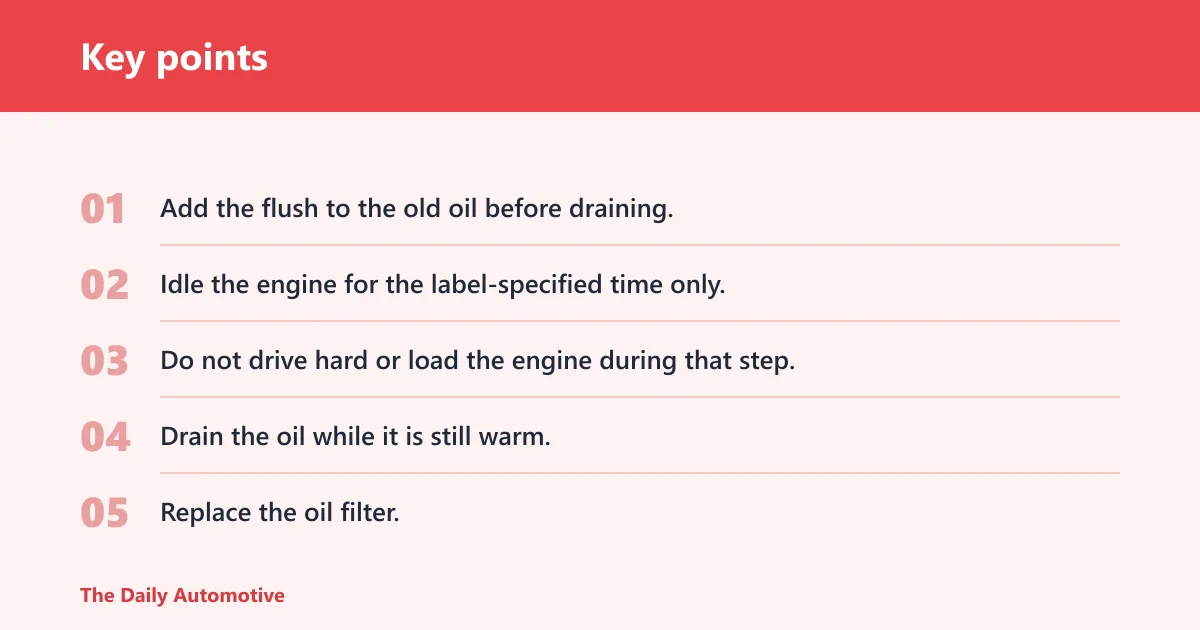
- Add the flush to the old oil before draining.
- Idle the engine for the label-specified time only.
- Do not drive hard or load the engine during that step.
- Drain the oil while it is still warm.
- Replace the oil filter.
- Refill with fresh oil at the correct grade and level.
- Start the engine and watch for abnormal noise or warning lights.
That sequence matters because the flush is meant to suspend contaminants in the draining oil. It is not meant to stay in the engine. Follow the bottle instructions closely, since idle time and dosage are part of the safety margin.
Decision matrix: when to use Flush, Pro-Line, or skip it
This matrix ties the product choice to engine condition instead of blanket mileage rules. Cost per use is based on the listed retail items here when available, so you can compare the flush to the line item cost of a service and to buying another cleaner.
| Engine condition | Mileage / history | Sludge risk | Best action | Cost per use |
|---|---|---|---|---|
| Clean engine, normal operation | Known regular intervals | Low | Skip flush and shorten oil intervals only if needed | $0 for flush; oil/filter service remains the main spend |
| Light varnish, stable pressure | Moderate to high mileage with decent records | Low to medium | Use standard Liqui Moly Engine Flush | One bottle of standard flush; typically smaller than the cost of a full oil-and-filter service |
| Visible deposits, longer service gaps, but no pressure symptoms | High mileage, uneven history | Medium | Use Pro-Line flush if the engine is still mechanically quiet | Pro-Line is the stronger bet when the job is harder, so the higher spend is tied to the cleaner choice |
| Heavy sludge, blocked drains, ticking, or hot-idle warning signs | Unknown or neglected | High | Inspect mechanically first | Inspection costs more up front than a bottle, but it is cheaper than a damaged pickup or oil pump issue |
| Minor deposits on a serviceable engine | Any mileage, but consistent changes | Low | Skip flush and shorten intervals | Usually the lowest-cost path over time |
On price alone, a bottle like Liqui Moly Engine Flush Plus in a 300 ml size at around $15.49 is a modest add-on compared with a full oil service, and another cleaner in the same category can push the total into a similar spend range fairly quickly. That does not make one product better by itself. It means the engine condition should decide the purchase, not the label.
What should make you skip a flush?
Skip any flush when the engine already shows signs of serious oiling trouble. Heavy sludge, blocked oil return paths, low oil pressure, cold-start rattle that does not clear, persistent ticking, or signs of partial oil starvation all argue for inspection first. In those cases, a chemical cleaner can move the problem into a place that matters more.
A mechanical check is also the safer first step when maintenance history is unknown and the inside of the engine could be part sludge, part wear. A flush does not diagnose pickup screen clogging, oil pump wear, or a failing pressure relief path.
Post-flush checklist
- Replace the oil filter.
- Inspect the drained oil for heavy grit, thick tar, or metal sparkle.
- Watch oil pressure and warning lamps on the first startup.
- Listen for new ticking, knock, or top-end noise.
- Recheck the oil level after warm-up and shutoff.
If fresh oil turns dark almost immediately, that can be normal on a dirty engine. If pressure drops, lifter noise grows, or the engine sounds strained, stop and inspect. That is the point where the flush has become a clue, not a cure.
Alternatives
Liqui Moly Engine Flush Plus 300ml
Based on the spec sheet and review context, this is the more direct consumer option inside the Liqui Moly flush family. It is described as a concentrated engine flush treatment for pre-oil-change cleaning, and the smaller bottle size may make it easier to use for a single service. The drawback is simple: a standard-size cleaner may not be the first choice for engines that need the stronger Pro-Line approach.
 As an Amazon Associate we earn from qualifying purchases. Prices and availability are accurate as of the date shown and are subject to change.

Sea Foam SF-16 Motor Treatment – 16 oz, White (Pack of 2)
Sea Foam gives you a two-pack value angle and a simpler application path, so it can appeal when you want a general maintenance product rather than a brand-specific flush. The drawback is that it is a broader treatment, not a purpose-built Liqui Moly flush comparison target, so it may not answer the same sludge-cleaning use case as directly.
Shortening oil intervals is often the safer alternative when the engine is basically healthy. Mechanical cleaning wins when the deposit load is heavy enough that a liquid cleaner becomes a risk. Choose the tool that matches the fault, not the one with the most aggressive label.
Should you buy it
Buy Liqui Moly Engine Flush if the engine has a known service record, mild deposits, and no pressure symptoms, and you want a pre-drain cleaner before the next oil change. Choose Pro-Line when the cleaning job is more serious and the engine still appears mechanically sound. Skip both if sludge, noise, or starvation signs point to internal risk.
For most DIY owners, that makes the decision narrower than the marketing suggests. A flush is a service aid, not a habit. If the engine is clean, it is usually unnecessary. If the engine is badly dirty, it may be too late for a chemical-only fix.
Frequently asked questions
does liqui moly engine flush work
Yes, it can work as intended when the engine has light deposits and a normal oiling system. The result depends on engine condition, sludge level, and maintenance history. It is most useful as a pre-drain cleaner, not as a fix for worn parts or blocked oil passages.
how much liqui moly engine flush to use
Use the amount listed on the bottle for your engine and oil capacity. The key point is not to improvise dosage, because flush products are designed around a short, controlled idle before draining. Too much cleaner or too much running time can raise risk in a dirty engine.
what is liqui moly engine flush
Liqui Moly Engine Flush is an engine oil additive used before an oil change to help loosen deposits and sludge so they leave with the old oil. It is not a replacement for fresh oil or a filter change, and it is not meant to stay in the crankcase as normal lubrication.
how often to use liqui moly engine flush
Not every oil change is the default answer. Many engines do better with shorter oil intervals and a quality filter instead of routine flushing. Use it only when the engine condition, deposit level, or maintenance gap makes pre-drain cleaning the better call.
is liqui moly pro-line engine flush better than the standard flush
It is better for harder cleaning jobs, not automatically better for every engine. The Pro-Line version is positioned as the stronger, workshop-grade choice and is listed by Walmart as a 500 ml oil additive, SKU 2037. A cleaner engine may not need that level of action.
can liqui moly engine flush help on a high-mileage engine
Yes, if the high-mileage engine has light deposits, stable oil pressure, and a history that suggests normal oil flow is still intact. It is a poorer fit for engines with severe sludge, uncertain upkeep, or signs of oil starvation, where inspection comes first.
Products related to this article
Sponsored / affiliate links. As an Amazon Associate I earn from qualifying purchases. I may earn additional commission from eligible campaigns.