Motorcraft Fuel Injector Cleaner Review
Motorcraft Fuel Injector Cleaner is the safest OEM-aligned pick for Ford and Lincoln owners, but it works best for light injector deposit cleanup, not misfires, clogged filters, bad pumps, or worn ignition parts. Miss that split, and you can waste money, hide the real fault, and leave drivability problems in place. This review explains what Motorcraft cleaner can fix, when a stronger PEA-based additive makes more sense, and how to choose the right bottle.
This guide is part of our Car engine troubleshooting guide series.
That recommendation is narrow for a reason. Motorcraft says its parts are “engineered by the same people who engineered the vehicle,” and Ford says Motorcraft includes “more than 18,000 OEM-engineered parts” for Ford and Lincoln vehicles, backed by “two-year coverage with unlimited mileage and labor included.” Those signals matter if you want the lowest-risk additive choice for a Ford-family fuel system.
Verdict


Use it for maintenance, not repair. A cleaner can help fuel injectors keep a better spray pattern, strip light gum and varnish, and sometimes calm rough idle or hesitation. It cannot fix a failing pump, a clogged filter, vacuum leaks, bad coils, or intake-valve carbon on a GDI engine.
Pros and cons
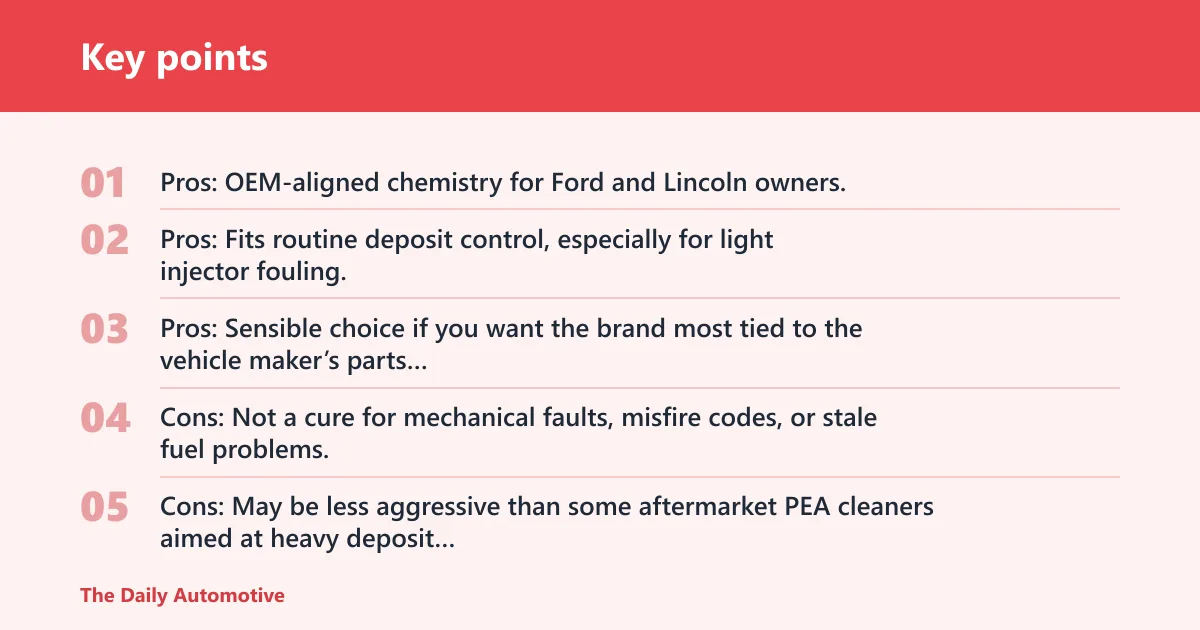
- Pros: OEM-aligned chemistry for Ford and Lincoln owners.
- Pros: Fits routine deposit control, especially for light injector fouling.
- Pros: Sensible choice if you want the brand most tied to the vehicle maker’s parts catalog.
- Cons: Not a cure for mechanical faults, misfire codes, or stale fuel problems.
- Cons: May be less aggressive than some aftermarket PEA cleaners aimed at heavy deposit cleanup.
- Cons: Tank additives do little for intake-valve deposits on many GDI engines.
📊 The Drive says Red Line SI-1 cleans “injectors, carburetors, valve, and combustion chamber deposits.”. Source: Thedrive.
Who it’s for
Motorcraft Fuel Injector Cleaner fits Ford and Lincoln daily drivers who want a conservative maintenance product with factory-brand alignment. It also makes sense for turbocharged gasoline engines and GDI owners who want periodic injector cleanup, provided they understand its limits. If your issue looks electrical, air-related, or mechanical, start diagnostics elsewhere.
A dealer-style OEM choice fits when the owner wants one bottle that matches the vehicle brand’s service approach. It matters less if the goal is the strongest possible deposit-cleaning action for stubborn symptoms, where a higher-dose PEA cleaner may be the better tool.
Say your Explorer develops a slight idle shake after a few months of short trips. A tank additive can be a reasonable first step if the scan tool shows no misfire codes and the engine otherwise runs normally. Suppose the same truck flashes a misfire light and shakes hard under load; that points away from a bottle and toward diagnosis.
Fuel injector decision table
This table separates symptoms that can fit a cleaning product from symptoms that usually need diagnosis. Use it before you buy any bottle. It is the fastest way to avoid treating a mechanical fault as if it were a deposit issue.
| Symptom | Likely cause | Can Motorcraft cleaner help? | What to inspect next |
|---|---|---|---|
| Light rough idle after storage or short trips | Injector deposits, gum, or varnish | Yes, sometimes | Fuel age, misfire codes, air leaks, and ignition condition |
| Small hesitation at steady throttle | Minor spray-pattern fouling | Yes, possibly | Fuel pressure, plugs, coils, and vacuum leaks |
| Hard start with no warning lights | Dirty injectors or stale fuel | Maybe | Battery health, fuel pressure, and fuel freshness |
| Misfire code, flashing MIL, or severe shaking | Ignition fault, injector failure, air leak, or compression issue | No | Scan codes, coils, plugs, wiring, compression, and fuel delivery |
| Loss of power on a GDI engine with carbon buildup | Intake-valve deposits or another airflow issue | Not usually | Intake cleaning method, airflow testing, and valve inspection |
| Fuel smell, lean code, or repeated stalls | Mechanical fuel-system fault | No | Pump output, filter restriction, rail pressure, and leaks |
| Cost per treatment | Varies by bottle size and local price | Use shelf price ÷ treatments per bottle | Confirm the label’s ounce count and treat rate before buying |
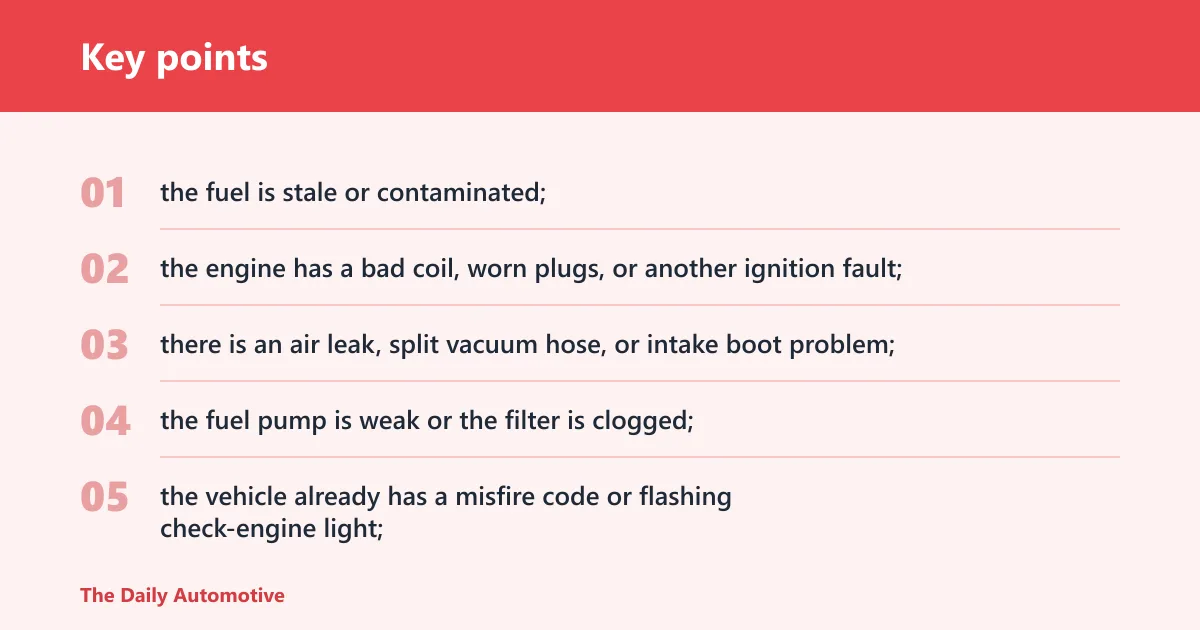
Not a fix if…
- the fuel is stale or contaminated;
- the engine has a bad coil, worn plugs, or another ignition fault;
- there is an air leak, split vacuum hose, or intake boot problem;
- the fuel pump is weak or the filter is clogged;
- the vehicle already has a misfire code or flashing check-engine light;
- the problem is intake-valve carbon on a GDI engine;
- the injector itself is electrically failed or mechanically stuck.
Does Motorcraft fuel injector cleaner work?
Yes, for the job it is built to do: light deposit cleanup in the fuel system. A cleaner can help with injector spray-pattern fouling, gum, and varnish, which is why some engines get smoother idle, easier starts, or less hesitation. It will not fix a broken part or a fault code by itself.
What it can clean
Fuel injector cleaners aim at deposit control. That means cleaner spray pattern quality, lighter carbon on injector tips, and some buildup in the fuel path. The Drive notes these products can help because of “a clean and efficient combustion process,” which is the right way to think about them: maintenance first, repair second.
What it cannot reach
It cannot restore a weak pump, repair worn injector internals, or clean intake-valve carbon on most GDI engines. It also will not solve bad spark plugs, a failing coil, or an air leak that is leaning out the mixture. If symptoms point there, an additive is the wrong tool.
Realistic symptom changes
Expect modest changes, not miracles. The best-case result is often smoother cold start, less stumble at part throttle, or slightly cleaner idle quality. If the engine has a deeper issue, the cleaner may do nothing noticeable because the root cause is not deposit-related.
Fuel injector cleaner vs fuel system cleaner
Motorcraft’s lineup shows why this distinction matters. Ford’s catalog includes both “Premium Fuel Injector Cleaner” and “Pressurized Fuel Injector Cleaner,” and it also lists “Carburetor Tune-Up Cleaner” and “Premium Cooling System Flush.” That tells you Motorcraft sells different service chemicals for different jobs, not one universal bottle.
How to read the Motorcraft lineup
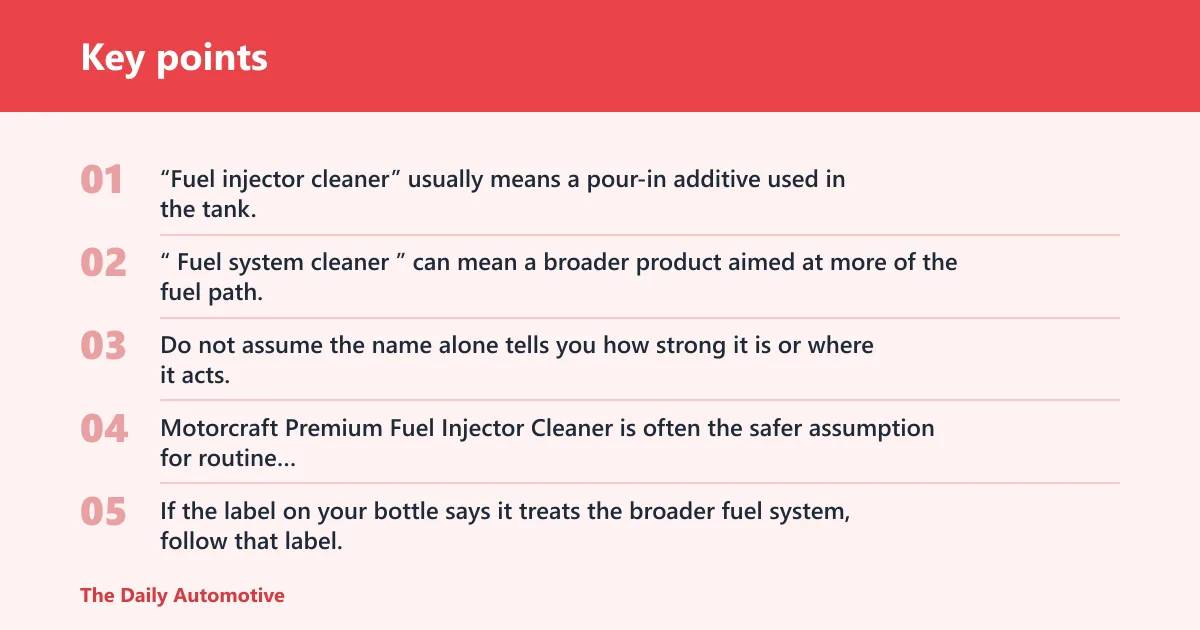
“Fuel injector cleaner” usually means a pour-in additive used in the tank. “Fuel system cleaner” can mean a broader product aimed at more of the fuel path, depending on the label and delivery method. Do not assume the name alone tells you how strong it is or where it acts.
Standalone injector cleaner or broader system cleaner
Motorcraft Premium Fuel Injector Cleaner is often the safer assumption for routine maintenance on Ford and Lincoln vehicles: a maintenance additive that is commonly used to help with injector deposits. If the label on your bottle says it treats the broader fuel system, follow that label, but do not expect it to reach intake valves on a GDI engine.
Where the pressurized cleaner fits
Motorcraft Pressurized Fuel Injector Cleaner is generally used in a service workflow rather than the usual pour-into-the-tank routine. It belongs in a more controlled service setting, where the mechanic or technician follows the pressurized application procedure rather than mixing the product with a full tank of fuel. For owners, that usually means dealer or shop service.
A common first-timer mistake is buying the pressurized version when the car only needs routine tank treatment. If the goal is maintenance, the pour-in bottle is simpler and usually cheaper. If the goal is service-bay cleaning under controlled conditions, the pressurized product belongs there instead.
When will it not help?
It will not help when the real problem sits outside the fuel injectors. Stale fuel, bad ignition components, vacuum leaks, fuel pump faults, clogged filters, and GDI intake-valve carbon all need their own fix. A cleaner can sit in the tank and still leave the symptom untouched.
Stale fuel and contamination
Fuel that has aged badly, absorbed water, or picked up contamination can cause drivability problems that a detergent will not solve. If the vehicle sat for months, start with fuel quality, not additive choice. In severe cases, the fuel itself needs to be addressed before any cleaner matters.
Ignition, air, and sensor faults
Misfire codes often point to plugs, coils, wiring, vacuum leaks, or another air-fuel control problem. A bottle cannot correct a lean condition from an intake leak or a bad signal from a sensor. That is why the symptom table above separates rough idle from actual fault-code diagnosis.
GDI intake-valve deposits
On many GDI engines, gasoline does not wash over the intake valves the way it does in port-injection engines. That means a tank additive can help injectors but still leave intake-valve carbon in place. For those engines, you may need a separate intake-valve cleaning method if deposit buildup is the real issue.
Does adding fuel injector cleaner work?
Yes, if the complaint is deposit-related and mild. Adding cleaner to the tank can improve injector cleanliness, and that can reduce hesitation or rough idle in some vehicles. It is not a universal fix, and it should never be used as a substitute for checking fuel pressure, ignition parts, or stored codes.
How to add fuel injector cleaner
- Read the bottle label before pouring anything in.
- Add the cleaner to the fuel tank before refueling unless the label says otherwise.
- Use the full treatment amount listed on the container.
- Drive normally so the treated fuel reaches the injectors through regular operation.
- Recheck symptoms only after the tank has been used enough to make the treatment relevant.
Because the supplied facts do not verify a specific ounce count or treat rate for this Motorcraft bottle, confirm both on the label before buying. That matters for cost-per-treatment, and it matters for compatibility with your tank size. A product meant for routine maintenance should still match the vehicle and the bottle instructions.
Is Motorcraft fuel injector cleaner good for Ford vehicles?
Yes, it is the safest OEM-aligned choice for Ford and Lincoln vehicles when the problem is light deposit buildup. Motorcraft’s own positioning is the key reason: the brand says its parts are engineered by the same people behind the vehicle, and Ford ties the line directly to its parts catalog and warranty coverage.
That does not make it the strongest cleaner on the shelf. A more aggressive aftermarket PEA formula may be better when the owner wants a harder-cleaning product for persistent deposit control. But if the main goal is brand alignment and low risk, Motorcraft is a sensible first pick.
What fuel injector cleaner works best?
The best cleaner depends on the problem you are solving. For Ford and Lincoln owners who want the most conservative OEM-aligned option, Motorcraft is the cleanest fit. If the goal is stronger deposit removal and the vehicle is outside warranty concerns, a well-regarded PEA cleaner can be more aggressive on buildup.
How Motorcraft compares in practice
The Drive’s roundup put Sea Foam IC5 as “Best Value” and named Gumout High-Mileage Fuel Injector Cleaner as its best-overall pick. It also says Red Line SI-1 cleans “injectors, carburetors, valve, and combustion chamber deposits,” and notes some cleaners are safe in “super and turbocharged vehicles.” Those comparisons matter because they show the aftermarket range.
Motorcraft’s advantage is not headline cleaning strength. Its advantage is fit: Ford/Lincoln alignment, OEM confidence, and a lower-risk choice for owners who want to keep service choices inside the brand ecosystem.
Fuel injector cleaner worth it
It is worth it when symptoms are mild, the maintenance interval has been neglected, or the owner wants low-cost deposit control before a deeper repair hunt. It is not worth it when the vehicle already has clear signs of a fuel delivery, ignition, or airflow fault. In those cases, diagnosis beats guessing.
Turbocharged engines
Turbocharged Ford and Lincoln engines can use fuel injector cleaner just like naturally aspirated gasoline engines, as long as the bottle is labeled safe for modern fuel systems. The Drive notes that some cleaners are safe in “super and turbocharged vehicles,” and that fits the normal use case: regular maintenance, not repair.
GDI engines
GDI owners should set expectations carefully. Cleaner can help injector deposits, but it will not scrub intake valves that are not being bathed in fuel. If the engine’s complaint is rough idle from valve carbon, a tank additive may leave the symptom unchanged.
Frequently asked questions
Does fuel injector cleaner really work?
Yes, when the issue is light injector deposit buildup. Cleaner can improve spray pattern quality and help with rough idle, hesitation, or hard starting tied to varnish and gum. It will not repair failed injectors, ignition faults, air leaks, or fuel-pressure problems.
Fuel injector cleaner vs fuel system cleaner: injector cleaner is usually aimed
Injector cleaner is usually aimed at the injectors and nearby fuel-path deposits. Fuel system cleaner is a broader label and may imply treatment of more of the fuel delivery path, depending on the product. Read the bottle carefully, because the name alone does not tell you the full cleaning scope.
Is Motorcraft fuel injector cleaner good for Ford vehicles: yes, especially?
Yes, especially if you want the safest OEM-aligned choice for Ford and Lincoln ownership. Motorcraft is tied closely to Ford’s service ecosystem, which makes it a sensible maintenance pick. It is best for light deposit cleanup, not for misfires or mechanical failures.
What fuel injector cleaner works best: the best cleaner depends
The best cleaner depends on the problem. For OEM-aligned Ford service, Motorcraft is the conservative choice. For stronger deposit cleanup, some aftermarket PEA-based products may do more. Pick based on symptom severity, engine type, and whether you need brand alignment or stronger cleaning action.
How to add fuel injector cleaner: most pour-in cleaners go
Most pour-in cleaners go into the fuel tank before refueling, then the vehicle is driven normally so the treated fuel reaches the injectors. Always follow the bottle label. If the label’s treat rate or bottle size is not clear, confirm it before pouring anything in.
Products related to this article
Sponsored / affiliate links. As an Amazon Associate I earn from qualifying purchases. I may earn additional commission from eligible campaigns.