Major Entry Barriers in the Automotive Industry: 2026 Analysis
Getting into the car business can seem really tough. The Major Entry Barriers in the Automotive Industry: 2026 Analysis is a big topic that often makes new people feel overwhelmed. It’s like trying to climb a huge mountain without a map.
But don’t worry! We’ll break down these challenges into simple steps. Let’s explore what makes it so hard to start a car company and how new players can plan for success.
We’ll look at the main hurdles you’ll face.
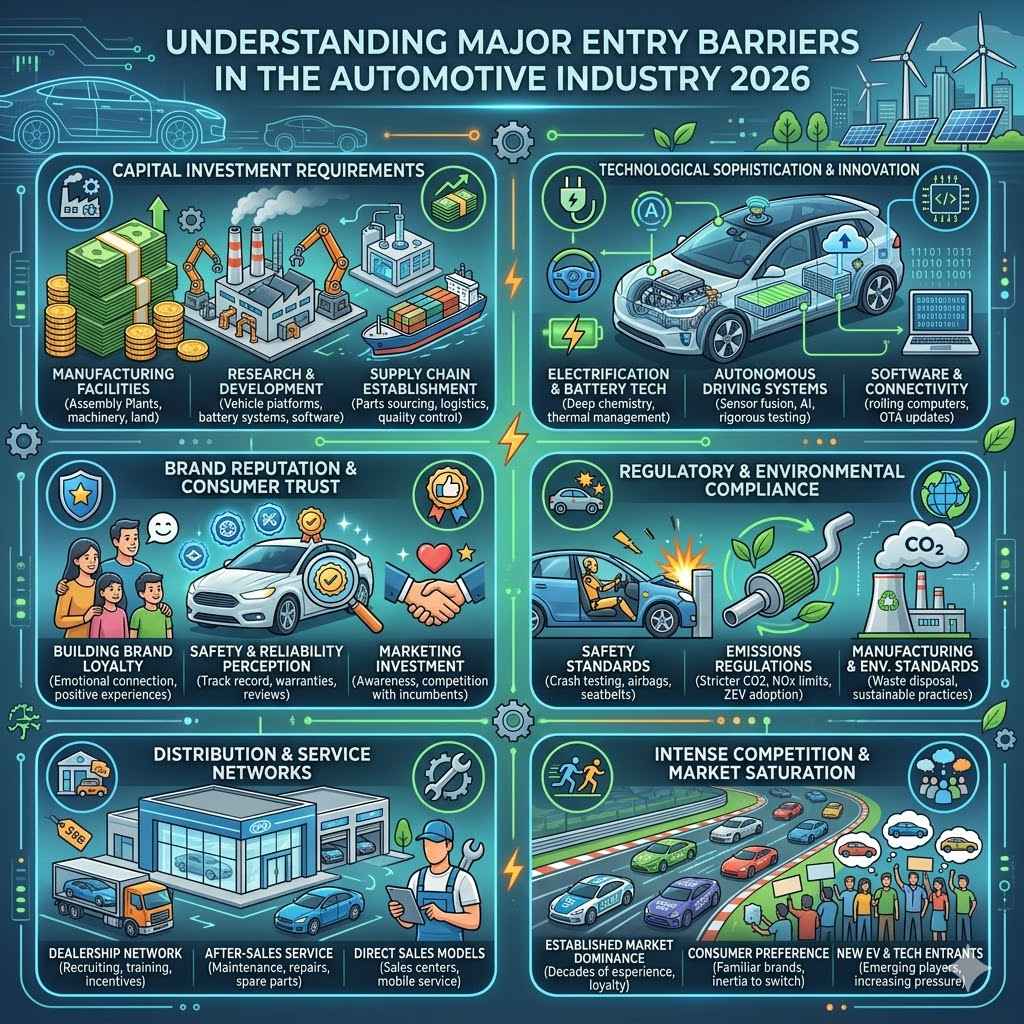
Understanding Major Entry Barriers in the Automotive Industry 2026
This section will lay out the fundamental difficulties that companies face when trying to enter the automotive market. We will explore the significant obstacles that have historically prevented new entrants and are projected to remain key challenges. Understanding these barriers is the first step for any aspiring automotive manufacturer or technology provider.
It helps in forming realistic strategies and allocating resources effectively. We aim to provide a clear picture of the landscape newcomers will encounter.
Capital Investment Requirements
Starting an automotive company demands a colossal amount of money. Think about building factories, buying advanced machinery, and setting up research and development centers. Then there are the costs of design, engineering, testing, and safety certifications.
Even just creating a prototype can cost millions.
Massive Financial Outlay for Manufacturing Facilities
This involves building state-of-the-art assembly plants. These facilities need specialized equipment for stamping, welding, painting, and final assembly. The scale of these operations requires significant land, construction, and machinery costs. A single modern automotive plant can easily cost billions of dollars to build and equip.
Research and Development Expenses
Developing new vehicle platforms, engine technologies, battery systems, and software requires substantial R&D investment. Companies must fund teams of engineers, designers, and researchers. They also need advanced simulation tools and testing grounds. This ongoing investment is critical for innovation and staying competitive.
Supply Chain Establishment Costs
Building a reliable supply chain for thousands of parts is another huge expense. This includes negotiating contracts with numerous suppliers for everything from steel and aluminum to microchips and interior components. Setting up logistics and ensuring quality control across this complex network is costly.
A report by IHS Markit indicated that the average R&D spending for the top global automakers in recent years has been around 6% of their revenue. For a new entrant, this percentage can be even higher as they establish their technological base. For instance, Tesla, in its early years, spent heavily on R&D, which was a major factor in its eventual success but also a significant initial hurdle.
Technological Sophistication and Innovation
Modern vehicles are incredibly complex. They combine mechanical engineering with advanced electronics, software, and artificial intelligence. New entrants must possess or acquire expertise in areas like electric powertrains, autonomous driving systems, and connected car technology.
The pace of technological change means continuous investment in R&D is essential just to keep up, let alone lead.
Electrification and Battery Technology
The shift towards electric vehicles (EVs) requires deep expertise in battery chemistry, thermal management, and electric motor design. Developing competitive battery technology that offers good range, fast charging, and durability is a significant challenge. It also involves securing reliable sources for critical battery materials like lithium and cobalt.
Autonomous Driving Systems
Creating safe and reliable autonomous driving features is a major technological hurdle. This involves complex sensor fusion, artificial intelligence algorithms, and rigorous testing. The software for self-driving cars is incredibly intricate and requires constant updates and validation to ensure passenger safety.
Software and Connectivity
Vehicles are becoming rolling computers. They rely heavily on sophisticated software for everything from infotainment and navigation to vehicle diagnostics and over-the-air updates. Developing secure and user-friendly software platforms, along with integrating various connectivity features, is a demanding task.
A typical new vehicle today can have over 100 million lines of code. This highlights the immense software engineering challenge. Companies like Waymo, Google’s self-driving car project, have invested billions of dollars and over a decade in developing their autonomous driving technology, showcasing the scale of the challenge.
Brand Reputation and Consumer Trust
Established car brands have decades of history, building trust and recognition with consumers. New companies must convince buyers that their vehicles are reliable, safe, and worth the investment. This is particularly true for a product as significant and expensive as a car, where safety and long-term durability are paramount concerns for customers.
Building Brand Loyalty
Consumers often develop strong brand loyalty based on past experiences, perceived quality, and emotional connection. Creating this kind of connection from scratch is exceptionally difficult. It requires delivering consistently high-quality products and exceptional customer service over many years.
Establishing a Perception of Safety and Reliability
A car is a major purchase. Buyers want assurance that the vehicle will be safe and dependable for many years. New brands lack the track record that established manufacturers have. They need to prove their mettle through rigorous testing, positive independent reviews, and strong warranty offerings.
Marketing and Advertising Investment
To build awareness and establish a brand presence, new entrants need substantial marketing and advertising budgets. They must compete for consumer attention against well-funded incumbents with established advertising campaigns and dealer networks. This requires significant investment to cut through the noise.
According to a Nielsen study, 77% of consumers trust recommendations from people they know. For a new brand, building this word-of-mouth trust takes time and positive experiences. Early adopters and influencers play a critical role in shaping public perception.
Regulatory and Environmental Compliance
The automotive industry is heavily regulated, with strict rules concerning safety, emissions, and manufacturing standards. New entrants must meet all these requirements, which can vary significantly by region. Navigating this complex web of regulations demands extensive expertise and significant compliance costs.
Safety Standards and Crash Testing
Vehicles must pass stringent safety tests, including crashworthiness standards for frontal, side, and rear impacts. They must also meet requirements for airbag deployment, seatbelt systems, and pedestrian protection. Meeting these global standards requires extensive engineering and testing, adding to development costs and timelines.
Emissions Regulations
Governments worldwide are imposing stricter emissions standards, particularly for internal combustion engines and encouraging the adoption of zero-emission vehicles. Meeting these evolving standards, especially for pollutants like CO2, NOx, and particulate matter, requires advanced engine technology or a full transition to electric powertrains.
Manufacturing and Environmental Standards
Factories must adhere to strict environmental regulations regarding waste disposal, energy consumption, and pollution control. Obtaining permits and implementing sustainable manufacturing practices can add significant costs and complexity to setting up production.
For example, in Europe, the Euro 7 emissions standards are set to become increasingly stringent, requiring automakers to invest in advanced exhaust after-treatment systems. In the US, EPA regulations also mandate specific fuel economy and emissions targets. These require continuous adaptation and investment.
Distribution and Service Networks
Selling cars requires more than just building them. New companies need to establish a widespread network of dealerships or direct sales channels and a robust after-sales service infrastructure. This includes providing maintenance, repairs, and spare parts availability across different markets, which is a massive logistical and financial undertaking.
Establishing a Dealership Network
Most traditional automakers rely on franchised dealerships to sell and service their vehicles. Building such a network involves recruiting, training, and supporting independent business owners. This requires significant investment in sales training, marketing support, and financial incentives for dealers.
Developing an After-Sales Service Infrastructure
Customers expect convenient access to maintenance, repairs, and warranty services. This means setting up service centers, training technicians, and stocking a comprehensive inventory of spare parts. This infrastructure needs to be extensive enough to cover all geographic areas where the vehicles are sold.
Direct Sales Models and Logistics
Companies opting for direct sales, like Tesla, must build their own sales centers, service centers, and mobile service fleets. They also manage the entire delivery and logistics process for new vehicles, which is a complex operation requiring significant investment in facilities and personnel.
A study by Deloitte found that the cost of setting up and maintaining a dealership network can represent a substantial portion of an automaker’s operating expenses. For instance, a new dealer might need an initial investment of several million dollars for facilities, inventory, and staffing.
Intense Competition and Market Saturation
The automotive market is already crowded with well-established global players. These companies have vast resources, loyal customer bases, and efficient production processes. New entrants must find a way to differentiate themselves and carve out a niche in a market where consumer choices are abundant.
Established Market Dominance
The top automotive manufacturers have decades of experience, economies of scale, and deeply entrenched supply chains. They can often compete aggressively on price and features due to their sheer size and efficiency, making it hard for newcomers to match their offerings.
Consumer Preference for Familiar Brands
Many consumers prefer to buy from brands they know and trust. This inertia can be difficult to overcome, even with innovative products. Convincing customers to switch from a familiar manufacturer to an unknown entity requires significant effort and a compelling value proposition.
Competition from New Entrants
The market isn’t just crowded with legacy automakers. New players, especially in the EV space, are also emerging, increasing the competitive pressure. Companies like Rivian and Lucid are already established competitors, creating an even tougher environment for those looking to enter.
The global automotive market sells over 70 million vehicles annually. This high volume indicates a mature market with established players controlling significant market share. Gaining even a small percentage of this market requires substantial effort and resources to displace existing competition.
Major Entry Barriers in the Automotive Industry Analysis
This section focuses on how the existing landscape of the automotive industry presents significant hurdles for newcomers. We will analyze the structural factors and market dynamics that make entry challenging. The focus is on the competitive environment and how established players maintain their positions.
This analysis helps in understanding the strategic challenges faced by any new business aiming to join this sector.
Economies of Scale
Large-scale production allows established manufacturers to significantly reduce the per-unit cost of vehicles. This is achieved through bulk purchasing of materials, efficient assembly line processes, and optimized logistics. New entrants, starting with smaller production volumes, cannot achieve these cost advantages, making their vehicles potentially more expensive or less profitable.
Bulk Purchasing Power
When companies produce millions of vehicles annually, they can negotiate much lower prices for raw materials like steel, aluminum, plastics, and electronic components. A smaller company buying the same materials in much smaller quantities will pay a premium, increasing their per-unit production cost.
Assembly Line Efficiency
Automotive assembly lines are highly optimized for speed and efficiency. The more vehicles produced, the more those fixed costs associated with the factory, machinery, and labor are spread out, lowering the cost per vehicle. A new company with lower output will have higher fixed costs per unit.
Research and Development Cost Spreading
The enormous cost of developing new vehicle platforms, engines, and technologies is also spread across millions of units. A new entrant must recoup its R&D investment over a much smaller sales volume, making each vehicle sold carry a larger portion of those development costs.
Consider the cost of a single advanced robot for an assembly line. For a company like Toyota, which builds millions of cars, this cost is negligible per vehicle. For a startup aiming to build only a few thousand cars, that same robot’s cost becomes a very significant portion of each car’s price.
Technological Obsolescence and R&D Pace
The automotive industry is undergoing rapid technological transformation, especially with the push for electrification and autonomous driving. Established companies can leverage their existing R&D budgets and technical expertise to adapt. New companies, lacking this foundation, must quickly develop or acquire cutting-edge technology, which is both costly and time-consuming.
The risk of investing in technology that quickly becomes outdated is also a major concern.
Rapid Advancements in Battery Technology
The efficiency, cost, and lifespan of batteries are improving at a fast pace. A company that invests heavily in current battery technology might find it obsolete within a few years as newer, better alternatives emerge. Keeping pace requires constant monitoring and significant investment in next-generation battery research.
Software Development Cycles
Vehicle software is becoming increasingly critical, from infotainment systems to advanced driver-assistance systems (ADAS). The development and testing cycles for sophisticated automotive software are long and complex. New entrants must have robust software development capabilities to compete with established players who have dedicated teams.
Autonomous Driving Algorithm Refinement
Developing safe and reliable autonomous driving systems requires years of data collection, algorithm refinement, and real-world testing. The computational power and machine learning expertise needed are immense. New companies must demonstrate they can develop and validate these complex systems to the highest safety standards.
According to Statista, global R&D spending in the automotive sector is projected to exceed 200 billion USD annually in the coming years, with a significant portion dedicated to future mobility technologies like EVs and autonomous driving. This figure highlights the scale of investment required to stay competitive.
Established Supplier Relationships
Major automakers have long-standing, often exclusive, relationships with their component suppliers. These relationships provide them with preferential pricing, guaranteed supply, and access to the latest innovations. New entrants struggle to secure similar favorable terms, potentially facing higher costs, longer lead times, and limited access to critical components.
Negotiating Power with Suppliers
Established automakers place massive orders for parts year after year. This gives them significant leverage to negotiate prices, delivery schedules, and even influence supplier product development. A new entrant with smaller order volumes has much less bargaining power.
Access to Advanced Components
Key suppliers often develop new technologies in partnership with major automakers. These cutting-edge components, such as advanced microchips or specialized sensors, might not be readily available to new companies or may come at a much higher cost.
Supply Chain Integration and Trust
Long-term supplier relationships are built on trust and reliability. Suppliers are more likely to prioritize established customers, especially during times of component shortages. Building this level of trust and integration takes considerable time and consistent business volume.
A shortage of semiconductors significantly impacted the automotive industry recently. Companies with strong, long-term contracts with chip manufacturers were better positioned to secure supply compared to those with weaker relationships or who were new to the market.
Major Entry Barriers in the Automotive Industry: 2026 Outlook
This section looks ahead to the specific challenges and opportunities that will likely shape the automotive industry in 2026 and beyond. It will consider how current trends and future predictions affect the feasibility of new market entrants. The aim is to provide a forward-looking perspective on the most significant obstacles.
The Electric Vehicle Transition
While the shift to electric vehicles (EVs) opens opportunities for new players, it also presents unique challenges. Building a charging infrastructure, securing battery supplies, and competing with established automakers who are heavily investing in EVs are significant hurdles. The technical expertise required for EV manufacturing and battery management is also a barrier.
Charging Infrastructure Development
For EVs to become mainstream, a robust and accessible charging infrastructure is essential. New companies may need to invest in developing their own charging solutions or partner with existing networks. This requires significant capital and strategic planning, especially for widespread availability.
Battery Raw Material Sourcing
The demand for batteries means a high demand for raw materials like lithium, cobalt, nickel, and manganese. Securing a stable and ethical supply of these materials is a growing challenge. New entrants might struggle to compete with larger companies for access to these critical resources.
Competition from Established EV Players
Many legacy automakers are now producing competitive EVs. Companies like Ford, GM, Volkswagen, and Hyundai are investing billions in their electric lineups. This means new entrants face fierce competition not only from traditional internal combustion engine vehicles but also from established brands’ electric offerings.
According to the International Energy Agency (IEA), the demand for critical minerals for clean energy technologies, including batteries, is projected to surge. This increased demand intensifies competition for raw materials.
Software Defined Vehicles and Connectivity
The rise of software-defined vehicles means that a car’s functionality and user experience are increasingly determined by its software. This creates a new set of barriers. New companies must excel in software development, cybersecurity, and data management.
They need to offer seamless connectivity and Over-The-Air (OTA) updates, which require significant technical capabilities and ongoing support.
Advanced Software Development Capabilities
Developing sophisticated vehicle software requires teams of highly skilled software engineers, AI specialists, and cybersecurity experts. The complexity of modern automotive software, which manages everything from powertrain control to advanced infotainment, is immense. New entrants may struggle to build and maintain such teams.
Cybersecurity Threats
Connected cars are vulnerable to cyberattacks. Protecting vehicle systems and user data from hackers is paramount. Establishing robust cybersecurity measures and continuous monitoring requires specialized expertise and significant investment to ensure customer safety and trust.
Over-The-Air (OTA) Update Systems
The ability to update vehicle software remotely via OTA updates is becoming standard. This allows for bug fixes, performance improvements, and new feature rollouts. Building a reliable and secure OTA update system requires a complex backend infrastructure and rigorous testing protocols.
A study by McKinsey found that software is becoming a key differentiator in the automotive industry, contributing significantly to vehicle value and customer satisfaction. This trend emphasizes the need for strong software capabilities.
Changing Consumer Expectations
Consumer preferences are shifting. There is a growing demand for personalized experiences, seamless integration with digital lives, and sustainable products. New entrants need to be agile and responsive to these evolving expectations.
This includes offering flexible ownership models, advanced digital services, and a strong commitment to environmental responsibility, which can add further complexity and cost.
Demand for Personalization
Consumers expect their vehicles to offer personalized experiences, from customizable interfaces to driver profiles that adjust settings automatically. Meeting these demands requires advanced software and data analytics capabilities to understand and cater to individual preferences.
Subscription Services and Mobility-as-a-Service (MaaS)
There is a growing interest in subscription models for vehicle features or even entire vehicles, and the broader concept of Mobility-as-a-Service. New companies may need to explore these new business models to attract customers who are moving away from traditional ownership.
Sustainability and Ethical Sourcing
Consumers are increasingly concerned about the environmental impact of their purchases and the ethical sourcing of materials. New entrants must demonstrate a strong commitment to sustainability throughout their supply chain and manufacturing processes to appeal to this segment of the market.
A survey by Deloitte revealed that a significant percentage of consumers are willing to consider subscription services for automotive features, indicating a shift in how people think about vehicle ownership and usage.
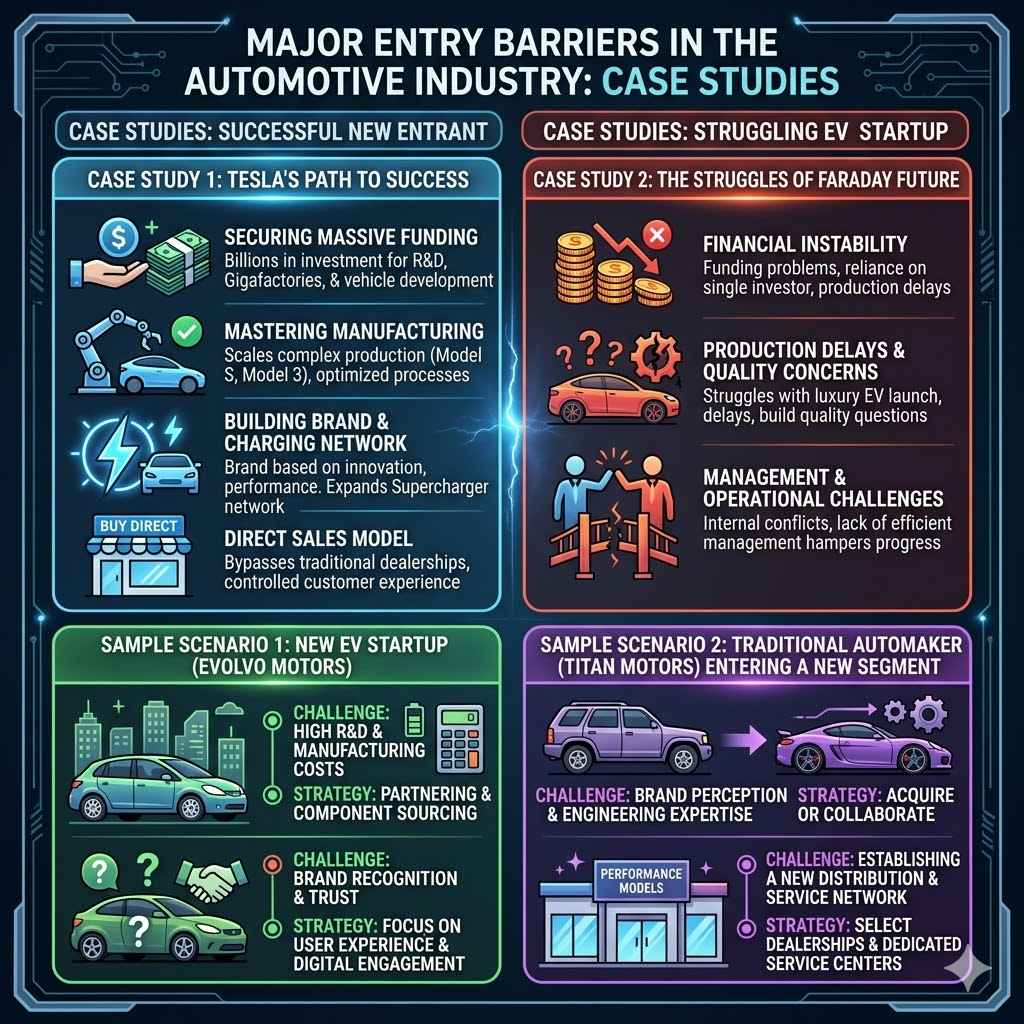
Major Entry Barriers in the Automotive Industry Case Studies
Examining real-world examples helps illustrate the challenges and successes related to entering the automotive market. These case studies provide practical insights into how companies have dealt with the barriers discussed. We will look at both those who faced significant hurdles and those who managed to overcome them through innovative strategies.
Case Study 1 Tesla’s Path to Success
Tesla is often cited as a prime example of a successful new entrant. However, its journey was fraught with immense challenges related to manufacturing, funding, and overcoming skepticism.
Securing Massive Funding
Tesla required billions of dollars in investment to fund its ambitious plans for R&D, manufacturing facilities (Gigafactories), and vehicle development. Early investors took on significant risk.
Mastering Manufacturing
Scaling production of complex vehicles like the Model S and Model 3 was a monumental task. Tesla famously encountered “production hell” but eventually optimized its manufacturing processes to achieve higher volumes and efficiency.
Building a Brand and Charging Network
Tesla built its brand on innovation and performance. It also proactively built its Supercharger network, addressing a key barrier for EV adoption and customer convenience, which established automakers were slower to address.
Direct Sales Model
By bypassing traditional dealerships and selling directly to consumers, Tesla controlled the customer experience and retained higher profit margins, though this also required building its own sales and service infrastructure.
Tesla’s ability to innovate rapidly, attract substantial investment, and solve production challenges demonstrates the extreme effort required for a new company to break into the automotive industry. Despite its success, it highlights the magnitude of the barriers.
Case Study 2 The Struggles of Faraday Future
Faraday Future (FF) aimed to be a high-tech EV startup but faced severe financial and management issues, illustrating the risks associated with such ventures.
Financial Instability
The company experienced significant funding problems, leading to production delays and uncertainty about its future. Reliance on a single major investor proved to be a vulnerability.
Production Delays and Quality Concerns
Despite ambitious promises, FF struggled to bring its FF 91 luxury EV to market consistently. Initial production runs were marred by delays and questions about build quality.
Management and Operational Challenges
Internal conflicts and a lack of efficient operational management further hampered progress, highlighting the need for strong leadership and execution in addition to technical innovation.
Faraday Future’s experience serves as a cautionary tale, demonstrating that even with significant initial investment and technological ambition, the logistical, financial, and operational hurdles can be insurmountable without proper execution and stability.
Sample Scenario 1 A New EV Startup
Imagine a startup, “Evolvo Motors,” wants to launch a line of affordable, compact EVs targeting urban commuters.
Challenge: High R&D and Manufacturing Costs
Evolvo needs to develop a cost-effective battery system and efficient electric motor for their city car. Building a small-scale production facility capable of meeting safety and quality standards will also be expensive, even for a smaller vehicle.
Strategy: Partnering and Component Sourcing
To mitigate costs, Evolvo could partner with a battery technology firm to co-develop their power units. They might also outsource certain manufacturing processes, like body stamping, to specialized providers instead of building their own massive press lines.
Challenge: Brand Recognition and Trust
As a new brand, Evolvo needs to convince consumers that their affordable EV is reliable and safe. They lack the reputation of established automakers.
Strategy: Focus on User Experience and Digital Engagement
Evolvo could heavily invest in a user-friendly digital interface, seamless app integration for charging and diagnostics, and exceptional online customer support. Positive reviews from tech bloggers and early adopters would be crucial.
Sample Scenario 2 A Traditional Automaker Entering a New Market Segment
Consider “Titan Motors,” a company known for its large SUVs, looking to enter the high-performance sports car segment.
Challenge: Brand Perception and Engineering Expertise
Titan’s current brand image is not associated with sports cars. They may also lack the specialized engineering expertise required for lightweight chassis, high-revving engines, and advanced aerodynamics.
Strategy: Acquire or Collaborate
Titan could consider acquiring a smaller, specialized sports car manufacturer to gain immediate engineering talent and brand credibility. Alternatively, they could form a joint venture or strategic partnership with a company that has proven expertise in this segment.
Challenge: Establishing a New Distribution and Service Network
Their existing dealer network might not be equipped or willing to sell and service high-performance vehicles, which often require specialized technicians and higher-value inventory.
Strategy: Select Dealerships and Dedicated Service Centers
Titan could identify key dealerships with the capital and interest to invest in a sports car division, or establish dedicated service centers in major metropolitan areas specifically for their performance models.
Frequently Asked Questions
Question: What is the biggest barrier to entering the automotive industry?
Answer: The biggest barrier is typically the massive capital investment required for research, development, manufacturing facilities, and distribution networks.
Question: How do new companies compete with established brands?
Answer: New companies often compete by focusing on niche markets, innovative technology (like EVs or autonomous driving), superior digital customer experiences, or by offering unique design and features.
Question: Is it harder to enter the automotive industry now than it was 20 years ago?
Answer: In some ways, yes. The technological complexity (especially in software and electrification) and regulatory demands have increased significantly, requiring even greater expertise and investment.
Question: Can a small startup succeed in the automotive industry today?
Answer: It is extremely challenging but not impossible. Success often depends on securing substantial funding, having a truly disruptive technology, and executing operations flawlessly, often by finding strategic partnerships.
Question: What role does government regulation play in entry barriers?
Answer: Government regulations regarding safety, emissions, and manufacturing standards create significant compliance costs and technical requirements that new entrants must meet, acting as a considerable barrier.
Summary
Entering the automotive industry is a formidable challenge. Major Entry Barriers in the Automotive Industry: 2026 Analysis reveals that immense capital, technological prowess, brand trust, regulatory hurdles, and established competition are key obstacles. Newcomers must possess exceptional innovation, secure vast funding, and execute flawlessly to succeed.
Focusing on specific market segments or leveraging new technologies like EVs and software can offer pathways forward. Careful planning and strategic partnerships are essential for any aspiring automotive player.