Universal Seat Covers vs Custom Seat Covers
Choose Custom Seat Covers if your car has side airbags, seat-mounted controls, or you plan to keep it for years; choose Universal Seat Covers only if you need a cheaper short-term fix for plain seats. A loose cover can block airbags, interfere with switches, and wear out early, which wipes out the savings. This guide compares fit, safety, materials, and total ownership cost so you can choose the right type.
| Factor | Universal Seat Covers | Custom Seat Covers | Winner |
|---|---|---|---|
| Upfront cost | Usually lower; basic sets are often listed around $20 to $50 | Usually higher; custom sets are often listed around $50 to $150+ | Universal Seat Covers |
| Fit and coverage | One-size-fits-most, with elastic edges, hooks, and straps; can shift or leave gaps | Made for the exact year, make, and model; better contour coverage and fewer gaps | Custom Seat Covers |
| Safety and feature access | Can interfere with airbags, armrests, controls, and seatbelt pass-throughs if the pattern is too generic | Can account for headrests, armrests, seat belt pass-throughs, and airbag cutouts when the listing is model-specific | Custom Seat Covers |
| Service life risk | More likely to bunch, wear at seams, or need replacement sooner if the fit is loose | Usually better suited to long-term use because the pattern matches the seat shape more closely | Custom Seat Covers |
| Best use case | Short-term, budget-first use on simple seats or multiple vehicles | Long-term ownership, feature-heavy interiors, and vehicles with complex seat layouts | Depends on use case |
Core differences in fit and price
The core trade-off is exact fit versus lower purchase price. Universal covers are built to fit many vehicles, while custom covers are made for one specific make and model, often down to the trim. That difference changes installation, comfort, and how long the cover stays in place.
What universal seat covers
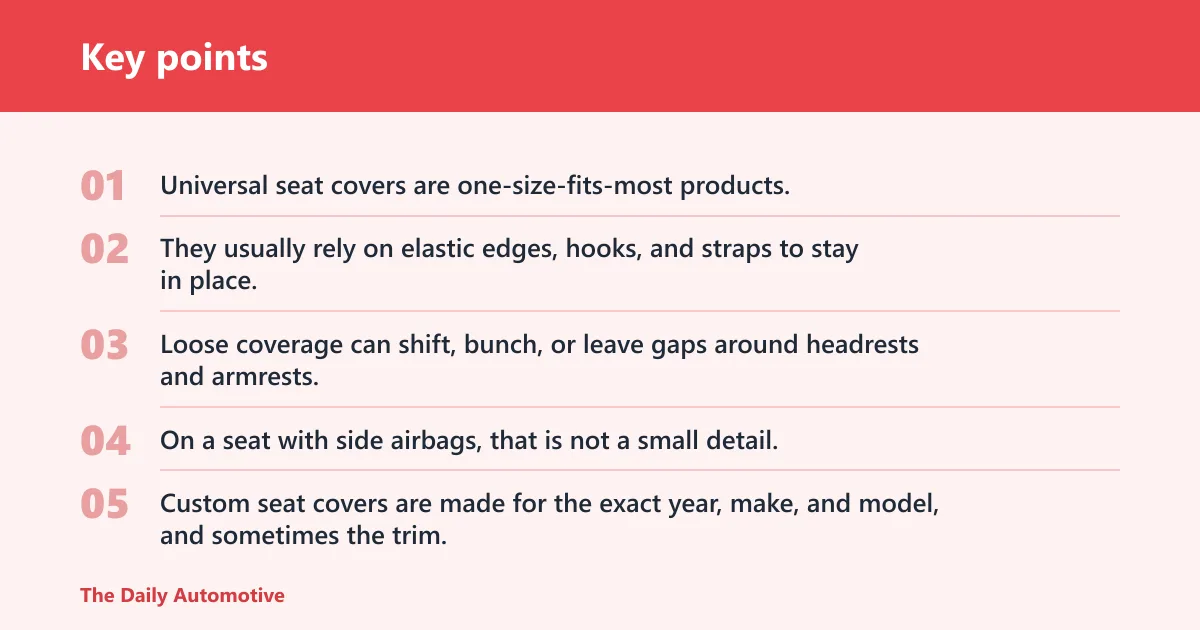
Universal seat covers are one-size-fits-most products. They usually rely on elastic edges, hooks, and straps to stay in place, which is why they are easier to buy for different vehicles and often cost less up front.
The downside is clear. Loose coverage can shift, bunch, or leave gaps around headrests and armrests, and a generic pattern may block seat controls, lumbar switches, or seatbelt pass-throughs. On a seat with side airbags, that is not a small detail.
What custom seat covers
Custom seat covers are made for the exact year, make, and model, and sometimes the trim. That lets the pattern account for the seat shape, the headrests, the armrests, and openings for seatbelt pass-throughs.
That closer pattern usually gives better coverage and a more factory-like appearance, though material choice still matters. A well-cut cover in the wrong fabric can still feel hot or bulky.
The fit, price, and compatibility trade-off
Say your sedan has simple front seats with no side airbags and fixed headrests. A universal set may look acceptable on day one and still be the cheaper buy if you only need a temporary fix. The risk is that movement over time can expose the seat edge or wear the straps sooner than expected.
Suppose your SUV has powered lumbar support, fold-down armrests, and a 40/20/40 rear bench. The fit risk rises quickly, because the cover has to clear several moving parts and separate seat sections. In that case, the extra cost of a custom pattern often buys fewer install headaches and less replacement risk.
Fit, features, and value
Universal Seat Covers and Custom Seat Covers solve different problems. One costs less and goes on fast; the other is built around the seat itself. The value question is not only what you pay today, but how likely the cover is to stay usable after weeks of entry, exit, and seat adjustment.
Fit and coverage
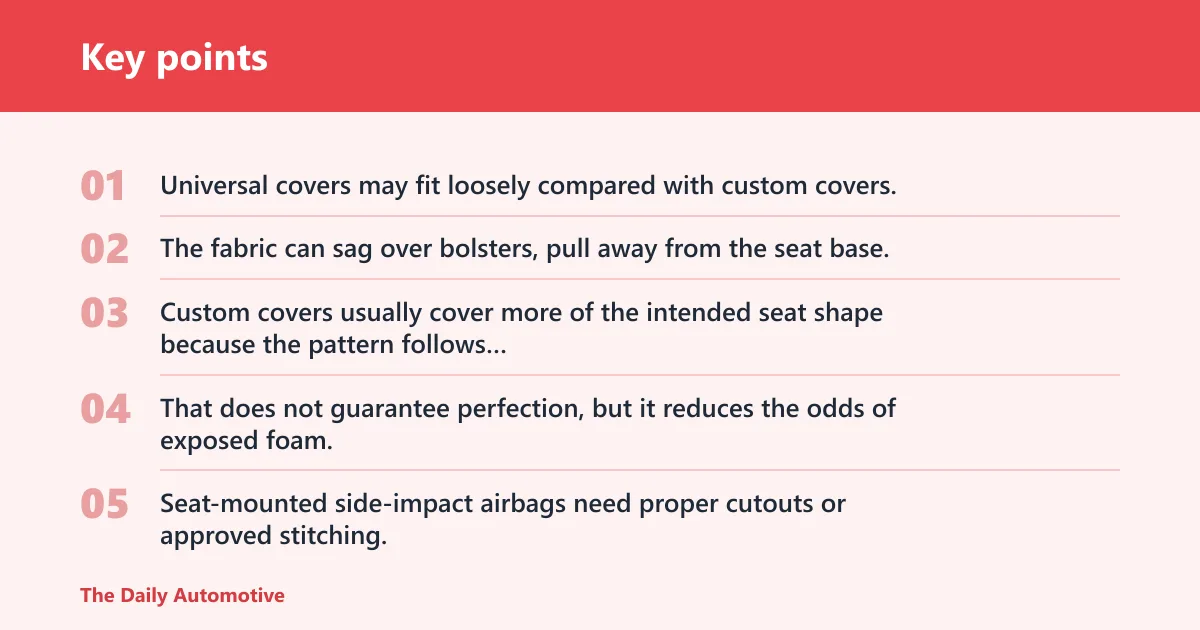
Universal covers may fit loosely compared with custom covers, and that looseness shows up in daily use. The fabric can sag over bolsters, pull away from the seat base, or leave a gap near the headrest opening.
Custom covers usually cover more of the intended seat shape because the pattern follows the vehicle’s dimensions. That does not guarantee perfection, but it reduces the odds of exposed foam, crooked seams, and constant readjustment.
Safety and seat features
Seat-mounted side-impact airbags need proper cutouts or approved stitching. If the cover blocks the deployment area or uses the wrong seam design, it becomes a compatibility problem, not just a comfort issue. Check the manufacturer’s listing for your model before buying.
Heated and ventilated seats raise another issue. Thick or poorly fitted material can obstruct airflow or slow heat transfer, and armrests, controls, and lumbar switches need precise openings so the cover does not pinch the panel or block the button.
Cost and replacement risk
Universal covers are presented as more affordable than custom covers, with basic sets often starting around $20 to $50. Custom covers are often listed around $50 to $150+, which is a wider spread because they are tied to vehicle-specific patterns and features.
That gap narrows if the universal set slips, tears at the edges, or becomes annoying enough that you replace it early. A cover that lasts twice as long can cost less over time even if it costs more at checkout.
Will universal seat covers fit your car?
Universal covers can fit many cars, but “fit” is doing a lot of work there. They are broad-compatibility products, not exact-pattern covers, so the real question is whether your seat shape and features are simple enough that the straps, hooks, and elastic edges can hold the cover in place without blocking anything important.
Headrests, armrests, and seat shape
Headrests and armrests are common trouble spots. Universal covers often leave gaps around them or bunch at the openings, especially when the seat has a sculpted backrest or a bulky armrest hinge.
If the seat has unusual bolsters, integrated headrests, or deep side wings, a generic cover has to stretch farther than intended. That is where slippage and wrinkles show up first.
Seat controls, lumbar switches, and access points
Power seat controls and lumbar switches need clear access. A loose cover can cover the switch panel, make the button hard to reach, or rub against the edges every time the seat moves.
That matters most on daily-driver seats that get adjusted often. The more often the seat moves, the more likely a weak fit becomes a daily annoyance.
Rear bench layouts and pass-throughs
Split bench rear seats such as 40/20/40 and 60/40 layouts need tailored rear-seat patterns. A generic rear cover can block a fold-down section, cover a pass-through, or interfere with child-seat anchor access.
For family vehicles and SUVs, this is often where universal covers fail first. They may look acceptable across the cushion, then get in the way the first time you fold the seat or install a child seat.
Are custom seat covers worth the extra cost?
Custom seat covers are worth the extra cost when fit and feature access matter more than the lowest price. They usually make sense for cars you plan to keep, seats with airbags or complex controls, and vehicles with rear-seat layouts that need precise cutouts and openings.
Long-term ownership
If you expect to keep the vehicle for years, the better pattern often pays back through fewer replacements and less daily irritation. A cover that stays aligned is easier to live with and less likely to wear at the stress points.
That matters more on seats that see constant entry and exit. Loose material wears faster at the same places, especially where the edge rubs against the bolster or seat track.
Better coverage on feature-heavy seats
Custom covers are the safer pick for seats with side airbags, heated or ventilated functions, and power controls. Vehicle-specific patterns can account for headrests, armrests, and seat belt pass-throughs, which lowers the chance of blocked access or uneven coverage.
Some custom sets also use waterproof materials, which can be useful for pets, kids, or wet work clothing. Material still matters, though. A waterproof cover that fits poorly can still be annoying to use.
When higher upfront cost makes sense
Choose the higher price when the vehicle has expensive upholstery, a complicated rear bench, or a lease return to protect. Small fit mistakes can become expensive if they leave marks, wear spots, or visible damage on the original seat.
For a short-term beater car, the math changes. If the vehicle is older and the interior is already showing wear, a cheaper cover may be enough to keep the seat usable without spending for a full vehicle-specific set.
Side airbags, heated seats, and split benches
These are the features that separate a decent-looking cover from a compatible one. A cover can fit the seat shape and still be the wrong choice if it interferes with deployment zones, heat flow, or folding sections.
Side-impact airbag compatibility
Side-impact airbags are a seat-mounted safety feature, so the cover must not block the deployment path. Proper cutouts or approved stitching are the key compatibility details, and they should be clearly listed for the exact vehicle or seat type.
Do not assume a universal cover is safe with airbags unless the listing explicitly says so. If that detail is missing, treat it as a mismatch and keep looking.
Heated and ventilated seat function
Heated and ventilated seats work best when the cover material and fit allow airflow and heat transfer. A thick or loose cover can slow both functions, which turns a comfort feature into a weaker one.
That is why material choice matters as much as pattern choice. A thin, well-cut cover is more likely to preserve function than a bulky one that traps air between layers.
40/20/40 and 60/40 rear seat layouts
Split rear benches need tailored rear-seat patterns, especially in family vehicles and SUVs. A 40/20/40 layout can fold in multiple ways, and a 60/40 bench often needs separate sections so you can keep using one side while the other folds.
If the cover does not respect the split, it can bunch at the hinge or block the folding motion. That is more than an annoyance when you need cargo room on short notice.
Seat cover scenarios matrix
This matrix treats the choice as a fit-risk and lifecycle-cost decision. The pick in each row matches the use case, the fit risk, and the likelihood that the cover will stay usable without blocking key features.
| Buyer scenario | Better pick | Fit-risk rating | One-line rationale |
|---|---|---|---|
| Daily commuter | Custom Seat Covers | Medium | Repeated seat use exposes slippage, wear, and control access problems. |
| Pet owner | Custom Seat Covers | Medium | Better coverage helps reduce gaps where hair, mud, and claws reach the original seat. |
| Family hauler | Custom Seat Covers | High | Split benches, child-seat anchors, and rear access points call for exact openings. |
| Work truck | Universal Seat Covers | Medium | Budget-first protection may be enough if the seats are simple and the goal is quick cover-up. |
| Leased vehicle | Custom Seat Covers | Medium | Better fit lowers the chance of visible wear or awkward coverage at lease return. |
| Hot climate | Custom Seat Covers | Medium | Fit and material control matter more when thick, loose fabric can trap heat. |
| Airbag-equipped seats | Custom Seat Covers | High | Seat-mounted airbags need the right cutouts or stitching, which is easier with vehicle-specific patterns. |
| Split rear bench | Custom Seat Covers | High | 40/20/40 and 60/40 layouts need tailored sections so the bench still folds correctly. |
| Short-term use | Universal Seat Covers | Low | Lower upfront cost makes more sense when you only need temporary protection. |
| Long-term ownership | Custom Seat Covers | Medium | Longer use makes better fit and lower replacement risk more valuable than the initial savings. |
Daily commuter, pet owner, and family hauler
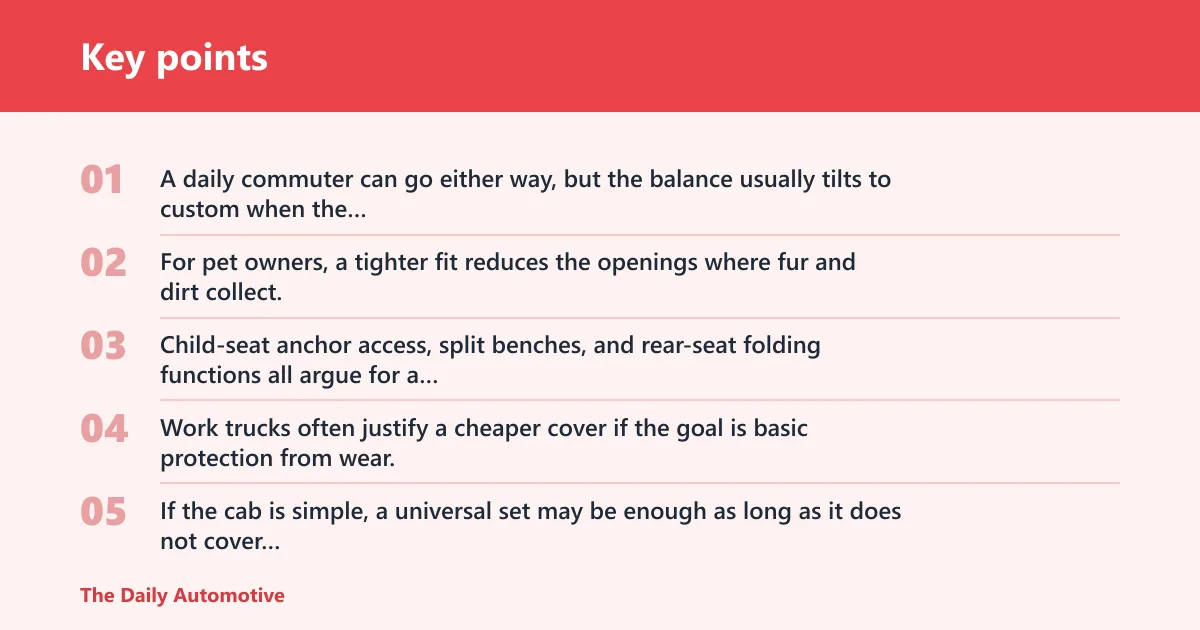
A daily commuter can go either way, but the balance usually tilts to custom when the seat has controls or airbags. For pet owners, a tighter fit reduces the openings where fur and dirt collect, and it holds up better to repeated entry and exit.
Family hauling is the toughest test. Child-seat anchor access, split benches, and rear-seat folding functions all argue for a pattern that matches the vehicle instead of fighting it.
Work truck, leased vehicle, and hot climate
Work trucks often justify a cheaper cover if the goal is basic protection from wear, grime, and frequent climbing in and out. If the cab is simple, a universal set may be enough as long as it does not cover switches or belts.
Leased vehicles and hot climates lean the other way. Lease returns reward cleaner coverage, while hot weather punishes thick, loose material that traps heat against the seat.
Short-term use and long-term ownership
Short-term use favors Universal Seat Covers when cost matters more than exact fit. That can be a smart move for a temporary car, a spare vehicle, or a seat you only need to protect for a season.
Long-term ownership is where Custom Seat Covers start to make more sense. The longer you plan to keep the car, the more important it becomes that the cover fits cleanly, stays put, and does not get in the way of the vehicle’s features.
Choose Universal Seat Covers if… / Choose Custom Seat Covers if…
Choose Universal Seat Covers if your seats are simple, you want the lowest upfront cost, or you only need temporary protection. They also make sense for a short-term vehicle, a work truck with basic seats, or a multi-car household that values easy availability over exact fit.
Choose Custom Seat Covers if your car has side airbags, seat-mounted controls, heated or ventilated seats, or split rear benches. They are also the better call for long-term ownership, lease protection, and any vehicle where you want fewer fit issues and less replacement risk.
The semi-custom middle ground is worth a look when you want more structure than a universal cover but do not need a full tailored setup. It can be the practical compromise for common seat shapes, especially when you want better coverage without paying for a full model-specific set.


Frequently asked questions
Are car seat covers universal?
No. Universal seat covers are made for a wide range of vehicles, not one exact model, which is why they are called one-size-fits-most. That broad approach makes them easier to buy, but it also means the fit can be loose, especially around headrests, armrests, and seat controls.
What is the difference between universal and custom seat covers?
Universal covers use elastic edges, hooks, and straps to fit many seats, while custom covers are made for the specific year, make, and model. The result is a trade-off between lower upfront cost and better coverage, with custom covers usually doing better on fit and feature access.
Which seat cover fits better on a car with side airbags?
Custom Seat Covers usually fit better on a car with side airbags because vehicle-specific patterns can include the proper cutouts or stitching. For safety, the listing should clearly say the cover is compatible with that seat and that airbag deployment is not blocked.
Are universal seat covers worth it for an older car?
They can be worth it if the car has simple seats and you only need a low-cost way to cover worn upholstery. If the car still has working seat airbags, powered adjustments, or unusual rear-seat folds, the cheap option can turn into a fit problem fast.
Do custom seat covers protect seats better than universal ones?
Usually yes, because better coverage reduces gaps, movement, and exposed edges where dirt and wear start. Protection still depends on material, though, so a custom cover in the wrong fabric may not help as much as a well-made one that also suits the climate and use case.
Will universal seat covers work with heated seats and armrests?
Sometimes, but only if the design leaves the right access and uses a material that does not block heat or ventilation too much. Armrests are a common fit problem, and a loose cover can bunch around them or cover the opening that needs to stay clear.
Which seat cover is best for pets, kids, or work use?
Custom Seat Covers are usually better for pets and kids because better coverage helps keep dirt and mess out of gaps. For work use, a universal cover can still be the practical choice if the seats are simple and the main goal is cheap, quick protection rather than exact fit.
Products related to this article
Sponsored / affiliate links. As an Amazon Associate I earn from qualifying purchases. I may earn additional commission from eligible campaigns.
 Teuaktty Car Seat Covers Universal Car Protective Front Seat Covers Washable Non-Slip Seat Protectors for Gym Workouts,Waterproof and Sweatproof Towel Seat Covers for Cars,Trucks, Jeeps (2 Pack Grey)
 FLORICH Front Seat Covers 2 Pieces Universal Seat Cover for Cars Breathable Leather Waterproof Car Seat Cover Driver Seat Cover Automotive Car Seat Cushion Fit for Most Cars SUV Trucks, Beige&Coffee