Outdoor Vinyl for Car Decals: Cast vs. Calendered Guide
Use cast vinyl for curved or long-life car decals, polymeric calendered for flat panels with medium-term outdoor use, and basic calendered only for short-term, flat graphics. Pick the wrong film, and you invite edge lift, shrinkage, cracking, or a decal that quits before the vehicle does. This guide gives a surface-and-lifespan decision matrix, plus buying rules for DIY and small-shop jobs.
Cast vs. calendered at a glance
| Factor | Cast | Calendered | Winner |
|---|---|---|---|
| Manufacturing method | Made by casting liquid PVC onto a liner | Made by rolling heated PVC through rollers | tie |
| Conformability | Thin, soft film that follows compound curves, bumpers, mirrors, and recesses better | Thicker, stiffer film that fits flat or gently curved surfaces best | Cast |
| Outdoor life | Commonly listed around 5-10 years, with some products rated up to 8 years or 5-7+ years | Commonly listed around 1-5 years, with some products rated 3-5 years or 1-3 years | Cast |
| Cost for decal-sized jobs | Higher material cost | Lower material cost | Calendered |
| Best-fit use case | Long-term decals, curved panels, vehicle graphics | Shorter-life decals on flat glass or panels | depends on surface |
Manufacturing method matters because the film behaves differently
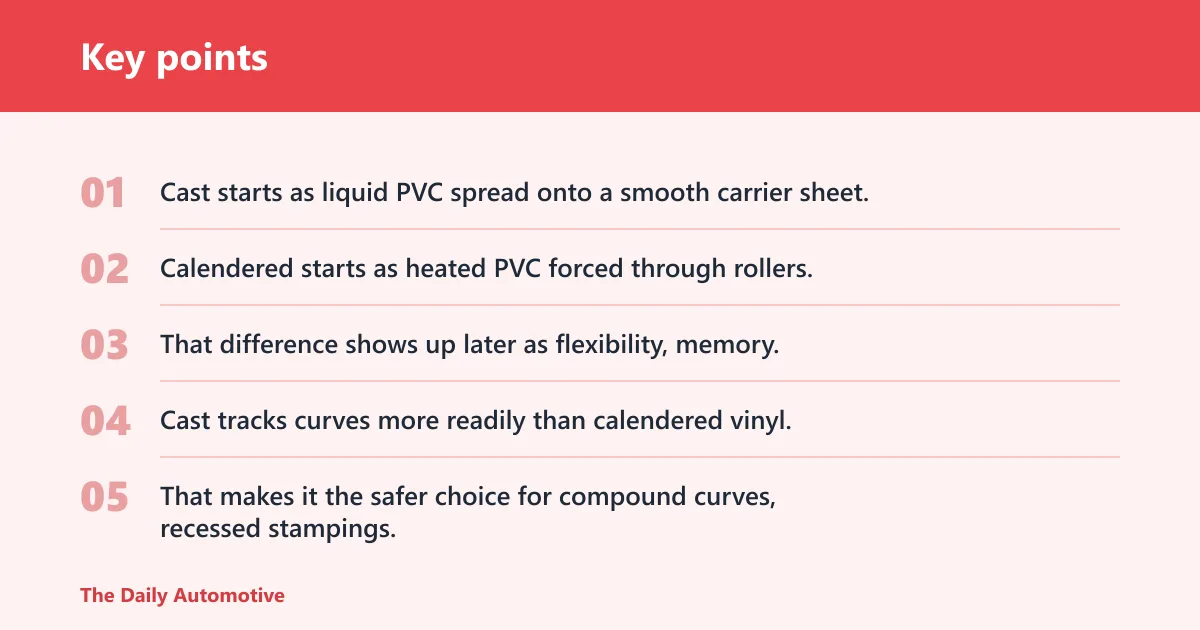
Cast starts as liquid PVC spread onto a smooth carrier sheet, then it sets into a thin film. Calendered starts as heated PVC forced through rollers, which leaves it thicker and stiffer. That difference shows up later as flexibility, memory, and how hard the film pushes back at edges.
Conformability is the real dividing line
Cast tracks curves more readily than calendered vinyl. That makes it the safer choice for compound curves, recessed stampings, and parts that bend in more than one direction. Calendered belongs on flatter work where the film does not need much stretch and recovery.
Outdoor life is tied to shape and service time
Cast usually lasts longer outdoors than calendered, but product data still varies by brand and adhesive system. For decal work, the useful question is not only “which lasts longer?” It is “which lasts long enough for this surface without shrinking back at the edges?”
Which vinyl for which car surface?
For flat windows and body panels, a polymeric calendered decal is usually the practical buy if the graphic is medium-term and the surface stays simple. Move to lightly curved doors, and cast starts to make more sense. On bumpers, mirrors, and recessed areas, cast is the safer film because the surface itself raises the failure risk.
Flat window decals and flat body panels
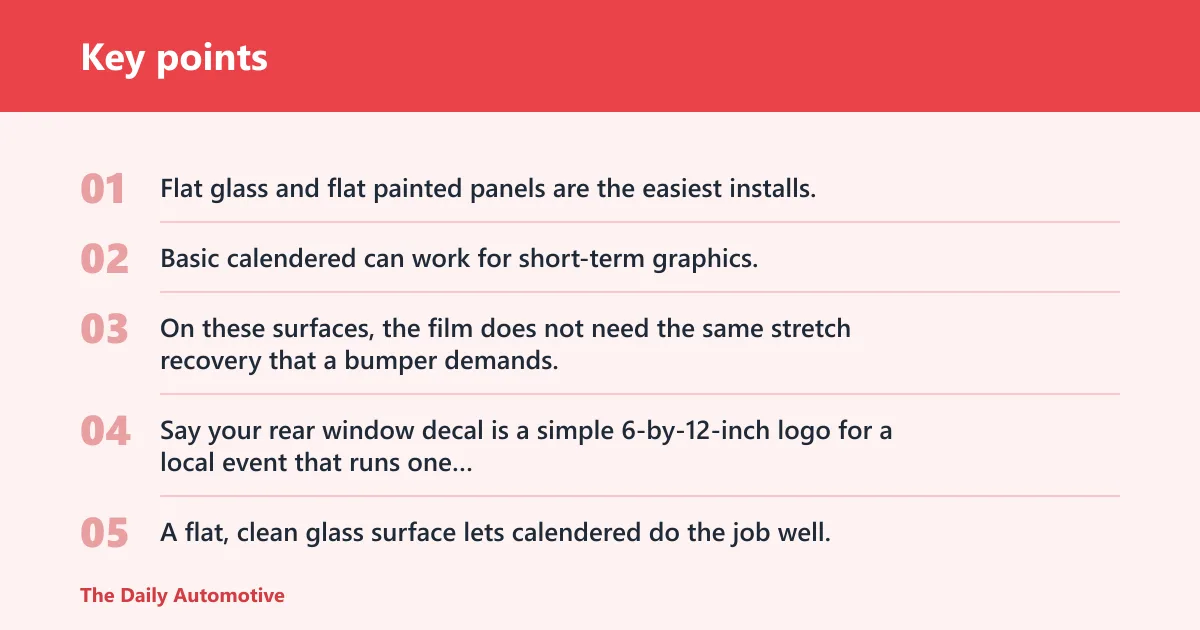
Flat glass and flat painted panels are the easiest installs. Basic calendered can work for short-term graphics, while polymeric calendered is the better everyday choice for outdoor decals that need more life. On these surfaces, the film does not need the same stretch recovery that a bumper demands.
Say your rear window decal is a simple 6-by-12-inch logo for a local event that runs one season. A flat, clean glass surface lets calendered do the job well, as long as the adhesive matches the install plan and the print is not expected to live for years.
Lightly curved door decals
Light curves are where the gap between calendered types becomes visible. Polymeric calendered handles mild wraparound on a door skin better than basic calendered, but cast still has stronger conformability and less shrink-back risk for longer service life. If the panel has only a gentle curve and the decal is not expected to live long, calendered remains workable.
Bumpers, mirrors, and recessed areas
These are cast jobs. Bumpers and recessed panels create compound curves, and mirrors add odd transitions and tight return edges. When calendered is forced onto those shapes, common failures include edge lift, tunneling, and shrink-back that exposes the paint line.
Short-term promo decals versus long-term fleet decals
Short-term promotions can justify basic calendered on simple surfaces because the service window is short and the cost stays down. Long-term fleet decals are the opposite case: consistency, outdoor durability, and edge stability matter more than saving a little on material. For fleet work, cast or at least premium polymeric calendered is the more defensible choice depending on the surface.
Car decal decision matrix
| Surface type | Risk level | Recommended film | Adhesive type | Expected outdoor life | Common failure mode |
|---|---|---|---|---|---|
| Flat window decal | Low | Polymeric calendered | Air-release acrylic | 3-5 years for quality outdoor film; shorter for basic calendered | Dust specks, bubbles, edge dirt pickup |
| Lightly curved door decal | Medium | Cast | Air-release acrylic | 5-8 years or longer on suitable products | Edge lift if the film is too stiff |
| Bumper/recessed area | High | Cast | Vehicle-grade air-release acrylic | 5-10 years on products rated for outdoor vehicle use | Tunneling, shrink-back, lifting in recesses |
| Short-term promo decal | Low | Basic calendered | Standard removable or air-release acrylic | 1-3 years, depending on product and exposure | Early edge wear if left outdoors too long |
| Long-term fleet decal | Medium to high | Cast or premium polymeric calendered on simple panels | Vehicle-grade air-release acrylic | 5-10 years for cast; 3-5 years for premium calendered on simple surfaces | Memory, edge pullback, adhesive fatigue |
How to read the matrix before you buy
Start with the surface, not the price. If the decal touches a curve, bumper, or recess, move toward cast. If the decal sits on a flat window or flat panel and the job is short-term, a calendered film can be the smarter buy. Then match the adhesive and service life to the same plan.
How cast and calendered vinyl are made
The manufacturing method changes the film’s memory. Cast is thin and relaxed from the start, while calendered is mechanically stretched through rollers and carries more internal tension. That is why one film settles into curves and the other prefers flat work.
Cast vinyl: liquid PVC cast onto a liner
Cast vinyl is made by spreading liquid vinyl onto a smooth carrier sheet and letting it set. The result is a thin, soft film that settles into curves easily and keeps dimensional change low over time. That makes it the standard answer for vehicle graphics and other long-term outdoor decals.
Calendered vinyl: heated PVC rolled through rollers
Calendered vinyl is made by pushing heated vinyl through large rollers to flatten it into a sheet. It comes out thicker and stiffer, which is useful on flat surfaces and helps keep cost lower. Basic calendered is the short-life option, while polymeric calendered extends that service window for better outdoor use.
Why manufacturing method changes memory and shrinkage
Cast has minimal shrinkage and low memory, so it stays put more cleanly at edges. Calendered can shrink or pull back over time, especially when heat and sun keep cycling the panel. That is why a calendered decal can look fine at install and still fail later on a tight curve.
Does durability change with the surface?
Yes. The same film can behave differently on glass, a flat door skin, or a bumper. Outdoor life depends on UV exposure, installation quality, and whether the surface shape forces the film to fight itself after the decal is already on the vehicle.
Outdoor lifespan ranges for cast and calendered vinyl
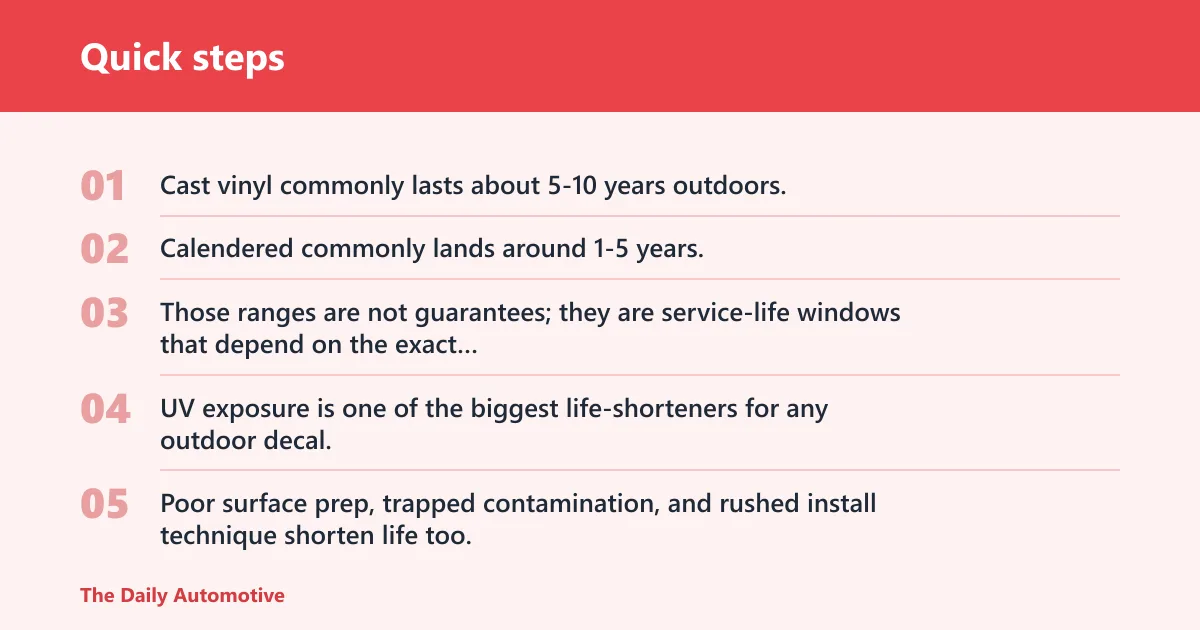
Cast vinyl commonly lasts about 5-10 years outdoors, and some product data places it around 5-7+ years or up to about 8 years under proper use. Calendered commonly lands around 1-5 years, with many listings putting it at 3-5 years or 1-3 years. Those ranges are not guarantees; they are service-life windows that depend on the exact product and its exposure.
UV exposure, installation quality, and service-life limits
UV exposure is one of the biggest life-shorteners for any outdoor decal. Poor surface prep, trapped contamination, and rushed install technique shorten life too. A decal that is applied within the material’s stated service life is also easier to remove cleanly than one that has baked far past it.
A common first-timer mistake is using a budget calendered film on a black rear bumper because the price looked attractive. The decal may look fine on day one, then begin to lift at the corners after heat cycles and washes, while the center still clings hard enough to make removal messy.
What dimensional stability means for edge pullback
Dimensional stability is the film’s ability to keep its size and shape after installation. Cast holds its size better and shows less pullback, which matters on long outdoor installs. Calendered can be fine on flat panels, but on a curve it is more likely to show edge lift or a slight shrink line along the trim.
What adhesive and laminate should you choose?
Film type is only part of the decision. Adhesive controls how the decal installs and how it behaves during removal, while laminate adds protection against UV, scratches, and moisture. The best setup is the one that matches the film, the surface, and the planned service life.
Air-release adhesive and bubble control
Air-release adhesive uses micro-channels in the backing so trapped air can escape during installation. That makes DIY placement easier and cuts the chance of visible bubbles. It does not make a stiff film conformable, though, so it helps with install quality rather than surface shape.
When laminate should match the base film
Cast films are often paired with cast laminate. Matching laminate and base film preserves conformability, especially on curved vehicle panels. A stiff laminate over a flexible cast base can reduce the benefit of the cast film, which is why the pair should be treated as a system.
Why vehicle-grade adhesive matters on painted surfaces
Painted automotive surfaces are less forgiving than glass. Vehicle-grade material is the safer choice because it is made for that environment and its adhesive is chosen for outdoor use on paint, not only for easy sticking on a flat sign panel. That matters most when the decal has to stay put through heat, wash cycles, and road film.
Choose Cast if… / Choose Calendered if…
Cast is the right pick when the decal has to follow a curve, live outdoors for years, or stay dimensionally stable on a vehicle panel that moves through heat and weather. Calendered is the right pick when the surface is flat or gently curved, the service life is shorter, and cost matters more than long-term shape retention.
Choose Cast if…
- The decal goes on a bumper, mirror, recess, or other compound curve.
- You need long outdoor life and lower shrink-back risk.
- The job is on a painted vehicle surface and needs vehicle-grade behavior.
- You want the better option for fleet graphics and long-term branding.
Choose Calendered if…
- The decal is for a flat window, flat panel, or other simple surface.
- The job is short-term or medium-term and cost control matters.
- You can use polymeric calendered for better outdoor life, or basic calendered for a brief promo.
- You do not need the film to wrap tight curves or recessed edges.

Frequently asked questions
What is the difference between cast and calendered vinyl for car decals?
Cast is made by casting liquid PVC onto a liner, which creates a thin, soft film with better conformability and longer outdoor life. Calendered is rolled through heated rollers, which makes it thicker, stiffer, and better for flat or gently curved surfaces. The choice comes down to shape and service time.
Which vinyl is better for outdoor car decals?
Cast is usually better for outdoor car decals when the job must last longer or fit a curve. Calendered is still a sound choice for flat panels and shorter service life. For outdoor work, check the manufacturer’s data sheet for UV resistance and the stated life range before buying.
Can calendered vinyl be used on a car?
Yes, but only in the right place. Calendered works well on flat glass, flat doors, and other simple surfaces. On bumpers, mirrors, and recessed panels, it is more likely to lift, tunnel, or pull back at the edges, so cast is the safer vehicle-grade choice.
How long does cast vinyl last outdoors?
Cast vinyl is commonly rated around 5-10 years outdoors, and some product data lists up to 8 years or 5-7+ years with proper application. Real service life depends on UV exposure, surface prep, install quality, and whether the decal is paired with the right laminate and adhesive.
How long does calendered vinyl last outdoors?
Calendered vinyl is commonly rated around 1-5 years outdoors, with many products listed at 3-5 years or 1-3 years. Basic calendered fits shorter jobs, while polymeric calendered extends that window on simple surfaces. Past the stated life, removal gets harder and edge failure becomes more likely.
Are cast and calendered laminates supposed to match?
They should, especially on vehicle graphics. Cast laminate over cast film helps preserve conformability on curved surfaces, while a stiffer mismatch can reduce how well the graphic settles into shape. Matching the laminate to the base film is the cleaner choice for long-term outdoor work.
Products related to this article
Sponsored / affiliate links. As an Amazon Associate I earn from qualifying purchases. I may earn additional commission from eligible campaigns.