Best AGM Car Batteries for Daily Drivers (2026): We Compared
For daily drivers, the best AGM car battery matches your tray size, CCA requirement, and charging system. Pay extra only if you run start-stop, make short trips, carry heavy accessories, or live in cold weather. Pick wrong and you waste money on a battery that adds no real benefit, or buy one that will not fit, crank well, or recharge properly. This guide compares AGM replacements on reliability, fitment, cold-start performance, and value, and shows when a standard flooded battery is the smarter buy.
Quick comparison
| Product | Badge | Best for | Price | ||
|---|---|---|---|---|---|
 |
OPTIMA® Batteries High Performance 25 REDTOP® Sealed AGMOPTIMA | Our pick | 720 CCA · Sealed AGM · Starting Battery | $249.99
Price as of 10 Nov 2026
|
View |
 |
Odyssey Battery ODX-AGM34 Extreme Series AGM BatteryOdyssey | Upgrade pick | Group 34/78 · 850 CCA · AGM | $367.32
Price as of 10 Nov 2026
|
View |
AGM makes sense when commuting patterns, accessory load, or climate put real strain on the battery. It is not a default upgrade for every car, and the fitment check comes before the brand choice.
How we chose
This comparison is based on manufacturer specs, listing details, and published buyer feedback.
- Fitment first: BCI group size, case dimensions, and terminal layout had to match common replacement needs.
- Starting and backup power: CCA and reserve capacity mattered more than marketing language.
- Daily-driver value: We favored batteries that fit commuting, short-trip use, and modern electrical loads.
- Warranty and ownership cost: Longer coverage helped, but only when the specs still fit the use case.
Optima redtop 25: best for everyday commuting
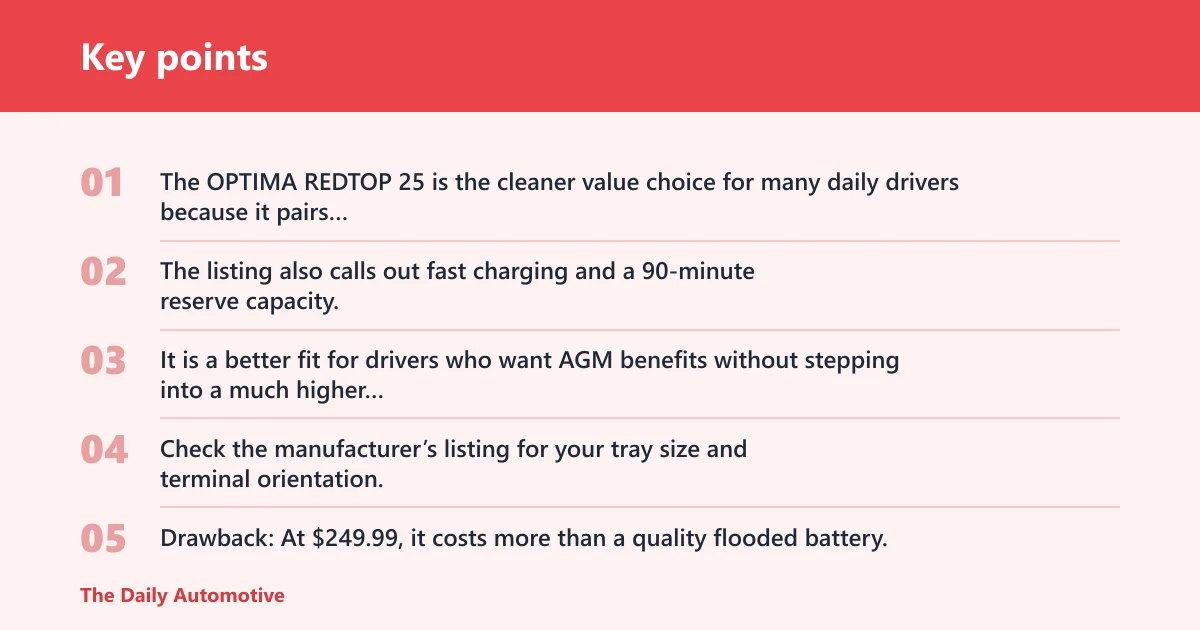
The OPTIMA REDTOP 25 is the cleaner value choice for many daily drivers because it pairs a sealed AGM design with 720 CCA, maintenance-free ownership, and vibration resistance that suits normal commuting. The listing also calls out fast charging and a 90-minute reserve capacity, which helps when the car sees repeated starts and moderate accessory use.
It is a better fit for drivers who want AGM benefits without stepping into a much higher price tier. Check the manufacturer’s listing for your tray size and terminal orientation, since Group 25 fitment still has to match the vehicle.
Drawback: At $249.99, it costs more than a quality flooded battery, and the reserve capacity is not as high as the stronger options in this guide.
Odyssey odx-agm34: best for stronger starts
The Odyssey ODX-AGM34 suits drivers who want a stronger starting setup, since the listing shows about 850 CCA, roughly 134 minutes of reserve capacity, and top posts plus threaded side terminals. That mix is useful for vehicles that see colder starts, more electrical demand, or a tighter margin for backup power.
This is the better pick when the car’s factory battery spec, tray space, and terminal layout line up with Group 34/78 fitment. It is also a more expensive buy, so it makes the most sense when the battery has real work to do.
Drawback: The $367.32 price is a clear jump, so the premium is hard to justify if your car does not need the extra cranking margin or reserve capacity.
Agm battery: best for short trips
AGM is often worth the premium for short-trip commuting because repeated starts and brief drive cycles leave less time for a battery to recover. A quality AGM handles that pattern better than many flooded batteries, especially when the car also runs heated seats, navigation, dash cams, or frequent phone charging.
Why short commutes stress batteries
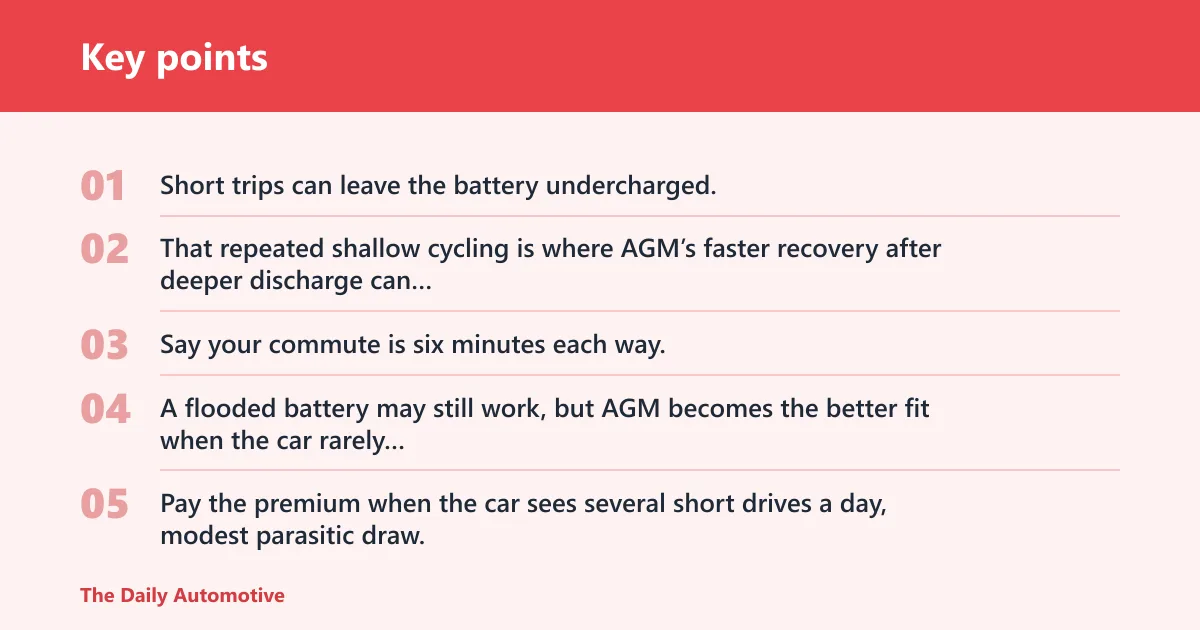
Short trips can leave the battery undercharged, then the next start asks for more power before the alternator has fully caught up. That repeated shallow cycling is where AGM’s faster recovery after deeper discharge can help, but it does not fix a charging system that is already weak.
Say your commute is six minutes each way, with a rear defroster on and the cabin fan at a high setting. A flooded battery may still work, but AGM becomes the better fit when the car rarely gets a long highway recharge window.
When AGM earns its premium
Pay the premium when the car sees several short drives a day, modest parasitic draw, and a steady load from electronics. If the vehicle sits for long periods or the alternator is healthy and the drives are long, a quality flooded battery may be the smarter buy.
The ownership tradeoff is simple: AGM usually costs more up front, but it can last longer in the right commuting pattern. That gain disappears if the battery is chronically undercharged because of a bad alternator, a parasitic drain, or poor installation.
Agm battery: best for start-stop cars
Start-stop systems are one of the clearest reasons to choose AGM because the battery has to survive frequent engine restarts and more cycling than a standard starter battery typically sees. In many modern cars, AGM is factory spec for exactly that reason.
Frequent restart demands
Every restart pulls current, and a start-stop car can do that many times in a normal commute. AGM’s cycle-life advantage matters more here than raw peak audio output or other non-commuting uses.
If the vehicle shuts off at a light, restarts in traffic, and powers heated seats plus a charging phone, the battery needs both cranking strength and repeatability. That is where reserve capacity and proper CCA spec matter together.
Charging-system compatibility checks
Do not treat AGM as a drop-in upgrade without checking charging voltage and the vehicle’s battery registration or charging profile, where applicable. Some older cars and some smart-charging vehicles need the correct battery type so the alternator does not undercharge or overwork the new battery.
Undercharging is a common reason AGM gets blamed for failure. The battery is not the problem if the regulator profile, cable condition, or replacement procedure is wrong.
Agm battery: best for older cars
For older cars, AGM can be a good replacement, but only when the charging system can support it. If the alternator voltage and regulator behavior are not a good match, a quality flooded battery is often the safer value choice.
When a flooded battery is smarter
If the car has simple electrical loads, does not run start-stop, and sees regular longer drives, the premium for AGM may buy very little. In that case, spend on the correct BCI group size and a reputable flooded battery rather than paying extra for features the car will not use.
A common first-timer mistake is buying AGM because the label sounds stronger, then discovering the real issue was a weak alternator or corrosion at the terminals. Fix the charging system first.
Alternator voltage and regulator checks
Older cars can be especially sensitive because their charging systems were not designed around AGM-specific charging ranges. If the battery voltage never gets where it should during normal driving, even a premium AGM can act like a poor choice.
Always check the vehicle manual and the battery manufacturer’s listing before swapping types. The right battery still has to fit the tray, match the terminal orientation, and work with the charging profile.
Battery fitment decision matrix
This table turns daily-driver use into a simple fitment decision. Count the factors that apply to your car, then use the result as your starting point before you compare brand and warranty.
| Factors that apply | AGM recommendation | Reason in one line |
|---|---|---|
| 0 to 1 | Stay flooded | Low electrical stress and normal commute patterns usually do not justify the AGM premium. |
| 2 | AGM optional | AGM can help, but a quality flooded battery may still be the better value if charging is healthy. |
| 3 | AGM recommended | Short trips, accessories, or cold weather start to stack up enough load to justify AGM. |
| 4 to 5 | AGM recommended | Frequent starts, high accessory draw, and cold weather make AGM the safer commuting choice. |
How to count the factors
- Short-trip frequency: frequent trips under 15 minutes count as a factor.
- Start-stop system: factory start-stop is a strong AGM signal.
- Accessory load: heated seats, navigation, dash cams, and phone charging raise the count.
- Climate: cold weather raises starting demand and favors higher CCA.
- Vehicle age and charging compatibility: older charging systems may push you back toward flooded unless compatibility is confirmed.
Which one should you buy?
If you want the best overall daily-driver value, start with the OPTIMA REDTOP 25. It gives you AGM benefits for commuting, vibration resistance, maintenance-free ownership, and a lower price than the stronger premium option.
If your car needs more reserve capacity or stronger cranking, the Odyssey ODX-AGM34 is the more demanding-spec choice. It makes sense when the vehicle’s fitment and charging setup call for more battery headroom.
If you drive an older car with light electrical loads, a quality flooded battery is often the smarter buy. The money you save can matter more than AGM’s benefits if the car does not have short-trip stress, start-stop, or heavy accessory use.
For cold-weather commuters, prioritize CCA that meets or exceeds the OEM spec, then check reserve capacity and group size. For start-stop vehicles, AGM is usually the right starting point, but the battery still has to match the car’s charging profile.
What AGM batteries are and why they differ from flooded batteries
AGM commonly stands for absorbent glass mat, a sealed lead-acid battery construction that uses glass mats to help hold the electrolyte in place. That design is maintenance-free, spill-resistant, and more vibration-resistant than a standard flooded battery, with faster recovery after deeper discharge.
For daily driving, those traits matter most when the car sees repeated starts, short trips, or more electrical load than a basic commuter. They matter less when the car spends most of its time on longer drives with modest accessory use.
Can any car use an AGM battery?
Many cars can use an AGM battery if the BCI group size, case dimensions, and terminal orientation fit the tray and cables. But fitment is only half the check; the charging system also has to support AGM properly, especially in older cars and smart-charging vehicles.
The safe move is to match the vehicle manual and the battery listing before you buy. A battery that physically fits but charges poorly is not a good swap.
Do I need an AGM battery for my car?
You need AGM when the car’s use pattern creates real battery stress: short trips, start-stop operation, frequent accessory use, or cold weather. If those factors are absent, a quality flooded battery is usually enough and may be the better value.
Think in terms of the whole system, not one number. CCA, reserve capacity, commute length, and charging compatibility all matter together.
AGM battery vs regular car battery?
AGM is generally better sealed, more vibration-resistant, and better suited to repeated cycling than a regular flooded battery. A flooded battery is usually cheaper and still a solid choice for cars with lighter electrical demand and longer drives.
The better buy depends on use case, not brand hype. If the vehicle does not stress the battery, AGM can be extra cost without extra benefit.
Are AGM car batteries better for daily driving?
They are better for daily driving when the daily drive is short, cold, or full of electrical load. They are not automatically better for every commuter, because a longer, simpler drive pattern can make a flooded battery the smarter purchase.
Start-stop vehicles are the clearest daily-driving case for AGM. The frequent restarts put the battery in the zone where AGM’s cycle-life advantage matters most.
Will AGM batteries work in older cars?
Yes, they can work in older cars if the fitment matches and the charging system is compatible. The risk is not age by itself; it is whether the alternator and regulator profile keep the battery properly charged.
If the older car has a simple electrical system and light accessory use, AGM may be more battery than the car needs. In that case, a good flooded battery is often the cleaner value.
How do I know if my car needs an AGM battery?
Check the owner’s manual, look at the battery type that came from the factory, and compare your commute and accessory load. If the car has start-stop, repeated short trips, or a heavy electrical load, AGM is usually worth serious consideration.
Also confirm the vehicle’s group size, terminal orientation, and charging system before choosing a replacement. Those fitment checks prevent the most common mistakes.
How do I test an AGM car battery?
Use the vehicle manual’s procedure and the battery manufacturer’s instructions, then check state of charge, cranking performance, and charging voltage. If the battery keeps failing after a full charge, inspect the alternator, cables, ground points, and for parasitic draw.
A weak battery reading is not always a bad battery. Chronic undercharging often points to the vehicle, not the AGM design.
Frequently asked questions
What is the advantage of AGM over a standard battery?
The main advantage is durability under real-world stress: vibration, frequent starts, deeper discharge, and backup demand. That makes AGM a better commuting battery when the car’s use pattern actually asks for it.
Products related to this article
Sponsored / affiliate links. As an Amazon Associate I earn from qualifying purchases. I may earn additional commission from eligible campaigns.