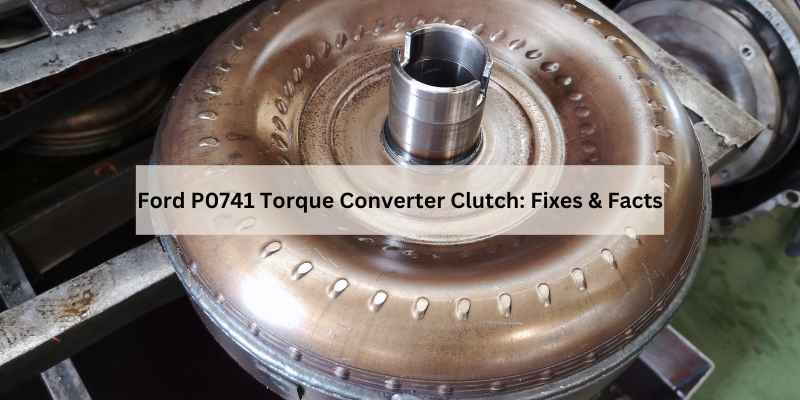
Ford P0741 Torque Converter Clutch: Diagnosis and Fixes That Actually Work
You’re cruising at 65 mph on the highway, and the tachometer suddenly jumps 300 rpm without you touching the gas. The engine sounds louder, fuel economy drops, and the transmission feels like it’s slipping. A scan tool reads P0741. This is the Ford torque converter clutch (TCC) failing to lock up, and it’s one of the most common transmission complaints across Ford trucks and SUVs.
Most articles on this code give you generic advice that applies to a Chevy as much as a Ford. This one doesn’t. I’m going to walk you through the Ford-specific quirks, the difference between a shudder and a true slip, and a diagnostic order that saves you from replacing a transmission when a $30 solenoid would have fixed it. You’ll know exactly what to check, in what order, and what each result means for your wallet.

IPARTS EXPERT
212CC Torque Converter 6.5 HP 3/4" -…
- 【TORQUE CONVERTER DIY MODIFICATIONS COMPATIBLE】DIY Modifications fits for go karts and mini bikes and drift carts, such as BT200X,…
- 【REALLY WAKES UP THE BIKE】 This 3/4" Torque Converter is a direct replacement kit for the most popular Comet TAV2 go-kart torque-c…
- 【BRING YOUR OFF-ROAD MACHINE TO LIFE】This TAV2 30 Series Go Kart Clutch Kit fits a 3/4" shaft and comes with your choice of a 10 t…
If you’re working on a small engine project like a go-kart or mini bike, the same hydraulic principles apply. A quality torque converter kit for a Predator 212 uses a belt and sheaves to multiply torque, much like the fluid coupling in your Ford’s transmission. The difference is scale and complexity.
What Does the P0741 Code Mean on a Ford?
P0741 stands for “Torque Converter Clutch Circuit Performance or Stuck Off.” The powertrain control module (PCM) commands the TCC solenoid to lock the clutch inside the torque converter. Then it watches the difference between engine speed (RPM) and turbine speed (input shaft speed). When the clutch locks, those two speeds should match within a small window, usually under 50 rpm. If the PCM sees more slip than allowed while the clutch is commanded on, it sets P0741 after two consecutive failed drive cycles.
This is not a wiring code. P0741 means the PCM sent the command, but the clutch didn’t physically lock. The fault lies in hydraulics, mechanical parts, or occasionally the solenoid itself. A related code, P0740, means the TCC solenoid circuit is malfunctioning—that’s an electrical issue. P0743 is a short in the solenoid circuit. Knowing the difference narrows your diagnosis immediately.
Symptoms of a Stuck-Off Torque Converter Clutch
The most obvious symptom is rpm fluctuation on the highway. At steady throttle, the engine speed will hunt up and down by 200-400 rpm. You’ll also notice:
- Fuel economy drops by 2-4 mpg because the converter never locks, so there’s constant fluid slippage.
- Transmission fluid temperature runs higher than normal, especially in summer or while towing.
- A shudder or vibration during light throttle at 40-55 mph. This feels like driving over rumble strips.
- The check engine light may flash or blink if the PCM detects a misfire condition caused by the TCC shudder.
The shudder deserves special attention because it changes your repair strategy. A shudder usually means the friction material inside the converter is worn or the fluid is contaminated. A true slip, where the rpm jumps and stays high, points to a hydraulic leak or a worn pump. You need to know which one you have before spending any money.
The Root Causes: From Simple to Severe
Fluid Level, Condition, and Type (Mercon V vs. LV)
Start with the cheapest possible cause. Low fluid level is the number one reason for TCC slip. The pump can’t build enough line pressure to engage the clutch. But here’s the Ford catch: checking the level on a 6R80 or 10R80 is not like checking oil. The transmission must be at operating temperature, typically 150-170°F, and the engine must be running. The dipstick marking for “cold” is useless for a TCC diagnosis.
Fluid type matters more than most owners realize. The 4R70W and 4R75E transmissions require Mercon V. The 6R80 and 10R80 require Mercon LV. These are not interchangeable. Mercon LV is a lower-viscosity fluid designed for the newer transmissions’ tighter tolerances. If someone put Mercon V in a 6R80, the TCC may shudder or slip because the fluid is too thick to flow through the converter’s apply passages quickly.
Dark, burnt-smelling fluid means the friction material inside the converter is shedding. This contamination clogs the valve body and accelerates wear on the TCC solenoid. If the fluid looks like used motor oil, a simple drain and fill won’t fix it. The converter holds fluid too, so a drain and fill only replaces about half the total volume.
TCC Solenoid and Valve Body Wear
The TCC solenoid is a pulse-width-modulated valve on most Ford transmissions. It regulates hydraulic pressure to the converter clutch. The solenoid itself can fail electrically, but more often the issue is debris clogging its small filter screen. When that screen plugs, the solenoid can’t modulate pressure, and the clutch won’t engage.
Valve body wear is common on high-mileage 4R70W and 4R75E units. The bore that houses the TCC control valve wears oval-shaped over time. This allows pressure to bleed past the valve, so the clutch never fully applies. You can’t see this wear without removing the valve body and inspecting it. Some shops install a Sonnax valve and bore repair kit, which reams the bore oversize and installs a new valve and sleeve. This is a permanent fix, but it’s labor-intensive.
Internal Mechanical Failure (Torque Converter, Pump, or Clutch)
If fluid is clean, level is correct, and the solenoid tests fine, the problem is inside the converter or transmission. The converter’s internal clutch friction material can wear out, especially if the vehicle has been driven for thousands of miles with a shudder. The turbine splines can strip, or the stator one-way clutch can fail. Any of these require converter replacement.
The front pump is another suspect. If the pump gears are worn, line pressure drops at idle and under load. Low line pressure means the TCC apply pressure is insufficient. A worn pump usually shows other symptoms, like delayed engagement from park into drive or reverse.
The input shaft seal inside the transmission can leak, allowing converter apply pressure to escape. This is a transmission-out repair. On a 4R70W, replacing this seal while you’re doing a converter is cheap insurance. On a 6R80, the pump and seal are integrated, so the repair gets more expensive.
Step-by-Step Diagnosis: A Ford-Specific Approach
Follow this order. It eliminates the cheap possibilities before you commit to major work. Skip a step and you might replace a converter when a fluid change was all you needed.
Step 1: Verify Fluid Level and Temperature
Drive the vehicle for 15-20 minutes to bring the transmission to operating temperature. Park on level ground, keep the engine running, and shift through all gears, pausing in each for two seconds. Return to park and check the dipstick. The fluid should be at the “full” mark, not just within the crosshatch. If it’s low, add the correct fluid—Mercon V for 4R70W/4R75E, Mercon LV for 6R80/10R80—and re-test. Clear the code and drive it. If the code doesn’t return, you’re done.
Step 2: Scan Tool Data (TCC Slip RPM vs. Commanded)
Connect a scan tool capable of reading live transmission data. You need three PIDs: TCC slip rpm, TCC commanded state, and turbine speed. Drive at a steady 50-55 mph with light throttle. Watch what happens when the PCM commands the TCC on.
- If TCC slip rpm drops to near zero within 2-3 seconds, the clutch is working. The code may have been a one-time event.
- If slip rpm stays above 100 rpm while commanded on, the clutch is not engaging. This is a true hydraulic or mechanical fault.
- If slip rpm fluctuates rapidly between 0 and 200 rpm, the clutch is barely grabbing. This is a shudder condition, likely friction material wear.
Also monitor the TCC solenoid duty cycle. It should increase smoothly as the PCM commands lockup. If the duty cycle is pegged at 100% and slip is still high, the solenoid or valve body is the problem.
Step 3: Electrical Testing (Solenoid Resistance and Wiring)
Turn the ignition off and disconnect the transmission wiring harness connector. Measure resistance between the TCC solenoid pin and ground. For most Ford transmissions, you should see 10-15 ohms. A reading outside that range, especially an open circuit or a short to ground, means the solenoid is bad.
Inspect the wiring harness for chafing or corrosion, particularly where it passes near the exhaust. Ford trucks are notorious for harness rub-through on the transmission case. Test the continuity from the PCM connector to the transmission connector. If the harness checks out and the solenoid resistance is in spec, the solenoid is likely fine electrically. The problem is hydraulic.
How to Fix P0741: Repair vs. Replacement
Let’s talk about the fork in the road. You’ve diagnosed the issue, and now you need to decide how deep to go.
Repair option one: Fluid and filter change. This works if the fluid is merely old or slightly dark, and the TCC shudder is mild. Use a quality Mercon V or LV fluid. Some Ford owners report success with a fluid change plus a bottle of Lubegard shudder fix. I’m skeptical of additives, but the chemistry in Lubegard is specifically designed to restore friction modifier properties to the fluid. It’s worth a shot before you spend hundreds on parts.
Repair option two: TCC solenoid replacement. If the solenoid tests bad, it’s a relatively accessible part on most Ford transmissions. On a 4R70W, it’s inside the valve body, which means dropping the pan. On a 6R80, the solenoid is part of the valve body assembly, and you can replace the whole unit without pulling the transmission. This is a few hundred dollars in parts and a weekend of work.
Repair option three: Torque converter replacement. This is the correct fix when the converter’s internal clutch is worn. You have to drop the transmission to do it. While it’s out, replace the front pump seal, the input shaft seal, and the filter. This is a $1,500-$2,500 job at a shop, or about $500 in parts if you do it yourself.
Repair option four: Used transmission. On a vehicle with over 200,000 miles, a used transmission from a salvage yard might cost $800-$1,200. A rebuilt unit with a warranty runs $2,500-$3,500. Compare that to the cost of a converter replacement plus labor. If the transmission has other issues—hard shifts, slipping in multiple gears—a used or rebuilt unit is often the smarter financial move.
Ford Transmission Differences (4R70W, 4R75E, 6R80, 10R80)
Not all Ford transmissions fail the same way. Here’s a quick rundown of what’s specific to each.
| Transmission | Years Used | Fluid Type | Common P0741 Cause | Repair Difficulty |
|---|---|---|---|---|
| 4R70W | 1994-2026 | Mercon V | Valve body bore wear, worn converter clutch | Moderate |
| 4R75E | 2026-2026 | Mercon V | TCC solenoid, converter shudder | Moderate |
| 6R80 | 2026-2026 | Mercon LV | Wrong fluid, valve body failure | Hard |
| 10R80 | 2026-Present | Mercon LV | Software glitches, torque converter failure | Very Hard |
The 4R70W is the oldest and most forgiving. Parts are cheap, and a DIY mechanic with basic tools can handle a valve body job. The 4R75E is similar but has an updated solenoid design. The 6R80 is a heavy-duty unit used in F-150s and Mustangs. It’s more sensitive to fluid type, so verify what’s in it before anything else. The 10R80 is the current 10-speed used in F-150s and Rangers. It has had more than its share of TCC-related complaints, and Ford has issued several TSBs and software updates that change the TCC apply schedule. Before you replace any hardware on a 10R80, check if a PCM update is available.
P0741 Repair Cost Breakdown
Here’s what you can expect to pay at a reputable shop, based on current labor rates of $100-$150 per hour.
- Fluid and filter change: $150-$300. This is a 1-2 hour job, plus the cost of 6-8 quarts of fluid.
- TCC solenoid replacement: $300-$600. This includes the part ($50-$150) and 2-4 hours of labor for pan drop and valve body access.
- Torque converter replacement: $1,500-$2,500. The converter costs $200-$400, but labor is 8-12 hours because the transmission must come out.
- Used transmission installation: $1,800-$3,000. Parts and labor vary widely by region and salvage yard pricing.
- Rebuilt transmission installation: $3,500-$5,000. You’re paying for the rebuild plus labor.
Don’t ignore the cost of a new radiator or external cooler if your transmission has been running hot. The TCC failure may have overheated the fluid, which damages the transmission cooler in the radiator. A new radiator adds $200-$400 to the job but prevents a repeat failure.
Can You Drive with a P0741 Code?
You can, but you’re gambling. The transmission will still shift gears and drive normally around town. The TCC only locks in 3rd, 4th, and higher gears at cruising speed. The real danger is heat. Without lockup, the torque converter generates excess heat, especially under load. Transmission fluid that runs consistently above 220°F will break down and cook the clutches. If you have a long commute or tow anything, the risk of turning a $300 repair into a $3,000 rebuild is high.
If you must drive it, keep trips short, avoid highway speeds, and don’t tow. Watch the transmission temperature gauge if you have one. And get it fixed within a week or two.
Frequently Asked Questions (FAQs)
Can a bad TCC solenoid cause a P0741 code?
Yes. The TCC solenoid is the valve that routes fluid to the converter clutch. If it’s stuck closed, the clutch can’t engage, and the PCM sees excessive slip. Electrical testing of the solenoid’s resistance is a quick way to confirm or rule this out.
Will changing the transmission fluid fix P0741?
Sometimes. If the fluid is old, contaminated, or the wrong type, changing it can restore the friction properties needed for the clutch to grab. It’s the cheapest fix to try first. If the converter’s friction material is physically worn, a fluid change won’t help.
Is P0741 the same as a transmission slipping?
No. A P0741 is specific to the torque converter clutch. A transmission that slips between gears has a different set of codes and symptoms. However, a worn TCC can cause a shudder that feels like a transmission slip.
How long can I drive with a P0741 code?
Short trips around town for a week or two are usually fine. Highway driving and towing should be avoided. The heat generated by continuous TCC slip is what causes permanent damage to the transmission’s internal clutches.
Does a P0741 code require a transmission rebuild?
Not always. Many cases are solved with a fluid change or a solenoid replacement. A rebuild is only necessary if the torque converter or internal clutch packs are damaged. A proper diagnosis is the only way to know for sure.
Final Thoughts: What to Do Next
- Check the fluid level and condition first. It costs nothing and solves a surprising number of P0741 cases.
- Use the correct fluid for your transmission. Mercon V for 4R70W/4R75E, Mercon LV for 6R80/10R80.
- Watch the live TCC slip rpm data on a scan tool. This tells you if the clutch is engaging at all.
- Test the TCC solenoid resistance before replacing any major parts. A $50 solenoid beats a $2,000 converter job.
- If the converter is the culprit, replace the front pump seal and filter while the transmission is out.
- On a 10R80, check for a PCM software update before buying any hardware.
- If your vehicle has over 200,000 miles and other transmission issues, price out a used transmission before committing to a converter replacement.
P0741 is a warning, not a death sentence. Work through the diagnosis in order, and you’ll most likely find a fix that doesn’t require a second mortgage. For more on how torque converters work in different applications, take a look at this torque converter guide or this testing procedure.
Products related to this article
Sponsored / affiliate links. As an Amazon Associate I earn from qualifying purchases. I may earn additional commission from eligible campaigns.