P21S Wheel Cleaner Review: Is It Worth It?
P21S Gel is the safest all-purpose pick for most factory-painted wheels; choose a stronger formula if you need heavier grime removal, and use any of them on cool wheels only. Use the wrong formula or leave it on too long, and you can stain trim, waste product, or leave brake dust behind. This guide compares P21S variants by wheel type, contamination level, safety risk, and value so you can buy once and clean correctly.
Verdict

Based on the manufacturer’s specs and published product details, P21S makes more sense as a wheel-care system than as a single cleaner. Gel is the price-sensitive default for routine maintenance, POWER GEL adds a color-change cue and longer cling for dirtier wheels, and HIGH END is the strongest route when you want the highest cleaning headroom and a broader size ladder.
Pros and cons
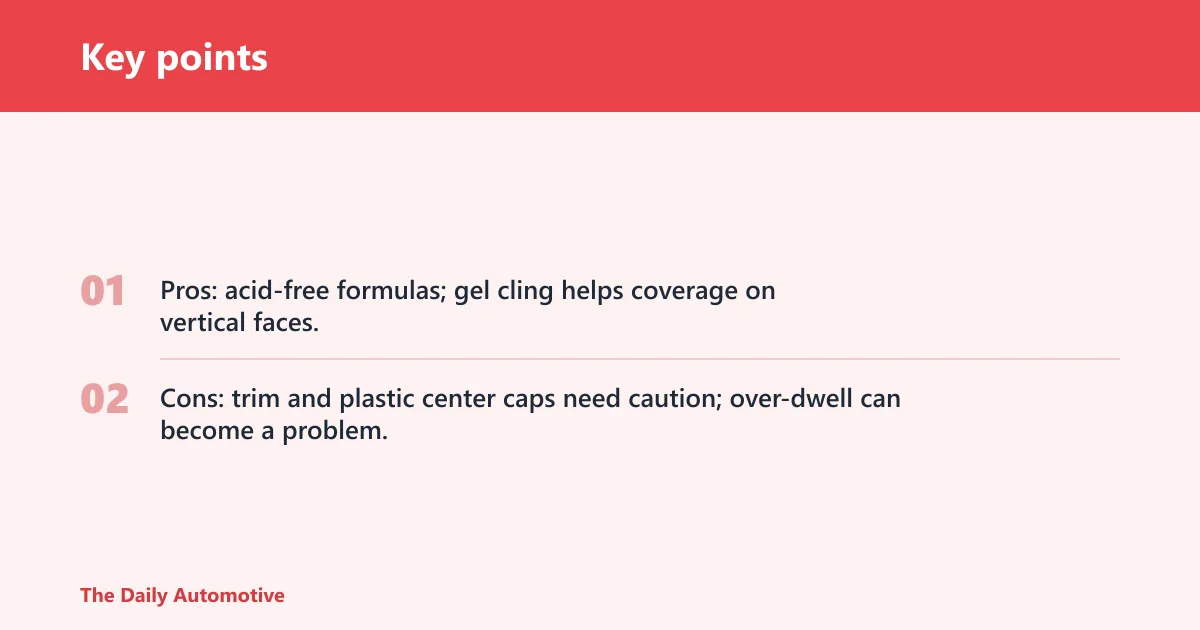
- Pros: acid-free formulas; gel cling helps coverage on vertical faces; useful size and strength spread across the line.
- Cons: trim and plastic center caps need caution; over-dwell can become a problem; premium pricing means you should watch cost per wash.
Who it
This suits DIY owners of factory-painted, clear-coated, black, and OEM-style wheels who want a safer cleaner for routine brake dust. It is less appealing if you only want the lowest possible cost per bottle, or if your wheels carry heavy neglected buildup that needs a more aggressive iron-focused cleaner.
Say your commuter has 17-inch painted wheels and only light gray dust after a week of driving. Gel is the sensible first buy, because the wheel face needs cleaning more often than rescue work. Say your weekend car has darker dust baked into spoke pockets after a few months of storage. POWER GEL or HIGH END is the better match.
Specs at a glance
| Formula | Positioning | Formula type | Stand time | Package sizes | Notes that matter |
|---|---|---|---|---|---|
| P21S Wheel Cleaner Gel | Everyday wheel cleaner | Acid-free gel | Up to 2 hours on extremely soiled wheels; the reviewed gel was left for 5 minutes | 17 oz; 1000 mL refill | Spray-on use; needs a sharp jet of water for rinsing; price-sensitive |
| P21S POWER GEL | Stronger gel step-up | Acid-free gel | Designed for cling time; exact dwell depends on dirt load | Package size not listed in the supplied details | Colour indicator shows reaction; better for heavier contamination |
| P21S HIGH END | Maximum cleaning power for all rims | Acid-free wheel cleaner | Follow label timing; built for the hardest jobs | 100 ml, 750 ml, 1000 ml, 2 L, 5 L | Rims-focused; strongest line choice when contamination is heavy |
Who is it for?
P21S Gel fits owners who want a safer, easy-start wheel cleaner for regular maintenance on painted or clear-coated wheels. POWER GEL fits people dealing with heavier brake dust and wanting a visible reaction cue. HIGH END fits drivers who clean neglected wheels, multi-spoke designs, or larger fleet-style jobs where strength and size options matter.
The line is less suited to anyone expecting a no-touch miracle on filthy wheels. A cleaner can loosen iron-rich contamination, but it still has limits around lug holes, spoke corners, and tight crevices. A brush or sponge still earns its keep there.
Light brake dust and maintenance washes
Gel is the practical starting point for weekly or biweekly washes where the wheels are dirty, not abused. The gel consistency helps it stay on the face long enough to work, which matters more on vertical spokes than on flat surfaces. For routine dust, that is usually enough.
Heavier contamination and neglected wheels
POWER GEL and HIGH END make more sense when brake dust has built up beyond a simple maintenance layer. That includes wheels that have gone several weeks or months without care, or wheels with iron-rich residue visible in recesses. The stronger the buildup, the more you want a cleaner with longer cling and clearer reaction feedback.
Owners worried about trim and center caps
If your wheels have plastic center caps, black trim rings, or painted accents, start conservatively. Safe chemistry does not mean every surface likes the same dwell time. The more plastic and trim around the wheel face, the more careful you need to be with overspray and over-dwell.
Wheel cleaner comparison table
| Product | Badge | Best for | Price | ||
|---|---|---|---|---|---|
|
P21S 10005L Wheel Cleaner Canister, 5 LP21S | Our pick | 5 L · No rating · Canister | $129.95
Price as of 25 Oct 2026
|
View |
 |
SONAX Wheel Cleaner Full Effect, Non-Acid Brake DustSONAX | Budget pick | 500 ml · No rating · pH-neutral | $16.99
Price as of 25 Oct 2026
|
View |
 |
CARRO WheelX Wheel & Tire Cleaner Spray for Car Detailing –CARPRO | Also great | 1 L · No rating · Spray | $35.96
Price as of 25 Oct 2026
|
View |
| Product | Contamination level | Dwell time | Safe-use cautions | Package sizes | Estimated cost per wheel |
|---|---|---|---|---|---|
| P21S Wheel Cleaner Gel | Light to moderate brake dust | About 5 minutes in the reviewed use case; label allows up to two hours on extremely soiled wheels | Use on cool wheels only; keep off trim and plastic center caps; rinse with a sharp jet of water | 17 oz; 1000 mL refill | About $2.12 per wheel if a 17 oz bottle at $18 is used at 2.5 oz per wheel |
| P21S POWER GEL | Moderate to heavy brake dust | Longer cling than the base gel; timing should stop before residue dries | Watch color change and do not let product sit on plastic trim | Size not listed in the supplied product details | Not enough pricing data in the supplied listing set to calculate cleanly |
| P21S HIGH END | Heavy contamination and neglected rims | Use as directed on the label; built for maximum cleaning power | Best for rims where stronger chemistry is needed; still avoid hot surfaces and unprotected trim | 100 ml; 750 ml; 1000 ml; 2 L; 5 L | About $0.88 per wheel if the 5 L canister at $129.95 is used at 10 mL per wheel |
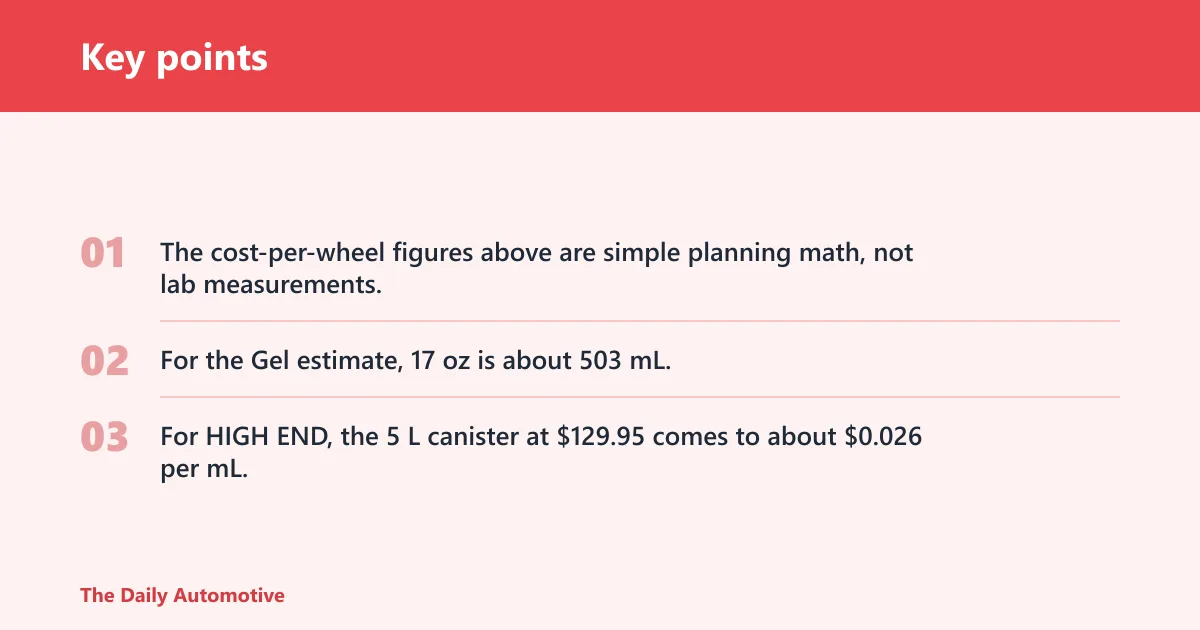
The cost-per-wheel figures above are simple planning math, not lab measurements. For the Gel estimate, 17 oz is about 503 mL, so a bottle at $18 works out to roughly $0.036 per mL; at 60 mL per wheel, that is about $2.12. For HIGH END, the 5 L canister at $129.95 comes to about $0.026 per mL; at 10 mL per wheel, that is about $0.88.
What works
P21S works best when you match the formula to the level of dirt instead of treating every wheel the same. The Gel’s cling helps coverage on the face, POWER GEL adds a reaction cue that helps you see contamination, and HIGH END gives you the strongest cleaning headroom for neglected rims. That fit is the point.
Gel cling and coverage
The gel consistency matters because wheel faces are rarely flat. It helps product stay on spokes and barrels long enough to soften dust instead of running off immediately. That makes the base gel a rational choice for maintenance washes and frequent cleaning.
Brake-dust reaction and visible change
Brake dust is iron-rich contamination, so the visual cue matters. POWER GEL’s colour indicator gives you a clearer read on when the cleaner has started working. On dirtier wheels, that helps you decide whether the first pass was enough or whether a second application makes sense.
Low-agitation use on typical dirt
For typical dirt, the cleaner can do much of the work, but not all of it. The published review says the gel removed about 80-85% of brake dust and dirt, and the reviewer left it for 5 minutes before rinsing. That is the kind of result that supports low-agitation use on regular grime, not a promise of zero contact on every wheel.
Suppose a set of black painted wheels has a light tan haze after highway use. A short dwell followed by a brush on lug holes is a sensible path. Now picture the same wheels with months of brown buildup in the spoke corners. The cleaner still helps, but the brush becomes part of the job.
What does not?
P21S is not immune to failure cases. Over-dwell can leave product sitting where it should not, especially on plastic center caps and trim pieces. The cleaner also loses ground in deep crevices, where the film can sit without reaching embedded dirt unless you add agitation.
Over-dwell risk
The label allows long stand times on extremely soiled wheels, but that does not mean every wheel should get maximum dwell. On a warm wheel, or one with mixed materials, long contact time raises the chance of staining or residue issues. Stay conservative unless the wheel is truly caked.
Plastic center caps and trim caution
Can P21S wheel cleaner stain plastic center caps? It can be a risk point, especially if the product is left too long or allowed to dry on trim. Acid-free chemistry is a plus, but plastic accents and decorative inserts still deserve a test patch and a shorter dwell time.
When a brush still matters
The reviewer said the cleaner had a harder time with cracks and crevices. That lines up with normal wheel geometry. Lug holes, spoke roots, valve-stem pockets, and barrel edges usually need a wheel brush or sponge, even when the cleaner is doing the heavy lifting.
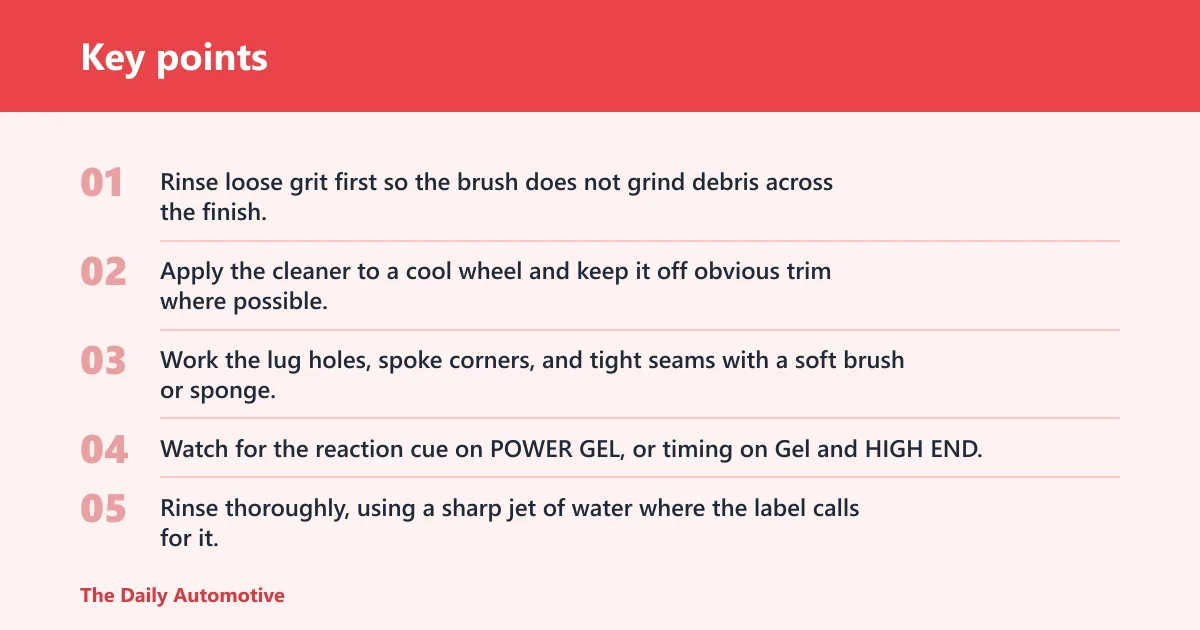
- Rinse loose grit first so the brush does not grind debris across the finish.
- Apply the cleaner to a cool wheel and keep it off obvious trim where possible.
- Work the lug holes, spoke corners, and tight seams with a soft brush or sponge.
- Watch for the reaction cue on POWER GEL, or timing on Gel and HIGH END.
- Rinse thoroughly, using a sharp jet of water where the label calls for it.
Alternatives
P21S sits in a sensible middle ground, but it is not the only answer. Choose Gel if you want the safest and most forgiving entry point, POWER GEL if you want more reaction feedback and cling, and HIGH END if you want the strongest P21S option with the broadest size spread.
Gel versus POWER GEL
Gel is the better budget-minded maintenance pick. The forum pricing example put it at $18 for 17 oz, and the refill was described as a better deal but still pricey. POWER GEL is the step up when the wheel needs more visual feedback and longer cling, but the stronger positioning also makes dwell discipline more important.
POWER GEL versus HIGH END
HIGH END is the cleaner to look at when the wheel is truly neglected or when you want the maximum-cleaning version of the line. The detailing1 shop lists it in 100 ml, 750 ml, 1000 ml, 2 L, and 5 L sizes, and describes it as maximum cleaning power for all rims. That makes it the stronger choice for heavy jobs, while POWER GEL keeps the convenience edge for regular detailers who want a colour indicator.
When another wheel cleaner makes more sense
If you want a pH-neutral, color-changing spray with a simpler ready-to-use format, SONAX Wheel Cleaner Full Effect is the cleaner to compare against. It fits the same general job, but the P21S line gives you more of a formula ladder: Gel for value, POWER GEL for visible reaction, and HIGH END for maximum cleaning power.
Should you buy it?
Buy P21S if you want one wheel cleaner system that you can tune to your wheels instead of overbuying strength you will rarely use. Gel is the best budget choice for most factory wheels, POWER GEL is justified when you want stronger visual feedback, and HIGH END earns its price on neglected rims and larger cleaning jobs.
Best-buy recommendation by budget
For most people, Gel is the best first purchase. It offers the most forgiving starting point for routine care, and the refill format gives the brand a practical value path. If your wheels stay relatively clean, paying for the strongest formula is usually unnecessary.
Refill economics
The 1000 mL refill matters because it lowers packaging churn and should improve the cost per ounce or liter compared with buying small bottles repeatedly. The forum note that the refill is a better deal is consistent with that logic, even if it still sits in the premium tier for wheel cleaners.
When the premium price is justified
P21S is worth the price when you need safer chemistry on mixed wheel materials, better cling on spoke-heavy designs, and a formula that matches contamination level instead of forcing one bottle to do everything. If your wheels are heavily soiled, HIGH END or POWER GEL can save time. If they are usually clean, Gel is enough.
Frequently asked questions
What is a good wheel cleaner?
A good wheel cleaner matches the wheel finish, the amount of brake dust, and the amount of contact you want to do by hand. For painted or clear-coated wheels, an acid-free formula with controlled dwell time is usually the safest starting point. P21S Gel fits that role well.
What is wheel cleaner?
Wheel cleaner is a product made to loosen brake dust, road film, and grime from wheels so you can rinse them away or brush them out. The better formulas are matched to wheel finish and contamination level, because wheel faces, barrels, and trim do not all tolerate the same chemistry equally.
Is wheel cleaner necessary?
It is not necessary for every wash, but it becomes useful when brake dust starts bonding to the wheel surface or sitting in spokes and lug holes. A maintenance wash may be enough for light film, while a dedicated wheel cleaner saves time and reduces scrubbing once contamination gets heavier.
Is sonax wheel cleaner good?
SONAX Wheel Cleaner Full Effect is a strong comparator because it is pH-neutral, color-changing, and ready to spray. That makes it a good choice for people who want a simpler spray format with visual feedback. It is worth comparing directly against P21S if you want a safer wheel-care pick.
Does P21S wheel cleaner work on brake dust?
Yes, it works on brake dust, including iron-rich buildup, but the result depends on how much dust is present and how long the cleaner is allowed to dwell. The reviewed gel removed about 80-85% of brake dust and dirt, which is solid for routine cleaning but not a guarantee on severe buildup.
Is P21S wheel cleaner safe for all wheel types?
The line is described as acid-free, and a forum reviewer called it safe for all wheel types. Even so, that should be read with caution around plastic center caps, trim, and unprotected accents. Safe use still depends on the exact surface, the dwell time, and the rinse method.
How long should you let P21S wheel cleaner dwell?
For the reviewed Gel use case, 5 minutes was enough before rinsing. The instructions also say the gel can stand for up to two hours on extremely soiled wheels, but that is a special-case limit, not a normal target. On mixed-material wheels, shorter is usually smarter.
Is P21S wheel cleaner worth the price?
It is worth the price if you value safer chemistry, good cling, and a size ladder that scales from maintenance to heavy cleaning. The Gel can work out to about $2.12 per wheel using the cited 17 oz and $18 price, while the 5 L HIGH END canister can be cheaper per wheel on heavy jobs.
Can P21S wheel cleaner stain plastic center caps?
Yes, that is a real caution point. Acid-free does not mean risk-free, especially if the cleaner sits too long or dries on plastic trim. Keep the dwell short on center caps, rinse promptly, and avoid spraying carelessly across black accents or decorative inserts.
What is the difference between P21S POWER GEL and HIGH END?
POWER GEL is the step-up gel with a colour indicator and cling time, so it is built to give you visible feedback during cleaning.
Products related to this article
Sponsored / affiliate links. As an Amazon Associate I earn from qualifying purchases. I may earn additional commission from eligible campaigns.