How Much Does a MAP Sensor Cost?
A MAP sensor usually costs about $25 to $150 for the part, while total replacement often runs about $100 to $400 depending on diagnosis and access. Skip proper diagnosis and you can replace the wrong part, chase drivability faults, and pay for labor twice. This guide breaks down parts pricing, test costs, and the labor factors that push the bill higher.
What a MAP sensor does
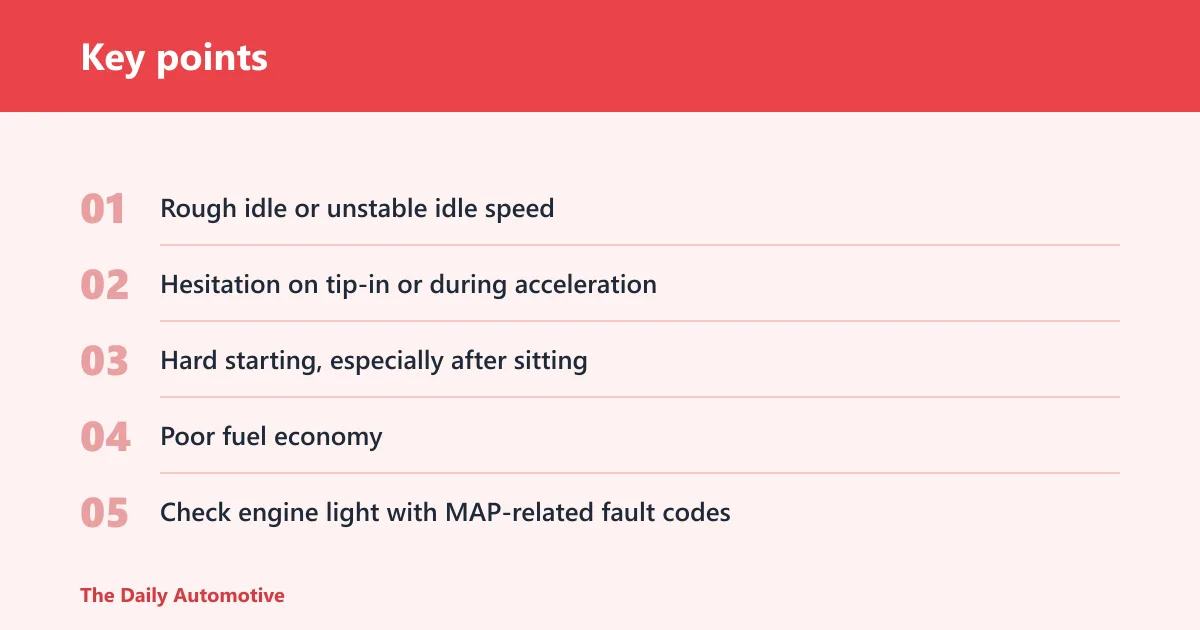


MAP stands for manifold absolute pressure. A MAP sensor monitors intake manifold pressure, which tells the engine control unit how much air the engine is likely ingesting. That signal helps the computer control fuel delivery and ignition timing, so a bad reading can create rough idle, hesitation, hard starting, poor fuel economy, and a check engine light.
Most MAP sensors are small bolt-on electrical sensors with a connector and, on some vehicles, a short vacuum passage or hose. Fitment is vehicle-specific, so the correct replacement depends on the engine code and part number, not just the year and model.
Common symptoms of a failing sensor
- Rough idle or unstable idle speed
- Hesitation on tip-in or during acceleration
- Hard starting, especially after sitting
- Poor fuel economy
- Check engine light with MAP-related fault codes
- Surging, stumbling, or weak throttle response
Those symptoms are not proof that the sensor has failed. Vacuum leaks, damaged wiring, contaminated throttle bodies, or a loose connector can produce similar symptoms and send the same kind of bad data to the engine computer.
How much does a MAP sensor cost?
Most MAP sensors cost $25 to $150 for the part alone. Prices vary by make, model, and engine. Budget aftermarket units often sit near the bottom of that range, midrange aftermarket parts usually land in the middle, and OEM parts tend to cost more. Dealer counters commonly charge more than a parts store or an online retailer.
Part pricing by source
- Budget aftermarket: about $25 to $50
- Midrange aftermarket: about $50 to $90
- OEM replacement: about $80 to $150
- Dealer parts counter: often the highest price for the same OEM part number
Online pricing is usually lower than local-store pricing, especially for aftermarket parts. A local parts store may cost more, but it can reduce downtime if you need the sensor the same day. For hard-to-match engines, paying extra for the exact OEM number can avoid fitment problems.
What does replacement cost with labor?
Total replacement cost usually falls between $100 and $400, but that range expands when diagnosis, difficult access, or related repairs are included. A simple sensor swap on top of the intake can take less than an hour. A buried sensor that requires intake removal can add several hundred dollars in labor.
Diagnostic fee and shop minimums
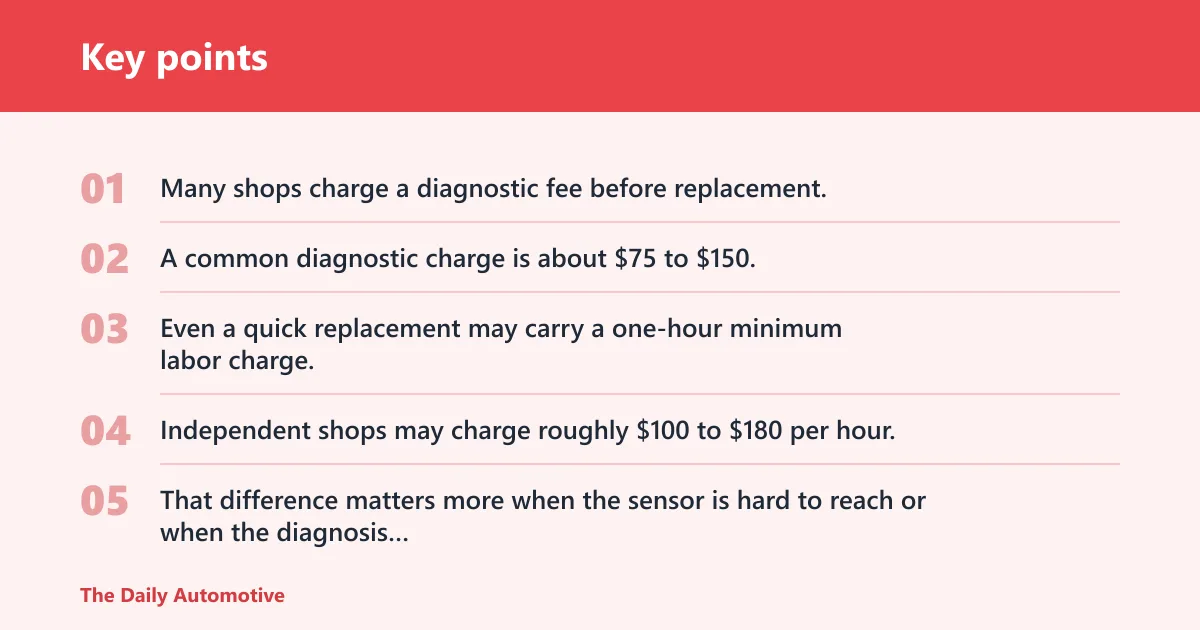
Many shops charge a diagnostic fee before replacement. A common diagnostic charge is about $75 to $150, and some facilities may apply that fee toward the repair if you approve the work. Even a quick replacement may carry a one-hour minimum labor charge.
Labor rates vary by region. Independent shops may charge roughly $100 to $180 per hour, while dealer labor often runs higher. That difference matters more when the sensor is hard to reach or when the diagnosis includes live-data testing, vacuum testing, and electrical checks.
Easy-access versus hard-to-reach jobs
On many vehicles, the MAP sensor is a single bolt-on electrical part with easy access from the top of the engine. In those cases, labor is light. On some engines, intake ducting, the intake manifold, or other components must come off before the sensor can be reached, and the bill rises quickly.
Access difficulty can matter as much as the sensor itself. A $40 part can still become a $350 repair if the job requires extra labor, a new gasket, or a smoke test to find the real fault.
MAP sensor cost calculator
| Vehicle access level | Part type | Diagnostic fee | Labor hours | Likely total cost | Common add-on repairs |
|---|---|---|---|---|---|
| Easy-access DIY | Aftermarket, budget to midrange | $0 to $30 for scan-tool or parts-store check | 0.3 to 1.0 | $25 to $110 | Vacuum hose, cleaner, connector inspection |
| Independent-shop replacement | Aftermarket or OEM | $75 to $150 | 0.8 to 1.5 | $150 to $350 | Vacuum leak repair, wiring repair, intake gasket |
| Dealer or complex-access replacement | OEM | $120 to $200 | 1.5 to 3.5 | $300 to $700+ | Intake removal, gasket set, throttle body cleaning |
Easy-access DIY scenario: Suppose the sensor sits on top of the intake and the fault is already confirmed with live data. A $35 aftermarket part, a $15 scanner loaner, and a 30-minute install can keep the total near the low end.
Independent-shop replacement scenario: Say the same code returns after a vacuum hose split near the throttle body. The shop may charge for diagnosis, replace the hose, and install a $70 sensor, pushing the bill into the midrange.
Should you replace it or diagnose first?
Diagnosis should come before replacement. A scan tool can confirm whether MAP readings make sense at key-on, idle, and under load. If the live data is implausible, the issue may still be the sensor, but the wiring, hose, or manifold pressure source needs checking before money changes hands.
When a scan tool helps
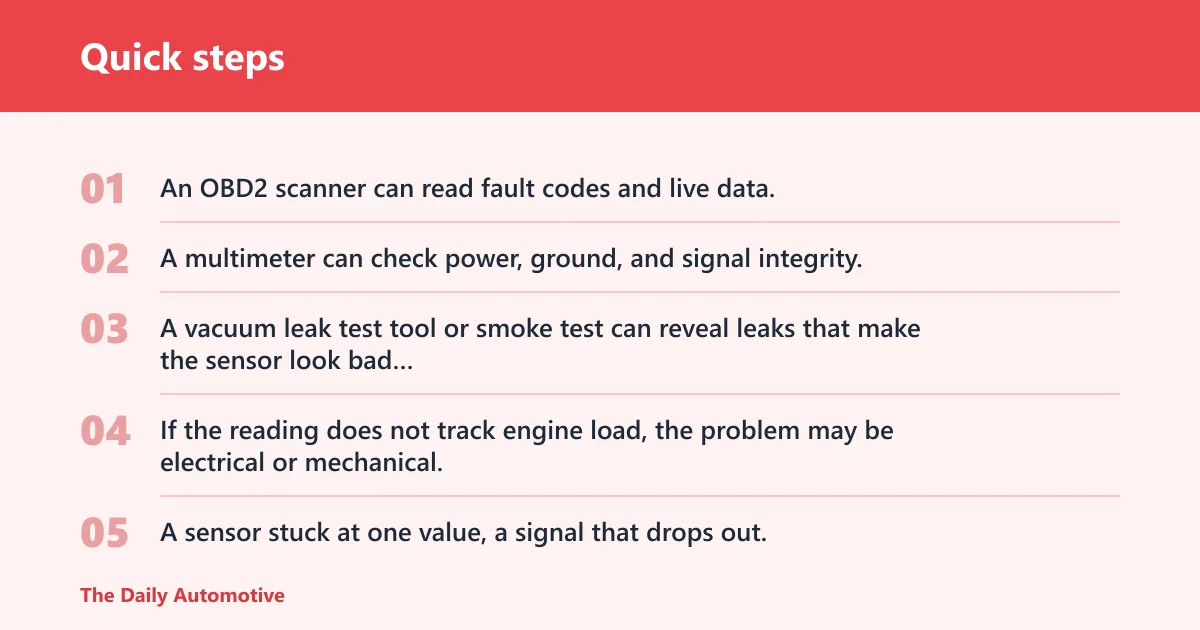
An OBD2 scanner can read fault codes and live data. A multimeter can check power, ground, and signal integrity. A vacuum leak test tool or smoke test can reveal leaks that make the sensor look bad even when the sensor is working.
If the reading does not track engine load, the problem may be electrical or mechanical. A sensor stuck at one value, a signal that drops out, or a reading that does not change with throttle movement should prompt more testing, not blind replacement.
When vacuum leaks mimic sensor failure
Vacuum leaks can confuse the engine computer because MAP data depends on manifold pressure. Cracked hoses, split intake boots, and leaking gaskets can all change manifold vacuum and create codes that point toward the sensor. Wiring faults can do the same.
That is why diagnosis matters. A replacement sensor will not fix a leaking hose or a corroded connector, and the vehicle may still run poorly after the new part goes in.
When cleaning is enough and when it is not
Some MAP sensors collect oil vapor or light contamination that can be removed with electronic-safe cleaner. That can help when the sensor is dirty but not electrically failed. If the sensor is out of range, shorted, or internally damaged, cleaning will not fix it.
Cleaning can also miss the real issue if the throttle body is dirty or the air filter is badly clogged. Those problems can change airflow and drivability, then get blamed on the MAP sensor by mistake.
What else can add to the bill?
Related repairs are common because the MAP sensor works in a system, not in isolation. The total often climbs when a vacuum hose, connector, or gasket needs attention at the same time. That is especially true on engines with tight packaging.
Vacuum hose repair
A cracked or loose vacuum hose can cost little in parts but still add labor if the hose is buried or hard to route. If the hose feeds the sensor directly, replacing the sensor without fixing the hose will not solve the complaint.
Connector or wiring repair
Corrosion in the electrical connector, backed-out terminals, or damaged wiring can create false MAP readings. Connector cleaning may be enough in minor cases. If the wiring is broken or heat-damaged, wiring repair can add an hour or more.
Intake gasket or throttle body work
If intake components must come off to reach the sensor, a new gasket is often smart insurance. Throttle body cleaning may also be recommended if carbon buildup is part of the drivability issue. Those items add cost, but they may be the real fix.
Picture a compact SUV with a check engine light and a rough idle after a recent battery replacement. If the sensor connector was bumped loose during the battery job, the repair may be a connector reseat or terminal repair rather than a new sensor. That is the kind of mistake diagnosis prevents.
Frequently asked questions
How much does a MAP sensor cost to replace?
Most MAP sensor replacements cost $100 to $400 all in, including part and labor. Easy-access jobs land near the low end, while dealer work or complex access can push the bill higher. If diagnosis is needed first, add $75 to $150 in many shops.
How much does a MAP sensor cost at AutoZone?
AutoZone pricing varies by vehicle, but aftermarket MAP sensors commonly fall in the $25 to $100 range there. Exact cost depends on fitment, brand, and whether the part is standard aftermarket or premium replacement. Checking the exact engine application matters more than the shelf label.
How much does a new MAP sensor cost?
A new MAP sensor usually costs $25 to $150 for the part alone. Budget aftermarket units sit at the low end, while OEM parts sit higher. If you buy from a dealer, the same OEM part often costs more than it does from an online parts seller.
How much does it cost to fix a MAP sensor?
Fixing a MAP sensor issue can mean replacement, wiring repair, vacuum leak repair, or cleaning. A simple sensor swap may cost under $150 if the part is cheap and access is easy. If the actual fault is a hose, connector, or gasket, the total changes with the repair needed.
How long does a MAP sensor last?
There is no single mileage target for MAP sensor life. Some last the life of the vehicle, while others fail early because of oil vapor, heat, connector problems, or contamination. If symptoms start, diagnosis should focus on the sensor, its wiring, and the vacuum source together.
Can I drive my car with a bad MAP sensor?
You may be able to drive it short term, but a bad MAP sensor can cause rough running, poor fuel use, and hard starts. If the engine runs poorly enough to stall, misfire badly, or lose power, it is better not to keep driving until the fault is confirmed and repaired.
How long does it take to change a MAP sensor?
Many MAP sensors take about 15 to 60 minutes to replace when they are easy to reach. Hard-to-access jobs can take about one to three hours or more if intake parts must come off. Diagnosis may add time before the replacement even starts.
Products related to this article
Sponsored / affiliate links. As an Amazon Associate I earn from qualifying purchases. I may earn additional commission from eligible campaigns.