Hitch Mounted Bike Racks for Cars: Platform vs. Swing-Away Guide
Choose a tilt-away platform rack if you mainly need normal bike hauling and occasional trunk access; choose a swing-away rack only when full rear-door clearance matters. A bad fit can block cargo access, strain a hitch, or force you to remove bikes just to open the back. This guide compares both styles by vehicle type, bike mix, rear-access needs, and hitch fit so you can pick the right rack.
| Decision factor | Platform | Swing-Away | Winner |
|---|---|---|---|
| Rear access | Tilt function can help open a hatch or trunk with bikes loaded. | Swinging the rack to the side gives full rear access. | Swing-Away |
| Vehicle packaging | Usually a better fit for compact SUVs and smaller garages. | Needs more side clearance and more parking room. | Platform |
| Bike mix | Better for e-bikes, carbon frames, and step-through frames. | Works best when rear access matters more than size and weight. | Platform |
| Hitch fit | Commonly available for common receiver sizes. | Many common models require a 2-inch hitch only. | Platform |
| Cost and mass | Usually less expensive and lighter than swing-away designs. | Usually heavier and more expensive. | Platform |
| Load style | Wheel-based support reduces frame contact. | Usually built on a platform-style base, with extra hardware for swing action. | Platform |
Platform vs. swing-away at a glance
Platform and swing-away racks solve different access problems. Platform racks carry bikes by the wheels in trays or cradles, and many tilt down for hatch access. Swing-away racks are usually platform-based too, but they move the entire loaded rack to the side so the rear door, tailgate, or cargo area stays clear.
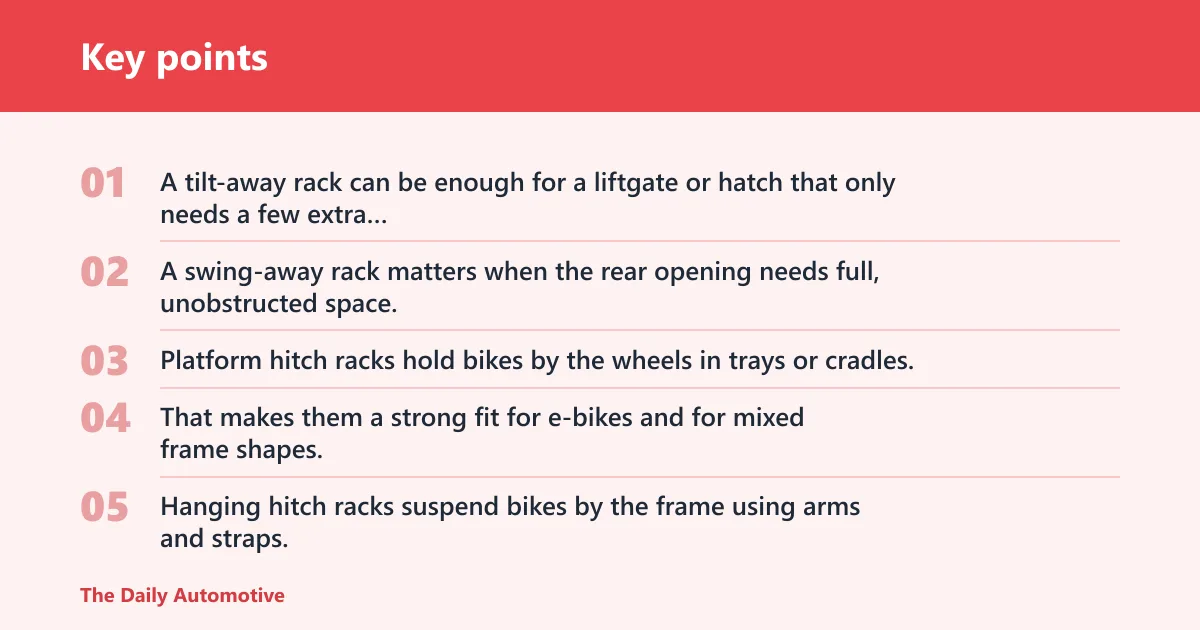
That difference matters. A tilt-away rack can be enough for a liftgate or hatch that only needs a few extra inches of clearance. A swing-away rack matters when the rear opening needs full, unobstructed space, such as on trucks, vans, campers, or tall SUVs with rear cargo use.
How each rack carries bikes
Platform hitch racks hold bikes by the wheels in trays or cradles. That makes them a strong fit for e-bikes and for mixed frame shapes, including step-through bikes and carbon frames that are awkward to clamp by the top tube.
Hanging hitch racks suspend bikes by the frame using arms and straps. They are often lighter and less expensive, and they can carry about four to five bikes in some cases, but they are less ideal for e-bikes and many step-through frames.
What rear access each style gives
Tilt function and swing-away motion are not the same feature. Tilt-away helps you reach a hatch or trunk after loosening the rack’s angle, while swing-away moves the whole rack far enough to one side for full rear access.
For a compact SUV, tilt is often enough. For a pickup with a tailgate camp setup, a cargo van, or a camper van with a rear kitchen or storage bay, full side swing can be the difference between usable and annoying.
Where hanging racks fit in the decision
Hanging racks still make sense when you need lower cost and lighter weight more than wheel trays. They are a practical choice for family hauling when the bikes are standard frame shapes and the rack will carry several bikes.
The trade-off is fit. Unusual frame shapes, step-through designs, fenders, and heavier bikes are more likely to need adapters or create loading issues than they would on a platform rack.
Bike rack decision matrix
| Vehicle type | Bike mix | Rear-access need | Best rack style |
|---|---|---|---|
| Compact SUV | 1 to 2 bikes, including e-bikes or mixed frames | Occasional hatch access | Platform |
| Compact SUV | Several standard-frame bikes | Rear access is secondary | Hanging |
| Truck | Mixed bikes, tailgate use, heavier bikes | Need full bed or tailgate access | Swing-Away |
| Minivan | Family bikes, step-through bikes, e-bikes | Rear hatch still needs to open | Platform |
| Cargo van | Work bikes or mixed bike shapes | Rear doors must stay usable | Swing-Away |
| Camper van | Heavy bikes, wide bars, travel setup | Rear gear storage must stay open | Swing-Away |
Say your compact SUV has a liftgate and two bikes, one of them an e-bike weighing about 55 lb. A platform rack is the cleaner fit because it supports wheel-based loading and often tilts for hatch access without adding the extra side swing that a small driveway may not allow.
Suppose a camper van carries two bikes on the back and the owner needs to open rear doors for gear every day. That setup usually needs a swing-away rack, because a simple tilt feature may still leave the doors blocked by the loaded bikes.
Which rack fits your vehicle?
The right choice starts with the vehicle body, not the bike count. Compact SUVs usually favor platform racks because they need occasional rear access without giving up parking space. Trucks, vans, and camper vans are the cases where swing-away designs earn their price by restoring usable rear access.
Compact SUVs
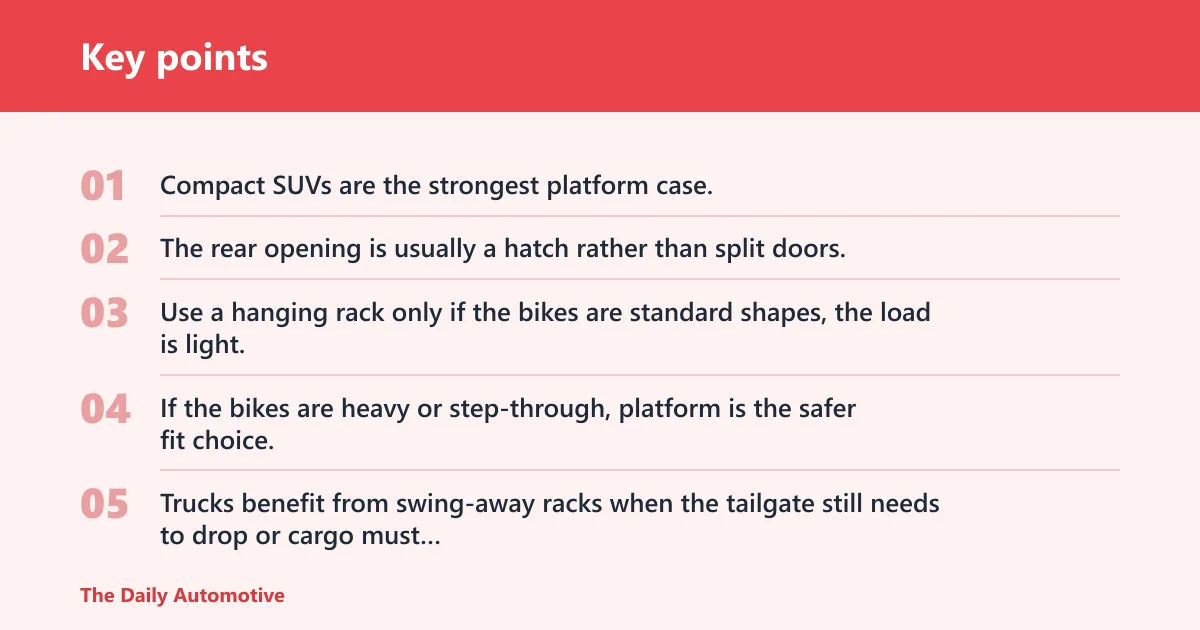
Compact SUVs are the strongest platform case. The rear opening is usually a hatch rather than split doors, so a tilt-away rack often solves the access problem without requiring a large side swing zone.
Use a hanging rack only if the bikes are standard shapes, the load is light, and the lower price matters more than wheel support. If the bikes are heavy or step-through, platform is the safer fit choice.
Trucks
Trucks benefit from swing-away racks when the tailgate still needs to drop or cargo must come out often. The extra side motion helps avoid the common problem of bikes blocking the bed or the rear camera view.
Platform racks still work on trucks when rear access is occasional. If you only need to open the tailgate once in a while, a tilt-away platform rack is easier to live with than a heavier swing-away system.
Minivans
Minivans usually point to platform racks because the rear hatch is used often and the bikes may include child or step-through frames. A platform rack with tilt can keep the hatch usable while keeping loading simple.
Hanging racks can work for lighter family sets, but adapters may be needed for unusual frames. If the van carries e-bikes, platform is the better default.
Cargo vans and camper vans
Cargo vans and camper vans are the clearest swing-away use cases. Rear doors, cargo drawers, and rear kitchens can all make a tilt feature feel insufficient, because the opening needs to be completely clear, not partly open.
That said, measure the clearance first. A swing-away rack adds parking and backing complexity because the rack occupies more room when it swings open, and that can matter in garages, tight lots, and narrow campsites.
How do bike mix and weight change the choice?
Bike mix matters as much as vehicle type. Platform racks are better for e-bikes and diverse frame types because they support the wheels rather than squeezing the top tube. Hanging racks can carry more bikes in some cases, but they are less suited to heavy or unusual frames.
E-bikes and heavy bikes
Check both per-bike limit and total rack capacity before buying. Premium platform racks commonly list around 60 lb per bike, and the rack’s total limit still needs to cover the full load you plan to carry.
A swing-away rack may solve access, but it does not erase weight concerns. If a bike is near the per-bike limit, the rack still has to support it safely while stationary and while moving on the highway.
Carbon frames and step-through frames
Platform racks are often the better choice for carbon frames because wheel trays avoid clamp pressure on a frame tube. Step-through bikes also tend to fit more naturally on a wheel-support rack than on a frame-hanging design.
That said, check the frame’s brake and cable routing, the tray spacing, and any strap contact points. A good frame fit is not the same as a universal fit.
Fenders, fat tires, and wheelbase limits
Fenders can be a failure point for some racks. RockyMounts BackStage is not for bikes equipped with fenders, which is a reminder that fender clearance should be checked before buying any rack style.
Wheel and tire fit matter too. The same product is listed for 20-inch to 29-inch wheels, and some models support fat-bike tire widths up to 5 inches. Wheelbase also matters, because a bike can fit the wheel size spec and still fail the tray length or spacing check.
Rear access: tilt-away vs. swing-away
Tilt-away is for access that stays close to the vehicle. Swing-away is for access that has to stay fully open. If the goal is only to reach groceries or a small cargo bin, tilt is often enough. If the goal is to open the rear doors without removing the bikes, swing-away is the correct tool.
When tilt is enough
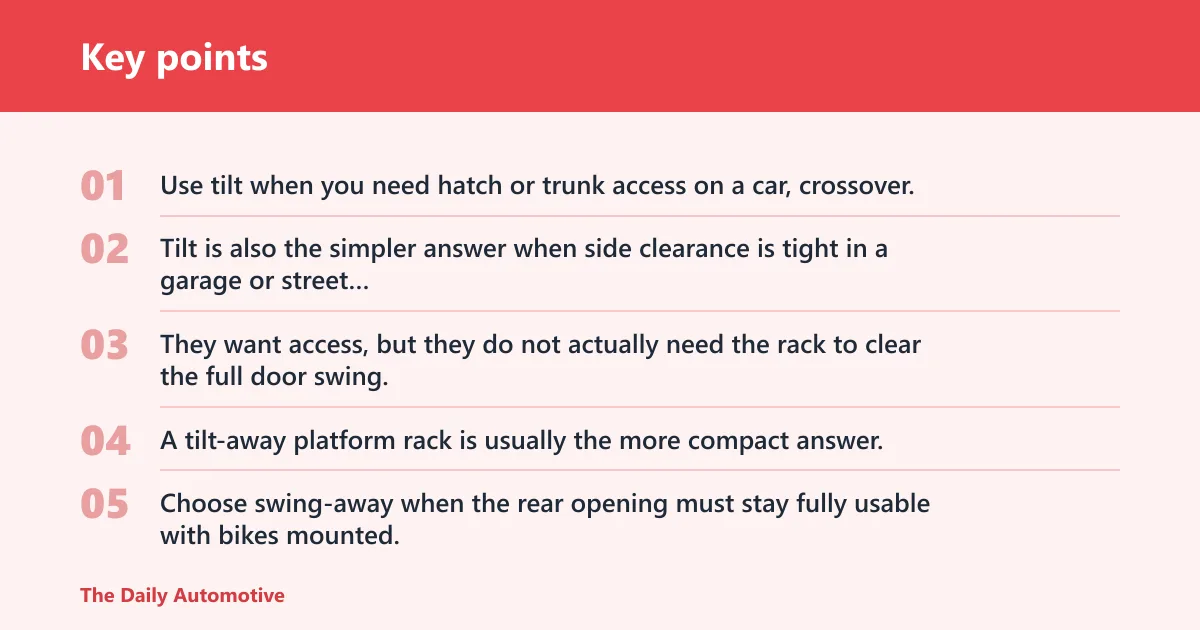
Use tilt when you need hatch or trunk access on a car, crossover, or minivan and there is room to lower the rack without hitting the ground. Tilt is also the simpler answer when side clearance is tight in a garage or street parking space.
This is where a lot of buyers overbuy. They want access, but they do not actually need the rack to clear the full door swing. A tilt-away platform rack is usually the more compact answer.
When full swing-away matters
Choose swing-away when the rear opening must stay fully usable with bikes mounted. That includes cargo vans with rear doors, trucks with tailgate use, and camper vans with rear storage that cannot be reached through a partially opened hatch.
Some tailgate setups still need extension hardware, even with a swing-away rack. If the bike tray or arm geometry reaches too far forward, the rack may swing clear but still leave the tailgate short of fully opening.
Parking, backing up, and garage clearance
Swing-away racks create a real space penalty. They need room on the side of the vehicle to rotate, which can complicate parking, backing into a spot, and garage storage more than a fixed or tilt rack does.
A common first-timer mistake is buying swing-away for convenience, then discovering the vehicle now needs more room every time the rear door opens. If your parking space is tight, the better answer may be a tilt-away platform rack plus a stricter loading routine.
Choose Platform if… / Choose Swing-Away if…
Choose Platform if your priority is compact size, lower cost, easier loading, or better fit for e-bikes and mixed frame types. Choose Swing-Away if your rear door, tailgate, or cargo bay must stay fully open while the bikes stay mounted.
Choose Platform if…
- You drive a compact SUV, minivan, or smaller crossover and only need occasional hatch access.
- You carry e-bikes, carbon frames, step-through bikes, or a two-bike mix with different frame shapes.
- You want a rack that is usually lighter and cheaper than a swing-away design.
- You do not want the extra side-clearance demands of a full swing-away mechanism.
Choose Swing-Away if…
- You drive a truck, cargo van, or camper van and need full rear access with bikes loaded.
- You use rear doors or a tailgate often enough that tilt access is not sufficient.
- You can confirm the hitch and vehicle layout can handle a 2-inch-only swing-away model.
- You accept the extra size, weight, and cost in exchange for easier rear cargo access.

Frequently asked questions
Are platform hitch bike racks better than swing-away racks?
Platform racks are better for most drivers who want simpler loading, better e-bike fit, and a smaller footprint. Swing-away racks are better only when you need full rear access without unloading bikes. If rear access is not the main problem, platform usually wins on cost, size, and convenience.
Do swing-away hitch bike racks work with e-bikes?
They can, but you still have to check per-bike weight, wheelbase, tire width, and hitch size. A swing-away mechanism does not override the rack’s load limit. If the bike is heavy or unusual, a platform rack with confirmed capacity is usually the safer starting point.
How much weight can a hitch bike rack carry?
It depends on the rack type and the model. Premium platform racks commonly list about 60 lb per bike, while the total rack limit also matters. You should confirm both the per-bike rating and the overall capacity before loading any e-bike or heavy mountain bike.
Will a hitch bike rack still let me open my trunk or hatch?
Often yes, but the answer depends on whether the rack tilts and how far the door swings. Tilt-away helps with hatch or trunk access. Swing-away gives full rear access. If your vehicle has a tall rear door or a deep cargo area, full clearance may still require swing-away.
What hitch size do I need for a swing-away bike rack?
Many common swing-away racks require a 2-inch hitch only, so you should confirm the receiver size before buying. Standard hitch sizes are commonly 1.25-inch and 2-inch, though not every rack works with both. Vehicle hitch compatibility has to be checked in the owner’s manual and the rack listing.
Do hitch bike racks affect gas mileage less than roof racks?
Usually yes, because hitch racks sit lower and create less drag than roof-mounted bikes. The exact difference depends on vehicle shape, speed, and how many bikes are mounted. If fuel use matters most, a hitch rack is generally the better choice than a roof setup.
Which hitch bike rack is best for rear cargo access?
Swing-away is the best choice when full rear cargo access is the main goal. Tilt-away platform racks are better when you only need enough access to open a hatch or trunk partially. For compact SUVs, tilt is often enough; for trucks, vans, and camper vans, swing-away is the stronger fit.
Follow the vehicle manual, the rack manual, and the hitch rating together. Do not exceed the vehicle’s hitch, tow, or payload limits, and confirm any adapter or extension hardware before you load bikes. A rack that fits the bike can still fail the vehicle.
Products related to this article
Sponsored / affiliate links. As an Amazon Associate I earn from qualifying purchases. I may earn additional commission from eligible campaigns.
 Swing‑Away 2 Inch Hitch Adapter, Heavy‑Duty 120 Degree Pivot, 260 Lbs Load Capacity, Hitch Mount Bike Rack Extension for Standard 2" Receiver, Fits Most 2‑inch Hitch Racks
 RockyMounts BackStage 2" Receiver Swing Away platform hitch 2 bicycle rack. Allows full access to the rear of the vehicle with bikes on or off the rack.