Car HVAC Blend Door Actuator Kit Review: Is It Worth It?
A blend door actuator kit is worth buying only when it replaces two or more hard-to-reach actuators, or when one dashboard removal covers the whole HVAC job; for a single easy-access actuator, buy the one part instead. Get that wrong and you can pay twice in parts, or tear the dash apart again for one failed motor. This guide compares kit value, fitment risk, and diagnosis cost so you can choose the right repair path.
Car HVAC blend door actuator kit review: is it worth it?
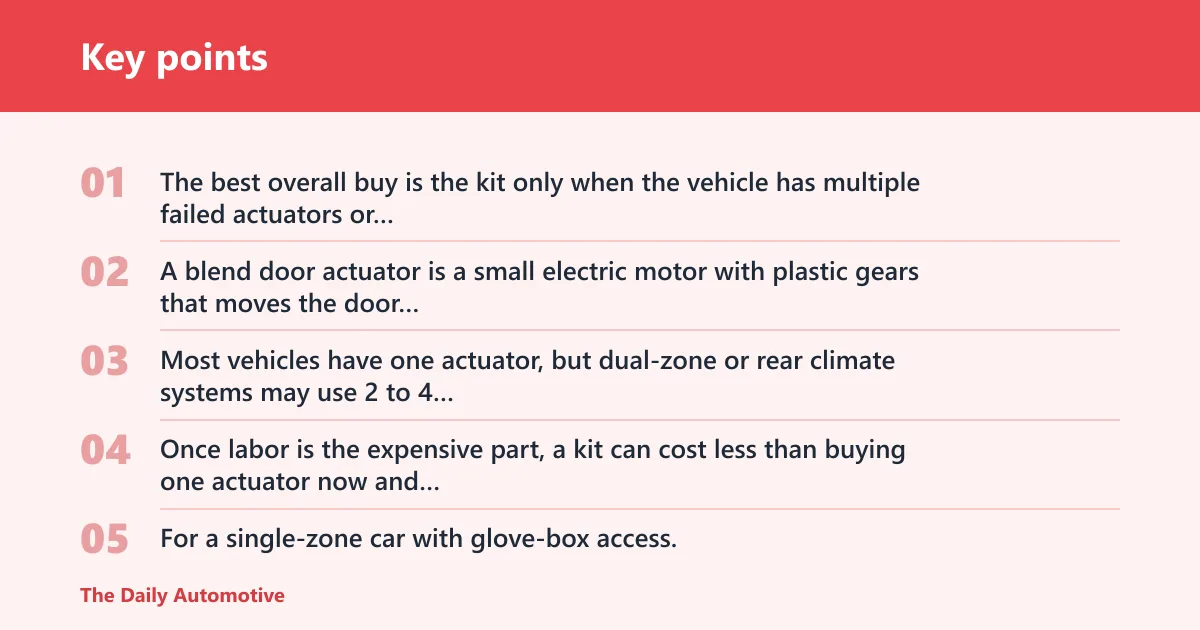


The best overall buy is the kit only when the vehicle has multiple failed actuators or the labor to reach them overlaps enough that one teardown fixes the whole HVAC stack. A blend door actuator is a small electric motor with plastic gears that moves the door between the heater core and AC evaporator to control cabin temperature.
Most vehicles have one actuator, but dual-zone or rear climate systems may use 2 to 4 actuators. That changes the math fast. Once labor is the expensive part, a kit can cost less than buying one actuator now and paying for the same dashboard access later.
Top pick by repair scenario
For a single-zone car with glove-box access, skip the kit unless the seller proves it includes the exact part number you need and you already know another actuator is failing. For a dual-zone sedan or tri-zone SUV, the kit becomes more defensible when both sides or the rear system are acting up and the dash is already open.
When a kit beats a single actuator
Buy the kit when the repair requires dashboard removal, when multiple actuators sit in the same access path, or when the same model is known for repeat failures in adjacent actuators. The value is not in the box count. It is in avoiding a second tear-down and cutting duplicated labor.
When to skip the kit and buy only one part
Skip the kit when symptoms point to only one door, when the car uses a simple layout, or when the other actuators test normally. Kits also lose value if they are modification-required instead of direct-fit, because any fitment mismatch can turn a cheap repair into a return and a delay.
📊 Aftermarket blend door actuator parts cost about $30 to $100. Source: What Is a Blend Door Actuator & How Do You Know If It Needs….
Quick picks by repair need
- Best for single-zone cars: one direct-fit actuator matched to the OEM or cross-reference number.
- Best for dual-zone cars: a kit only if both temperature sides are failing or access overlaps.
- Best for tri-zone SUVs: a kit that covers the front and rear actuators already behind the same trim.
- Best when dashboard removal is required: the full actuator set for that HVAC case, because the labor is the expensive part.
- Best when the same actuator keeps failing: a kit that includes the known weak point plus any adjacent actuator that shares the same access route.
What a blend door actuator does and why it fails
The actuator moves the blend door so the HVAC system can mix air from the heater core and AC evaporator. That lets the cabin go from heat to cool and anywhere between. It is usually an electric motor with plastic gears, and some versions include a position sensor so the control module knows where the door sits.
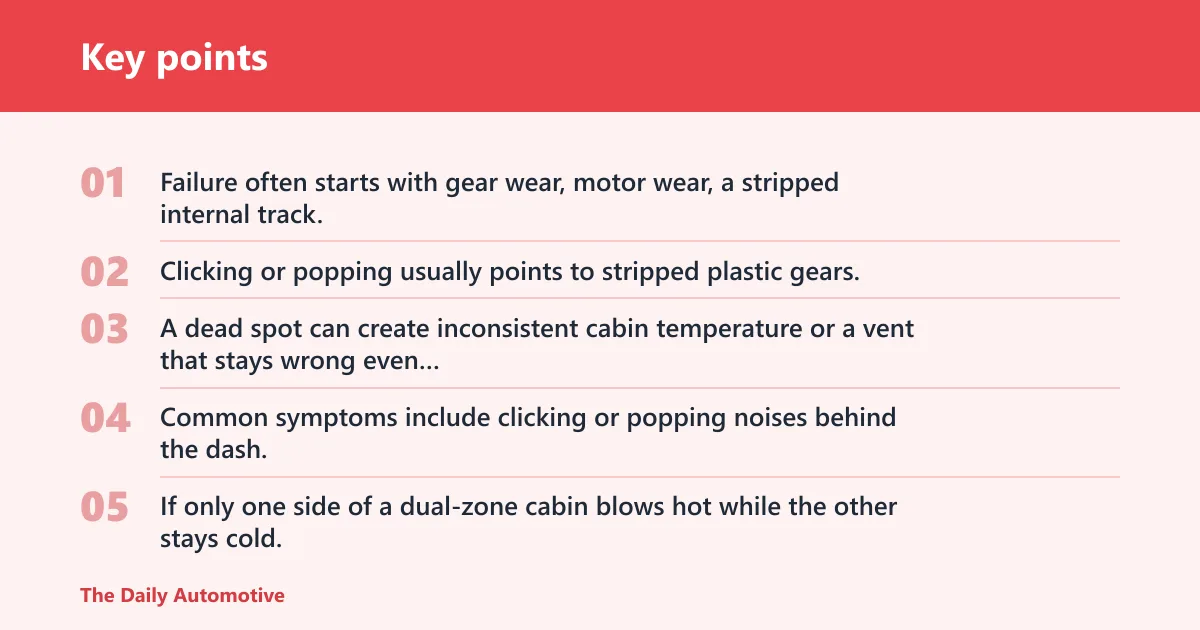
Failure often starts with gear wear, motor wear, a stripped internal track, or a bad position reading. Clicking or popping usually points to stripped plastic gears. A dead spot can create inconsistent cabin temperature or a vent that stays wrong even after the control knob changes.
Symptoms that point to actuator trouble
Common symptoms include clicking or popping noises behind the dash, wrong temperature from the vents, unresponsive controls, and defrost problems. If only one side of a dual-zone cabin blows hot while the other stays cold, that points more toward a blend door actuator than a blower motor.
Suppose the driver side stays cold while the passenger side responds normally. That pattern usually points to the driver-side temperature door or its actuator. If every vent is weak, though, the blower motor, resistor, or cabin air filter deserves attention first.
Which cars need more than one actuator?
Vehicles with single-zone climate control often use one actuator. Dual-zone systems use separate driver and passenger control, and tri-zone systems add rear control. Trim level matters because the same body shell can use a different HVAC box, extra sensors, or rear ducts in a higher package.
Single-zone versus dual-zone layouts
Single-zone systems are usually the simplest case. One actuator usually handles temperature blending for the whole cabin. Dual-zone systems typically use at least two temperature actuators, one for each side, and may also have other door motors for mode or recirculation functions depending on the design.
Tri-zone and rear climate systems
Tri-zone SUVs and family vehicles can be more complex. Rear climate controls may add actuators for rear temperature doors or distribution doors. That is where a kit starts to make sense, because the extra parts often sit deeper in the dash or near the rear HVAC case.
Why trim level changes the part count
Trim can change the HVAC box, the number of sensors, and the connector style. A base trim and a loaded trim may not use the same actuator even if the model year and body style match. This is why the exact model year, trim, engine package, and HVAC option code matter, not just the badge on the tailgate.
How to tell a bad actuator from a bad heater core, blower motor, or sensor
A bad actuator usually creates a direction problem, not a total airflow problem. Clicking, a single side stuck hot or cold, or a vent that ignores commands points toward the actuator or the door it moves. A heater core issue usually brings coolant smell, poor heat output, or both sides failing in a different pattern.
Clicking and popping noises
Repeated clicking near the dashboard is a strong sign of stripped gears inside the actuator. It can also happen when calibration is off and the door reaches a stop the module does not expect. That is why a scan tool matters before you buy parts.
Defrost problems and airflow clues
Defrost matters because the system has to route air correctly to the windshield. If the mode door is stuck, you may get heat from the floor vents but little or none to the glass. That is a safety issue, not just a comfort complaint.
When wiring or calibration is the real issue
Not every failed temperature change is a dead motor. Wiring faults, HVAC sensors, or calibration drift can produce the same symptom set. B1080 and B1081 are common diagnostic codes tied to position sensor and motor failures, but the code still needs confirmation before parts are ordered.
Decision table: when a kit is worth it
| Scenario | Typical access | Estimated parts-and-labor savings | Buy kit vs single actuator |
|---|---|---|---|
| Single-zone car | Glove box or lower trim | $0 to $80 | Buy single actuator unless the kit is the same price and exact fit |
| Dual-zone car | Behind center dash or both sides | $80 to $250 | Buy kit if both temperature actuators show symptoms or access overlaps |
| Tri-zone SUV | Front dash plus rear HVAC area | $150 to $400+ | Buy kit when rear and front repairs share labor |
| Glove-box access | Simple removal path | $0 to $60 | Buy single actuator for one failed unit |
| Dashboard removal | Full dash out | $200 to $500+ | Buy kit if more than one actuator is in reach |
| Recurring actuator failures | Same access route as before | $100 to $300 | Buy kit if the known weak point is shared by nearby actuators |
What should you check before buying a kit?
Start with the exact model year, trim, engine package, and HVAC option code, then match the OEM or cross-reference number. A kit that fits one package may miss another by connector shape, shaft length, or mounting angle. Direct-fit is the goal. Modification-required parts can erase the savings.
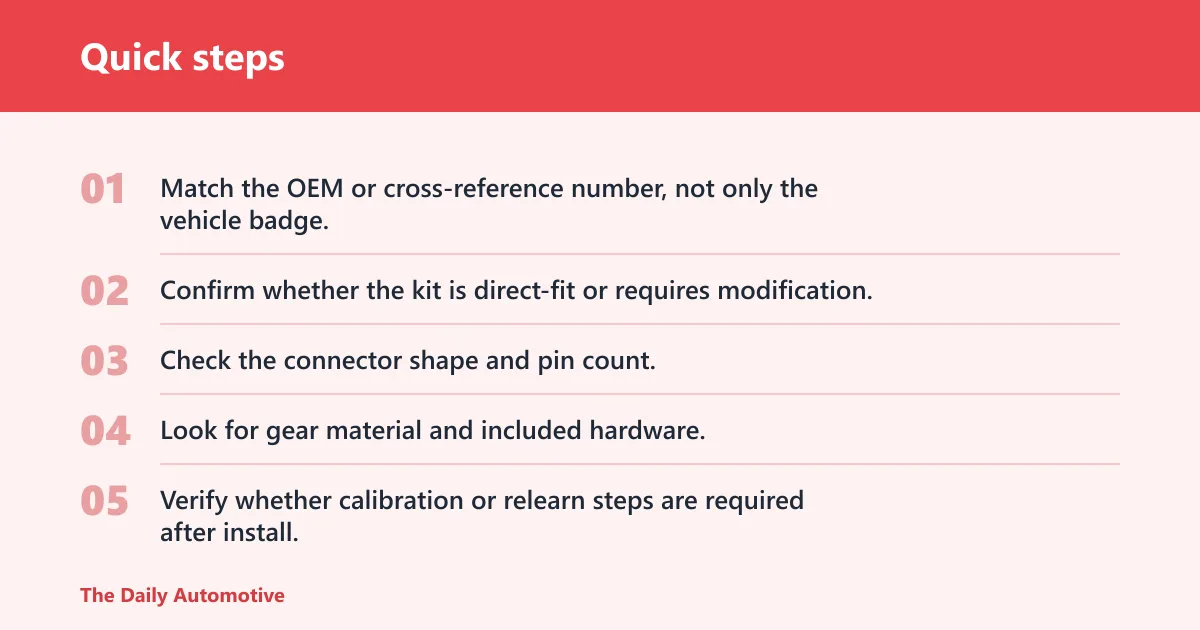
- Match the OEM or cross-reference number, not only the vehicle badge.
- Confirm whether the kit is direct-fit or requires modification.
- Check the connector shape and pin count.
- Look for gear material and included hardware.
- Verify whether calibration or relearn steps are required after install.
- Use an OBD-II HVAC-capable scanner if the system stores codes or needs bidirectional actuator control.
A common first-timer mistake is buying the wrong actuator because the listing matches the model year but not the trim. A dual-zone version can use a different part from the base car, and that mistake usually shows up only after the dash is partly apart.
Can I reset a blend door actuator without replacing it?
Yes, sometimes. Battery disconnect, fuse removal, or scan-tool calibration can temporarily clear a stuck position or force a relearn. A scan tool calibration can take 5 to 10 minutes, but a reset is only useful if the motor, gears, and door are still mechanically sound.
What tools do I need to test a blend door actuator at home?
An OBD-II HVAC-capable scanner is the most useful tool because it can read HVAC-related trouble codes and run bidirectional tests on the actuator. Basic hand tools help remove trim panels, and a flashlight makes it easier to inspect the connector, linkage, and mounting screws behind the dash.
How much replacement should cost
Replacement costs range from $30 to $500+ depending on vehicle type. Aftermarket blend door actuator parts cost about $30 to $100, while OEM blend door actuator parts cost about $100 to $300. Luxury vehicle actuator replacement can reach $200 to $500+, especially when access is poor.
Aftermarket versus OEM parts
Aftermarket parts are the lower-cost path and can be fine when the fit is exact and the connector matches. OEM parts cost more but often reduce guesswork on trim-specific fitment. If the vehicle is expensive to open, a higher-priced part can still be cheaper than repeating the labor.
Labor ranges by access difficulty
Simple glove box access labor can run $50 to $150. Dashboard removal labor can run $200 to $500+. Some repairs take 1 to 2 hours for full replacement, but that assumes the actuator is reachable without major trim removal or hidden fasteners.
Parts and labor savings when you buy a kit
Kit savings are strongest when two or more actuators fail in the same access zone. If the first repair requires a dash removal and the second actuator sits only a few inches away, the kit may prevent paying for the same labor twice. If not, the extra parts can sit unused.
Picture a three-row SUV with rear climate control and a dash that has to come out for the front actuator. If the rear temperature actuator is also starting to click, the kit can save a second major teardown. If only one front actuator is bad, the kit becomes expensive insurance.
Does a bad blend door actuator affect defrost and safety?
Yes. If the mode door or blend door cannot move air where the system commands it, windshield defrost may be weak or misrouted. That matters in rain, frost, or fog because the HVAC system is part of visibility management, not just cabin comfort.
Frequently asked questions
Is a blend door actuator kit worth it for my car?
It is worth it when your car has multiple failed actuators, a dual-zone or tri-zone setup, or expensive access that forces a major teardown. If only one easy-access actuator is bad, the kit usually adds cost without adding value. Fitment and labor are the deciding factors.
Do I need one actuator or multiple actuators for dual-zone climate control?
Dual-zone climate control usually uses multiple actuators, often one for each side’s temperature door and sometimes more for mode or recirculation functions. The exact count depends on the HVAC design and trim. Do not assume one part will fix both sides of the cabin.
What symptoms point to a bad blend door actuator instead of a heater core or blower motor?
Clicking, popping, wrong temperature from one side, and controls that do not change vent temperature point more toward an actuator or door problem. A blower motor problem usually affects airflow volume, not temperature split. Heater core issues often affect heat output across the cabin in a different pattern.
How much does blend door actuator replacement cost compared with buying a kit?
Aftermarket parts usually cost about $30 to $100, OEM parts about $100 to $300, and labor can add $50 to $150 for easy access or $200 to $500+ for dash removal. A kit only saves money when it prevents a second labor charge or covers multiple failing actuators.
Can I reset a blend door actuator without replacing it?
Sometimes. Battery disconnect or scan-tool calibration can temporarily restore operation if the problem is a lost position or a calibration issue. It will not fix stripped gears, a burned-out motor, or a damaged door. If the clicking returns, replacement is still the right repair.
How do I know if a kit will fit my exact year, make, and trim?
Check the OEM or cross-reference number, the connector style, and whether the part is listed as direct-fit. Trim level matters because HVAC boxes can differ within the same model year. If the seller cannot confirm exact fitment, treat the kit as a risk, not a bargain.