
Snow Tire Storage Cost: What You’ll Actually Pay
Snow tire storage typically costs roughly $40 to $120 per season for storage alone, while bundled swap-and-storage packages can often run about $80 to $250, depending on whether the shop also mounts, balances, cleans, and bags the tires. Skip the details and you can pay for handling you do not need, or end up with damaged tires and a surprise bill at spring changeover. This guide breaks down storage fees, bundled service charges, and the real annual out-of-pocket cost.
What winter tire storage costs
Snow tire storage usually means off-season storage for a second set of tires, often tied to a seasonal tire program. The clearest comparison is storage-only pricing separated from swap labor and add-ons. Typical annual pricing for a set of four sits in the $40 to $120 range, with urban shops often higher than rural ones.
Storage-only versus bundled pricing
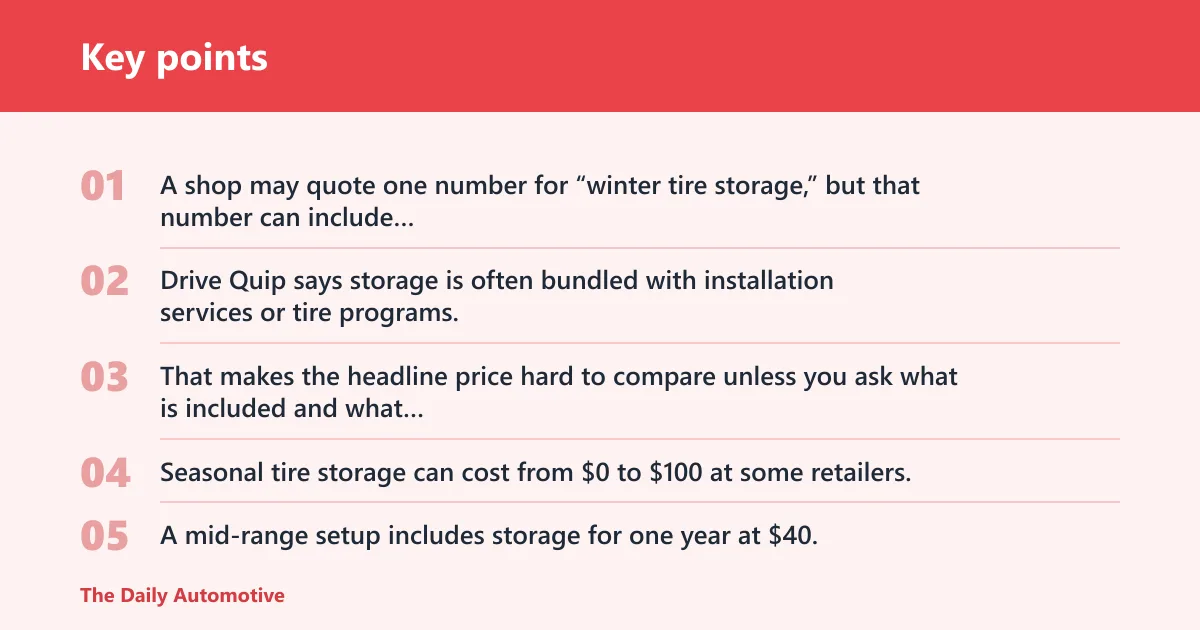
A shop may quote one number for “winter tire storage,” but that number can include mounting, balancing, bagging, and cleaning. Drive Quip says storage is often bundled with installation services or tire programs. That makes the headline price hard to compare unless you ask what is included and what will appear on the spring invoice.
Typical annual ranges by shop type
Seasonal tire storage can cost from $0 to $100 at some retailers, but the broader market sits higher once service is added. A mid-range setup includes storage for one year at $40. A premium setup includes storage of $60. Dealer pricing is often the highest once labor and vehicle-specific service are folded in.
Urban and rural price differences
Urban pricing tends to run higher because space is tighter and labor costs are usually higher. Rural shops may charge less for the same stored set, but they can also be less likely to bundle all services into one price. Toronto-area searches often surface higher storage and swap totals than Edmonton-area searches for the same tire size.
What the fee usually includes
A storage quote can mean very different things from one shop to the next. The basic fee may cover shelf or rack space only, or it may include off-season tire handling, seasonal swap labor, and bagging. If you want a true snow tire storage cost, ask for each line item separately before you agree to the package.
Storage alone
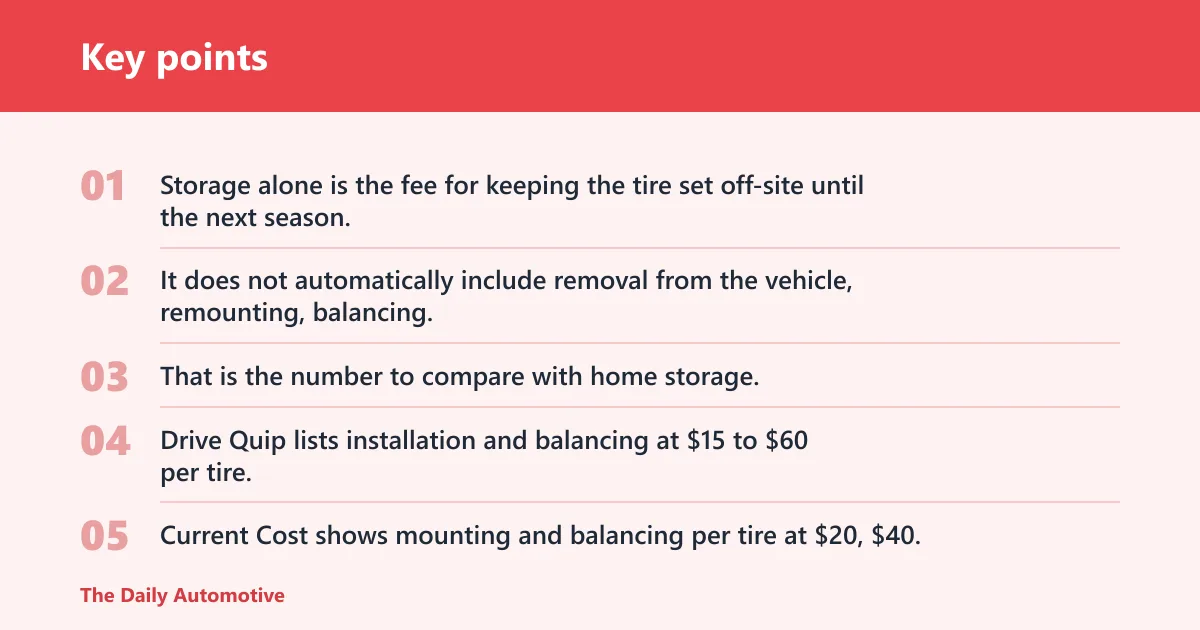
Storage alone is the fee for keeping the tire set off-site until the next season. It does not automatically include removal from the vehicle, remounting, balancing, or inspection. That is the number to compare with home storage, because it isolates the cost of space and custody, not the labor around it.
Seasonal swap and balancing
The same source lists installation and balancing at $15 to $60 per tire, and Drive Quip also says snow tires generally range from $100 to $250 per tire. Current Cost shows mounting and balancing per tire at $20, $40, and $60 in three scenarios. Those numbers can dwarf storage if you are comparing a full swap package.
Bagging, cleaning, and other add-ons
Common add-ons include wheel bags, bagging service, cleaning, disposal of damaged bags, and shop minimums. Storage.com advises cleaning tires with mild soap to remove grime, brake dust and salt residue. If the shop handles that step, expect the bill to rise. Some retailers also charge extra for oversized wheel bags or for tires returned dirty.
A common first-timer mistake is assuming the snow tire storage fee also includes seasonal mounting, balancing, and pickup service. A driver with 225/60R17 winter tires may see a low storage quote in fall, then pay again for bagging, swap labor, and an alignment check in spring. The storage fee was real, but it was only part of the bill.
Winter tire storage cost breakdown table
Use this table to compare storage-only fees with the full annual cost. The goal is to isolate what you pay for storage space, then add the charges that usually appear around seasonal changeover. Mounted tires, unmounted tires, and larger fitments can each shift the final amount.
| Scenario | Storage-only fee | Bundled seasonal swap fee | Optional bagging or cleaning fee | Estimated annual total |
|---|---|---|---|---|
| At-home | $0 | $0 to $80 if you pay for the swap elsewhere | $0 to $20 for bags, cleaner, labels | $20 to $140, plus any equipment you already own |
| Independent shop | $40 to $120 | $80 to $240 for seasonal mount, balance, and swap labor | $10 to $30 | $130 to $390 |
| Dealer | $60 to $120 | $120 to $250 or more | $15 to $40 | $195 to $410+ |
Notes: Mounted tires are stored on rims, so racks, vertical storage, stacked storage, or hanging may be used. Unmounted tires usually need more careful handling and should be stored vertically, not stacked flat. Larger sizes, performance fitments, and SUV tires can push the total up because they take more space and labor.
Do mounted tires cost more to store?
Mounted tires do not always cost more to store, but they can be handled differently and that can affect the bill. Tires on rims are easier to swap at the next changeover, while unmounted tires usually require more careful storage and handling. The format matters because it changes labor, space, and risk.
Mounted tires on rims
Mounted tires are stored on wheels. Storage.com recommends that mounted tires can be stored vertically, stacked flat up to 4 tires high, or hung. They should be inflated to the maker’s recommended pressure before storage. That helps preserve shape and makes the next installation easier for the shop.
Unmounted tire storage rules
Unmounted tires should be stored vertically, and Storage.com says they should be rotated about 90 degrees every month. They should not be stacked flat. That reduces deformation risk. If a shop stores loose tires, the labor can be a bit different from mounted set handling, and the quote may reflect that extra care.
How handling affects the bill
Handling charges often rise when the shop must remove wheels, remount tires, balance them, label positions, and inspect for damage. Mounted sets can be quicker to process, but that does not guarantee a lower storage fee. A shop may charge more for mounted sets if wheel bags, cleaning, or rim protection are included.
What changes the price
Three things move the price most often: tire size, service level, and location. Larger or specialty tires cost more to service, and regional pricing can differ sharply between city and rural shops. Climate-controlled storage also costs more because the shop is paying for a tighter environment and better protection.
Tire size and vehicle type
Larger sizes increase cost because they need more room and more handling time. Performance tires, SUV tires, and some truck fitments can cost more than a standard compact-car set. If your vehicle uses wide, low-profile winter tires, expect the quote to move up from the base storage price.
Climate-controlled storage
Climate-controlled storage aims to hold tires in a steadier environment, usually around the 50-70 degrees F range that Storage.com recommends. Stable temperature matters because rubber ages faster in heat swings. Humidity control helps limit moisture issues, and protection from UV and ozone helps reduce cracking and surface damage over time.
Regional and seasonal pricing
Prices rise in areas with high seasonal demand, limited shop space, or expensive real estate. Off-peak booking can reduce the bill, especially if you schedule before the first cold snap. Some shops also discount storage when it is paired with a seasonal tire program, which is why the same set can cost very different amounts in different cities.
How to prep tires before storage
Good prep lowers the odds of stains, smell, cracking, and flat spotting. The basic sequence is simple: clean the tire, inspect it, label it, and store it in the right position. That applies whether the set is staying at home or going to an independent shop or dealer.
- Wash off salt, brake dust, and grime with mild soap.
- Dry the tires fully before wrapping or storing them.
- Inspect tread depth, sidewalls, and bead areas for cracks or cuts.
- Label each tire position, such as LF, RF, LR, and RR.
- Set mounted tires to the recommended pressure before storage.
- Keep tires away from direct sunlight, ozone sources, and damp floors.
Suppose a set of 19-inch SUV winters comes off after the first cold season. If salt residue stays on the sidewalls and the tires sit in a hot garage, the rubber ages faster and the next installation can reveal surface checking or staining that was avoidable.
Is home storage cheaper than shop storage?
Home storage can be cheaper, but only if you already have the space and the right equipment. Once you buy tire bags, a rack or stack-safe storage setup, labels, and cleaning supplies, the gap gets smaller. If the shop bundle includes mounting, balancing, and storage, the package can beat home storage on convenience and price.
Equipment and space costs at home
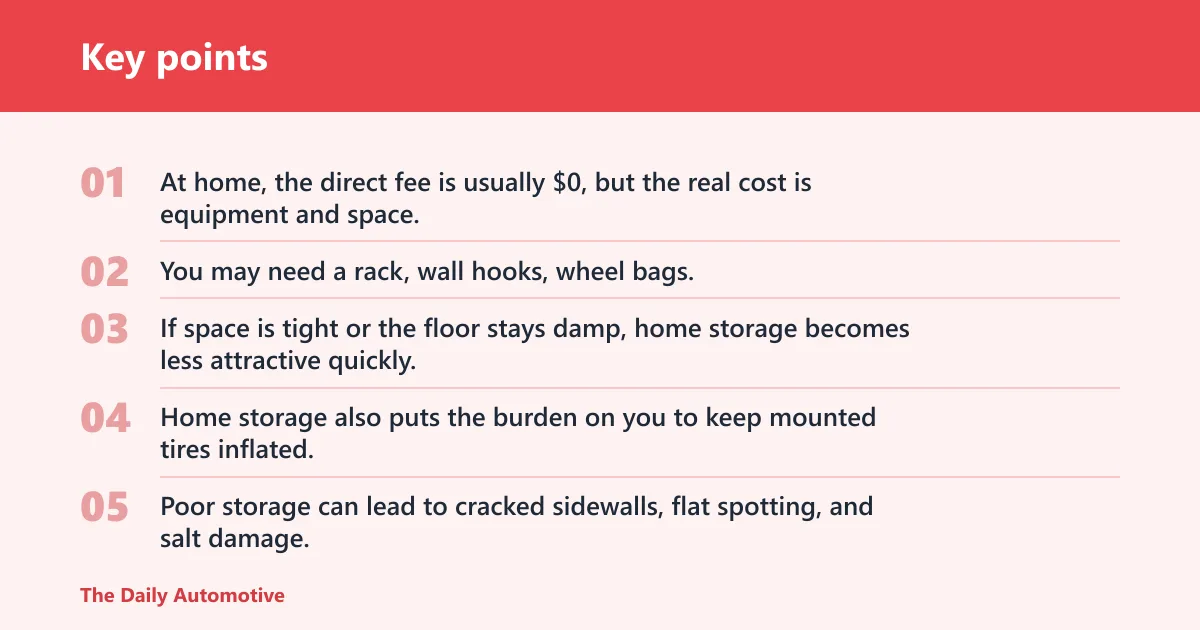
At home, the direct fee is usually $0, but the real cost is equipment and space. You may need a rack, wall hooks, wheel bags, and enough dry indoor room to keep the set out of sunlight. If space is tight or the floor stays damp, home storage becomes less attractive quickly.
Damage risk and convenience tradeoffs
Home storage also puts the burden on you to keep mounted tires inflated, rotate unmounted tires monthly, and prevent contact with oil, heat, and ozone sources. Poor storage can lead to cracked sidewalls, flat spotting, and salt damage. A shop package can be worth it when those risks are higher than the extra fee.
When a shop package wins on price
Shop storage becomes cheaper once the annual cost of home equipment, bags, and your own swap labor exceeds the bundled quote. For many drivers, that crossover happens when the shop offers a mid-range storage fee plus mounting and balancing in one package. The deal is especially strong if you would otherwise pay separately for two seasonal swaps.
Frequently asked questions
How much to store winter tires
For a set of four, storage alone typically runs $40 to $120 per year. Some retailers quote $0 to $100 for seasonal storage, but that usually depends on whether the price is bundled with another service. Ask for storage-only pricing first so you can compare it cleanly with at-home costs.
How much is winter tire storage?
Most drivers will see winter tire storage quoted as either a storage-only fee or a seasonal package. Storage alone is commonly in the $40 to $120 range per set of four. If the quote includes swapping, balancing, or bagging, the total can climb quickly and no longer reflects storage by itself.
How much does winter tire storage cost?
The answer depends on what is inside the quote. A basic off-season storage fee may stay near $40 or $60, while a dealer package can move into the low hundreds once labor is included. The clearest comparison is to separate storage, mount-and-balance work, and add-ons before you book.
What does snow tire storage usually include?
It may include only space, or it may include a seasonal tire program with swap labor, balancing, and bagging. The same source says storage is often bundled with installation services or tire programs. Some shops also add cleaning, valve checks, or tire labeling. Always ask what is included before comparing prices.
Is it cheaper to store winter tires at home or at a shop?
Home storage is cheaper on paper because the storage line is $0, but that ignores equipment, space, and your own handling time. A shop package can be cheaper once you count bags, rack gear, and seasonal swap labor. The best choice depends on your space, tire format, and how often you change them yourself.
How much do tire storage fees add to seasonal tire changeover?
Storage fees can add $40 to $120 a year on top of the changeover itself. If the shop also charges for mounting and balancing, the seasonal bill can jump much higher. For that reason, many drivers should compare the full annual total instead of the storage line alone.
Do mounted winter tires cost more to store than unmounted tires?
Not always, but mounted sets can be easier and faster to service at the next changeover. Mounted tires may be stored vertically, stacked flat up to 4 tires high, or hung, while unmounted tires should be stored vertically and rotated monthly. The handling method can change both risk and price.
What size or vehicle factors raise winter tire storage costs
Larger wheel diameters, wide performance tires, and SUV fitments often raise the price because they need more space and handling time. Dealer programs for premium vehicles also tend to include more labor. If you drive a larger vehicle, ask whether the quote changes with tire size before you accept the storage package.
Products related to this article
Sponsored / affiliate links. As an Amazon Associate I earn from qualifying purchases. I may earn additional commission from eligible campaigns.