Battery Test Cost in Winter
Winter battery test cost is often $0 at auto parts stores for a basic load check, while a deeper electrical diagnosis usually runs about $100 to $200; pay for the diagnostic if the battery passes but the car still struggles to start in cold weather. Skip the wrong test and you can replace a good battery, miss a parasitic draw, or get stranded on a freezing morning. Here’s how free checks differ from paid diagnostics, what they should tell you, and when each one is worth paying for.
Winter battery test prices and What each covers
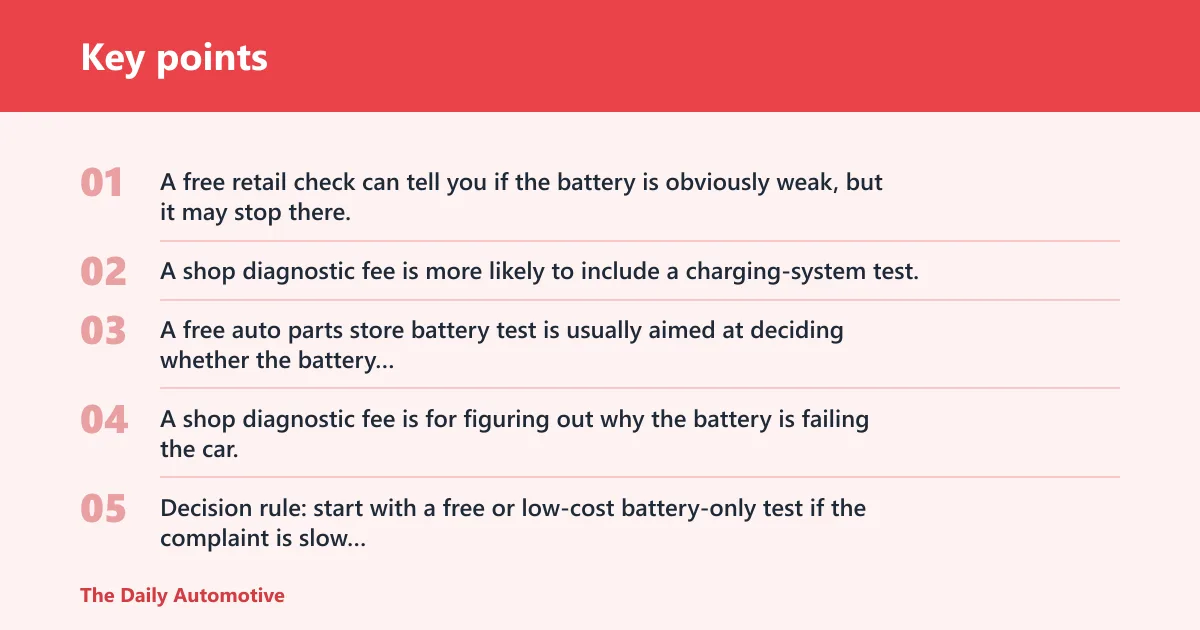

Price depends on how far the test goes. A free retail check can tell you if the battery is obviously weak, but it may stop there. A shop diagnostic fee is more likely to include a charging-system test, starter-circuit checks, or a parasitic-draw diagnosis when the complaint is deeper than “it cranks slowly.”
Winter battery test matrix
| Test type | Typical price range | What is included | When it is worth paying |
|---|---|---|---|
| Free retail test | $0 | Quick battery check, often a load or conductance test, sometimes a cranking and charging check | Worth it for a quick first pass before buying a battery |
| Basic voltage check | $0 to $20 | Resting voltage reading with a multimeter or simple tester | Worth it for a home check or to confirm low state of charge |
| Load test | $20 to $50 | Battery load test that checks cranking performance under demand | Worth it when voltage looks fine but winter starting is weak |
| Charging-system test | $30 to $100 | Alternator output, charging voltage, and sometimes ripple or belt-related checks | Worth it when the battery keeps going dead or a recent battery still fails |
| Parasitic-draw diagnosis | $100 to $200 | Current draw test with the vehicle off, then circuit isolation if draw is excessive | Worth it when the battery dies overnight or after a short sit |
A battery test may be free, but a diagnosis usually is not. The difference is scope. A free auto parts store battery test is usually aimed at deciding whether the battery itself should be replaced. A shop diagnostic fee is for figuring out why the battery is failing the car, not just whether the battery is weak.
Decision rule: start with a free or low-cost battery-only test if the complaint is slow cranking and the battery is older or has been sitting through short trips. Pay for deeper diagnosis if the battery passes but the car still has trouble starting, if the battery is new and still weak, or if the battery dies after parking overnight.
What a free check usually includes
Most free retail checks focus on the battery itself. Many stores will test state of charge, estimated cold-cranking amps, and sometimes cranking or charging performance. That is enough to catch a battery that is plainly worn out or severely undercharged.
It may not identify a bad alternator, a loose ground, corroded terminals, or a draw that drains the battery while the car sits. That is why a free pass does not always end the story.
When shop diagnostics cost extra
Shop diagnostics cost extra when the test is bundled into fault-finding. A technician may need to verify alternator output, inspect the starter circuit, or measure current draw after the vehicle goes to sleep. That takes time and equipment, so the bill is higher than a battery-only check.
Some shops credit the diagnostic fee toward repair. Ask before authorizing work, because that policy varies.
Is a battery test free at auto parts stores in winter?
Often, yes. Many auto parts stores offer free battery testing year-round, and winter is one of the busiest times for it. The test is usually quick and walk-in friendly, and it often includes a basic cranking or charging check. It is a good first step, not a full electrical diagnosis.
What walk-in testing usually covers
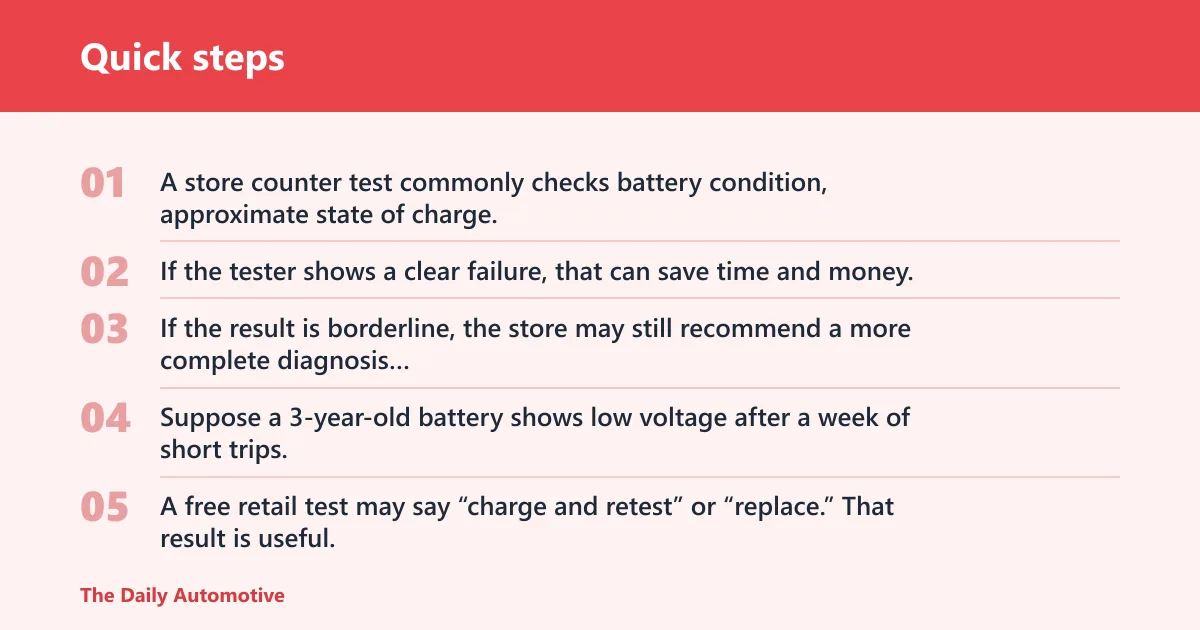
A store counter test commonly checks battery condition, approximate state of charge, and whether the battery can deliver enough current for starting. If the tester shows a clear failure, that can save time and money. If the result is borderline, the store may still recommend a more complete diagnosis elsewhere.
Suppose a 3-year-old battery shows low voltage after a week of short trips. A free retail test may say “charge and retest” or “replace.” That result is useful, but it does not answer whether the alternator is charging fully or whether the car has a draw while parked.
What the store may not diagnose
A free battery test usually does not isolate why the battery is weak. It may miss a charging-system fault, a bad connection at the terminals, or a parasitic drain that appears only after the car sits. It can also miss false passes caused by a battery that was recently charged but still cannot supply winter cranking current.
Decision rule: use the free check when you want a quick screen before buying parts. Pay for a shop diagnosis when the car still has symptoms after the battery passes, when the battery is new, or when the complaint is “dead by morning.”
When a paid shop test is better
A paid test is better when the problem is intermittent, repeatable, or hard to pin down. If the battery passes at the counter but the starter still drags in cold weather, the issue may be outside the battery. That is where a charging-system test or parasitic-draw diagnosis becomes worth the money.
How to test a car battery at home
You can do a basic winter check at home with a multimeter. That will tell you resting battery voltage and help spot undercharging, but it will not prove cold-weather cranking ability by itself. It is a useful first pass before a cold snap, especially if you want to know whether a shop visit is likely worth paying for.
Using a multimeter on resting voltage
Set the multimeter to DC volts and measure across the battery terminals with the car off. A healthy, fully charged 12-volt battery often reads about 12.6 volts at rest. Around 12.4 volts suggests partial charge, and about 12.2 volts or lower points to a low state of charge.
For a meaningful reading, the car should sit long enough for surface charge to fade. If the engine was just turned off, the voltage can look better than the battery really is.
What voltage can and cannot tell you
Voltage shows state of charge, not full starting strength. A battery can read acceptable and still fail under load in the cold. That is why a voltage-only check can miss a weak battery that cannot deliver its rated cold-cranking amps when demand rises.
Cold weather changes the picture fast. Lower temperature slows the battery’s chemical reaction and makes the engine harder to crank. Short trips make it worse because the battery may not recharge fully between starts.
Why cold conditions change the reading
Cold can pull the battery’s resting voltage lower and its usable output down even more. A battery that looks borderline at 12.4 volts in mild weather may behave much worse after an overnight freeze. That is why winter test results should be read alongside the battery’s age, recent driving pattern, and terminal condition.
Decision rule: if the resting voltage is low, charge the battery and retest before replacing it. If the voltage is normal but the car still starts poorly, move to a load test or charging-system check.
Do you need a load test or charging test?
If you want to know whether the battery can crank the engine in winter, a load test matters more than voltage alone. If the battery seems good but keeps ending up discharged, the charging system is the next step. Those tests answer different questions, and winter often exposes the difference.
How a car battery load tester works
A car battery load tester applies a controlled electrical load and watches how far voltage drops. Consumer versions and shop versions both try to see whether the battery can hold up under cranking demand. That is why a load test is more relevant than a resting voltage check in cold weather.
A battery with decent resting voltage can still collapse under load. If the tester shows weak cranking performance, the battery may be near end of life even if the dashboard has not yet warned you.
Why CCA matters in winter
Cold-cranking amps, or CCA, is the rating that ties directly to cold starting ability. The tested performance should be compared with the battery’s stated CCA, not just with the vehicle’s symptoms. If the measured output falls well below the rating, winter starting trouble is more than a hunch.
Battery labels vary, but the rule is simple: the colder it gets, the more a weak battery exposes itself. A battery that barely passed in fall may fail the first hard freeze.
When alternator testing is the next step
If a battery load test passes and the battery is charged, but the vehicle still starts poorly or dies again after driving, the charging system should be checked. That test measures whether the alternator is putting out the right voltage and whether the battery is actually being recharged while the engine runs.
Picture a compact SUV that starts after a jump in the morning, then struggles again the next day even after a 30-minute drive. A battery-only replacement could miss the real issue. A charging-system test is the better spend.
Decision rule: choose a load test when the question is “can this battery start the car in the cold?” Choose a charging-system test when the battery keeps running low despite regular driving.
When a dead battery points to something else
A dead battery does not always mean a failed battery. In winter, low state of charge from short trips, a charging fault, or an overnight parasitic draw can create the same symptom. That is why replacement should wait until testing rules out other causes.
Low state of charge from short trips
Short winter trips can leave the battery undercharged. Heated seats, defrosters, blower motors, and frequent starts take more than a quick drive can restore. A low state of charge can mimic a bad battery on a voltage test and sometimes even on a quick retail check.
Overnight parasitic draw
If the battery dies after sitting, a parasitic draw test is the right diagnosis. That test looks for current flowing with the vehicle off. Common causes include lights that stay on, modules that fail to sleep, or accessory wiring problems. This is one of the clearest cases for paying a shop diagnostic fee.
Decision rule: if the battery goes dead overnight, do not replace it first. Test for parasitic draw and charging issues, because the battery may be the victim, not the cause.
When the battery should be tested, not replaced
Test first when the battery is less than about five years old, the car has been sitting in cold weather, the terminals are dirty, or the symptoms started after short-trip use. Replace first only when the battery is clearly at end of life, physically damaged, or fails a proper load test after a full charge.
Cleaning corrosion matters because poor terminal contact can make a good battery act weak. Tight, clean connections are part of the fix, not an afterthought.
Frequently asked questions
How much for a car battery test
Expect $0 for many retail battery tests, about $20 to $50 for a standalone load test, and roughly $100 to $200 for a deeper electrical diagnosis. The right price depends on whether the test only checks the battery or also looks at charging output and parasitic draw.
How to test batteries at home
Use a multimeter set to DC volts and measure across the battery terminals with the car off. Around 12.6 volts is fully charged, while 12.4 volts or lower points to a weaker state of charge. That check is useful, but it cannot prove winter cranking strength.
What does a winter battery load test cost?
A winter battery load test usually costs about $20 to $50 if it is paid separately. Many stores provide a basic version for free. The test matters because it checks whether the battery can hold up under demand, which voltage alone cannot show.
Do cold temperatures change battery test results?
Yes. Cold slows battery chemistry, lowers available cranking power, and can make a marginal battery fail sooner. It can also make a low state of charge look worse. That is why winter results should be read with the battery’s age, CCA rating, and recent driving pattern in mind.
What’s the difference between a battery test and a charging-system test?
A battery test checks the battery’s condition and cranking ability. A charging-system test checks whether the alternator and related charging parts are keeping the battery charged while the engine runs. If the battery passes but keeps going dead, the charging system needs attention next.
Products related to this article
Sponsored / affiliate links. As an Amazon Associate I earn from qualifying purchases. I may earn additional commission from eligible campaigns.