Car Battery Replacement Cost in Cold Weather
A winter battery replacement often costs roughly $180-$350 installed for a typical 12-volt battery, and a 3- to 4-year-old battery that fails a load test should be replaced before the first hard freeze. A weak battery can turn into a tow bill, a diagnostic charge, and a missed start on a cold morning. This guide covers replacement cost, when to test instead of replace, and how to budget for a winter failure.
What winter adds to battery cost


Cold weather does more than slow cranking. It can push the bill up. A planned replacement at an independent shop often stays near the battery-and-labor price, while a winter no-start can add towing, diagnostic time, and sometimes after-hours labor. Those extra charges make an emergency repair more expensive than a scheduled visit.
At an independent shop, car battery replacement costs $120 to $300 including installation. A standard lead-acid battery replacement is estimated at $120 to $200, while an AGM battery replacement is estimated at $180 to $300. Battery-only self-install pricing is estimated at $80 to $220.
Emergency winter service can move outside those ranges. If the car will not start in a parking lot or driveway, the final bill may include a tow, a diagnostic charge, and labor outside normal hours. That is why a battery that is already weak often costs more in real life than the same battery replaced on a weekday morning.
| symptom | likely cause | best next step | expected cost band |
|---|---|---|---|
| slow crank in below-freezing weather | Weak battery, low CCA, or poor cable connection | Load test the battery and inspect terminals before buying parts | $0 to $50 for testing; $120 to $300 if replacement is needed |
| one-off no-start after a cold night | Marginal battery exposed by cold, or a charging issue | Jump-start only if needed, then test battery and alternator the same day | $0 to $150 if testing is free; more if towing or after-hours service is needed |
| repeated jump starts | Battery near end of life, bad alternator, or parasitic draw | Test charging system before replacing the battery | $0 to $150 for diagnostics; $120 to $300 for battery replacement; higher if alternator repair is needed |
| battery over 4 years old | Age-related loss of capacity and reserve power | Replace now if winter driving matters or the load test is weak | $120 to $300 installed, depending on battery type |
| battery warning light with dimming accessories | Charging system fault, often alternator-related | Test alternator output and battery under load before swapping the battery | $0 to $150 for testing; repair cost varies by charging-system fault |
Picture a compact sedan parked outside overnight at 10°F. The starter turns slowly, then the engine finally catches after a long crank. That is not a reason to wait weeks; it is a reason to test immediately, because cold weather often exposes a battery that was already near failure.
How cold weather changes the bill
Legacy Auto Repair says a battery loses roughly 60% of its cranking power at 0°F. That matters because a battery can look fine in mild weather and still fail on the first hard freeze. The colder the night, the less margin you have for short trips, age, or accessory use.
A winter no-start can also hide the real fault. A basic voltage check may show a battery near 12 volts and still miss a battery that fails under load. That is why a load test matters more than a quick voltage reading when the weather turns cold.
Should you buy AGM or flooded?
AGM batteries use Absorbent Glass Mat construction. They usually cost more than flooded lead-acid batteries, but they can fit start-stop systems better, resist vibration better, and accept recharge faster. Flooded lead-acid batteries have a lower upfront cost, are common in older vehicles, and often appear in economy cars, but they tend to perform worse in winter than AGM units.
AGM is not automatic for every driver. It makes the most sense when the vehicle has a start-stop system, higher accessory loads, rough roads, or a history of short winter trips that do not fully recharge the battery. Flooded lead-acid is often enough for older, simpler vehicles with easy access and modest electrical demand.
Say your older sedan uses a simple charging system, sits in a garage, and gets a 20-minute commute each way. A flooded battery may be the sensible buy. Suppose the vehicle has start-stop, a power liftgate, heated seats, and a habit of short trips in subfreezing weather. AGM starts to make more sense, even with the higher price.
Winter fit by vehicle age and system type
Battery choice should match the car, not the weather alone. Newer vehicles with start-stop systems often need AGM. Older vehicles with conventional charging systems may do well with flooded lead-acid if the battery tray, terminals, and hold-down hardware fit correctly. The wrong battery can create installation problems and weak performance.
Battery group size matters here. It must fit the tray and terminals correctly, and the wrong size can cause both fitment and performance issues. Reserve capacity matters too, especially on vehicles with many accessories that keep drawing power after the engine is off.
| scenario | battery type | labor complexity | registration need |
|---|---|---|---|
| low-cost winter replacement | Flooded lead-acid | Easy-access tray, no memory reset | Usually none |
| mid-range winter replacement | AGM | Moderate access, possible memory reset | Sometimes required |
| premium winter replacement | AGM or equivalent OEM spec | Hard-to-access battery, diagnostic time, possible trim removal | Often required on supported models |
What CCA and reserve capacity mean
Cold Cranking Amps, or CCA, is the winter starting spec commonly rated at 0°F for 30 seconds. The same source says most passenger vehicles need at least 600 CCA for reliable winter starts, while trucks and larger SUVs often need 700-800 CCA. It also recommends an AGM battery rated 700+ CCA for cold-climate daily drivers.
CCA tells you whether the battery can turn the engine over in cold weather. Reserve capacity tells you how long the battery can support electrical loads if charging drops or accessories keep drawing power. A battery with good CCA but weak reserve capacity may still struggle on accessory-heavy vehicles or during repeated short trips.
Battery age still matters even when the printed spec looks fine. A battery can carry a useful CCA rating on paper and still lose useful capacity as it ages. That is why a 4-year-old battery deserves more suspicion in winter than a recently installed one with the same label.
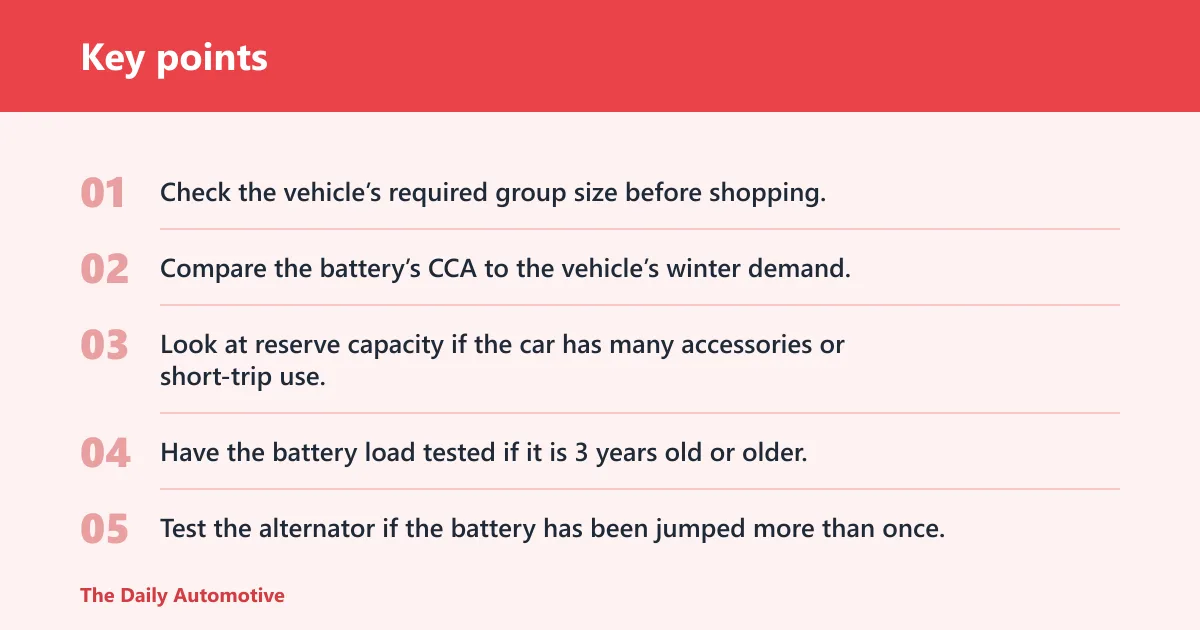
- Check the vehicle’s required group size before shopping.
- Compare the battery’s CCA to the vehicle’s winter demand.
- Look at reserve capacity if the car has many accessories or short-trip use.
- Have the battery load tested if it is 3 years old or older.
- Test the alternator if the battery has been jumped more than once.
Is the battery always the problem?
No. Repeated dead-battery symptoms can come from the alternator, starter, cable connections, or a parasitic draw. A weak alternator can kill a new battery quickly, so the charging system should be tested before you spend money on a replacement battery. Winter often makes those faults more obvious.
A load test checks the battery and charging system together, and it can reveal a failure that a basic voltage test misses. Many parts stores will perform that test free. If the battery fails under load, replacement is reasonable. If the battery passes and the car still struggles, the fault may be elsewhere.
A common first-timer mistake is replacing the battery after one cold no-start, then finding the new battery dies too. That usually points to an alternator or charging problem. Battery replacement alone does not fix every winter no-start.
Alternator faults that mimic battery failure
A battery warning light with dimming accessories is a charging-system clue, not a battery-only clue. Dim headlights, slow power windows, and repeated jump starts can happen when the alternator is weak or the system voltage is low. In that case, a new battery may be the wrong first purchase.
Start with the test that separates the battery from the charging system. A load test, followed by alternator output testing if needed, gives a cleaner answer than guessing from a cold-morning symptom alone.
Do you need battery registration?
Some BMW, Audi, Mercedes, Porsche, Volvo, and Land Rover models need battery registration after replacement. That process uses a scan tool to tell the charging system a new battery is installed and calibrate charging strategy. On those vehicles, skipping registration can shorten battery life or leave charging behavior out of sync with the new battery.
Registration matters most after installation, not before. It is separate from the physical swap. If your vehicle calls for it, the new battery should be matched to the proper specification and then registered so the system charges it correctly.
What a scan tool does during registration
The scan tool updates the vehicle’s battery management system with the new battery’s details. That can include the battery type and capacity, depending on the model. When a replacement is registered correctly, the charging system can adapt to the new battery instead of treating it like an old one.
If your car does not require registration, you still need the right group size, correct terminals, and the proper CCA. Registration is one part of the job, not the whole job.
Frequently asked questions
Do car batteries die in cold weather?
Yes. Cold weather cuts available cranking power and makes a weak battery more likely to fail on start-up. The same source says a battery loses roughly 60% of its cranking power at 0°F. That does not mean every battery dies, but it does mean winter exposes batteries that were already marginal.
Does cold weather affect car batteries?
Yes. Cold slows the chemical reaction inside the battery and reduces starting power. The vehicle may crank slower, need more current to start, or show no-start symptoms after a cold night. A battery that seems acceptable in mild temperatures can act much weaker in freezing conditions.
Can cold weather damage car battery?
Cold weather usually does not damage a healthy battery by itself, but it can expose weakness, increase stress, and leave a marginal battery unable to start the car. If the battery is old, undercharged, or repeatedly deep-cycled, freezing conditions can shorten its useful life.
Does cold weather make car battery die?
Cold weather can make a weak battery fail, but it is often the final trigger rather than the root cause. Age, short trips, a bad alternator, or a poor connection may already be present. Winter simply reduces the battery’s margin until the car will not start.
What CCA rating is good for winter starts?
For most passenger cars, at least 600 CCA is a practical winter target. Trucks and larger SUVs often need 700-800 CCA, and Legacy Auto Repair recommends an AGM battery rated 700+ CCA for cold-climate daily drivers. Always match the vehicle’s required group size too.
Do I need battery registration after replacement?
Sometimes. Some BMW, Audi, Mercedes, Porsche, Volvo, and Land Rover models require registration with a scan tool after installation. If the vehicle uses battery management, registration tells the charging system that a new battery is installed and helps it charge correctly.
Is a dead battery always the battery’s fault?
No. A dead battery can be caused by a weak alternator, a starter issue, loose terminals, or a parasitic draw. If the car has repeated jump starts or a battery warning light, test the charging system before buying a new battery. That can prevent a repeat failure.
How much does a car battery replacement cost in winter?
For a typical 12-volt battery, plan on about $180-$350 installed if winter service is involved. Emergency towing or after-hours service can push the total higher.
Should I buy AGM or flooded for cold weather?
AGM is usually the better winter choice when the vehicle has start-stop, many accessories, or frequent short trips in the cold. Flooded lead-acid is still sensible for older, simpler vehicles when the budget matters more and the car’s electrical demand is modest. The right pick depends on the vehicle, not just the temperature.
Products related to this article
Sponsored / affiliate links. As an Amazon Associate I earn from qualifying purchases. I may earn additional commission from eligible campaigns.