The Future of Automotive Technology and Daily Life
Future automotive technology will change daily life most through electrification, software-defined features, driver-assistance, and connected services. Plan around charging, data use, and subscription costs before you buy. Miss those details and you can face longer commutes, surprise bills, and privacy trade-offs that affect the whole household. This guide explains how new car tech changes commuting, charging, maintenance, privacy, and family logistics.
How will automotive technology change daily life?



The biggest change is not the dashboard. It is the routine around the car. Future automotive technology will shift when you charge, when you update software, how you park, and what your car knows about your trips. Electric, autonomous, and connected vehicle technology is projected to dominate new car sales within the next decade, so these choices will shape everyday ownership, not just shopping.
Why the ownership experience matters more than the spec sheet
A car can look familiar and still act very differently day to day. A software-defined vehicle can receive new features after purchase, while a connected car may depend on an app, a data plan, and account permissions to do basic tasks like remote locking or trip planning. The sheet metal may stay the same. The ownership contract changes.
Which parts of the day change first
Morning charging, route planning, and parking are the first habits to move. Then come maintenance alerts, cabin preconditioning, and app-based controls for family handoffs. Over time, the ownership burden shifts from oil changes and mechanical checks alone to software updates, authentication, and privacy settings.
What changes in the morning commute and charging routine?
Electric vehicles change the commute by moving energy use into the home or a public charging network. That means range, charging speed, and daily distance matter more than fuel stops once did. For many commuters, the deciding factor is simple: does the car cover the round trip with margin, or does the household need a charging routine built around it?
EV range, home charging, and public charging tradeoffs
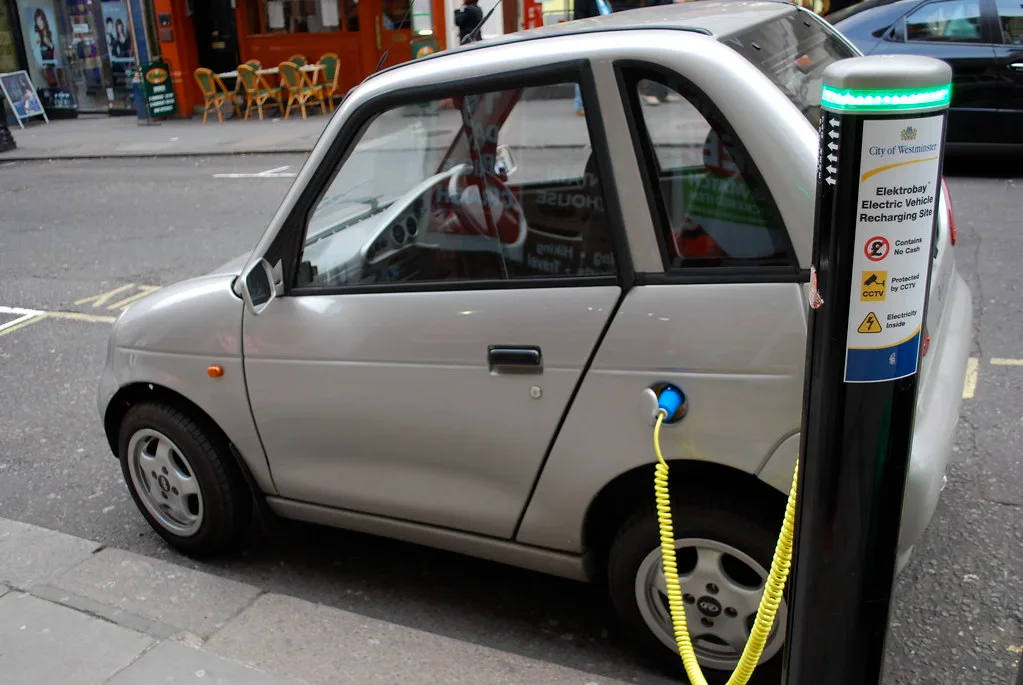
EVs have no tailpipe emissions, but they need charging. Home charging is usually the least disruptive option because the car can refill while parked overnight. Public charging helps on road trips and for households without off-street parking, yet it adds time, pricing variability, and station reliability to the week.
Say your commute is 28 miles each way and you also do school pickup twice a week. A home charger can make that pattern easy if overnight parking is available. If you live in an apartment, the same routine may depend on workplace charging, curbside access, or a nearby fast-charging site.
Parking, errands, and route planning around charging
With an EV, errands often get grouped by charger location. A grocery stop near a DC fast charger becomes useful in a way a random parking lot never was. Trip planning also changes because a low battery warning is not the same as an empty tank; charging time matters, not only remaining range.
A common first-timer mistake is assuming an EPA range of around 300 miles means about 300 miles of comfortable everyday driving. Weather, highway speed, and cabin heating or cooling all affect how far you can go before plugging in. The practical question is whether the vehicle fits your routine with reserve, not whether it sounds long-range on paper.
Which car technologies are most likely to become common first?

The first technologies to spread widely are driver-assistance, connected-car services, over-the-air updates, and software-defined functions. True full autonomy is a different category and will arrive much later, if regulators allow it broadly at all. Most drivers will see assistance features and app-linked services before they see cars that drive themselves without supervision.
Driver assistance now versus full autonomy later
Level 2 driver assistance can help with lane centering, adaptive cruise, and braking support, but it still requires an attentive driver. That is not the same as full autonomy. Real-world deployment of self-driving systems depends on regulation, validated safety performance, geofenced operating limits, and the vehicle class involved.
Connected features, OTA updates, and software-defined functions
Connected features are already common because they are easy to add through software and apps. Software updates matter more than hardware alone, and software updates are a defining part of car capability after purchase. That means some functions can improve later, while others stay fixed by hardware.
| Day in the life | Current-car routine | EV/software-defined/connected-car routine |
|---|---|---|
| Commuting | Leave with a full tank; fuel stop happens when convenient. | Check state of charge, route around charging, and precondition cabin on the app. |
| Charging | No charging step unless the car is a plug-in hybrid. | Plug in at home overnight or plan a public charging stop during errands. |
| Updates | Dealership visits handle recalls, map updates, or service campaigns. | Receive OTA software updates remotely; some fixes may install while the car is parked. |
| Parking | Park and lock with a key fob. | Use app alerts, remote lock status, and location-based charging or climate actions. |
| Maintenance | Oil changes, fluid checks, belts, and exhaust-related service. | Fewer moving parts in the powertrain, but more attention to software, sensors, and diagnostics. |
| Privacy checks | Minimal telematics unless paired to an app or insurance device. | Review consent settings, location sharing, voice data, and connected-service permissions. |
What does connected-car technology do for drivers?
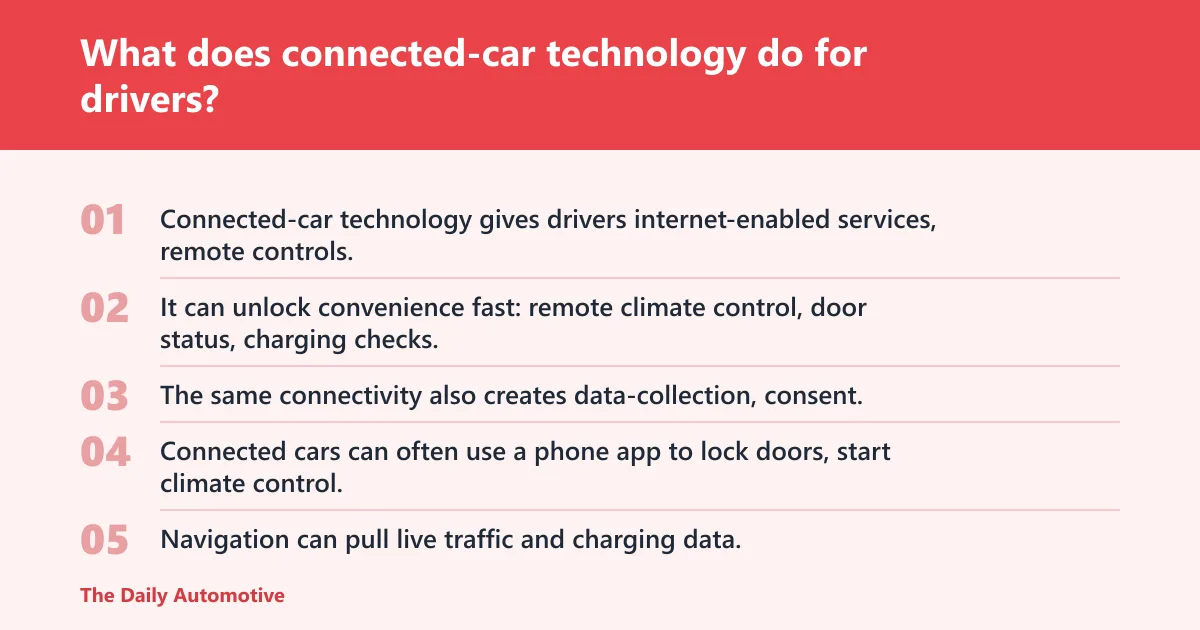
Connected-car technology gives drivers internet-enabled services, remote controls, live navigation, and app-linked infotainment. It can unlock convenience fast: remote climate control, door status, charging checks, stolen-vehicle tracking, and route updates. The same connectivity also creates data-collection, consent, and account-security questions that should be reviewed before daily use.
Remote access, navigation, infotainment, and app-linked controls
Connected cars can often use a phone app to lock doors, start climate control, check battery status, or locate the vehicle. Navigation can pull live traffic and charging data, while infotainment can sync calendars, podcasts, and contacts. Those features are useful, but they work only if the account, network, and permissions stay in order.
Data collection, privacy settings, and consent management
Connected vehicles often collect location traces, diagnostic logs, voice inputs, and usage patterns. Drivers should review what data is shared, whether opt-outs exist, and which services are tied to a subscription. Privacy matters because telemetry can outlast a single trip. It can follow the owner through service profiles, app accounts, and cloud dashboards.
How will software updates change car ownership?
Software updates will turn ownership into an ongoing relationship with the car’s code. OTA updates can patch bugs, adjust menus, add safety fixes, and sometimes add features after purchase. That can reduce dealership visits, but it also means the buyer must think about update reliability, account control, and cybersecurity for years after delivery.
What software can change after purchase and what stays fixed
Some features are software-defined, but not everything can be rewritten later. A battery pack, motor output limits, sensor hardware, and cabin layout are still physical limits. What can change includes interface design, charging logic, driver-assistance behavior, navigation tools, and some convenience features. Subscriptions and upgrades may alter access after the sale.
Why update reliability and cybersecurity matter
OTA updates are valuable only if they are trustworthy. Canonical describes OTA updates as compressed, transactional, signed and simple, which matters because update failure can leave a car partly functional or exposed. ISO/SAE 21434 is a widely used automotive cybersecurity standard that helps organize security management for connected vehicles.
Canonical says it has achieved ISO/SAE 21434 certification for its Security Management System. It also says fully over-the-air device management can handle devices and updates remotely. For long-term support, Ubuntu Pro for Devices is described as offering up to 12 years of security maintenance. Those claims matter because software now stretches across the vehicle’s life cycle.
Are smart cars ready for home life and family logistics?
Smart cars are moving into home routines through the Internet of Things, but the ecosystem still matters. A connected vehicle can talk to chargers, calendars, locks, and assistants, yet not every brand plays well with every device. Family logistics improve fastest when the household uses a compatible stack and keeps permissions organized.
IoT links with chargers, calendars, locks, and home assistants
IoT integration lets the car react to home and household cues. A charger can start at off-peak hours, a calendar can suggest departure time, and a smart lock can confirm the garage door is closed before the car leaves. These workflows are useful, but they depend on interoperability across devices and apps.
Big data, predictive maintenance, and route or energy planning
Big data and analytics can identify driving patterns, estimate range more accurately, and flag component wear earlier. Predictive maintenance may warn about a battery cooling issue or a charging-system fault before the driver notices a symptom. That can reduce surprises, but it also increases the amount of data a household must trust and manage.
What are the risks and tradeoffs of smart cars?
The main risks are privacy, cybersecurity, repair complexity, subscription drift, and uneven regulation. Smart cars collect more data and rely more on cloud services, so failures can affect convenience, access, or safety. A connected vehicle can feel simpler on the surface while becoming harder to own if permissions, software, or support terms change.
Privacy, cybersecurity, and subscription risk
Location history, voice commands, driver profiles, and charging behavior can all be exposed if accounts are weak or policies are unclear. Subscription models can also turn features on or off after purchase. That means buyers should check whether navigation, remote start, data connectivity, and some driver-assistance features are included, trialed, or recurring fees.
Repair complexity and support timing
More software usually means more diagnostics, and more diagnostics can mean more dependence on dealer tools or certified service. Some issues can be fixed remotely. Others need hardware replacement, calibration, or both. If the vehicle is out of support, the cost and wait time can rise quickly, especially for niche systems.
According to Canonical, Ubuntu is preferred by developers at 66% of working professionals. Canonical also positions Anbox Cloud as a cloud-based environment for Android development teams, and says it can develop, debug and test a virtual infotainment device in the cloud. That kind of tooling matters because the car is increasingly a software platform, not only a machine.
Which automotive trends are real now versus still speculative?
Real now: EVs, connected services, OTA updates, and Level 2 driver assistance. Still speculative: broad full autonomy in ordinary mixed traffic without supervision, near-term uniform regulation, and universal interoperability across brands and home devices. The market is moving, but the legal and infrastructure layers are moving at different speeds.
What is real now
Today’s practical changes are easy to spot. Drivers can charge at home, receive remote alerts, update software over the air, and use app-based controls. These features already affect commuting, parking, and maintenance. Shared mobility and ride-hailing may grow too, but they do not erase private ownership; they change how some households use cars.
What still depends on regulation and infrastructure
Full autonomy depends on safety validation, regulatory approval, and roadway conditions that vary by region. Public charging expansion, apartment charging access, and cybersecurity discipline also determine how quickly new tech becomes normal. Cars may become more automated, convenient, and app-linked, but the pace will differ by vehicle class, city, and household setup.
Frequently asked questions
How will automotive technology change daily life?
Daily life changes most through routine, not novelty. Charging replaces some fuel stops, software updates replace some service visits, and connected apps handle more of the driving experience. That can save time and add convenience, but only if the car fits your parking, commute, privacy, and subscription needs.
Which car technologies are most likely to become common first?
Driver assistance, connected-car features, OTA updates, and software-defined functions are most likely to spread first. They fit into current cars without requiring full infrastructure rebuilds. Full autonomy is much harder because it depends on regulation, safety proof, and operating limits that vary widely.
Will self-driving cars really be part of everyday commuting?
Not in the same way a normal commuter car is today. Level 2 assistance is already part of many vehicles, but true self-driving for everyday mixed traffic remains limited and heavily regulated. Expect gradual use in specific zones or conditions before broad household reliance.
How will software updates change car ownership?
Software updates make ownership more dynamic. The car can gain fixes, interface changes, and sometimes new features after purchase. That can be useful, but it also means you need to watch update policies, account access, subscription terms, and cybersecurity practices over the vehicle’s life.
What does connected-car technology do for drivers?
It connects the car to apps, cloud services, and other devices. That enables remote lock and unlock, charging checks, route updates, and infotainment features. It also creates privacy and data-sharing choices, so drivers should review permissions and decide which services they actually want enabled.
How will EVs affect home charging and daily routines?
EVs shift energy use into the parking routine. Many owners charge overnight at home, which changes the meaning of refueling from a stop on the road to a habit at home. For households without home charging, public access, workplace charging, and route planning become much more important.
Products related to this article
Sponsored / affiliate links. As an Amazon Associate I earn from qualifying purchases. I may earn additional commission from eligible campaigns.