Timing Belt Replacement Cost: What a Quote Should Include
Timing belt replacement usually costs about $500 to $1,200, but quotes can climb once you add a water pump, tensioners, or accessory-drive parts. If a quote sits far below that range, check what is missing. Skip the service or do it badly, and a broken belt can leave you with a no-start engine and, on interference engines, much higher repair bills. This guide breaks down each line item so you can compare shop quotes, spot missing parts, and judge whether the price is fair.
Typical cost range

For a typical service, the average timing belt replacement cost runs between $882 and $1,285. A cited breakdown puts labor at $584–$858 and parts at $297–$428, which is why the final bill often lands well above the belt itself. Vehicle design, parts access, and what the shop includes in the quote all move the total.
Mileage, age, and engine layout
Manufacturers typically recommend replacement every 60,000 to 100,000 miles, and age matters too. Many belts are scheduled by time as well as mileage because rubber ages even when the car is driven lightly. The belt is a reinforced rubber loop strengthened with Kevlar, so a low-mileage car can still need service if the belt is old.
Engine layout changes the price more than the belt does. A straight-four with clear access is usually simpler than a transverse V6 with cramped front-end packaging. Some vehicles also use timing chains instead of belts, so you need the exact engine before comparing prices.
Why timing belt service costs so much
Timing belt service is expensive because labor dominates the job. The belt itself is only one piece of a repair that often includes removing covers, accessory components, and sometimes the water pump, then re-timing the engine correctly. CostHelper says the work can take two to eight hours or more, which explains why quotes vary so widely.
Labor time versus parts cost
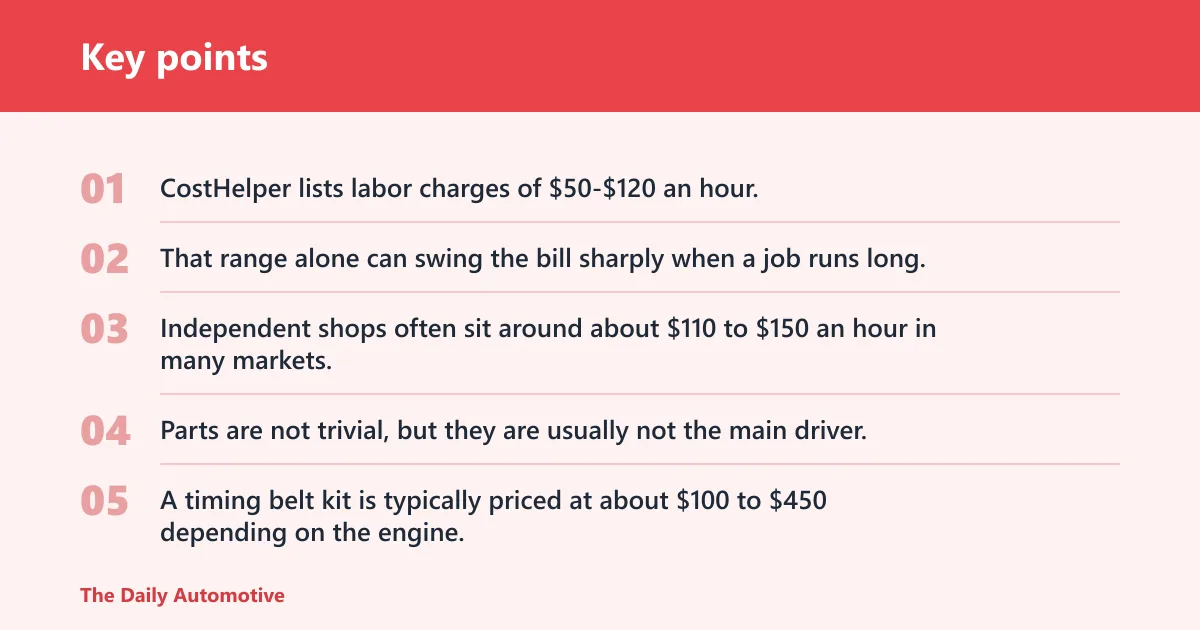
The same source lists labor charges of $50-$120 an hour. That range alone can swing the bill sharply when a job runs long. Independent shops often sit around about $110 to $150 an hour in many markets, while dealership labor rates are commonly about 25% to 35% higher than independent shops.
Parts are not trivial, but they are usually not the main driver. A timing belt kit is typically priced at about $100 to $450 depending on the engine, and it may be sold with the water pump. Jerry estimates $100 to $350 for a kit with necessary parts, while CostHelper says professional replacement can be $150-$1,000+ for the belt only and $300-$1,600+ for package replacement.
Why access matters more than the belt itself
The difference between a fair quote and an inflated one often starts with access. If the belt sits behind multiple covers and pulleys, labor rises. If the pump sits behind the timing cover too, a second repair later means paying much of that labor again. That is why one quote can look modest on parts and still be expensive overall.
Say your compact four-cylinder needs a belt service and the shop lists four labor hours, a belt kit, and coolant. That is a very different estimate from a transverse V6 quote with eight labor hours, a water pump, seals, and an accessory belt. The final total may differ by hundreds before the first bolt comes out.
What should be included in a timing belt quote?
A complete timing belt quote should spell out the belt kit, the water pump if it is being replaced, any seals, coolant, accessory belts, and the labor time. If the estimate only names “timing belt” with one flat price, you do not yet know whether it covers the pieces most likely to be replaced during the job.
Belt kit, tensioner, and idler pulleys
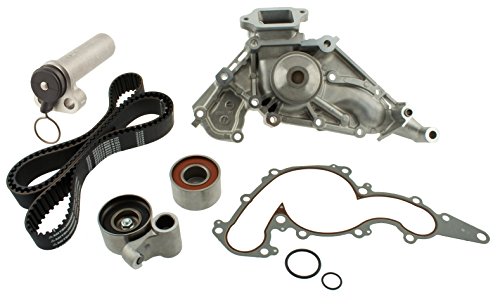
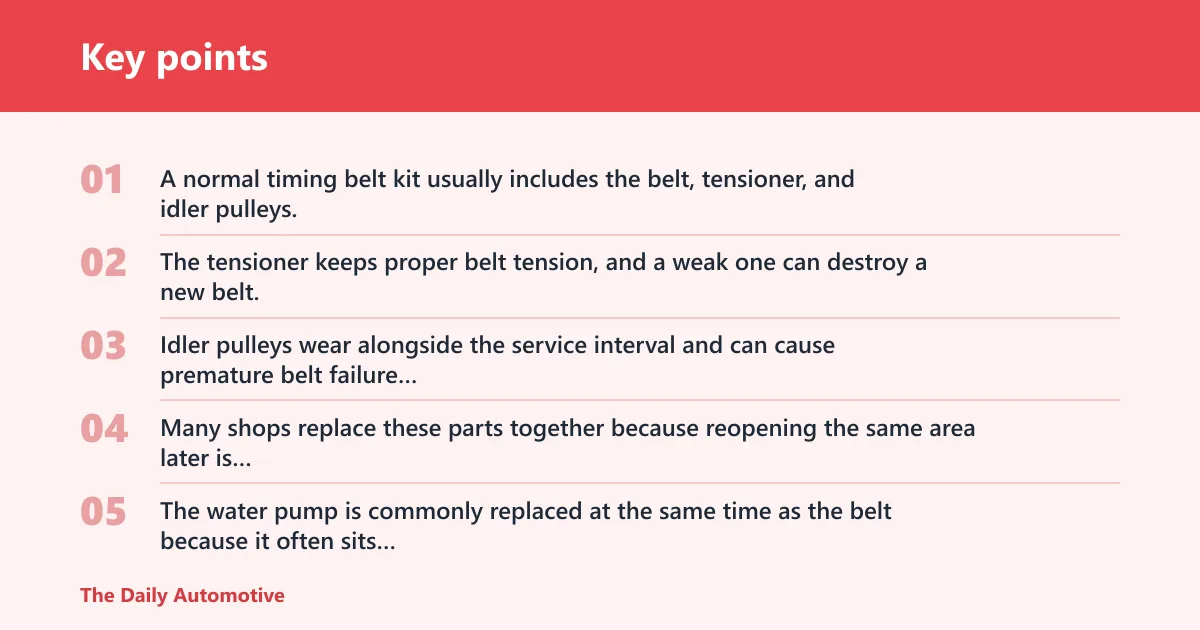
A normal timing belt kit usually includes the belt, tensioner, and idler pulleys. The tensioner keeps proper belt tension, and a weak one can destroy a new belt. Idler pulleys wear alongside the service interval and can cause premature belt failure if they are skipped. Many shops replace these parts together because reopening the same area later is inefficient.
Water pump, seals, coolant, and accessory belts
The water pump is commonly replaced at the same time as the belt because it often sits behind the timing cover. That adds parts cost, but it can avoid a second labor charge later. Seals may also be changed if the front of the engine is already open, and coolant is often needed when the pump comes out.
Accessory belts are another line item to watch. If the shop has already removed them to reach the timing cover, replacing them during reassembly is usually cheaper than paying again later for the same access. If the quote leaves them out, ask whether they are being reused or simply omitted.
Labor hours and shop supplies
Labor hours should be listed in the quote, not buried in the final number. Ask whether the estimate assumes removal of only the timing covers or whether it also includes related components in the front of the engine bay. Shop supplies may appear as a separate line, but they should be modest and explained if they are charged at all.
Timing belt quote checklist
Use a line-by-line check before you compare prices. A quote can be fair even if it is not the cheapest one, but it should explain what is included, what is optional, and what changes the labor time. Missing parts are the most common reason a low estimate turns expensive later.
| Quote item | Normal inclusion status | Red flags | Questions to ask |
|---|---|---|---|
| Belt kit | Usually included in a full timing service | “Belt only” with no kit detail | Does this include the belt, tensioner, and idler pulleys? |
| Water pump | Often included on the same job | Pump omitted with no explanation | Will the pump be replaced now or only if it is leaking? |
| Tensioner | Commonly replaced during the service | Reuse of an old tensioner on a fresh belt | Is the tensioner part of the kit or charged separately? |
| Idler pulleys | Often included in a timing kit | No mention of pulley bearings | Are all idlers being renewed with the belt? |
| Seals | Sometimes included if access is already open | Oil seepage left unaddressed with no note | Are front crank or cam seals included, and at what cost? |
| Coolant | Often needed if the pump is removed | No coolant listed after pump replacement | Is fresh coolant included after the pump swap? |
| Accessory belts | Frequently replaced while access is open | Old drive belts reused without comment | Will the accessory belts be reused or replaced? |
| Labor hours | Should be stated clearly | Flat price with no time breakdown | How many billed hours are you using, and why? |
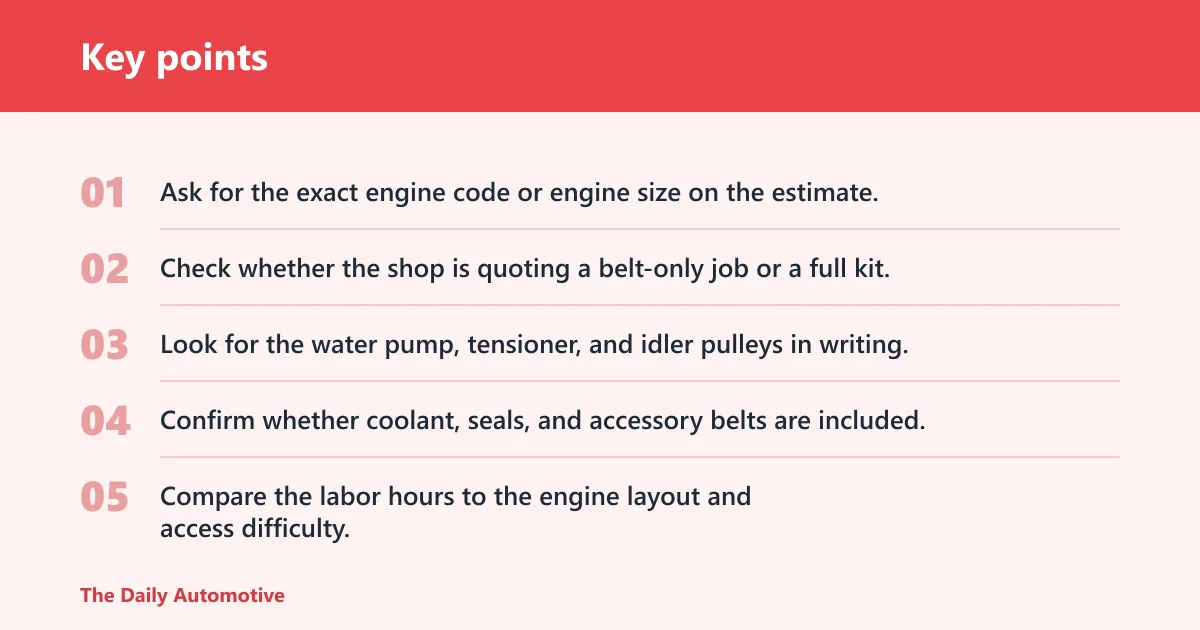
- Ask for the exact engine code or engine size on the estimate.
- Check whether the shop is quoting a belt-only job or a full kit.
- Look for the water pump, tensioner, and idler pulleys in writing.
- Confirm whether coolant, seals, and accessory belts are included.
- Compare the labor hours to the engine layout and access difficulty.
- Make sure the quote says whether OEM or aftermarket parts are planned.
Should you replace the water pump too?
Yes, in most timing belt services the water pump belongs in the same quote. If the pump is behind the timing cover, replacing it while the belt is off can avoid paying for much of the same labor twice. It also reduces the risk of having to reopen the job for a leaking pump soon after the belt service.
When the extra parts cost is worth it
Jerry says experts recommend replacing the water pump at the same time. That advice makes practical sense when the pump is buried behind the belt drive. If the pump fails later, you are not just buying a pump; you are often rebuying access time, coolant service, and part of the original labor.
Picture an owner who skips the pump on a high-mileage engine to save a small amount up front. Six months later, a leak appears and the front of the engine has to come apart again. The second visit can erase the original savings quickly.
When a separate pump job may make sense
A separate pump job can make sense when the pump is not driven by the timing belt or when the service history is unusually recent and documented. That is vehicle-specific, not automatic. If the pump is easy to reach from outside the timing belt path, the value calculation changes and the quote should say so plainly.
Should I go to a dealer or independent shop for timing belt replacement?
Either can do the job correctly, but the quote structure is usually different. Independent shops often have lower labor rates, while dealerships typically charge more and often use OEM parts. If you want the lowest total bill, an independent shop is usually the first place to compare; if you want factory parts and brand-specific familiarity, the dealer may still be a reasonable option.
How labor rates usually differ
Independent shop labor rates often run lower than dealership pricing, and dealer labor is typically 25% to 35% more. That spread matters on a repair that can take multiple hours. The difference becomes larger on engines with tight packaging or when the shop adds water pump and seal work at the same time.
OEM parts versus aftermarket parts
Dealerships usually price OEM parts into the repair. Independent shops may quote OEM, aftermarket, or a mix of both. Neither is automatically wrong. The useful question is whether the quote identifies the parts grade clearly and whether the labor time fits the vehicle, not just the badge on the invoice.
What changes by vehicle and engine layout?
Vehicle-specific fitment is the biggest reason timing belt quotes do not line up from one car to another. Some engines are straightforward and others demand far more disassembly. Transverse V6s are usually more expensive because access is tighter, the packaging is denser, and the labor time rises. Some vehicles do not use timing belts at all, so the first step is confirming the engine design.
Interference engines and repair risk
On an interference engine, a belt failure can allow piston-to-valve contact, and repair bills often start at about $2,000 or more. That makes scheduled replacement urgent, even if the car still runs fine. A belt can fail with little warning, so waiting for symptoms is not a reliable plan.
What happens if a timing belt breaks?
If a timing belt breaks, the engine may stall immediately and refuse to restart. On a non-interference engine, the damage may be limited to the belt service itself. On an interference engine, broken timing can bend valves and damage the top end fast. That is why the service interval matters more than a search for symptoms.
A common first-timer mistake is to assume the car will “sound wrong” before the belt fails. Sometimes it will. Sometimes it will not. If the service interval is due, the quote is the place to scrutinize, not the dashboard warning lights.
Frequently asked questions
How much does a timing belt replacement cost?
The average timing belt replacement cost runs between $882 and $1,285, with many jobs landing lower or higher depending on engine layout and what is included. Industry costs can span from $500 to $2,500 depending on the vehicle, so the quote only makes sense when you know the engine and the parts list.
How much should a timing belt and water pump replacement cost?
A belt-and-pump quote should usually be higher than a belt-only quote because it adds parts and sometimes coolant, but it can still be a better value than splitting the jobs. The same source says the total cost is about $400 to $1,000 for a kit-based repair, while broader package pricing can go higher on difficult engines.
Why is timing belt replacement so expensive?
It is expensive because the labor takes time and the access can be awkward. The belt itself is not the main cost driver. Once the front of the engine has to come apart, the quote starts reflecting disassembly, reassembly, timing setup, and often related parts like the water pump and pulleys.
How much does labor cost for a timing belt replacement?
Your actual quote depends on billed hours and local shop rates. A shop with better access to the engine may bill fewer hours than one working on a tighter layout.
How much does timing belt replacement cost by car model?
There is no safe model-wide number without the year and engine. The same badge can cover timing chains on one engine and timing belts on another, and labor can change sharply with layout. That is why model-year and engine-code confirmation matter before you use any price quote.
Products related to this article
Sponsored / affiliate links. As an Amazon Associate I earn from qualifying purchases. I may earn additional commission from eligible campaigns.