STP Oil Treatment Review: Is It Worth It?
STP Oil Treatment is a thick oil additive that can quiet some worn, high-mileage engines, but it is a poor fit for modern low-viscosity or turbocharged engines; use it only if your owner’s manual does not forbid viscosity boosters. In the wrong engine, it can slow oil flow, hurt cold starts, and erase the benefit of the oil spec you paid for. This guide explains what it does, which engines can tolerate it, and when to skip it.
What STP Oil Treatment actually
STP Oil Treatment is an engine oil additive, not a standalone motor oil. It is meant to be mixed with the oil already in the sump during an oil change or between services, where its thicker blend can raise viscosity, cut some mechanical noise, and add a bit more film strength in older, looser engines.
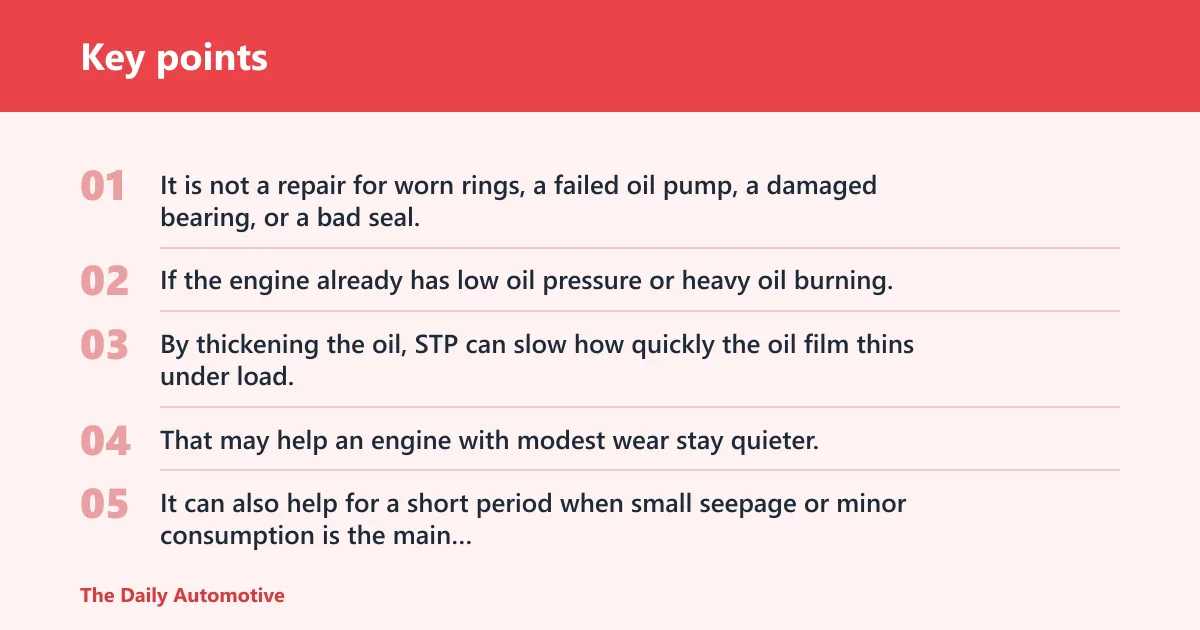
That is the basic use case. It is not a repair for worn rings, a failed oil pump, a damaged bearing, or a bad seal. If the engine already has low oil pressure or heavy oil burning, the additive may hide the symptoms for a short time without fixing the cause.
What it is meant to change inside the sump
By thickening the oil, STP can slow how quickly the oil film thins under load. That may help an engine with modest wear stay quieter, especially at idle or after a hot shutdown. It can also help for a short period when small seepage or minor consumption is the main issue.
That same thickening is the downside in the wrong engine. If the factory spec calls for 0W-20, 0W-16, or another low-viscosity oil, adding a thick additive can move the oil away from the spec the engine was designed around.
Where the standard bottle fits in a maintenance routine
The standard bottle belongs in the maintenance conversation, not as a substitute for oil changes. It can be added to fresh oil or to oil already in service if the sump has room for it and the engine can tolerate a thicker fill.
A common first-timer mistake is adding a full bottle to a small-sump engine without checking capacity first. That can push the oil level too high, and overfill is its own problem.
Does STP oil treatment work?
It can work in the narrow sense of changing how the oil behaves. In an older engine with mild wear, that can mean less valvetrain rattle, a steadier oil film, and some reduction in seepage or consumption. It does not reverse worn parts, and it does not restore lost compression or oil pressure.
That is why results depend on the engine, not just the bottle. The same additive that quiets a tired engine may be a bad fit for a modern turbo engine, a VVT system, or any application that depends on a precise oil viscosity.
What it can plausibly help
STP’s thickening action makes the most sense in older, high-mileage engines with mild wear. Rx Mechanic notes that STP is especially popular for older or high-mileage vehicles, and it also describes use during an oil change or between services. That lines up with the product’s intended role as an add-on, not a cure.
Reviews often mention ZDDP, the anti-wear ingredient many older-engine owners look for. That ingredient discussion is one reason some drivers see STP as a support product for worn engines, not a universal choice for every car on the road.
What it cannot repair
STP cannot fix a scored cylinder wall, collapsed lifter, leaking rear main seal, or worn piston rings. If an engine is burning oil because the internal hardware is worn out, a thicker additive may only reduce the visible symptom for a while.
That distinction matters. If oil pressure is low, there is sludge, or the engine has an actual mechanical fault, the correct next step is diagnosis, not a viscosity booster.
Which STP variant fits your engine?
STP sells more than one oil additive, and the right choice depends on the symptom. The standard STP Oil Treatment is the broadest option. STP High Mileage Oil Treatment + Stop Leak is aimed at older engines, leak control, and oil burning, and STP Ceramic Oil Treatment is positioned around anti-friction coating and longer protection.
The details matter. STP Shop lists a STP High Mileage Oil Treatment + Stop Leak – 15 FL OZ and prices it at $12.99. It also lists a STP Ceramic Oil Treatment (15k Mile Protection) 15oz priced at $14.99.
Standard STP Oil Treatment
This is the basic thick additive. It is the most straightforward choice if the goal is simply to increase oil film thickness in an older engine that is already showing some wear and the owner’s manual does not prohibit that change.
Use restraint. Standard STP is the least targeted option, so it is best reserved for engines where thickness is the point, not for engines that depend on low viscosity and tight oil control.
STP high mileage oil treatment + stop leak
This version is aimed at older engines with minor leaks or light oil burning. The 15 FL OZ bottle size and the stop-leak labeling point to that use case, and Walmart shows 4.7 out of 5 stars with 581 ratings and 137 reviews for the product.
That review volume does not prove performance, but it does show that the product is being used as a high-mileage fix. One Walmart review says it is used for high-mileage vehicles and “coats engine parts,” and another mentions a “2020 Prime XLE 115k miles” use case.
STP ceramic oil treatment
This is the more specialized option. Glenn Said reports that the ceramic treatment was used with Pennzoil Platinum 5w30, says it is designed to last up to 15,000 miles, and states that it is compatible with both conventional and synthetic oils.
That makes it different from the basic thickener. It is marketed around anti-friction and protective coating claims, so it is the version to look at when you want a coating-style additive rather than just more viscosity.
STP oil treatment decision table
| Engine type | Symptom | STP variant | Recommendation |
|---|---|---|---|
| Older high-mileage gasoline engine | Minor oil consumption | STP High Mileage Oil Treatment + Stop Leak | Conditional if wear is mild and the manual allows thicker oil |
| Modern turbo engine | Factory 0W-20 spec | Standard STP Oil Treatment | No; do not thicken a spec-sensitive turbo fill |
| Older engine with noisy lifters | Ticking at hot idle | Standard STP Oil Treatment | Conditional; may quiet noise if oil flow is still adequate |
| High-mileage engine with small seep | Minor gasket seepage | STP High Mileage Oil Treatment + Stop Leak | Conditional; acceptable for light seepage, not major leaks |
| Healthy engine | No noise, no consumption | Any STP variant | No; there is little upside if the engine is already happy |
| Synthetic-only spec application | Oil spec is tightly controlled | STP Ceramic Oil Treatment | Conditional only if the manual allows additives and viscosity stays in range |
| Modern VVT engine | Timing control relies on fast oil flow | Standard STP Oil Treatment | No; avoid changing flow characteristics without a clear need |
| Older engine with light wear | General valvetrain noise | STP Ceramic Oil Treatment | Conditional; a coating-style additive may be reasonable if viscosity is not a problem |
How much STP oil treatment should you use?
Use only the amount the bottle calls for, and make sure the final oil level stays within the safe range on the dipstick. There is no reason to “top off” by feel. The key issue is sump capacity, because too much additive can push the engine into overfill territory.
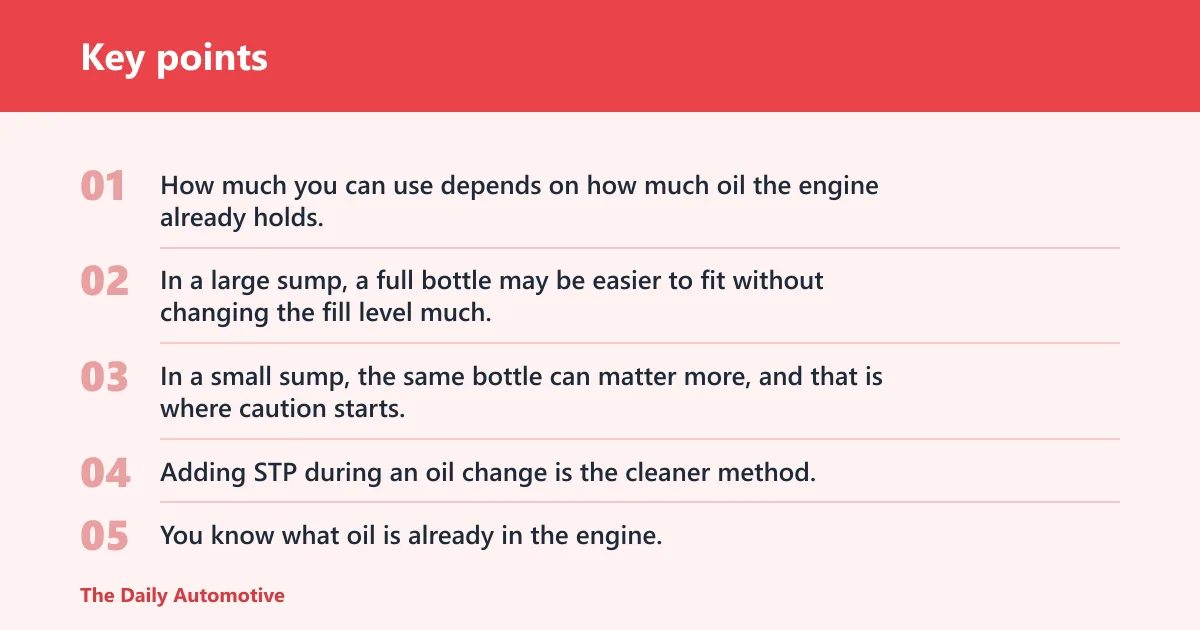
How much you can use depends on how much oil the engine already holds. In a large sump, a full bottle may be easier to fit without changing the fill level much. In a small sump, the same bottle can matter more, and that is where caution starts.
Adding it during an oil change
Adding STP during an oil change is the cleaner method. You know what oil is already in the engine, and you can check the dipstick after the fill so the final level is correct.
If you are using STP High Mileage Oil Treatment + Stop Leak or STP Ceramic Oil Treatment, this is the safer time to measure the final level because you can account for the additive before the engine is run.
Adding it between changes
Adding it between services can work, but it raises the chance of overfill. That matters more in small-sump engines and in engines already near the top mark on the dipstick.
Suppose a compact four-cylinder is already close to full and you pour in a full bottle. The dipstick can rise above the max mark, and that can create foaming or other oiling issues that cancel the benefit you were chasing.
Why sump capacity matters
Oil capacity sets the margin for error. A larger sump can absorb an additive bottle more easily, while a smaller sump leaves less room for extra fluid and less tolerance for a thicker fill.
If the engine calls for a precise low-viscosity oil, that capacity issue is only part of the story. The more important issue is whether the additive changes the oil enough to move it away from the intended spec.
Will STP help noise, leaks, or oil burning?
It can help mild versions of those problems, especially in older engines. A thicker additive may reduce lifter tick, slow a small seep, and trim light oil consumption. It will not stop major leaks, cure worn rings, or fix a deep mechanical fault.
That is the line to keep in view. Small symptom relief is plausible. Repair is not.
Noisy lifters and valvetrain noise
Quieting noise is one of the most believable uses for STP, because thicker oil can sometimes maintain pressure and film thickness a little better in worn valvetrain parts. That is most relevant when the engine is older and the noise is mild.
If the noise is new, loud, or worsening quickly, do not use an additive as a diagnosis. Low oil pressure, dirty lifters, or a failing component needs the actual cause found.
Small seepage and minor leaks
The high-mileage stop-leak version is the best fit here. It is aimed at older engines with small seepage around gaskets or seals, not at large external leaks that leave spots on the ground or drop the oil level quickly.
Use the word “small” carefully. If the leak is large enough that the dipstick keeps dropping, that is no longer a stop-leak problem. That is a repair problem.
Light oil consumption in older engines
Older engines that burn a little oil may benefit from the thicker blend because it can reduce how much oil slips past worn parts. That is where many high-mileage drivers see the best fit for STP Oil Treatment.
Still, oil consumption caused by worn rings or valve seals is not cured by a bottle. A thicker additive can only reduce the rate in some cases.
Is STP compatible with synthetic oil?
Sometimes, but compatibility is not the same as suitability. Some STP products are described as usable with synthetic oil, including the ceramic version that Glenn Said says is compatible with both conventional and synthetic oils. That does not mean every synthetic-filled engine should get one.
Modern engines are often filled with synthetic motor oil for a reason: tight tolerances, cold-flow needs, and exact viscosity targets. Additives that thicken the oil can work against those goals.
Conventional oil context
STP is easiest to justify with conventional motor oil in older engines that already have some wear. The broader oil-thickening effect is less likely to conflict with a loose, high-mileage engine using a more forgiving oil spec.
That is also where review language about friction reduction and smoother operation tends to sound most believable.
Synthetic oil context
Synthetic motor oil does not make STP unnecessary, but it does make the choice more delicate. A synthetic fill may already meet the engine’s protection needs without extra thickening, and adding viscosity can move the oil away from the intended behavior.
For that reason, compatibility should not be read as a blanket green light. It is a conditional fit, not a default one.
Why modern low-viscosity specs need caution
Low-viscosity oils such as 0W-20 are chosen for cold start flow, fuel economy, and in many cases the needs of turbo and VVT systems. Thickening that oil can slow circulation when the engine most needs quick flow.
That is why STP is a poor match for many modern engines. If the owner’s manual is strict about the spec, skip the additive and keep the oil exactly where the engine maker wanted it.
Frequently asked questions
What does STP oil treatment do?
It is an oil additive that aims to raise viscosity, cut friction, and quiet some wear-related noise. The high-mileage version adds stop-leak positioning, while the ceramic version claims anti-friction coating and 15,000-mile protection. It is meant to be used during or between oil changes, not as a replacement for oil.
Should I use STP oil treatment?
Use it only if the engine is older, mildly worn, and not sensitive to viscosity changes. If you have a modern turbo engine, a VVT setup, or a low-viscosity factory spec, the safer answer is usually no. For minor seepage or light oil burning in a high-mileage engine, a conditional yes is more reasonable.
Is STP oil good for your engine?
It can be helpful for some older, high-mileage engines, especially when the symptom is mild noise or slight oil loss. It is not a universal benefit and can be a poor choice for healthy modern engines that depend on a specific oil grade. Matching the product to the engine matters more than the brand name.
Is STP oil treatment compatible with synthetic oil?
Some STP products are marketed as compatible with synthetic oil, and the ceramic version is described that way in outside coverage. Compatibility does not mean it belongs in every synthetic-filled engine, though. If the engine has a strict low-viscosity spec, thickening the oil can still be the wrong move.
Products related to this article
Sponsored / affiliate links. As an Amazon Associate I earn from qualifying purchases. I may earn additional commission from eligible campaigns.