Top-End Engine Rebuild vs Full Engine Replacement Guide
Choose a top-end rebuild when wear stays in the head, valves, seals, or gaskets. Choose full engine replacement when the bottom end is damaged, parts are scarce, or the engine’s value is low.
This guide is part of our Car engine troubleshooting guide series.
Choose wrong, and you can spend thousands on a repair that still leaves low compression, oil loss, or repeat failure.
This guide explains how to tell top-end damage from bottom-end damage, when replacement makes more financial sense, and what to ask before you pay.
Top-end engine rebuild vs full engine replacement: what changes
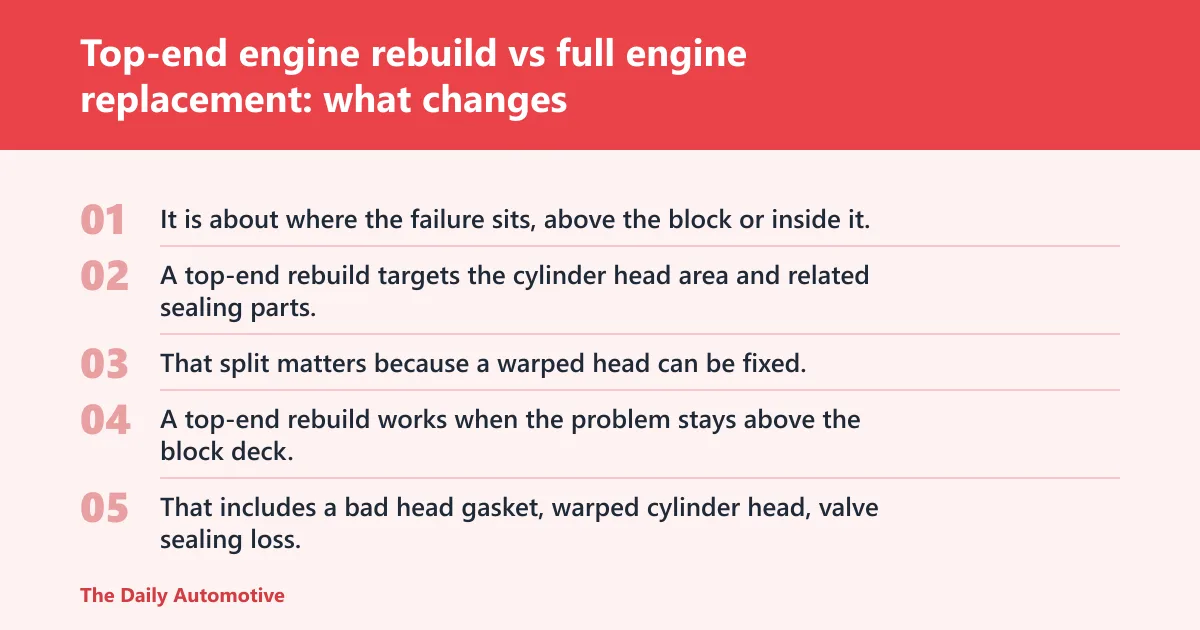


The choice is not about price alone. It is about where the failure sits, above the block or inside it. A top-end rebuild targets the cylinder head area and related sealing parts; a full engine replacement or overhaul goes deeper, often into complete disassembly and machining.
That split matters because a warped head can be fixed, but a cracked block or spun bearing changes the math fast.
| Decision factor | Top-End Engine Rebuild | Full Engine Replacement | Winner |
|---|---|---|---|
| Failure depth | Upper engine: cylinder head, valves, head gasket, timing-related work | Entire engine: complete disassembly, lower-end inspection, machining, bearings, seals | Full Engine Replacement |
| Typical cost band | RM 3,000 – 6,000 | RM 8,000 – 15,000 | Top-End Engine Rebuild |
| Turnaround time | 3-5 days | 7-14 days | Top-End Engine Rebuild |
| Best fit mileage band | Medium mileage engines | High mileage engines | Tie |
| Repair scope and risk control | Good when compression loss comes from sealing or head issues | Better when wear is widespread or the block and crankshaft are suspect | Full Engine Replacement |
Failure depth decides the repair
A top-end rebuild works when the problem stays above the block deck. That includes a bad head gasket, warped cylinder head, valve sealing loss, or upper-engine oil leaks that do not point to crankshaft or bearing damage. Once the lower end is involved, the repair stops being a top-end job.
Cost and time favor the top end
Top-end work is cheaper upfront and faster because it needs less teardown and fewer machine-shop operations. Full overhaul costs more because it can add boring, balancing, lower-end parts, and a longer reassembly process.
Durability depends on what failed
If the bottom end is healthy, a top-end rebuild can restore usable compression and oil control. If the engine has bearing wear, metal contamination, or a cracked block, a broader repair is the only route that addresses the actual damage.
📊 Top overhaul cost range is RM 3,000 – 6,000. Source: Top Overhaul vs Full Engine Overhaul: Which Do You Need ….
What a top-end engine rebuild includes
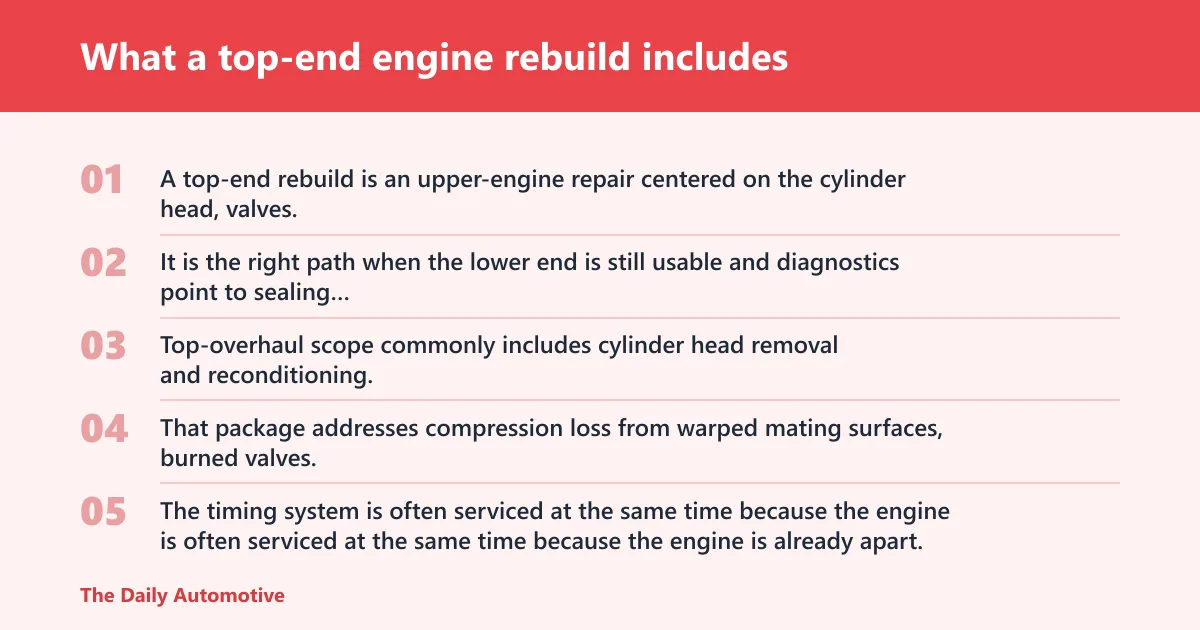
A top-end rebuild is an upper-engine repair centered on the cylinder head, valves, head gasket, timing system service, and related piston and ring work when cylinder wear or oil control problems are present. It is the right path when the lower end is still usable and diagnostics point to sealing loss above the block.
Cylinder head, valves, head gasket, and timing system work
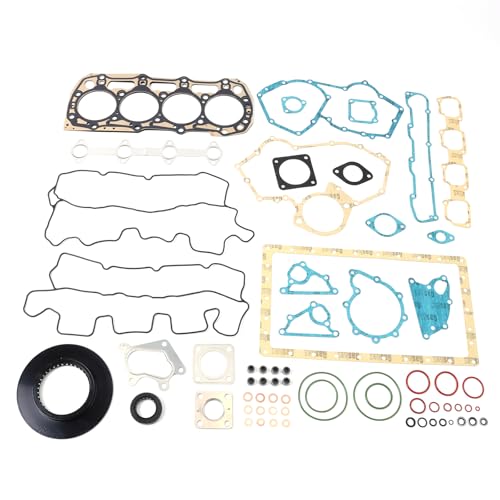
Top-overhaul scope commonly includes cylinder head removal and reconditioning, valve replacement and grinding, and head gasket replacement. That package addresses compression loss from warped mating surfaces, burned valves, or failed sealing surfaces.
The timing system is often serviced at the same time because the engine is already apart. If the timing components are worn, skipping them can leave you with a repaired head and a future no-start or valve timing issue.
Where pistons and rings fit into a top-end repair
Pistons and rings belong in this conversation when a compression test or leak-down test shows ring sealing problems but the block is still serviceable. Some shops classify piston and ring replacement as part of a top overhaul, especially when the engine shows moderate wear rather than a deeper bottom-end failure.
That said, if the cylinder walls are scored or out of spec, the repair may cross into full overhaul territory because the block will need more than a top-side refresh.
Typical labor-hours, cost range, and mileage band
A top overhaul is listed at 3-5 days, with RM 3,000 – 6,000 as the stated cost range and a 6 months warranty. It is described for medium mileage engines, which is where upper-engine wear often appears before the rest of the engine is worn out.
Hidden costs still matter. Fluids, gaskets, fasteners, machine-shop checks, and diagnostic time can move the final bill higher than a simple parts quote suggests.

What a full engine replacement or overhaul includes
A full engine replacement or full overhaul is a much broader repair that can involve complete engine disassembly, block machining and boring, crankshaft grinding and balancing, and replacement of bearings and seals. It is the correct choice when the damage reaches the bottom end or when the engine has too many internal unknowns to justify a partial repair.
Complete disassembly, block machining, boring, and balancing
Full overhaul means the engine comes apart far enough to inspect the block, crankshaft, rods, and related wear surfaces. Machining and boring may be required to restore cylinder condition, and balancing helps control vibration after major internal work.
That deeper process takes more time because the machine shop becomes part of the repair path, not just the shop floor.
Crankshaft, bearings, seals, and other lower-end parts
Crankshaft work is the clearest divider between top-end and full-engine repair. If the crankshaft needs grinding or balancing, or if the bearings show damage, the lower end is no longer “fine enough” for a head-only repair.
Bearings, seals, and other lower-end parts are there to restore oil control and durability. Without them, a fresh head on a worn bottom end can still fail early.
Typical labor-hours, cost range, and turnaround time
A full overhaul is listed at 7-14 days, with RM 8,000 – 15,000 as the stated cost range and a 12 months warranty. It is described for high mileage engines, where widespread wear is more likely and the full engine needs deeper correction.
That longer turnaround reflects teardown, machining, parts sourcing, reassembly, and break-in checks. It also reflects the fact that more parts can be discovered during inspection.
Which engine problems point to each option?
Head-gasket failure, a warped head, or valve seal problems usually point toward a top-end rebuild. Scored cylinders, spun bearings, low oil pressure, metal in the oil, or a cracked block usually push the decision toward full engine replacement or a full overhaul.
Parts scarcity changes the answer too. If the engine code is rare and major components are hard to source, the best technical repair may still be a poor financial choice.
Top-end failure signs
Common top-end symptoms include compression loss across cylinders that still share a healthy bottom end, coolant loss into the combustion chamber, white exhaust smoke after startup, or oil seepage from upper-engine seals. A warped head can create these issues without destroying the crankshaft or block.
Bottom-end failure signs
Bottom-end damage shows up differently. Low oil pressure, knocking, bearing material in the oil, and metal fragments in the filter point away from a head-only fix. A spun bearing or cracked block is a hard line for many owners because the repair scope expands fast.
Why cracked parts and parts scarcity matter
Even a technically repairable engine may not be worth saving if the block is cracked or the needed parts are unavailable. Engine code matching, warranty length, and supply of reusable cores should all influence the decision, especially on older models.
What diagnostics should you get before you approve repairs?
Compression testing, leak-down testing, and borescope inspection should come before any rebuild approval. Those three checks tell you whether the engine is losing sealing at the head, rings, or deeper internal parts, which is the difference between a manageable repair and a costly mistake.
Compression test and what each result can suggest
A compression test compares cylinder pressure and helps flag uneven sealing. Low compression in one cylinder can point to a head gasket, valve issue, or damaged piston/rings; low numbers across multiple cylinders can suggest broader wear or timing-related trouble.
Leak-down test and sealing checks
A leak-down test is better at showing where pressure escapes. Air heard at the intake, exhaust, or crankcase can indicate valve leakage, exhaust valve damage, or ring leakage, while bubbles in the cooling system can point toward a head gasket or cracked head.
Borescope inspection for cylinder, piston, and chamber condition
A borescope lets a mechanic look at cylinder walls, piston crowns, and combustion chambers without full teardown. Scoring, heavy deposits, coolant wash, or piston damage can move the recommendation from a top-end rebuild to a full overhaul, or even to walking away.
- Ask for compression results on every cylinder.
- Ask where the leak-down air escapes.
- Inspect cylinders with a borescope before authorizing teardown.
- Compare the repair cost with vehicle value and intended use.
- Confirm parts availability for the engine code before signing.
Use this decision matrix before you sign the estimate
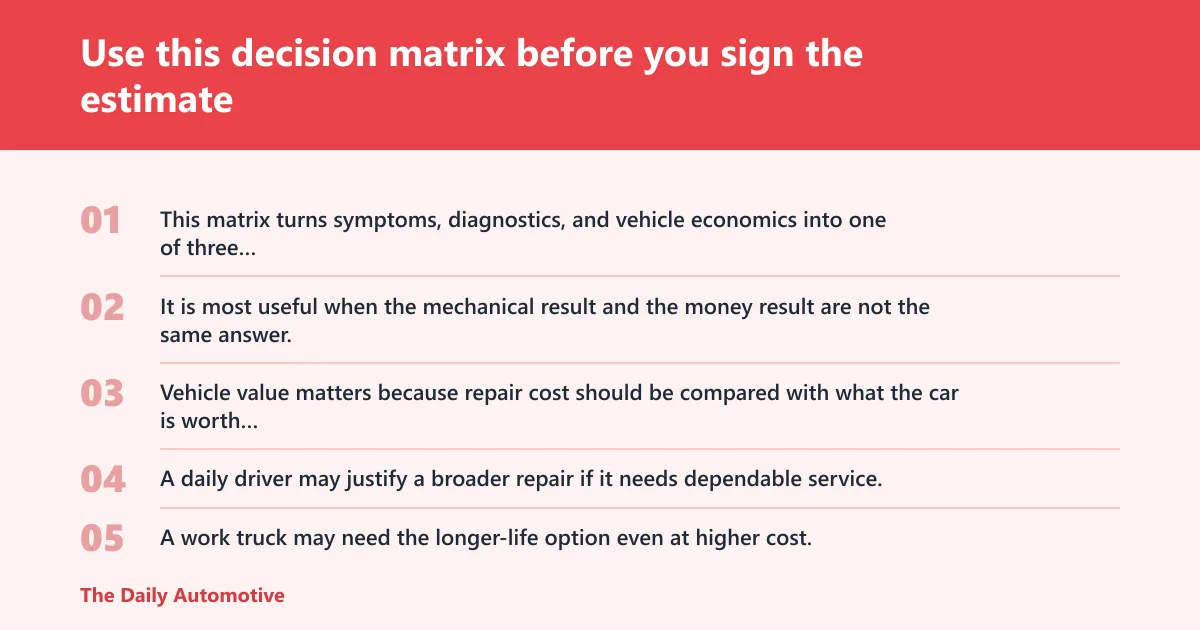
This matrix turns symptoms, diagnostics, and vehicle economics into one of three outcomes: top-end rebuild, full replacement, or walk away. It is most useful when the mechanical result and the money result are not the same answer.
| Symptom cluster / diagnostic result / vehicle factor | Top-end rebuild | Full replacement | Walk away |
|---|---|---|---|
| Warped head, bad head gasket, valve leakage, normal bottom-end checks | Yes | No | No |
| Scored cylinders, spun bearings, low oil pressure, metal in oil | No | Yes | Sometimes, if vehicle value is low |
| Cracked block, repeated overheating, or severe mixed failures | No | Maybe | Yes, if repair exceeds value |
| Engine code is rare, parts are scarce, or turnaround must be short | Maybe | Maybe | Possible if delay or sourcing risk is too high |
| Daily driver with moderate mileage and a realistic budget | Yes | Maybe | No |
| High-mileage car with worn internals, uncertain history, or low resale value | No | Yes | Maybe |
How to weigh value, use, mileage, budget, and availability
Vehicle value matters because repair cost should be compared with what the car is worth and how long you plan to keep it. A daily driver may justify a broader repair if it needs dependable service, while a high-mileage commuter with a low market value may not.
Intended use changes the answer too. A work truck may need the longer-life option even at higher cost, while a rare-classic car may justify a more expensive repair because originality and engine code matching matter.
Risk flags after the repair
Post-repair oil consumption, compression imbalance, and break-in procedure are all real concerns. A fresh engine or rebuilt top end still needs proper sealing checks, correct fluids, and a controlled break-in period before hard use.
Suppose a mid-size sedan shows one cylinder with low compression, a failed head gasket, and clean borescope images on the other cylinders. A top-end rebuild is usually the logical path. Suppose the same car also has bearing noise and metal in the oil; then the repair path changes immediately.
Choose Top-End Engine Rebuild if… / Choose Full Engine Replacement if…
Choose a top-end rebuild when diagnostics point to the cylinder head, valves, gasket, or timing area and the bottom end still checks out. Choose full engine replacement or full overhaul when the crankshaft, bearings, block, or cylinders are damaged, or when parts supply and engine code availability make a partial repair too risky.
Choose top-end engine rebuild if your case looks like this
Pick top-end work for a daily driver with medium mileage, a clear head-gasket or valve issue, and a budget that cannot stretch to a deeper overhaul. It also fits many cars where the engine’s lower end passes compression, leak-down, and borescope checks.
Choose full engine replacement if your case looks like this
Pick the broader repair when the vehicle is a high-mileage work truck, a performance car with deeper internal wear, or a rare model where the correct engine code can still be sourced. It is the safer choice when the damage includes bearings, crankshaft wear, or a cracked block.
Choose to walk away if the economics fail
Walk away when the repair bill is getting close to the car’s practical value, the engine parts are hard to source, or repeated overheating may have spread damage through the block and head. That decision can be painful, but it is often the cheapest path over the next 12 months.
Frequently asked questions
What is the difference between a top-end engine rebuild and a full engine replacement?
A top-end rebuild focuses on the upper engine: cylinder head, valves, head gasket, timing-related service, and sometimes pistons and rings if wear is still limited. A full engine replacement or overhaul goes deeper into the crankshaft, bearings, seals, block machining, and broader internal restoration.
When is a top-end rebuild enough instead of replacing the whole engine?
A top-end rebuild is enough when diagnostics show the problem is limited to head sealing, valve wear, or gasket failure and the lower end still passes inspection. If compression, leak-down, and borescope results do not show serious bottom-end damage, the smaller repair can be the right call.
How much does a top-end rebuild cost compared with an engine replacement?
The stated top overhaul cost range is RM 3,000 – 6,000, while the full overhaul cost range is RM 8,000 – 15,000. The wider repair costs more because it adds complete disassembly, machining, lower-end parts, and more reassembly and inspection time.
How long does a top-end rebuild take versus a full engine replacement?
The stated top overhaul time is 3-5 days, while the full overhaul time is 7-14 days. The longer schedule comes from teardown depth, machine-shop work, parts sourcing, and additional checks before the engine goes back into service.
What parts are included in a top-end rebuild?
Top-end rebuild work includes cylinder head removal and reconditioning, valve replacement and grinding, head gasket replacement, and often timing system service. In some cases, pistons and rings are added if compression or oil-control problems point to wear that is still repairable without full bottom-end work.
What signs mean I need a full engine replacement instead of a rebuild?
Scored cylinders, spun bearings, low oil pressure, metal in the oil, or a cracked block are strong signs that a full engine replacement or overhaul is needed. Those symptoms point to lower-end damage that a head-only repair cannot solve.
Is a rebuilt engine or replacement engine better for high-mileage cars?
For high-mileage cars, the better choice depends on where the wear lives and what the car is worth. If only the upper engine is damaged, a top-end rebuild can make sense; if the engine has widespread wear, a full overhaul is usually the more complete repair.
What diagnostic tests should a mechanic do before recommending rebuild or replacement?
Compression testing, leak-down testing, and borescope inspection should come first. Together they show whether the loss is coming from valves, head gasket, rings, cylinders, or deeper lower-end damage, which is the information needed before approving a major repair.
Products related to this article
Sponsored / affiliate links. As an Amazon Associate I earn from qualifying purchases. I may earn additional commission from eligible campaigns.