Best Tweeters for Car Audio: Top Picks & Where to Mount Them
The best tweeters for car audio are the ones you can mount high, aim correctly, and cross over around 2.5 to 5 kHz. Put location and crossover first, then buy the tweeter. Poor placement blurs vocals, shrinks the soundstage, and can make a good speaker sound harsh or thin. For many stock-power upgrades, the JBL GTO19T is a practical starting point because it adds mounting flexibility without requiring a separate amplifier.
Quick comparison
| Product | Badge | Best for | Price | ||
|---|---|---|---|---|---|
 |
TANVSO 1 Inch Car Tweeters 300W Peak, Silk Dome TweeterTANVSO | Our pick | 1 inch · 4 ohm · pair | $19.99
Price as of 30 Oct 2026
|
View |
 |
PIONEER TS-T110 7/8" Hard Dome Component Tweeters 120W MaxPIONEER | Also great | 7/8 inch · 4 ohm · pair | $48.26
Price as of 30 Oct 2026
|
View |
 |
KICKER 46KST2004 KS Series 3/4 Inch Silk Dome Car TweetersKICKER | Upgrade pick | 3/4 inch · silk dome · pair | $99.99
Price as of 30 Oct 2026
|
View |
 |
Rockford Fosgate PPROV2-BT Punch Pro Series 1" TweetersRockford Fosgate | Pair with it | 1 inch · 4 ohm · bullet | $169.99
Price as of 30 Oct 2026
|
View |
 |
Dayton Audio CF18N-4MP 3/4" Carbon Fiber Dome NeodymiumDayton Audio | Our pick | $59.98
Price as of 31 Oct 2026
|
View |
This quick view starts with fitment, because tweeters fail more often from bad placement than from bad branding. Use it to sort daily-driver clarity, OEM-style stealth, and loud SPL duty before you compare model names.
How we chose
This roundup uses manufacturer specs, product listing details, and published buyer feedback. The filter was simple: mounting options, crossover or protection details, power-source fit, and whether the tweeter style matches the cabin and listening goal.
Only the five listed models appear here. Each one gets a specific use case, plus one drawback to weigh before you buy.
Mounting matrix
| Goal | Tweeter type | Ideal mount | Likely failure mode | Protection needed | Tuning note |
|---|---|---|---|---|---|
| Daily-driver clarity | Silk dome | Sail panel or dash corner | Too much on-axis brightness from the A-pillar | Inline crossover or built-in high-pass network | Start around 3.5–4 kHz and trim level before EQ |
| OEM-retrofit stealth | Silk dome with flush or surface hardware | Factory location, sail panel, or dash corner | Soundstage stays low if mounted too far down | Built-in network or external crossover | Angle slightly off-axis to reduce glare |
| Loud bass-heavy system | Bullet or super tweeter | A-pillar or high custom pod | Sharp top end when fired straight at the listener | Inline crossover, attenuation, or DSP | Use 4–5 kHz high-pass and level match carefully |
| Front stage lift without custom work | Silk dome | Dash corner | Reflection off windshield can raise harshness | High-pass protection and careful aiming | Small angle changes often matter more than brand changes |
| High-output show or SPL use | Bullet / super tweeter | A-pillar or dedicated pod | Fatigue from excessive level or on-axis mounting | Higher-order crossover or DSP with attenuation | Do not chase output without checking cabin gain and level |
| Easy factory-style add-on | Silk dome | Flush or surface mount in stock-style spots | Mismatch with door woofer level if not padded down | Inline crossover and level matching | Choose the simplest mount that keeps the tweeter near ear height |
Should you choose silk dome or bullet tweeters?
Choose silk dome tweeters for most daily drivers, especially if you want smoother top end, wider off-axis dispersion, and less fatigue over long listening sessions. Choose bullet or super tweeters when the system needs higher output to cut through road noise, but expect a sharper sound if they are mounted straight at your face.
What daily drivers need
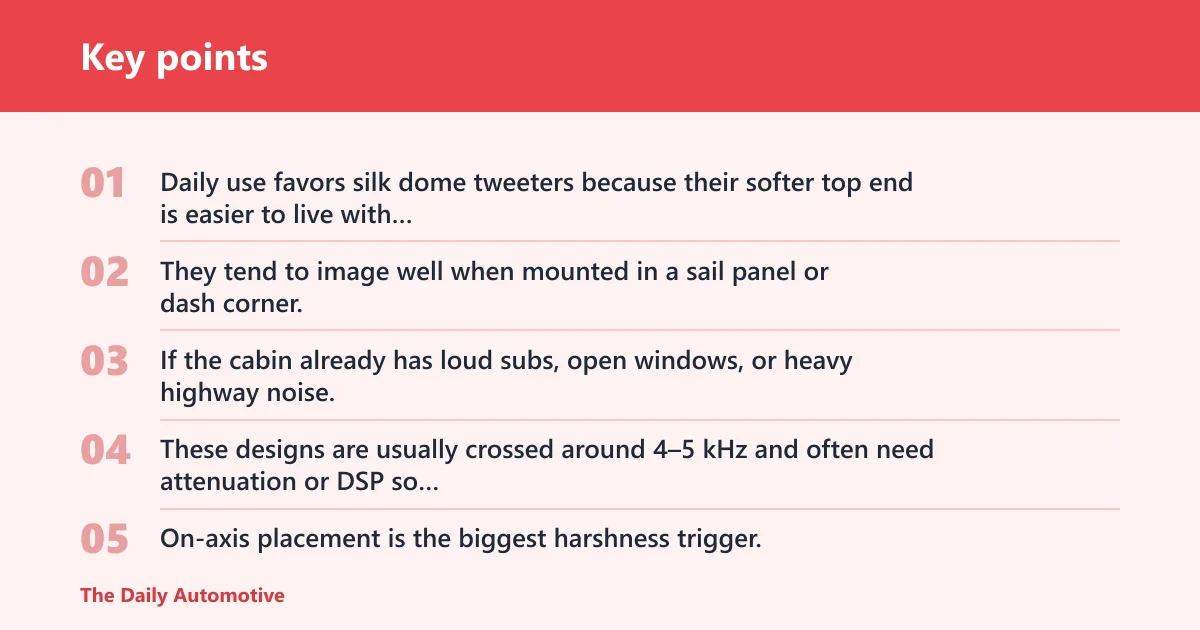
Daily use favors silk dome tweeters because their softer top end is easier to live with in reflective cabins. They tend to image well when mounted in a sail panel or dash corner, and they are usually crossed around 3.5–4 kHz, which leaves more room for the midrange to do its job.
What loud systems need
If the cabin already has loud subs, open windows, or heavy highway noise, a bullet or super tweeter can keep cymbals and vocals from disappearing. These designs are usually crossed around 4–5 kHz and often need attenuation or DSP so they do not sound shouty at the dash.
Where each style tends to sound harsh
On-axis placement is the biggest harshness trigger. A bullet tweeter mounted high in an A-pillar and aimed directly at the listener can sound hard fast, while a silk dome pointed into glass can still get bright if the cabin reflects too much top end back to the seats.
JBL GTO19T: best for factory power
The JBL GTO19T fits buyers who want an upgrade from stock tweeters without committing to a full amplifier setup. Its flush and surface mount cups, plus swivel adjustment, make it easier to place near factory spots where ear height and angle matter more than raw output.
This is a strong match for head-unit-powered systems because the install can stay simple while still improving staging. For a stock-power retrofit, check the manufacturer’s listing for your model and use the supplied crossover or protection path that comes with the kit.
One limitation is that flexible mounting does not remove the need for good aiming. If you point it straight at the listener in a bright cabin, the result can still turn sharp.
Alpine S-S10TW: best for external amplification
The Alpine S-S10TW is a better fit when the front stage is being run from an external amplifier and the goal is accuracy rather than brute output. CarAudioCalc says it is best for component system accuracy, which lines up with installs that reward careful alignment and level matching.
Precision aiming matters here because the payoff is imaging, not just volume. An A-pillar mount can work well if the pods are angled to keep the soundstage centered, while a dash corner can be kinder in cars that reflect a lot of high end off the windshield.
One limitation is that accuracy-focused tweeters expose upstream mistakes. A hot amp gain setting or poor crossover choice will still make them sound too forward.
Polk Audio DB1001: best for easy installs
The Polk Audio DB1001 suits OEM-style retrofit builds where the priority is flexible mounting and a straightforward wire path. Its marine-certified housing, flush, surface, and swivel install options, and simple two-wire hookup make it easier to place in factory-like locations without much fabrication.
That flexibility helps when you want better staging but do not want to build custom pods. Sail panels and dash corners are the first places to check, because they often deliver a better blend of staging and stealth than a low door location.
One limitation is that simple mounting can encourage quick placement decisions. Without level matching, even an easy install can end up too bright or too soft relative to the midrange.
Rockford Fosgate P1T-S: best for durability
The Rockford Fosgate P1T-S is the one to look at when heat, vibration, and long-term abuse matter more than cosmetics. The compact kit is aimed at durability-focused installs, and that makes sense in vehicles that see hard use, rough pavement, or frequent temperature swings.
Durability is most useful when the mounting position is exposed or the car sees heavy daily mileage. A-pillar pods and tighter dash-side spots should still be checked against the vehicle manual and the kit’s fitment notes before you cut anything.
One limitation is that a rugged tweeter is not automatically a forgiving tweeter. It still needs the right crossover and a mount that keeps it from firing straight at the listener.
Pioneer TS-T15: best for budget builds
The Pioneer TS-T15 is the budget choice here, and CarAudioCalc says it ships with its own inline crossover. That matters because budget systems still need protection, and the tweeter’s 0.75 in nominal size and soft dome design point it toward compact, easier installs rather than high-output duty.
It works best in a placement that keeps the sound high without getting too aggressive, such as a sail panel or dash corner. That keeps the tweeter useful for clarity while avoiding the most obvious on-axis glare.
One limitation is that budget does not mean carefree. Without the included crossover doing its job, a small tweeter can still be damaged or sound thin fast.
Which one should you buy?
Choose by cabin layout first. If your car already has a good high dash or sail panel location, a silk dome usually gives the easiest path to clean imaging. If the only viable spot is high and directly aimed, be more careful with level and crossover choice, because a good tweeter can still sound hard in a reflective cabin.
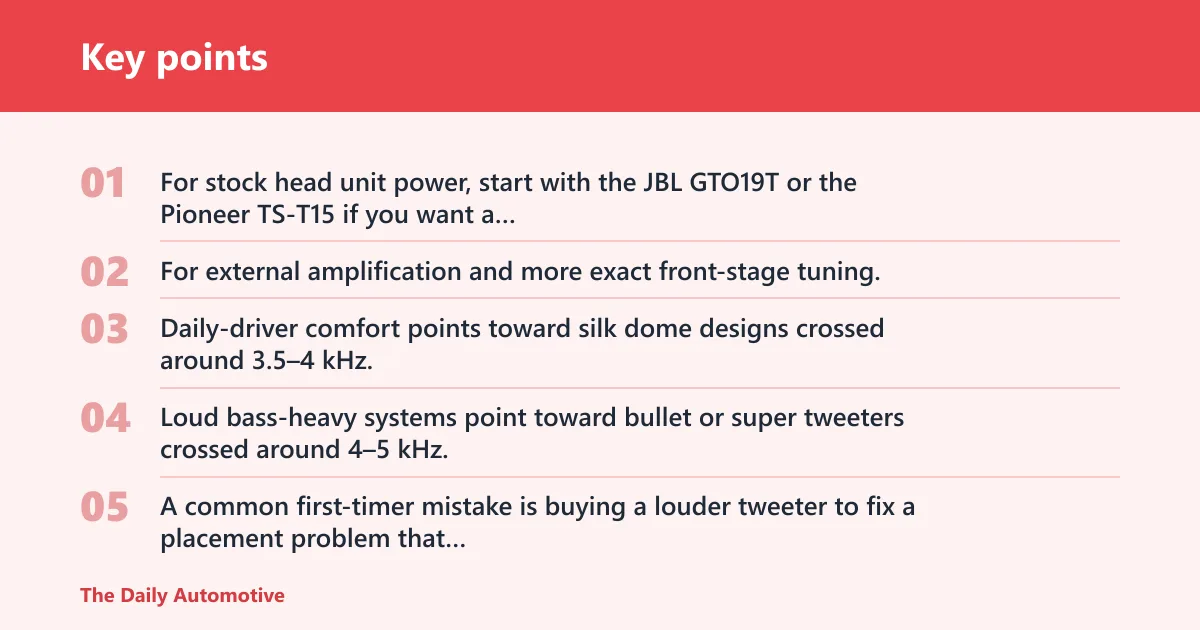
Choose by power source next. For stock head unit power, start with the JBL GTO19T or the Pioneer TS-T15 if you want a lower-cost path with protection built in. For external amplification and more exact front-stage tuning, the Alpine S-S10TW makes more sense, while the Polk Audio DB1001 is the easiest fit when you want flush, surface, or swivel options without much fabrication.
Choose by sound goal last. Daily-driver comfort points toward silk dome designs crossed around 3.5–4 kHz. Loud bass-heavy systems point toward bullet or super tweeters crossed around 4–5 kHz, with attenuation or DSP used if the top end runs hot. A common first-timer mistake is buying a louder tweeter to fix a placement problem that should have been solved with angle and crossover first.
Suppose your front doors already hold the midrange and you only have a sail panel opening left. A silk dome there will usually be easier to live with than a bullet tweeter mounted on the A-pillar, because the off-axis response is less likely to turn edgy when the cabin reflects high frequencies back to the seats.
Frequently asked questions
What are the best tweeters for car audio?
The best tweeters are the ones that fit your mount, power source, and sound goal. For most daily drivers, silk dome models are the safest starting point because they are smoother off-axis. For loud systems, bullet or super tweeters make more sense, but they need better protection and better aiming.
Where should tweeters be mounted in a car?
A-pillar, sail panel, and dash corner mounts are the main choices because they place the tweeter high enough to improve staging. A-pillar pods can help imaging when aimed well. Sail panels and dash corners often feel more OEM-like and can be less harsh than a hard on-axis mount.
What crossover point should I use for car tweeters?
Silk dome tweeters are usually crossed around 3.5–4 kHz, while bullet or super tweeters are usually crossed around 4–5 kHz, unless the manufacturer says otherwise. The exact setting depends on the driver, the slope, and the rest of the system. Too low a crossover is a common cause of damage and harshness.
Can tweeters work on stock head unit power?
Yes, some can. The key is whether the product listing says it is ready for factory power or includes the right protection. If you are staying on a stock head unit, prioritize efficient tweeters with an inline crossover or built-in network so the tweeter does not see bass it cannot handle.
How do I stop tweeters from sounding harsh?
Start with placement, not EQ. Move the tweeter off-axis, lower the level if needed, and make sure the crossover point is not too low. In reflective cabins, a small angle change or a dash-corner mount can soften the top end more effectively than buying a different tweeter.
Do tweeters need crossovers or protection?
Yes. Tweeters need a high-pass filter, whether that comes from an inline crossover, a built-in network, or DSP. Protection keeps bass energy out of the tweeter and helps reliability. A slope in dB/oct matters because it determines how much unwanted low-frequency energy the tweeter still sees.
What is the easiest tweeter to install in factory locations?
Look for a kit with flush and surface mounting options, swivel adjustment, and a simple wiring path. The JBL GTO19T and Polk Audio DB1001 are the kind of designs that fit that brief well. If fitment details are not listed for your vehicle, check the manufacturer’s listing for your model.
Products related to this article
Sponsored / affiliate links. As an Amazon Associate I earn from qualifying purchases. I may earn additional commission from eligible campaigns.