Vehicle Impound Cost: How Much to Get It Out?
A typical impound release often runs about $200 to $1,000+ in tow, storage, and fees. If the bill is higher than the car’s private-party value minus repair and title costs, paying usually makes no financial sense. Every day adds storage charges, and unpaid fees can also lead to auction loss or a lien. This guide breaks down the fee stack, common state and lot charges, and a simple break-even check before you pay.
What an impound bill includes
An impound bill usually combines a tow fee, daily storage, a release or administrative fee, and any tickets, tolls, or citations tied to the tow. Some lots also require payment in certified funds, and many will not release the car until the paperwork is complete. Ask for an itemized invoice before you pay.
Tow fee
The tow fee is the one-time removal charge. In the U.S., it typically runs from $75 to $350, depending on vehicle size, tow distance, and local rules. It is often non-negotiable after the tow happens, especially for police impounds or required removals.
Daily storage fee
Storage is the charge that grows by the day after impoundment. Typical U.S. storage runs from $20 to $75 per day, and it may start immediately or after a short grace period. This is the part that makes a bill jump fast if you wait.
Release fee
The release fee covers paperwork, processing, and handling at the lot. It commonly falls around $25 to $350, although some city or state schedules may list higher fixed amounts. This fee is usually required before pickup and is often not waived unless there is a billing error or a formal hardship rule.
Fines and citations tied to the tow
Outstanding fines can add about $0 to $500+ if the tow came from unpaid parking tickets, tolls, code violations, or citations. In many cases, those balances must be paid before release. This is one reason the impound total can be much higher than the lot’s posted tow and storage rates.
How much does impound cost by day?
By day 1, a first-visit impound bill often lands inside the $150 to $800 range, but that total can climb quickly if the lot charges storage from the tow time. By day 7, the same car can be several hundred dollars higher. By day 14, the total can exceed $1,000 if storage and release charges stack up.
Day 1 total
On day 1, the bill usually includes tow, release, and possibly one day of storage. If the lot starts storage immediately, the first-day total can already feel close to the higher end of the usual first-visit range. If there are unpaid tickets attached, the total moves higher.
Day 3 total
By day 3, storage has had time to add a meaningful amount. In places with a grace period, the total may still be close to the base tow and release charges. In places without one, three days of storage can materially change the number you owe at pickup.
Day 7 total
By day 7, storage often becomes the main swing factor. A vehicle with modest towing and release charges can still become expensive if the daily rate is at the higher end of the local schedule. This is where the cost begins to rival the value of older cars.
Day 14 total
By day 14, the bill can exceed $1,000 if the car sits for two weeks. That is why the right comparison is not the tow fee alone. Compare the full bill, including storage and any citation balance, against the car’s actual sale value and the cost to make it road legal again.
Impound cost calculator
Use this table to estimate the total bill before you go to the lot. The break-even column compares the impound cost against an estimated vehicle value, so you can decide whether reclaiming the car still makes sense.
| Scenario | Tow fee | Storage accrual | Release fee | Total bill | Break-even versus vehicle value |
|---|---|---|---|---|---|
| Day 1 | $200 | $25 | $75 | $300 | Worth reclaiming if the car is clearly worth more than $300 after repair and title costs |
| Day 3 | $200 | $75 | $75 | $350 | Worth reclaiming if the car’s practical value is above $350 |
| Day 7 | $200 | $175 | $75 | $450 | Dispute or repair only if the car still has value above $450 and can be driven legally afterward |
| Day 14 | $200 | $350 | $75 | $625 | Walk away if the car is worth less than $625, or less than the bill plus repairs and title work |
These figures are a decision aid, not a lot quote. The tow fee, storage, and release line items can be lower or higher depending on local caps, vehicle type, and whether a citation balance is attached.
What changes the final price?
Local rules matter as much as the lot’s posted schedule. City, county, and state caps can limit what a lot may charge, but caps vary widely and are not uniform across the U.S. Vehicle size, tow distance, and after-hours release rules also move the total. Police impounds, private-property tows, accident tows, and abandoned-vehicle cases can follow different fee and release rules.
City, county, and state caps
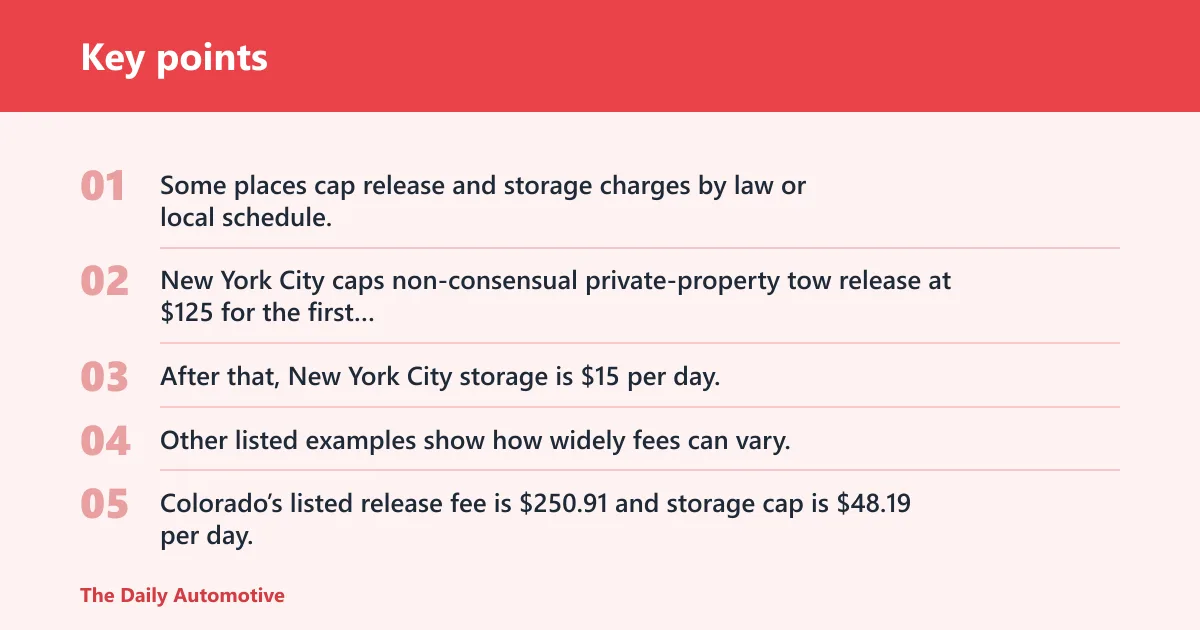
Some places cap release and storage charges by law or local schedule, while others let operators file rates within a set process. New York City caps non-consensual private-property tow release at $125 for the first three days, and that $125 covers removal plus the first three days of storage. After that, New York City storage is $15 per day.
Other listed examples show how widely fees can vary. Colorado’s listed release fee is $250.91 and storage cap is $48.19 per day. Texas’s listed release fee is $272 and storage cap is $22.85 per day. Ohio’s listed release fee is $144 and storage cap is $17 per day. Florida is shown as local-rule based, with fees set by county.
Vehicle size and tow distance
Large SUVs, low-clearance cars, and heavy vehicles can cost more to tow. A longer tow or a winch-out usually raises the price. If the lot had to recover the car from a difficult spot, the tow fee may land near the top of the local range rather than the bottom.
After-hours release rules
Some lots only release cars during posted business hours, and some charge extra for after-hours pickup. Others require cash, card, or certified funds, and they may refuse a release if the required person is not present. That can add another day of storage if you miss the pickup window.
Private tow versus police impound
A private-property tow often follows a different fee schedule from a police impound or an accident tow. Police impounds can involve citations, hold notices, or seizure paperwork. Private lots may have faster release once you prove ownership and pay. Accident tows may also involve insurer or lienholder paperwork before release.
What do you need to release the car?
Most lots ask for photo ID, proof of ownership, and sometimes proof of insurance before release. An itemized invoice matters because it lets you check whether the tow, storage, release, and fine charges match the posted rates or local cap. Missing paperwork can stop pickup even after payment.
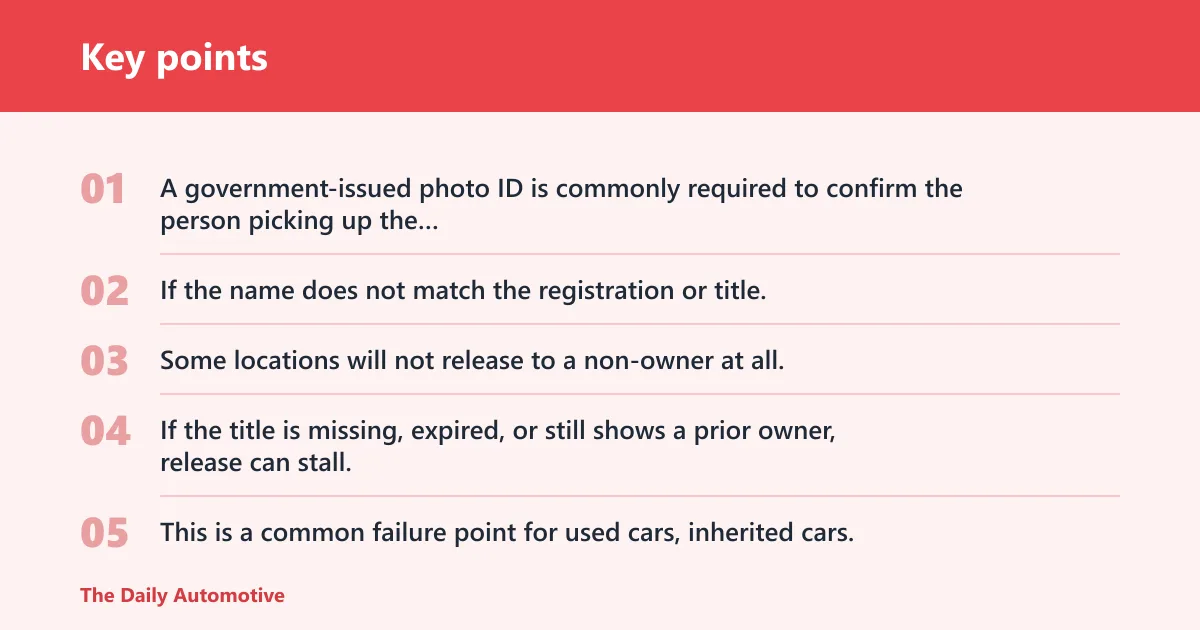
Photo ID
A government-issued photo ID is commonly required to confirm the person picking up the vehicle. If the name does not match the registration or title, the lot may refuse release unless there is extra authorization. Some locations will not release to a non-owner at all.
Proof of ownership
Title or registration is commonly required. If the title is missing, expired, or still shows a prior owner, release can stall. This is a common failure point for used cars, inherited cars, and recently purchased cars that have not been retitled yet.
Proof of insurance
Some lots require current proof of insurance before the car leaves the yard. If coverage lapsed, pickup can be blocked until a new policy is active, and in some cases an SR-22 may be needed. A car may be paid for but still not releasable without current coverage.
Itemized invoice
Ask for an itemized invoice before you pay. It should break out the tow, storage, release, and any citation or ticket balance. If the bill does not separate those items, disputes are harder. It also becomes difficult to tell whether a fee is fixed, capped, or improperly added.
Say your compact sedan was towed from a lot near an apartment building after a parking rule violation. If the car is worth about $700 on the private market, a $450 bill may still make sense only if the car is otherwise sound and you can title it, insure it, and drive it immediately. Add repair work, and the decision changes fast.
Suppose a full-size SUV is in a police impound, but the title is still in a former owner’s name and the insurance has lapsed. Even if the bill is only moderate, the car may not be releasable until the ownership paper trail and insurance status are fixed. Payment alone may not solve the problem.
Can insurance pay the impound bill?
Sometimes, but not always. Auto insurance may help with towing under specific policy terms, and some roadside plans cover a tow to a repair shop. Impound storage, release fees, and ticket balances are often excluded. If the claim is approved, the insurer may reimburse only part of the total.
When coverage may apply
Coverage is more likely if the tow followed a covered loss, such as an accident, theft recovery, or breakdown that triggers towing benefits. Some policies or roadside programs pay a set tow amount. If the impound happened after a crash, ask whether towing, storage, or salvage handling is covered separately.
When it usually will not
Coverage often does not apply to parking violations, expired registration, unpaid tickets, or many private-property tows. Storage and release charges are especially likely to be excluded. If the car was impounded because insurance lapsed, the insurer may also refuse payment for the impound itself.
What to confirm with your insurer
Ask whether the policy covers towing only, towing plus storage, or none of the impound bill. Confirm whether the car must be repaired at a network shop, whether reimbursement is capped, and whether the claim must be filed before pickup. If the policy has ended, a new policy or SR-22 may be needed before release.
Should you reclaim, dispute, or walk away?
Start with a simple rule: reclaim the car if the total cost is below its practical value and the car is worth repairing. Dispute the bill if the charges do not match the invoice, the cap, or the posted rate schedule. Walk away if the bill is higher than the car’s value or if paperwork makes release impossible.
When the bill is below vehicle value
If the car’s private-party value is clearly higher than the full impound bill, and the car is otherwise worth keeping, paying is usually the best move. Add repair costs, title transfer cost, and any missed registration or insurance expense before deciding. A low impound bill can still become a bad deal if the car needs major work.
When the car is worth less than the bill
If the total bill exceeds what the car could reasonably sell for, reclaiming it may not make financial sense. This is especially true for older cars, cars with engine or transmission issues, or cars that cannot pass inspection without major spending. A two-week impound can push even a cheap car past its value.
When to ask for a waiver or correction
Ask for a correction if the invoice has duplicate charges, the lot billed storage before it was allowed, or the release fee exceeds the local schedule. Hardship waivers, fee reductions, or dispute processes exist in some places, but they are not guaranteed. Get everything in writing and keep the invoice, photos, and any citation paperwork.
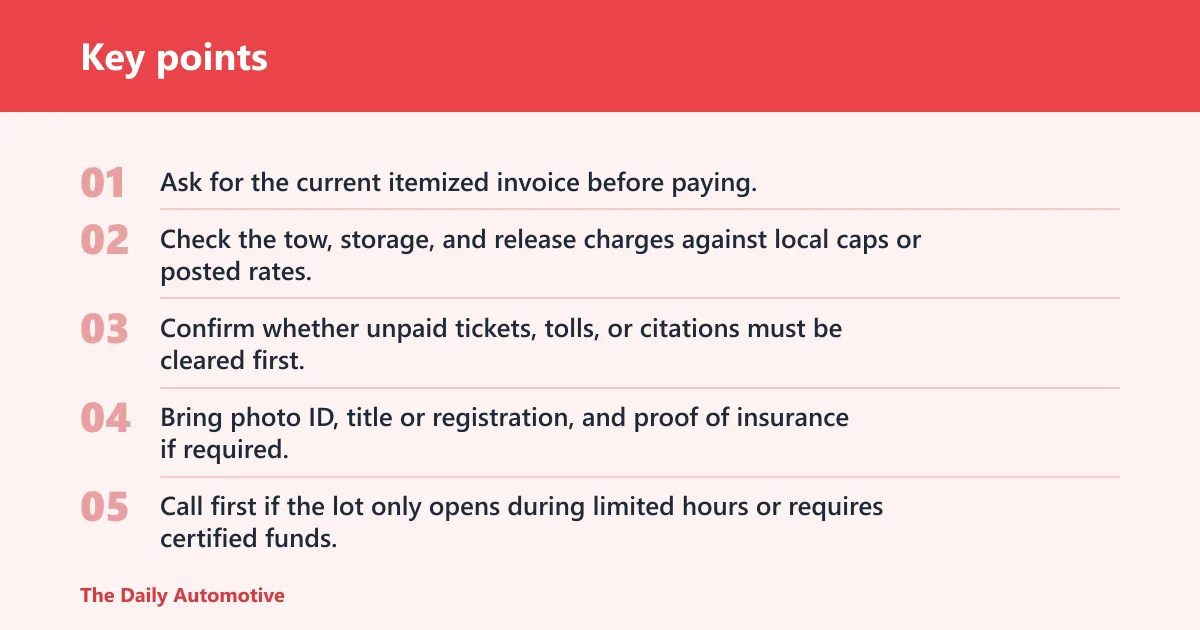
- Ask for the current itemized invoice before paying.
- Check the tow, storage, and release charges against local caps or posted rates.
- Confirm whether unpaid tickets, tolls, or citations must be cleared first.
- Bring photo ID, title or registration, and proof of insurance if required.
- Call first if the lot only opens during limited hours or requires certified funds.
- Compare the full bill with the vehicle’s practical value before you authorize release.
Frequently asked questions
How much is an impound fee?
An impound fee usually combines towing, storage, and release charges, so the total matters more than one line item. Tickets or citations can add more.
How much do impound lots charge?
Impound lots commonly charge a tow fee of $75 to $350, storage of $20 to $75 per day, and a release fee of $50 to $350. The exact number depends on the city, county, state, vehicle type, and whether the car was held for police, private-property, or accident reasons.
How much is impound fee per day?
Daily storage commonly runs from $20 to $75 per day, though some places cap it lower or higher. In New York City, storage after the first three days is $15 per day. The lot may start charging on day one or after a short grace period.
How much is impound per day?
If you mean storage, the daily charge is usually the same number that drives the bill upward each day. Typical storage ranges from $20 to $75 per day, but local caps can differ sharply. The total also keeps rising if the release fee or tickets are still unpaid.
Does car insurance pay for impound fees?
Sometimes it pays only part of the bill. Towing may be covered under roadside assistance or a collision claim, but storage, release fees, and citation balances are often excluded. If coverage lapsed, many insurers will not pay the impound bill at all, even if the car itself is insured later.
How much does an impounded car cost?
An impounded car often costs the tow fee, several days of storage, a release fee, and possibly tickets or fines before it can leave the lot. A day-1 total may be a few hundred dollars, while a two-week bill can exceed $1,000. That is why the car’s value matters.
Products related to this article
Sponsored / affiliate links. As an Amazon Associate I earn from qualifying purchases. I may earn additional commission from eligible campaigns.