Vinyl Restorer for Cars: Matte Fix for Faded Trim
For faded black plastic and vinyl trim, start with a water-based matte restorer if the surface is chalky or lightly gray; move to a dye-type trim coating only when the plastic is badly bleached, porous, or patchy, and avoid high-gloss dressings if you want OEM-sheen. Pick the wrong product and you get streaks, greasy dirt pickup, or a shiny finish that makes the trim look newer in the wrong way. This guide shows how to match product type to trim condition, finish goal, and application risk so you can restore faded trim without gloss or blotching.
What faded trim is telling you


Faded trim usually means UV exposure, heat, and repeated washing have stripped color from the surface or left residue on top of it. The real question is simple: is the material still sound, chalky at the surface, or porous enough that a dressing will sit unevenly?
Why black plastic turns gray or chalky
Exterior trim takes sun, rain, salt, detergents, and airborne contamination. Over time, the top layer oxidizes, the surface loses its deep black tone, and the trim may start to look gray, dry, or uneven in patches.
That matters because the finish outcome depends on what the surface can accept. A trim restorer can darken faded plastic, vinyl, or rubber, but it cannot always hide damage that has already moved below the top layer.
What matte, satin, and glossy outcomes mean
True matte is the closest match to OEM-style trim. It looks dry, dark, and non-greasy. Satin can still work on some exterior pieces, but glossy formulas usually read oily on black cladding, mirror housings, and window trim.
That is why finish chemistry matters as much as color. A product can restore black trim and still miss the target if it leaves a wet sheen that catches light in the wrong way.
Likely causes of trim failure
Most trim fade starts with UV and heat. Road grime, detergents, and old dressings often make it worse by leaving residue that blocks even absorption. Less commonly, the trim itself is already porous or heavily oxidized, which is why a simple wipe-on restorer can look blotchy.
- UV exposure and heat damage: the main driver of gray, chalky trim.
- Road salt and detergents: they strip protection and leave residue behind.
- Oxidation and porosity: they cause uneven darkening and fast failure.
Which restorer fits your trim?
The right choice depends on condition first, then finish target, then environment. A black plastic trim restorer is usually the best fit for faded exterior trim that still has a sound surface. General vinyl trim formulas make more sense when you are dealing with vinyl or mixed interior-exterior surfaces and need a softer, non-greasy result.
Faded-but-intact trim
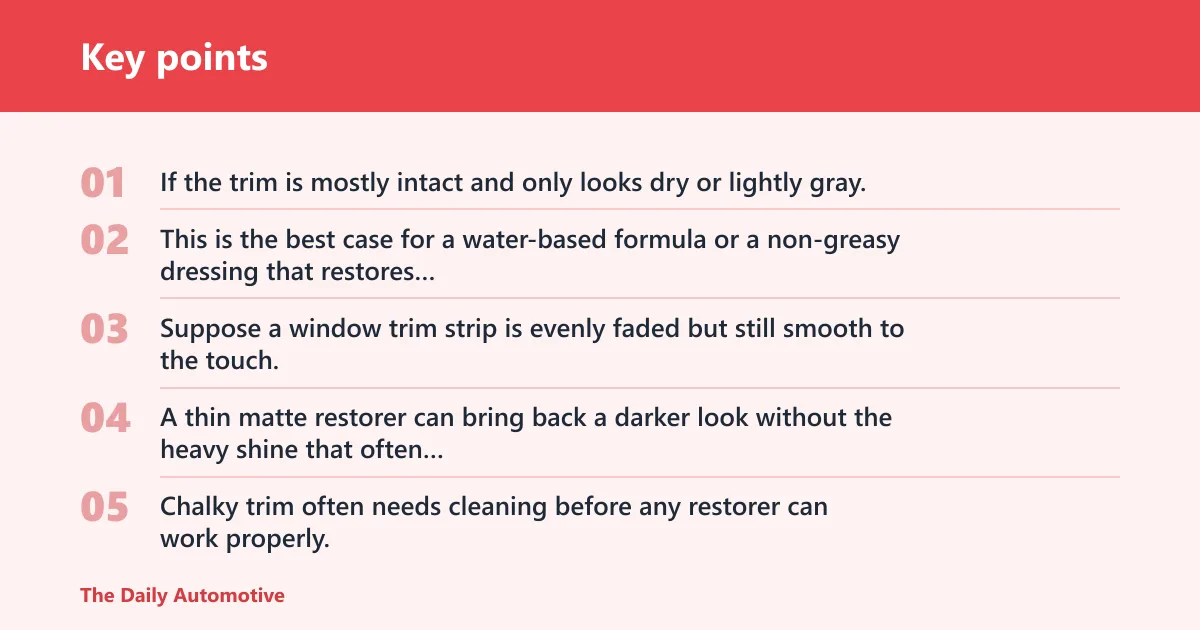
If the trim is mostly intact and only looks dry or lightly gray, a matte or satin restorer is usually enough. This is the best case for a water-based formula or a non-greasy dressing that restores color without making the part look freshly oiled.
Suppose a window trim strip is evenly faded but still smooth to the touch. A thin matte restorer can bring back a darker look without the heavy shine that often telegraphs a quick fix.
Chalky or oxidized trim
Chalky trim often needs cleaning before any restorer can work properly. If the product darkens the part for a day but fades back after the first wash, the surface likely needed de-oxidizing first. Dye-infused formulas are more appropriate here because they penetrate deeper than a surface dressing.
Porous or weathered trim
When the trim is porous, patchy, or unevenly weathered, regular dressings can blotch. This is where a dye-infused formula or ceramic trim coating starts to make more sense, because the goal shifts from temporary color boost to a more durable reset.
Picture a textured lower cladding panel on a truck that has gone gray in patches. A regular matte restorer may darken the high spots and leave the low spots dull, which is why porous trim often needs a stronger chemistry than intact trim.
Interior touchpoints versus exterior cladding
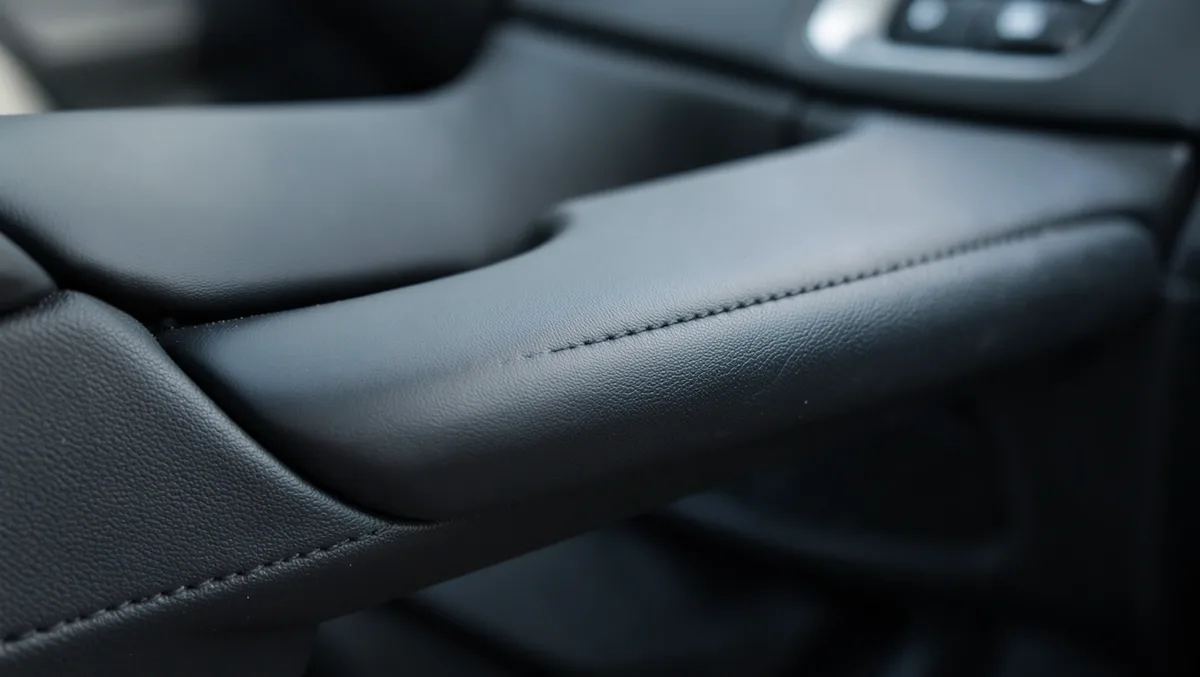
Interior trim needs a dry, non-greasy finish. Touchpoints such as door pulls, dash trim, and steering-column surrounds should not feel slick. Exterior trim needs weather resistance, UV protection, and a finish that can shrug off rain streaks and repeated washing.
That means the same product is not always the right answer inside and outside. A formula that looks fine on a bumper may feel oily on an interior handle.
Use this trim restorer matrix
This matrix ranks trim-restorer choice by condition, finish target, and environment. It is built for readers who want a matte OEM-style result, not a shiny dressing that only looks dark in the driveway.
| Trim condition | Desired finish | Environment | Best fit | Why it wins |
|---|---|---|---|---|
| Faded-but-intact | Matte | Mixed daily-driver use | Water-based matte restorer | Best for even color with low shine |
| Faded-but-intact | Satin | Garage-kept or light rain | Non-greasy trim dressing | Acceptable if you want slight sheen |
| Chalky or oxidized | Matte | Harsh sun and frequent washing | Dye-infused formula | Better chance of deeper color reset |
| Porous or weathered | Matte | Outdoor parking year-round | Ceramic trim coating | Higher-durability category |
| Interior touchpoints | Dry, non-greasy | Cabin contact surfaces | Vinyl trim formula | Safer for hands and repeated contact |
| Exterior cladding | Matte | Sun, rain, salt | Black plastic trim restorer | Built for exposed plastic surfaces |
Cost per application by vehicle size
Cost depends on bottle size, coverage, and how much trim you are restoring. A small car may use only a fraction of a bottle, while a truck can push a product from “several applications” into “one or two full jobs.”
| Product size | Assumed usable coverage | Small car | SUV | Truck |
|---|---|---|---|---|
| 2 oz | One compact trim job | 1 application | 1 application | Partial application |
| 8 oz | 4 medium applications | About 0.25 bottle | About 0.5 bottle | About 0.75 bottle |
| 8.4 fl. oz. | 4 medium applications | About 0.25 bottle | About 0.5 bottle | About 0.75 bottle |
| 10 fl oz | 5 medium applications | About 0.2 bottle | About 0.4 bottle | About 0.6 bottle |
| 12 oz | 6 medium applications | About 0.17 bottle | About 0.33 bottle | About 0.5 bottle |
That math matters because bottle size changes real value. Solution Finish is sold in a 2 oz size, CAR GUYS Plastic Restorer is sold as an 8 oz kit, Carfidant’s restorer is listed at 8.4 fl. oz., Turtle Wax sells a Hybrid Solutions Graphene Acrylic Trim Restorer in 10 fl oz, and Meguiar’s Ultimate Black Plastic Restorer comes in a 12 oz bottle.
How do you prep trim before applying it?
Prep is the difference between a clean matte reset and a streaky, patchy result. Wash off dirt first, remove old dressing or wax residue, and let the trim dry fully. If the surface is still contaminated, even a good restorer can leave blotches or a temporary dark patch.
Wash and decontaminate the surface
- Wash the trim with car shampoo and water.
- Rinse thoroughly so detergents do not stay behind.
- Dry the panel with a clean microfiber towel.
Remove old dressing or wax residue
- Wipe the trim with a residue-safe cleaner on a microfiber towel.
- Repeat on edges and textured areas where old product hides.
- Inspect for slick spots before applying restorer.
Dry fully before application
- Wait until the surface is completely dry.
- Check seams, lower edges, and mirror housings for trapped water.
- Apply only when the panel no longer feels cool or damp.
Apply it without streaks or shine
Streaks and shine usually come from using too much product or spreading it unevenly. Thin coats, careful edge control, and a foam applicator help keep the finish close to matte. That is especially important on textured plastic, where excess product can pool and dry unevenly.
Use a foam applicator for control
A foam applicator helps spread the product in a thin, even layer and keeps it off adjacent paint. Many kits include one for that reason. It is especially useful on grille trim, bumper corners, and mirror caps where edges are tight.
Work in thin coats
One light coat is safer than one heavy one. Thick application raises the odds of residue, shine, and dirt pickup. If the trim is badly faded, it is better to use two controlled passes than to flood the surface once.
Wipe edges before the product sets
Trim edges often catch excess product first. Wipe the borders while the formula is still workable so the panel line stays crisp. That step matters most on matte finishes, where a glossy edge can make the whole piece look uneven.
Why didn’t the finish hold?
If the trim looks good for a day and then fades, streaks, or turns patchy after washing, the issue is usually surface condition, product chemistry, or environment. The fastest thing to try first is a full clean-and-reapply cycle on a dry panel with a thinner coat.
The trim was too oxidized
Heavy oxidation can make a restorer look temporary because the surface is still shedding chalky residue. In that case, the product darkens what is on top, but not what is underneath.
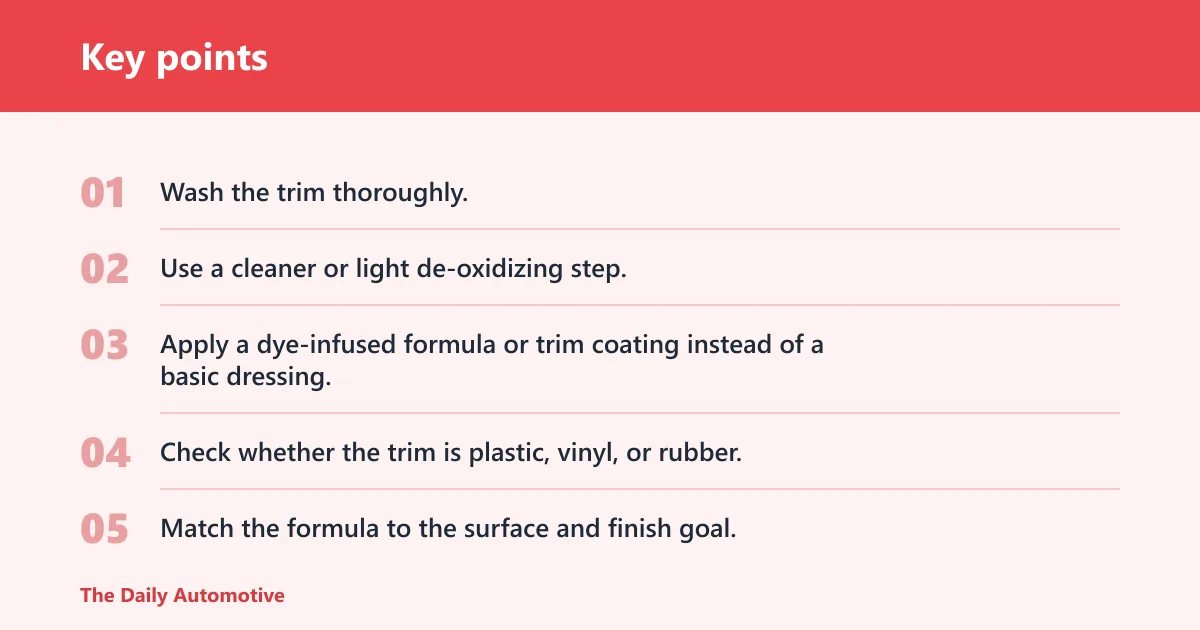
- Wash the trim thoroughly.
- Use a cleaner or light de-oxidizing step.
- Apply a dye-infused formula or trim coating instead of a basic dressing.
The product chemistry did not match the surface
Some formulas are surface dressings, while others penetrate deeper. A glossy or oily product may look dark but miss the OEM goal. A dye-infused formula is often the better match for badly bleached plastic, while a basic restorer suits intact trim.
- Check whether the trim is plastic, vinyl, or rubber.
- Match the formula to the surface and finish goal.
- Switch from dressing to dye-type chemistry if color keeps washing off.
The environment was too harsh for the formula
Harsh sun, frequent rain, road salt, and repeated washing shorten lifespan. Standard trim restorer products can last 4-8 weeks, while ExoForma claims 6+ months and Car Fluid Finder lists ExoForma as 6+ month durability. Car Fluid Finder also says CERAKOTE can last 200+ washes, which places ceramic trim coating in a higher-durability category.
- Move to a ceramic trim coating for exposed exterior trim.
- Choose a water-repellent finish for better rain resistance.
- Reapply sooner on daily drivers and sun-baked vehicles.
CAR GUYS Plastic Restorer is described as drying dry-to-the-touch for months, water-repellent, and a clean, non-greasy finish. Solution Finish is described as having no wet look. Those details matter because they separate a matte result from a shiny one.
Prevention note: keep exterior trim clean and free of old dressing residue before each new application. That single step lowers the odds of streaking and blotching on the next round.
Frequently asked questions
What is the best vinyl restorer for faded car trim?
The best choice generally depends on the trim’s condition. Use a matte restorer for lightly faded, intact surfaces; move to a dye-infused formula for badly bleached plastic; and choose a ceramic trim coating if you want longer wear on exposed exterior trim. A single product is rarely best for every panel.
Will a vinyl restorer make trim matte instead of shiny?
Only if the chemistry is built for it. A matte or dry-to-the-touch formula can stay close to OEM appearance, while satin and gloss products will read shinier on black trim. Solution Finish is described as having no wet look, which is the kind of result to look for on exterior trim.
How long does trim restorer last on cars?
Longevity depends on sun, wash frequency, and the product type. Turtle Wax says standard trim restorer products can last 4-8 weeks. ExoForma claims 6+ months, and Car Fluid Finder lists CERAKOTE at 200+ washes. Harsh-sun parking will shorten every one of those numbers.
Can I use vinyl restorer on plastic, rubber, and vinyl?
Many multi-surface formulas are made for all three, but always check the label first. Black plastic trim restorer products often list plastic, vinyl, and rubber compatibility, yet interior touchpoints still need a non-greasy finish. Use the driest formula that still restores the color you want.
How do I avoid a greasy or streaky finish?
Clean the trim thoroughly, let it dry, and apply a thin coat with a foam applicator. Wipe edges before the product sets. CAR GUYS Plastic Restorer is described as dry-to-the-touch and non-greasy, which is the finish profile that helps prevent dirt pickup on both interior and exterior trim.
How much does it cost to restore faded trim myself?
It often comes down to bottle size and how much trim you are doing. A 2 oz bottle may cover one compact job, while about 8 oz to 12 oz sizes can make more sense for SUVs and trucks. A full-vehicle exterior trim refresh can use roughly a third to half of a larger bottle.
Does trim restorer work on interior and exterior surfaces?
Yes, but not equally well for the same goal. Interior trim needs a dry, non-greasy finish for touchpoints. Exterior cladding, mirrors, and window trim need UV protection, weather resistance, and sometimes a water-repellent finish so the result survives rain and washing.
What causes black trim to fade and turn chalky?
UV exposure is the main reason, with heat, detergents, road grime, and salt adding more damage. Those conditions strip color from plastic, vinyl, and rubber and can leave the surface oxidized or porous. Once that happens, a surface dressing may only darken it temporarily.
Is a ceramic trim restorer better than a regular restorer?
It is better when durability matters more than quick appearance. Ceramic trim coating sits in a higher-durability category and is often sold as pre-saturated wipes or coating kits. If the trim is only lightly faded, a regular matte restorer is simpler and often enough.
Products related to this article
Sponsored / affiliate links. As an Amazon Associate I earn from qualifying purchases. I may earn additional commission from eligible campaigns.