Daihatsu Terios Interior Care Easy Mini Guide
Clean a Daihatsu Terios cabin in about 10 to 60 minutes by starting with dust, touch points, and floor mats; use the longer end only for seats, plastics, and stain work. Use the wrong cleaner or too much water, and you can stain fabric, haze trim, or trigger squeaks and sticky switches. This guide breaks the Terios cabin down by surface and time so you know what to do first, what to leave alone, and where owners usually slip up.
Start with loose dirt. Vacuum first, then dry dust, then wet clean. Glass comes after the grit is gone. Odor work comes last, once the cabin is clean and dry.
Terios cabin quick clean


10-minute reset
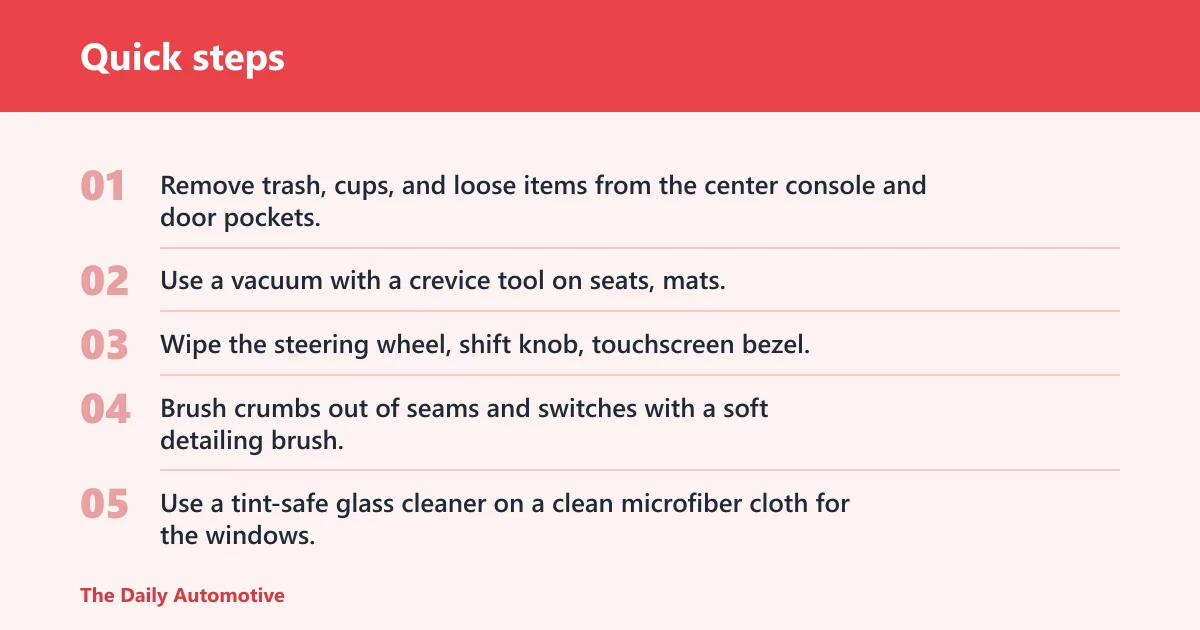
- Remove trash, cups, and loose items from the center console and door pockets.
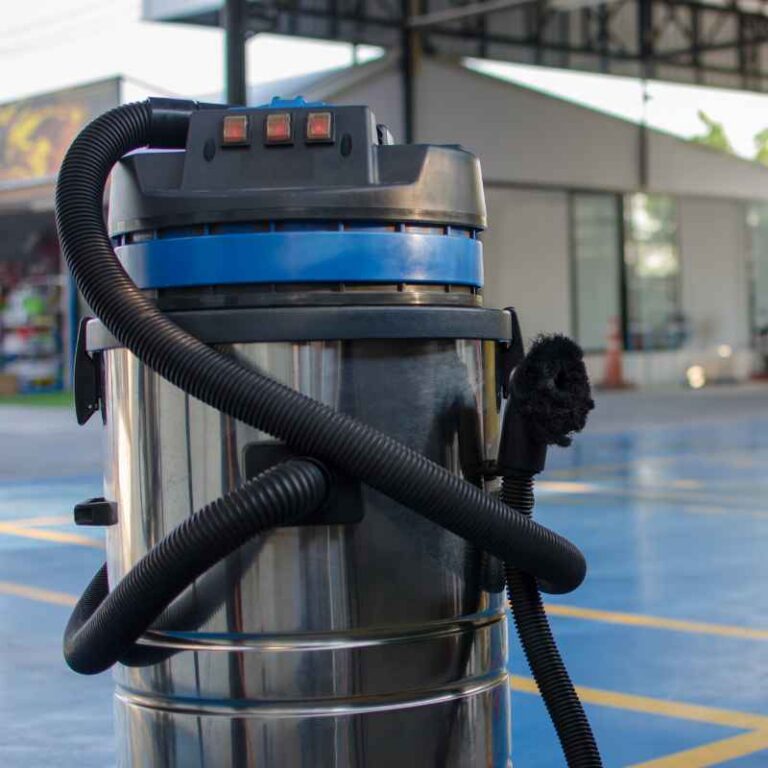
- Use a vacuum with a crevice tool on seats, mats, and the gaps around the shifter and seat rails.
- Wipe the steering wheel, shift knob, touchscreen bezel, and door pull with a microfiber cloth lightly dampened with a pH-neutral interior cleaner.
- Brush crumbs out of seams and switches with a soft detailing brush.
- Use a tint-safe glass cleaner on a clean microfiber cloth for the windows.
30-minute clean
- Do the 10-minute reset first.
- Pull out the mats and clean both sides.
- Clean the seats by material: cloth, leatherette, or leather.
- Wipe door cards, dash top, and the center console in small sections.
- Let the cabin dry with the doors open before you shut it up.
60-minute deep clean
- Do the 30-minute clean first.
- Treat stains on cloth or lower trim with the right product and as little moisture as practical.
- Clean piano-black trim with very light pressure and a soft microfiber only.
- Check vents, seat seams, storage bins, and switch edges with a brush and cotton swabs.
- Inspect for odor sources, then address wet mats, the cabin filter, and lingering dampness.
Say your Terios has wet floor mats after a rainstorm. Pull them out first, dry the carpet underneath, and only then clean the rest of the cabin. If you wipe the dash before dealing with the wet mats, you can trap humidity inside and chase the smell for days.
Terios interior care matrix
The Terios cabin usually mixes several surfaces that need different care. Material and switchgear can vary by market and generation, so check the owner’s manual for your trim before using a cleaner on leather, leatherette, or soft-touch panels.
| Cabin area | Safest cleaning tool | Recommended product type | Risk to avoid | Cleaning frequency |
|---|---|---|---|---|
| Seats | Microfiber cloth, soft interior brush, vacuum with crevice tool | pH-neutral interior cleaner; leather conditioner only if the seat is leather | Soaking cloth seats, using strong APC on leather, scrubbing stitching | Weekly wipe-down, monthly deep clean |
| Dash top | Microfiber cloth | pH-neutral interior cleaner | Over-spraying onto screens, vents, or buttons | Weekly |
| Door cards | Microfiber cloth, soft detailing brush | pH-neutral interior cleaner; diluted APC only on heavy grime | Water spots, sticky residue, harsh scrubbing on soft-touch trim | Monthly, or after muddy use |
| Piano-black trim | Dry microfiber cloth | Lightly damp microfiber; avoid strong chemicals | Scratches and swirl marks | As needed |
| Mats | Vacuum, brush, hose only if removable and fully dryable | APC diluted per label for rubber or heavy soil; fabric-safe cleaner for carpet mats | Leaving moisture under the mats, mildew risk | Weekly, and after rain |
| Glass | Two microfiber cloths | Glass cleaner safe for tint | Cleaning before dust removal, streaking on warm glass | Weekly or when smeared |
| Odor control | Vacuum, drying airflow, cabin filter check | Enzyme odor remover where organic spills are present | Masking smells without removing the source | After wet incidents, seasonally |
Which products are safe for each surface?
Use one cleaner for the job in front of you, not one product across the whole cabin. Cloth seats, leatherette or leather trims, touchscreens, and gloss black panels all react differently to moisture and scrubbing. A pH-neutral interior cleaner is the safest default for plastics and mixed trim, while glass cleaner should be reserved for glass only.
Cloth seats versus leatherette or leather trims
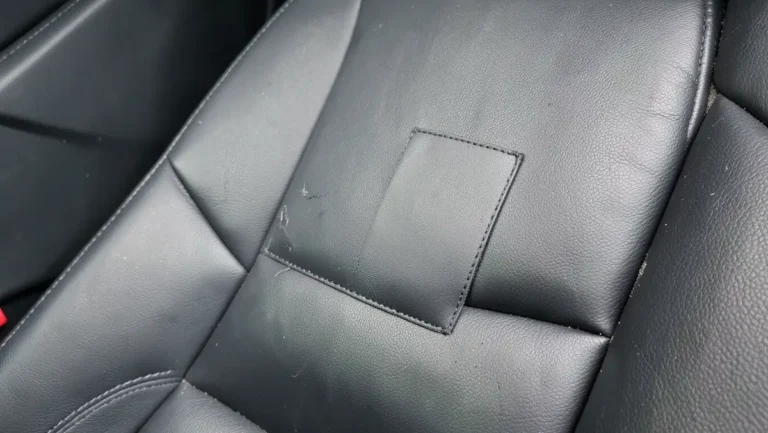
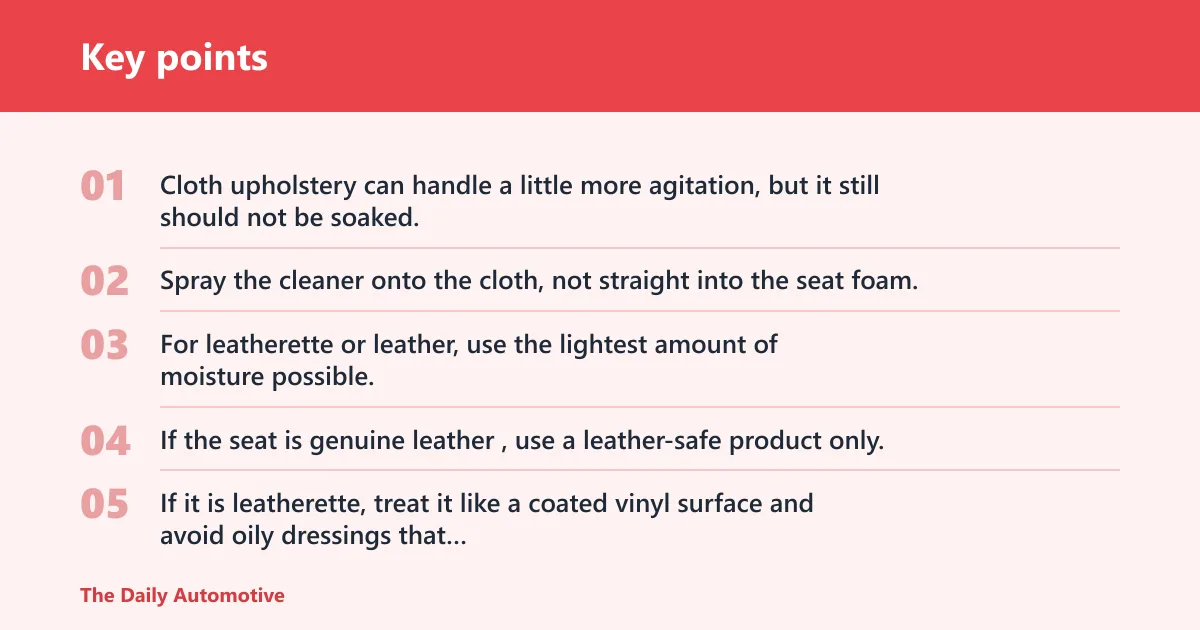
Cloth upholstery can handle a little more agitation, but it still should not be soaked. Spray the cleaner onto the cloth, not straight into the seat foam, and lift the soil with a microfiber cloth and brush. For leatherette or leather, use the lightest amount of moisture possible, then dry the surface so it does not feel sticky.
If the seat is genuine leather, use a leather-safe product only. If it is leatherette, treat it like a coated vinyl surface and avoid oily dressings that leave a slippery finish. Strong APC mix ratios belong on lower-plastic grime, not on seats unless the label specifically allows that use.
Soft-touch plastics, gloss black trim, and screens
Soft-touch plastics on the dash top and door tops need gentle wiping, not heavy pressure. Gloss black trim shows every scratch, so a dry microfiber towel is usually enough for dust. If you must use a cleaner, mist the cloth, then wipe once and dry it right away.
Touchscreens and control panels are sensitive. Spray nothing directly at them. Put a small amount of cleaner on the cloth, fold the cloth flat, and use light passes around the edges only. That reduces the chance of fluid creeping into buttons or sensor seams.
When diluted APC is useful and when to skip it
Diluted APC has a narrow job in the Terios cabin: lower door sills, rubber mats, and heavy grime on hard plastic. It is not the first choice for dashboards, piano-black trim, screens, or seats. When the surface is delicate or electrical, skip APC and stay with a pH-neutral interior cleaner.
Always match the dilution to the label and to the surface. A stronger mix is not a better mix. If the stain is light dust, food film, or finger oil, the wrong strength only leaves residue that attracts more dirt.
How do you clean the cabin without scratching it?
To clean a Terios cabin without scratching it, work from dry dirt to wet cleaning and use soft tools at the contact points. Vacuum first, then dust, then wipe. That sequence keeps grit from being dragged across the dash top, piano-black panels, and door cards, where marks show quickly.
Vacuum first, then dry dust, then wipe
Start with the vacuum and crevice tool in seams, under seats, and around the center console. Next, brush dust out of vents, switch gaps, and cupholder edges. Only after the loose grit is gone should you wipe with a damp cloth. This order matters more in a compact SUV because the cabin packs many touch points into a small space.
Use brushes and swabs on vents, seams, and switches
A soft detailing brush helps lift dust from vents and stitched seams. Cotton swabs are useful around buttons, window switches, and the edges of the touchscreen surround. Keep them barely damp. A wet swab can leave tracks in soft-touch plastic or push grime into the switch opening.
Avoid over-wetting buttons, seams, and piano black
Electrical switch sensitivity is a real concern on compact dashboards with tightly packed controls. Too much cleaner can travel into the gap around a button, then leave residue or make the switch feel sticky. On piano-black trim, skip force altogether. One light pass is enough.
Picture a Terios with a coffee ring on the center console and dust in the nearby switch bank. Clean the dust first, then spot-treat the ring with a cloth that is only lightly moistened. If you reverse that order, the wet spill drags grit into the gloss panel and makes the mark worse.
What removes food, mud, coffee, and oily residue?
Different stains need different pressure. Food spills on cloth often need vacuuming, blotting, and a pH-neutral cleaner. Mud belongs to the mats and lower trim, where a brush and a measured APC dilution can help. Coffee and oily residue need quick blotting before they set into fabric or leave a film on plastic.
Food spills on cloth and plastic
Lift solids first. Then blot, do not scrub. On cloth seats, work from the outside of the spill inward with a microfiber cloth and a small amount of interior cleaner. On plastic, wipe the area clean, then dry it so no film remains in the grain.
Mud on mats and lower trim
Let mud dry before trying to remove it. Dry mud brushes off more cleanly than wet mud. Vacuum the loose dirt, then use a brush and the correct cleaner for the mat material. Lower door trim can pick up splash marks after wet-weather entry, so check that area after the mats.
A common first-timer mistake is cleaning a muddy mat while it is still dripping. That spreads the soil into the carpet pile and the edges of the footwell. Remove the mat, tap off the loose mud outside the car, and dry the floor before reinstalling it.
Coffee, sunblock, and sticky residue on touch points
Coffee stains on cloth usually need fast blotting and a repeat wipe with a clean section of cloth. Sunblock and oily residue are common on steering wheels, shifter knobs, and door pulls. Those spots clean better with a pH-neutral interior cleaner on a microfiber cloth than with a greasy dressing that only hides the film.
If sticky residue remains on piano-black or near switches, use a very light cleaner pass and stop. Do not keep rubbing. Repeated pressure can leave micro-marks that catch light every time the cabin gets bright.
Terios odor control steps
Odor control in a Terios starts with the source, not the fragrance. Wet mats, damp carpet, and spilled food create mildew risk fast in a small cabin. Air the car out, dry the damp area, and check the cabin filter if the smell keeps returning after the visible mess is gone.
Wet mats, mildew risk, and airing out the cabin
If the mats are wet, remove them right away and let them dry outside the vehicle. Open the doors for airflow when weather allows. If the carpet below feels damp, dry that area before reinstalling anything. Mildew smell often comes from hidden moisture under a mat edge or near the seat rail.
Cabin filter checks and vent cleaning
If the odor seems to come through the vents, inspect the cabin filter according to the owner’s manual. A loaded filter can hold moisture and stale odor. Clean the vent openings with a brush and vacuum the loose dust from the intake area before replacing the filter. That is better than spraying fragrance into the vents.
When to use an enzyme odor remover
Use an enzyme odor remover when the source is organic: food, drink, pet mess, or a wet spill that has already started to smell. Apply it to the affected fabric or carpet area, not the whole cabin. Let it work fully, then dry the area with airflow. Masking the smell without removing the source rarely lasts.
Protect vulnerable trim areas
Some Terios cabin parts need more restraint than others. Piano-black trim scratches easily. Touchscreens and switch banks can be affected by fluid creep. Soft plastics can fade or haze if they get harsh chemical exposure, while sunlit areas can show UV aging sooner than the shaded parts of the cabin.
Scratched piano-black panels
Use a clean, soft microfiber cloth and very light pressure. Do not use paper towels, abrasive pads, or gritty cloths. If dust is present, remove it first rather than wiping over it. That is the main reason these panels pick up fine scratches.
Water spots and UV fading
Water spots show up most often on glass, piano-black trim, and glossy plastic after a too-wet wipe. Dry the area right away. For UV fading, use seasonal protection on exposed plastics and keep the dash top free of oily dressings that attract dust and bake under sunlight.
Touchscreen and switch sensitivity
Touchscreens, window switches, and climate controls should be cleaned with minimal moisture and a folded microfiber cloth. Spray the cloth, not the panel. If residue gets into the edge of a switch, stop and dry it before pressing the control again. That helps avoid a sticky feel and stray streaks.
How often should you detail the interior of a Daihatsu Terios?
Detail the Terios on three levels: a weekly wipe-down, a monthly deeper clean, and a seasonal protection pass. Weekly care keeps dust, crumbs, and fingerprints from building up. Monthly care handles seats, mats, and door cards. Seasonal care is for UV exposure, wet-weather cleanup, and odor prevention.
Weekly wipe-down
Do a quick vacuum, clean the steering wheel and touch points, and wipe the dash and screens. This is enough for most daily-use cabins if the mats stay dry and the seats are not heavily stained. It also keeps piano-black panels from collecting oily fingerprints that are harder to remove later.
Monthly deep clean
Set aside time for the seats, door cards, mats, storage bins, and the hard-to-reach gaps around the center console. This is the best time to spot-treat stains, brush seams, and clean the cabin filter area if the manual calls for it. Monthly work is where most odor sources get caught early.
Post-rain cleanup and seasonal protection
After rain, inspect the mats and footwells first. Dry any damp carpet before it turns into a mildew issue. Before hot weather, clean and protect the dash top and other sun-exposed plastics. Seasonal attention matters because the Terios cabin is compact, and small problems spread through the interior quickly.
What is the easiest way to clean hard-to-reach Terios storage areas?
The easiest way to clean storage areas is to empty them first, then use a crevice tool, a soft brush, and cotton swabs for corners. Small bins collect crumbs, dust, and sticky residue faster than larger open surfaces. Because the Terios cabin is compact, those pockets can hold a lot of grime in a small space.
Glove box, console bins, and door pockets
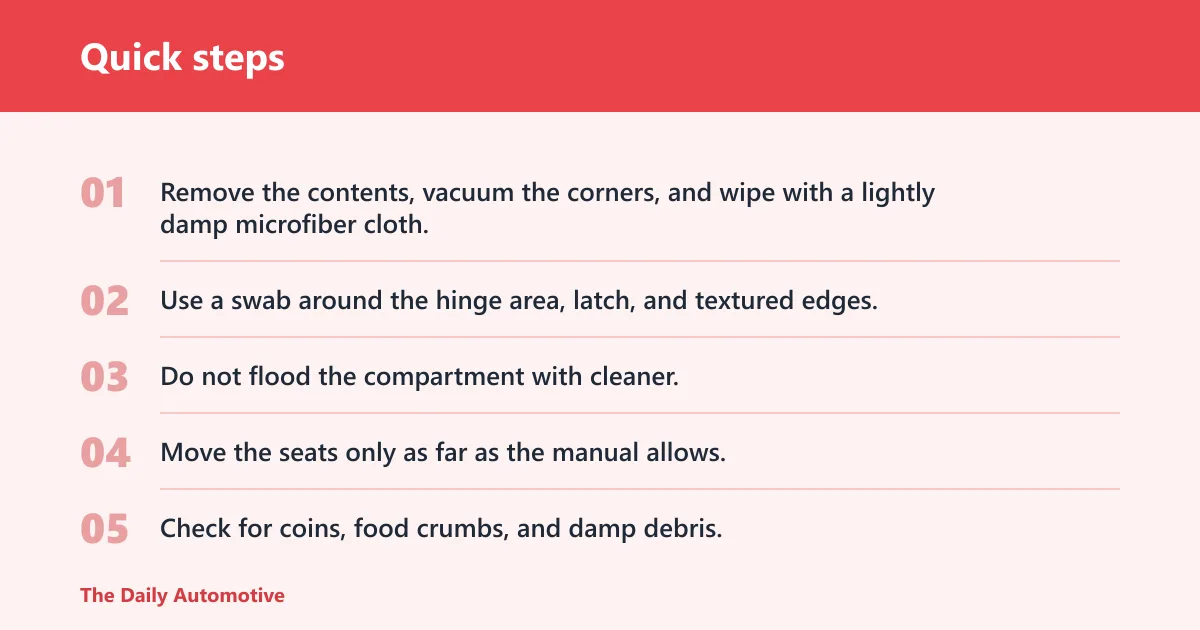
Remove the contents, vacuum the corners, and wipe with a lightly damp microfiber cloth. Use a swab around the hinge area, latch, and textured edges. Do not flood the compartment with cleaner; the residue will sit in the seams and attract dust again.
Seat rails, seams, and under-seat spaces
Move the seats only as far as the manual allows, then use the crevice tool and brush around the rails. Check for coins, food crumbs, and damp debris. Under-seat areas are easy to miss, but they often hold the source of a recurring smell or a rattle.
Suppose a small snack wrapper and a spilled coffee lid roll under the passenger seat. If you only wipe the visible floor area, the smell returns. Pull the item out, vacuum the track, and check the carpet edge before the seat goes back into place.
Is the Daihatsu Terios a good car for everyday use?
For everyday use, the Terios works best when you keep the cabin clean on a schedule. Its compact layout makes it easier to reach seats, mats, and door cards than a larger SUV, but that same compactness means dirt, spills, and odors spread quickly if you wait too long. Regular cabin care pays off.
Daihatsu Motor Co Ltd operates in the automotive industry, and the company’s Japanese page says it specializes in production and sales of various automotive vehicles. It also lists lightweight cars, low-fuel cars, reduced tax-free vehicles, safety and environmental performance, car accessories, and company information. The Terios fits that practical-use focus, but interior care still depends on trim and market.
Frequently asked questions
How do I clean the Daihatsu Terios interior without damaging trims or upholstery?
Clean from dry to wet: vacuum, brush, then wipe with a pH-neutral interior cleaner on a microfiber cloth. Use separate care for cloth seats, leather or leatherette trims, piano-black panels, and screens. Do not spray directly onto switches or touchscreens, and avoid soaking seats or seams.
What products are safe for Terios seats, plastics, and touch points?
A pH-neutral interior cleaner, a soft detailing brush, microfiber cloths, a tint-safe glass cleaner, and a diluted APC for hard plastic or mats are the safest core products. Use leather-safe care only on leather. For touch points, spray the cloth instead of the panel.
How do I remove smells, dust, and stains from a small SUV cabin?
Remove the source first. Vacuum dust and crumbs, dry wet mats, and treat stains on the exact surface where they sit. Use an enzyme odor remover for food, drink, or pet mess after cleaning the spot. If the smell persists, check the cabin filter and clean the vents.
Is daihatsu terios a good car?
For daily use, the Terios makes sense if you want a compact SUV cabin that is straightforward to maintain. It is easier to reach than many larger interiors, but it also asks for regular care because dirt, wet mats, and touch-point grime build quickly in tight spaces.
Products related to this article
Sponsored / affiliate links. As an Amazon Associate I earn from qualifying purchases. I may earn additional commission from eligible campaigns.