Underglow LED Lights for Cars: Legal Colors & How to Install
For public roads, choose white or amber underglow only if your state allows exterior accent lighting. Otherwise keep it off while driving, because red and blue are commonly restricted and flashing colors are often illegal. Wrong colors can earn a ticket, force a fix, or get your car failed at inspection. This guide covers legal color rules, basic wiring, switch placement, and a safe install plan.
What underglow lights


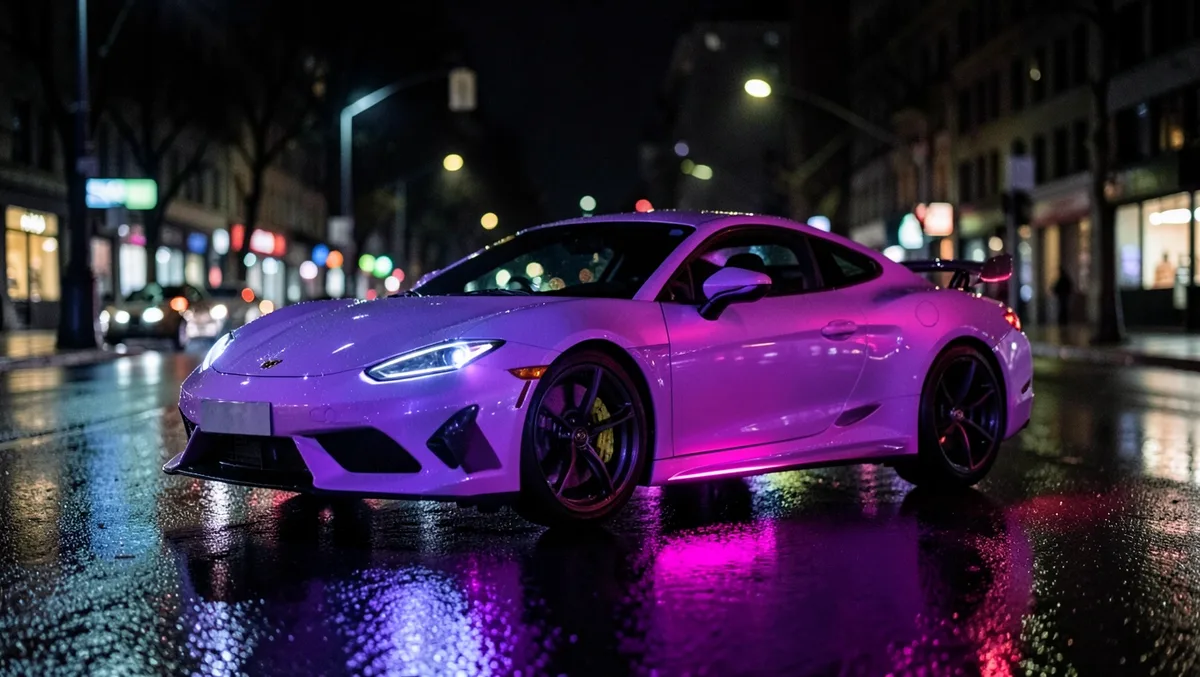
Underglow lights are LED or neon lighting mounted underneath a vehicle to create a glowing effect. You may also see them called neon underglow, ground effect lighting, or underbody lighting. Modern kits often use 12V automotive power, flexible strip or tubing layouts, and control options like remotes, phone apps, and preset modes.
Common kit parts and control options
Many current kits use 5050 SMD LED chips, waterproof or IP67 claims, adhesive strips, and zip ties for retention. Controls can include static colors, flashing patterns, app presets, and music or sound-active modes. Those features work well for parked display use, but they can create road-use problems if your state limits color, brightness, flashing, or visibility.
Why owners add underglow
Owners usually install underglow for show use, parking-lot display, or a customized look at meets and car shows. The legality split matters. A kit can be legal to buy and still be restricted on public roads, especially if it is visible from the front, rear, or sides while the car is moving.
Are underglow lights legal on your car?
State laws on vehicle lighting differ by color, brightness, visibility, flashing, and public-road use. That means the answer depends on where you live and how the kit is mounted and operated. Buying a kit is not the same thing as being allowed to run it on the street.
Why state lighting laws vary
Some states allow underglow with restrictions, while others limit it to off-road or parked use. The practical question is not whether a kit exists, but whether it stays within the lighting rules that apply to front, rear, and underbody visibility. A legal setup in one state can be illegal in the next.
Road use versus parked display use
Road use and parked display use are not the same. California underglow cannot be turned on while driving on public roads. Texas allows underglow only if it is not visible when the car is in motion. That distinction is the whole game: a show-only setup can still be fine when the car is parked, even if it must stay off on the street.
What to verify before you buy
Check your state’s rules for underbody lighting, especially any limits on color, brightness, or visibility from outside the vehicle. Also verify whether local police or inspection rules treat flashing, strobing, or music-synced patterns as prohibited public-road lighting. If you travel across state lines, do not assume your home-state setup remains legal everywhere.
Which underglow colors are legal?
Legal colors depend on where the light is visible and when it is used. White or amber is commonly allowed at the front, while red or amber is often restricted to the rear. Blue and emergency-style lighting create the most risk because they can resemble police or other emergency vehicles, which many laws forbid.
Front color rules
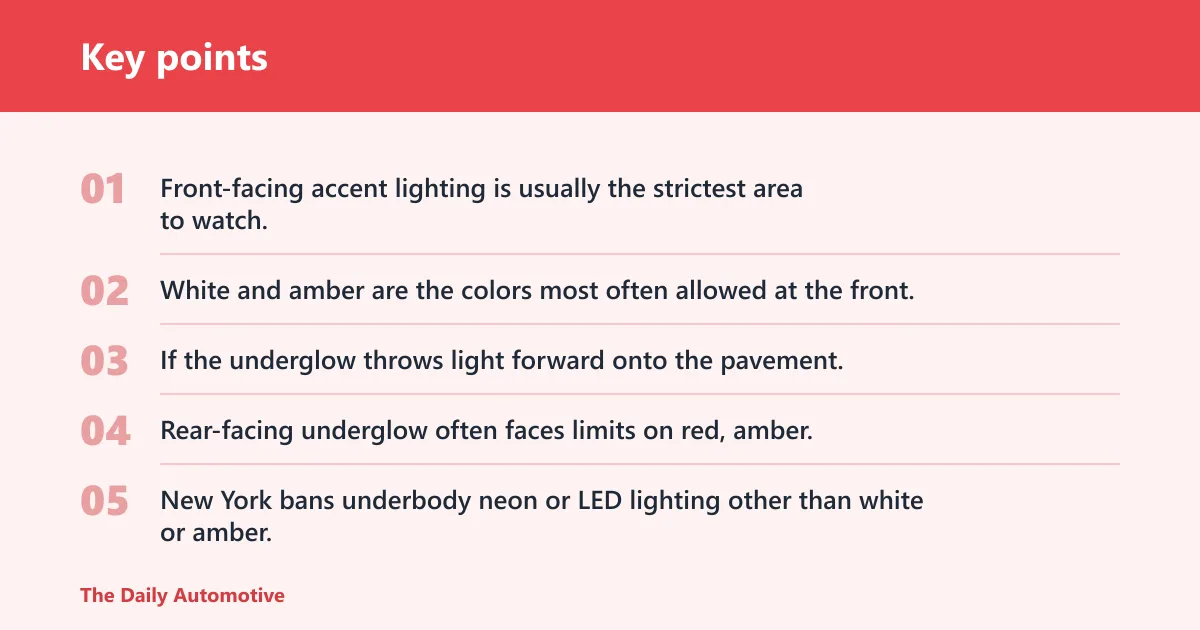
Front-facing accent lighting is usually the strictest area to watch. White and amber are the colors most often allowed at the front, but local rules still control whether the light can be visible from outside the car while moving. If the underglow throws light forward onto the pavement, that can still matter under your state’s visibility rules.
Rear color rules
Rear-facing underglow often faces limits on red, amber, and anything that looks like tail, brake, or emergency lighting. New York bans underbody neon or LED lighting other than white or amber. Illinois prohibits underbody lighting visible from outside the car. Those kinds of rules make rear visibility just as important as color choice.
Blue, red, and emergency-style lighting risks
Blue and red are the colors most likely to draw attention from enforcement because they can mimic emergency vehicles. That risk increases if the kit flashes, pulses, or alternates colors. Even if the hardware can produce an acceptable static color, a preset that cycles through red and blue can still create legal trouble on public roads.
Brightness and flashing limits
Brightness rules are often written as glare, dazzling light, or visible-light limits rather than a simple universal number. Florida permits underglow if it does not project glaring or dazzling light. Ohio underglow must be under 300 candlepower. Flashing, strobing, and sound-active patterns are higher-risk than a steady, non-glaring display.
Underglow legal checklist
This checklist turns the legal question into an install decision. Use it before you mount anything, because the wrong combination of color, visibility, and mode can make a kit legal to own but illegal to run. If a row sounds risky, build the car so the lights stay off while driving.
| Setup choice | Risk level | Recommended install action |
|---|---|---|
| White or amber only | Lower | Use as the default road color only if your state allows exterior accent lighting. |
| Red, blue, or red-blue mix | Higher | Keep for off-road or show use only unless your local law clearly allows it. |
| Visible from front or rear while driving | Higher | Mount and aim the kit so the light stays hidden from outside view when moving. |
| Flashing, strobing, or music mode | Higher | Wire the controller so these modes are used only when parked. |
| Very bright output or glare | Higher | Dim the kit, aim it downward, or disable road use if your state limits glare. |
| Parked at a show | Lower if local rules allow | Use the preset display modes only while stationary and away from traffic. |
How do you install underglow LED lights?
Install underglow by planning the mounting path first, then attaching the strips or tubes to clean surfaces, routing the wires safely, and separating display use from road use. Keep the kit on 12V automotive power, protect the wiring from abrasion and water, and avoid any mounting point that interferes with factory lights or moving parts.
Plan the mounting path
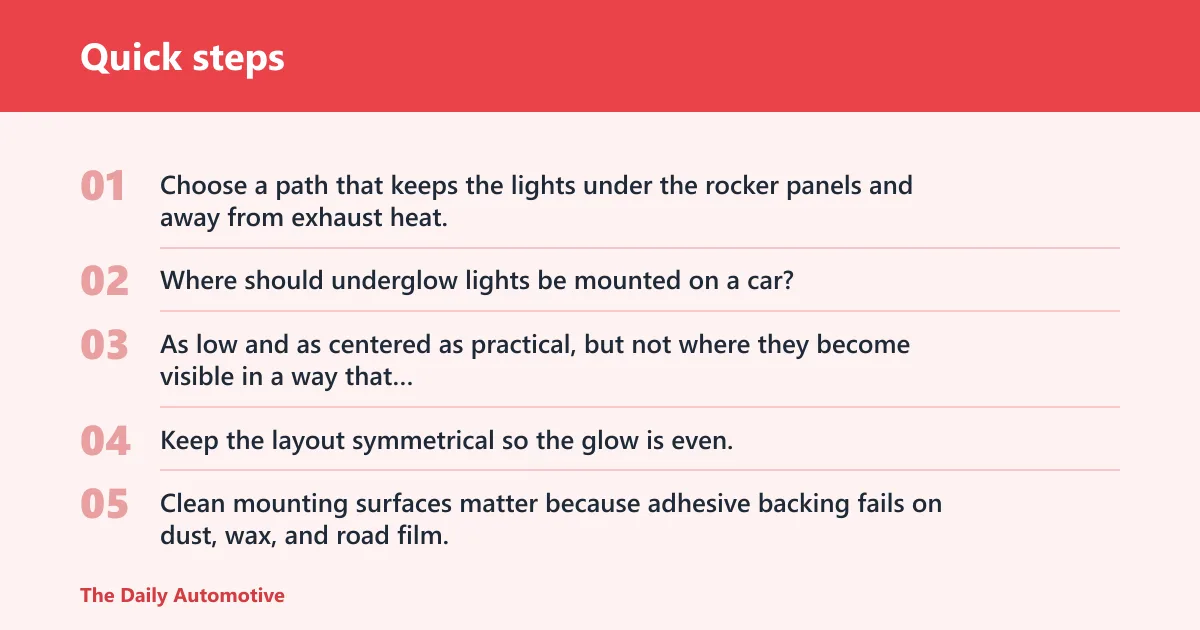
Choose a path that keeps the lights under the rocker panels and away from exhaust heat, suspension travel, and road debris. Where should underglow lights be mounted on a car? As low and as centered as practical, but not where they become visible in a way that violates your state’s front, rear, or side rules. Keep the layout symmetrical so the glow is even.
Clean the mounting surface
Clean mounting surfaces matter because adhesive backing fails on dust, wax, and road film. Wipe the rocker panels and any attachment points until they are dry and free of residue. If the surface is not clean, the strip can peel, sag, or tilt into the line of sight.
Attach strips or tubes
Most kits use adhesive backing plus zip ties for extra retention. That combination helps when the road gets wet or cold, but the strip still needs a flat, secure surface. Flexible tubing can protect LEDs better than exposed strip segments, yet it still needs solid fasteners and tidy ends to avoid sagging or water entry.
Route wires and protect connections
Route the wiring away from the exhaust, steering parts, and any sharp edge under the body. Use loom or protective wrap where the wire passes near metal. If the controller or splice sits low on the chassis, seal it carefully and leave enough slack for suspension movement without letting the wire drag.
Say your car has a 72-inch strip on each rocker panel and the rear left section peels loose after a week. The likely problem is adhesion, not the LED chips themselves. Cleaning the surface again and adding a second retention point with a zip tie usually solves the sag before the strip starts rubbing on the road.
Do you need a switch or fuse?
Yes. A switch and an in-line fuse make the system easier to control and safer to service. The switch lets you shut the kit off for street use, and the fuse protects the circuit if a wire shorts. Keep the controller accessible enough that you can disable the lights quickly before driving.
12V power and ground connection
Most kits are built for 12V automotive power, which matches the electrical system in most cars. Connect the kit according to the product manual and the vehicle manual. Use a proper ground point on clean metal, and do not assume any random bolt is suitable without confirming that it is a solid chassis ground.
In-line fuse placement
Place the in-line fuse close to the power source so the protected section of wire is as short as practical. That reduces the amount of unfused wiring in the car. If the kit does not include a fuse, add one that matches the manufacturer’s recommendation or the circuit’s expected load.
Switch location and access
Put the switch where you can reach it without distracting from driving, such as near the lower dash or another sheltered interior spot. The goal is simple: you should be able to turn the system off before you pull onto public roads. If the controller also manages app presets or music modes, make sure the road setting is easy to select.
Battery disconnection before testing
Disconnect the battery before testing new wiring if the manual calls for it, and follow the vehicle’s connection order for any battery work. That avoids shorts while you check fitment and routing. Never ignore ventilation, no-spark precautions, or the manual when working near electrical components.
How to avoid common install problems
Most underglow failures come from the same few mistakes: loose adhesive, exposed wiring, water entry, and light bleed into places that should stay dark. Test the kit before final reassembly, then inspect it again after a short drive. Small errors show up quickly under the car.
Loose adhesive and zip tie failures
If the strip droops, it usually means the mounting surface was not clean enough or the zip ties were spaced too far apart. Re-clean the area, dry it fully, and add retention where the strip bends or meets a seam. Do not rely on adhesive alone on a surface that gets sprayed by water and grit.
Wire damage and water entry
Exposed wire under the car is vulnerable to scrapes, salt, and splash. Keep connections elevated where possible, and seal any low-mounted controller according to the product instructions. An IP67 claim does not excuse poor routing; the installation still has to keep water out of connectors and splice points.
Light bleed and factory-light interference
Light bleed happens when underglow spills into the wheel well, up into the engine bay, or onto factory lighting parts. That can make the car look brighter than the law allows and can interfere with tail, marker, or brake lamp visibility. Aim the light downward and check the car from standing height before you call the job done.
Picture a sedan with an RGB kit that looks harmless in the garage, then throws blue light into the front wheel wells at night. That is the kind of spill that can create trouble even if the kit itself has a white preset. Re-aiming the strip and limiting the mode to parked use is the safer fix.
Frequently asked questions
What underglow colors are legal on cars?
White or amber is commonly allowed at the front, while rear rules often restrict red and amber. Blue and emergency-style colors are the most likely to cause problems. The real answer depends on your state, your mounting position, and whether the lights are visible while the car is moving.
Is underglow legal in my state?
Maybe, but you have to check your state’s vehicle lighting law and any local enforcement rules. The guide lists Arkansas, California, Idaho, Kansas, Montana, and Ohio as states where underglow is legal with restrictions, but that does not mean every setup is legal or every mode is allowed on the road.
Can underglow be on while driving?
In some states, yes, but only within narrow limits. California underglow cannot be turned on while driving on public roads, and Texas allows it only if it is not visible when the car is in motion. If your state does not clearly allow road use, keep it off while driving.
What colors are illegal for car underglow?
Red and blue are commonly restricted, especially if they resemble emergency lighting or are visible from outside the car. Some states also limit rear-facing red or amber and may only allow white or amber in certain positions. Flashing color changes can create additional risk even when the base color seems acceptable.
How do you install underglow LED lights on a car?
Plan the path, clean the mounting area, attach the strips or tubes with adhesive and zip ties, then route the wiring safely to a 12V source with a fuse and switch. Keep the system away from heat, moving parts, and exposed edges, and test it before final reassembly.
Can you use underglow at car shows or only when parked?
Many owners use underglow at car shows or while parked, because that is often the safer legal path. If your state restricts road use, keep the kit off while driving and use the show modes only when stationary. Always check the local rules before turning it on in public.
Products related to this article
Sponsored / affiliate links. As an Amazon Associate I earn from qualifying purchases. I may earn additional commission from eligible campaigns.