Waterless Car Wash vs Traditional Car Wash
Waterless car wash works best on lightly dusty, cool panels with no grit. If you can feel contamination or see mud, salt, bugs, or bird droppings, use a traditional wash. Using the wrong method can drag abrasive dirt across paint and create swirls, scratches, and residue that gets worse over time. This guide explains when waterless washing is safe, when traditional washing is safer, and which contamination signs force you to switch.
When to choose waterless over traditional
| Decision factor | Waterless Car Wash | Traditional Car Wash | Winner |
|---|---|---|---|
| Light dust, pollen, fingerprints | Works well for maintenance cleaning when the surface is already close to clean. | Can do the job, but is more setup than needed. | Waterless Car Wash |
| Mud, sand, road salt, ash, caked grime | Not the safe choice; wiping can move grit across paint. | Rinsing first is safer and better suited to heavy contamination. | Traditional Car Wash |
| Hot panels and direct sun | Higher streak risk because product can flash-dry too quickly. | Still better, especially if you can rinse and dry in shade. | Traditional Car Wash |
| Apartment, garage, or hose-restricted setup | Made for use without a hose or bucket, so it fits tight parking and quick touch-ups. | Requires more access, equipment, or a wash bay. | Waterless Car Wash |
| Rocker panels, wheel arches, wheels, lower doors | Often a skip area unless contamination is light and isolated. | Better for buildup in areas that catch road spray and debris. | Traditional Car Wash |
Cleaning power by contamination level
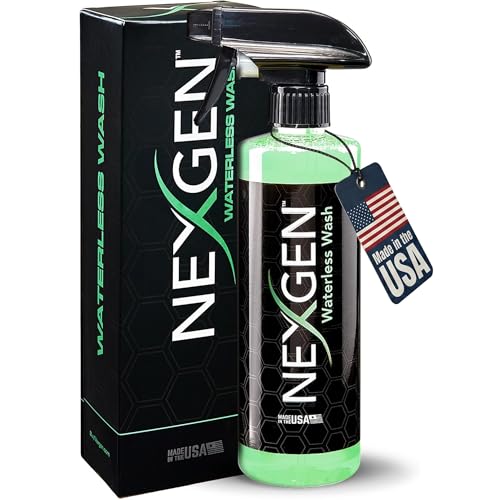
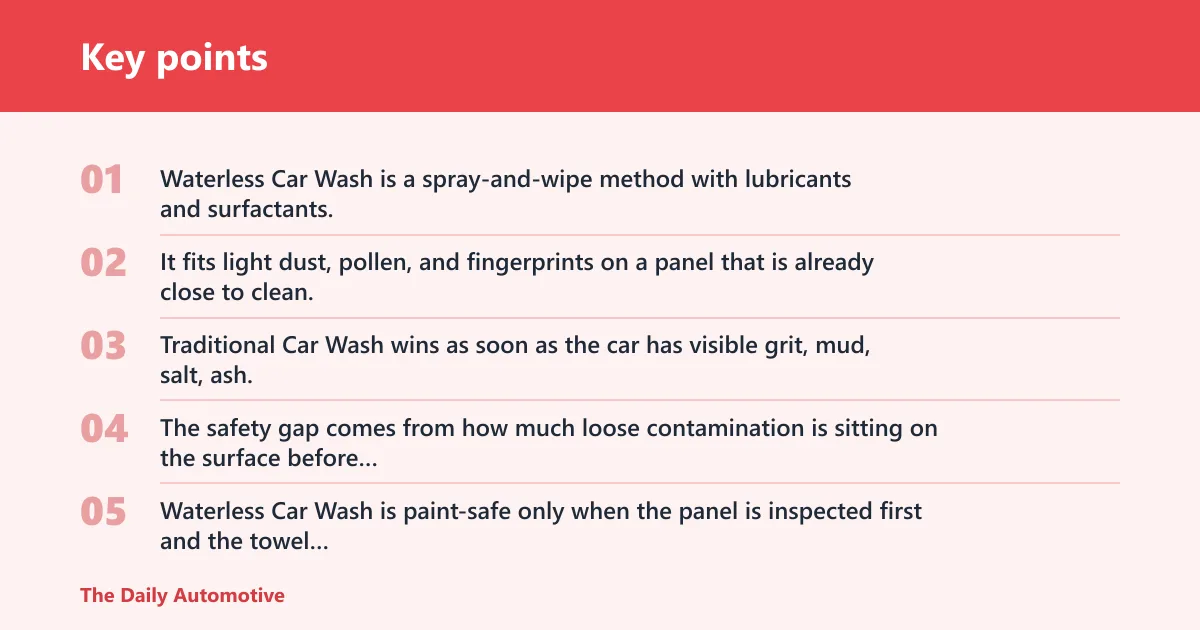
Waterless Car Wash is a spray-and-wipe method with lubricants and surfactants, and some formulas add wax or gloss support. It fits light dust, pollen, and fingerprints on a panel that is already close to clean. Traditional Car Wash wins as soon as the car has visible grit, mud, salt, ash, caked film, or heavy road spray.
Paint safety and scratch risk
The safety gap comes from how much loose contamination is sitting on the surface before you touch it. Waterless Car Wash is paint-safe only when the panel is inspected first and the towel stays clean, soft, and free of grit; if the towel starts dragging or you feel debris, stop. Traditional Car Wash is safer when contamination is heavier because the rinse removes the material before wiping starts.
Speed, setup, and water use
Waterless Car Wash is faster because it skips hose and bucket prep, so you can use it almost anywhere without those tools. That also means lower water use. Traditional Car Wash takes more setup and more time, but it gives you a better margin when the vehicle is dirty enough that a wipe alone is a bad bet.
Best fit by driver scenario
Apartment drivers, water-restricted households, and people who want a quick maintenance reset between full washes usually get the most value from Waterless Car Wash. Winter commuters, drivers who face road salt, and anyone dealing with wheel and lower-body buildup should lean to Traditional Car Wash. A common first-timer mistake is treating the whole car the same; a clean roof does not excuse dirty rocker panels.
Is waterless car wash safe for paint?
Yes, but only on light contamination and only with the right technique. The paint stays safer when the panel is cool, the towel is clean, and the surface has been inspected for grit before the first wipe. If you feel sand, salt, ash, or caked grime, skip the waterless method and switch to a traditional wash.
Why the method can be safe
Waterless wash formulas use lubricants and surfactants to lift light dirt while reducing the chance that loose dust scratches the finish. Many formulas also add wax or gloss support, which can help the panel look cleaner after the wipe. That benefit disappears if you drag dirty towel fibers across a panel that still has abrasive debris on it.
What makes it unsafe
Visible grit is a stop condition. So are mud, road salt, ash, and caked residue, because those contaminants are more likely to scratch paint during contact. Hot panels also raise the risk of streaking and fast drying, which makes a clean wipe harder.
When traditional washing is the safer choice
Traditional washing is the safer choice any time contamination is more than a light film. It is better for mud, sand, road salt, winter buildup, and the heavier grime that collects on rocker panels, wheel arches, wheel wells, lower doors, and wheels. If the car needs a rinse before any towel touches it, that is your answer.
Weather and exposure matter
Winter driving changes the decision fast. Road spray, salt, slush, and repeated wet-dry cycles load the lower body with abrasive residue that a spray-and-wipe method should not try to remove. Heavy rain exposure can also carry grime into seams and lower panels where waterless cleaning is less effective.
Failure-prone areas need a different call
Roof panels and upper doors may be suitable for Waterless Car Wash while rocker panels and wheel arches need Traditional Car Wash. That split is normal. The right method can change by panel, so do not clean a lower section simply because the upper half looks fine.
Car wash decision matrix
Use this matrix before you spray anything. Match the contamination level, the panel location, and the weather exposure to the method that fits all three. If any one of those points lands in the heavy-contamination column, switch to Traditional Car Wash.
| Contamination level | Panel location | Weather or exposure | Correct method |
|---|---|---|---|
| Light dust or pollen | Roof, hood, upper doors | Shade or cool storage | Waterless Car Wash |
| Light dust or fingerprints | Trunk lid, mirrors, glass | Dry weather, no recent road spray | Waterless Car Wash |
| Visible grit or road film | Lower doors, rear bumper | Mixed weather, frequent road traffic | Traditional Car Wash |
| Salt, slush, winter residue | Rocker panels, wheel arches, wheel wells | Cold weather, salted roads, slushy commute | Traditional Car Wash |
| Bird droppings or sticky spots | Any panel | Sun exposure or dried-on residue | Traditional Car Wash |
| Dust with no grit, after inspection | Single isolated panel | Cool shade, no windblown debris | Waterless Car Wash |
Choose Waterless Car Wash if…
Use Waterless Car Wash if the vehicle is already close to clean, the panel is cool, and the dirt is limited to dust, pollen, or fingerprints. It also fits apartment parking, hose restrictions, and quick maintenance between full washes. If only one panel needs a touch-up, you can clean that panel and skip the rest.
Choose Traditional Car Wash if…
Use Traditional Car Wash if you see mud, caked grime, ash, salt, heavy road film, or contamination in wheel areas and along the lower body. It is also the safer pick after winter driving or after a storm that leaves abrasive debris on the paint. If the towel catches or the panel feels gritty, stop and switch.
- Inspect the panel in good light before wiping.
- Touch the surface lightly. If you feel grit, do not use waterless cleaning.
- Check the temperature of the panel. Work only on cool surfaces.
- Use a clean, soft microfiber towel.
- Wipe in straight lines with light pressure.
- Flip to a clean towel face often.
- Stop if the towel drags, catches, or picks up visible grit.
- Move to Traditional Car Wash if the contamination is more than light dust.
What contamination means stop or switch?
Stop or switch when the panel shows more than a light layer of dust. Visible grit, mud, salt, ash, caked film, sticky bug residue, and bird droppings all push you toward Traditional Car Wash. The key point is simple: if you would be rubbing abrasive material across paint, the waterless method is the wrong tool.
Signs that still fit Waterless Car Wash
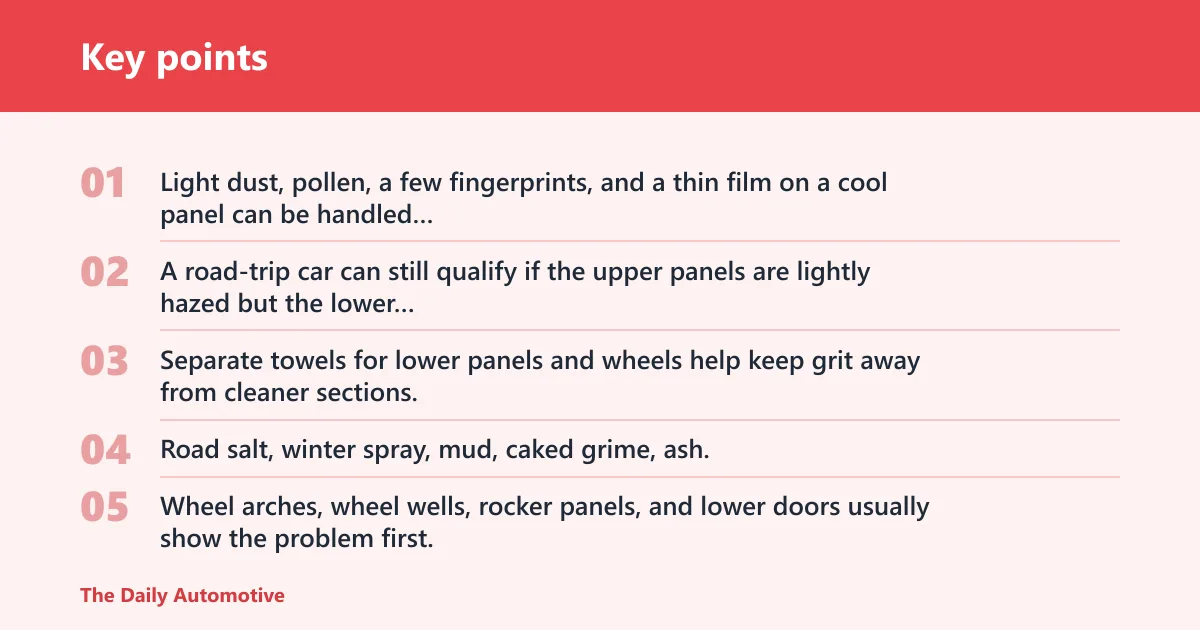
Light dust, pollen, a few fingerprints, and a thin film on a cool panel can be handled with Waterless Car Wash if the towel stays clean and the surface remains smooth to the touch. A road-trip car can still qualify if the upper panels are lightly hazed but the lower body is not packed with debris. Separate towels for lower panels and wheels help keep grit away from cleaner sections.
Signs that force Traditional Car Wash
Road salt, winter spray, mud, caked grime, ash, and any panel that feels gritty are generally no-go conditions for waterless cleaning. Wheel arches, wheel wells, rocker panels, and lower doors usually show the problem first. If the towel begins dragging unexpectedly, that is your cue to stop and rinse instead of forcing the wipe.
Say your sedan is parked in an apartment garage and the body has a thin layer of dust after three dry days. Waterless Car Wash fits that case if the roof, hood, and doors are cool and smooth to the touch. If the lower rear door has road grit near the wheel opening, that section is better left for a traditional wash.
Suppose a crossover has fresh winter residue on the rocker panels after about a 12-mile commute on salted roads. Even if the hood looks only lightly dusty, the lower body changes the call. Traditional Car Wash is the safer move because the contamination is heavier where the spray lands hardest.

Frequently asked questions
What is a waterless car wash?
It is a spray-and-wipe cleaning method that uses lubricants and surfactants to lift light dirt without a hose or bucket. Some formulas include wax or gloss enhancers. It works best as maintenance between full washes, not as a full replacement when the car is heavily soiled. (Caranddriver)
Can I use waterless wash on a dirty car?
Only if “dirty” means a light film of dust or pollen on a close-to-clean panel. If the car has visible grit, mud, salt, ash, or caked grime, a traditional wash is usually the better first step. The more abrasive the contamination, the more likely a wipe will drag debris across the paint.
Does waterless car wash save water compared with traditional washing?
Yes. Waterless washing is built to clean and shine a car without a hose or bucket, so it uses far less water than a traditional wash. That makes it a practical choice in apartment parking, limited-access garages, and water-restricted areas where a full rinse is harder to do.
What towels do I need for a waterless car wash?
Use clean, soft microfiber towels and keep multiple towel faces available. Separate towels for lower panels and wheels are a smart move because those areas collect more grit. Frequent flipping matters; if a face picks up debris, switch before it gets dragged back across cleaner paint.
How does waterless car wash compare to rinseless wash?
Waterless wash is a spray-and-wipe method with no bucket or hose required, and it is aimed at lightly dirty panels. Rinseless wash still uses a bucket and more liquid, so it is commonly used for more contamination than a true waterless spray, while still using less water than a standard wash.
Is waterless wash good for apartments or water-restricted areas?
Yes, that is one of its strongest uses. It is practical when a hose is unavailable, impractical, or restricted, and it lets you handle quick maintenance on lightly dirty panels. It still has limits, though, so winter salt, mud, and wheel buildup should go to a traditional wash.
Products related to this article
Sponsored / affiliate links. As an Amazon Associate I earn from qualifying purchases. I may earn additional commission from eligible campaigns.