Touchless Car Wash vs. Brush Car Wash: Which Wins Best?
Touchless car wash is often the safer default for paint, ceramic coatings, matte wraps, and dark finishes when dirt is light to moderate; use a brush wash only when heavier grime calls for contact cleaning and the brushes appear well maintained. Pick wrong, and you trade time for swirls, haze, or finish damage that shows fast on black paint. This guide compares both methods by soil level, finish type, and wash frequency so you can choose the lower-risk option.
| Decision factor | Touchless Car Wash | Brush Car Wash | Winner |
|---|---|---|---|
| Paint safety | No physical contact with paint; safer for delicate finishes | Mechanical contact can leave swirl marks or micro-scratches if maintenance is poor | Touchless Car Wash |
| Heavy contamination cleaning | Can leave behind mud, bugs, tar, and baked-on grime | Friction helps remove stuck debris more completely | Brush Car Wash |
| Best fit for coatings and wraps | Better choice for ceramic coating, PPF, vinyl wrap, and matte finish | Can be acceptable on standard clear coat, but is less friendly to sensitive surfaces | Touchless Car Wash |
| Risk on dark paint | Lower chance of visible abrasion | Any haze or swirl marks show quickly on black and deep colors | Touchless Car Wash |
| Cleaning consistency after storms or off-road use | May need pre-rinse or a second pass | Better at cutting through heavy road film | Brush Car Wash |
Touchless car wash vs. brush car wash: the core trade-off
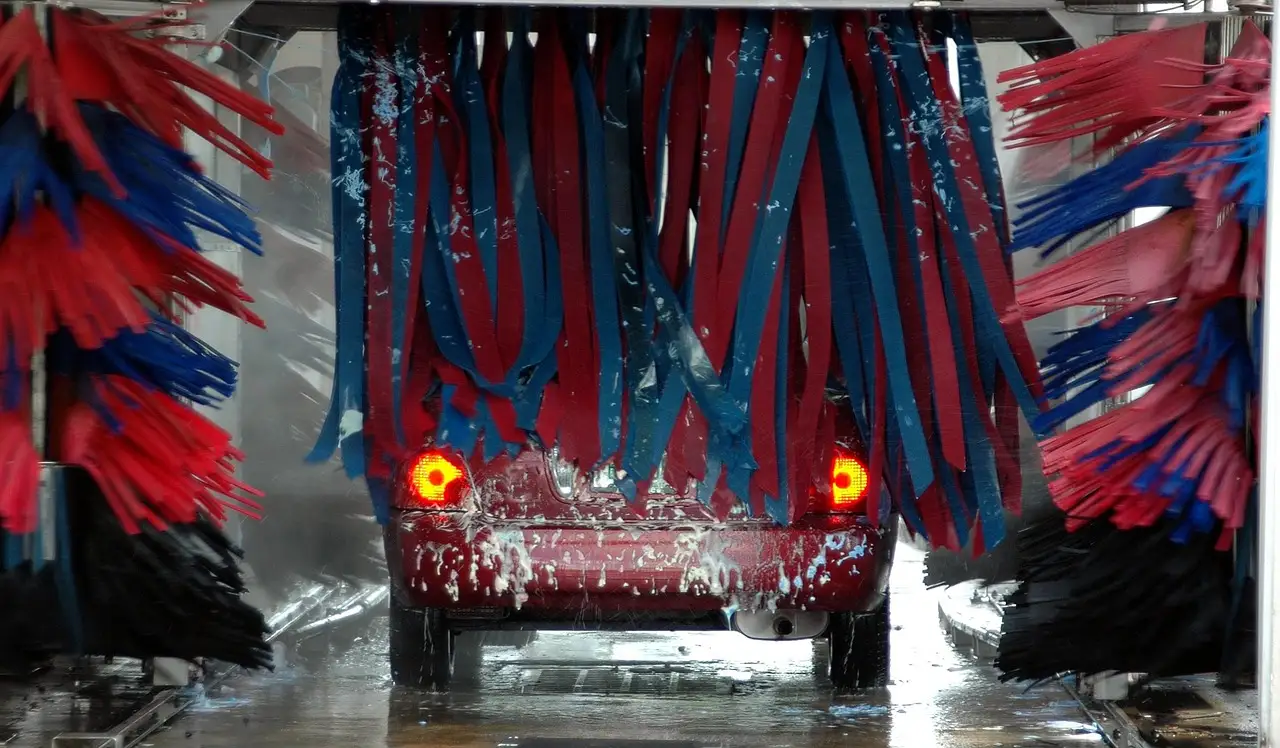


The choice gets clear once contamination and finish sensitivity are split apart. Touchless washing protects the surface by avoiding contact, while brush washing improves cleaning when dirt is bonded to the car and water jets alone are not enough.
That is the real trade: paint-risk versus soil-load. If the vehicle carries only routine dust or light road film, touchless is usually the safer move. If the car comes back from snow, mud, construction dust, or a long highway run with insects baked on, a maintained brush system often cleans better.
What each wash method actually does
Touchless car wash systems use high-pressure water jets and chemical detergents only. There is zero physical contact with the paint, so contact-related damage is removed from the equation.
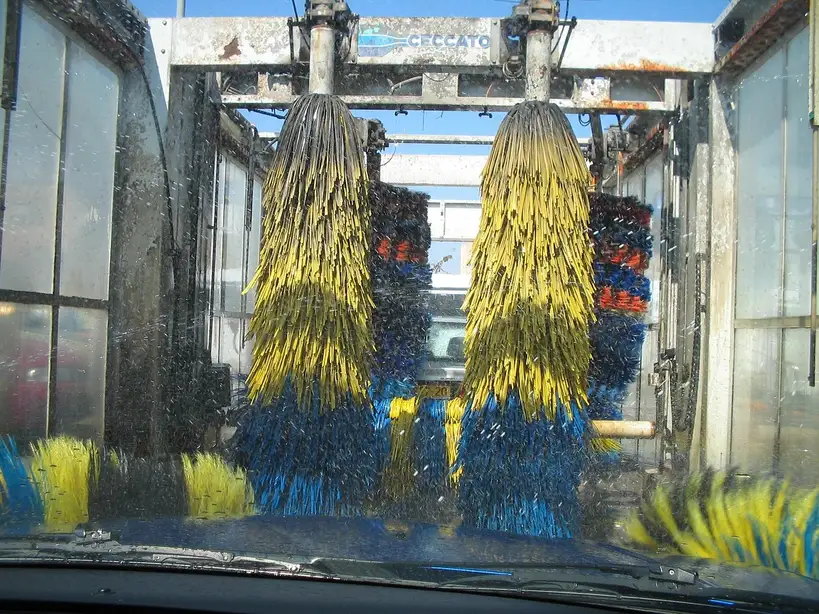
Brush car wash systems use rotating foam pads, cloth strips, or synthetic brushes to scrub the vehicle. That friction helps remove stubborn debris, but it also creates the chance of swirl marks and light abrasion when the equipment is dirty or worn.
The trade-off between paint safety and cleaning power
Touchless systems depend on chemistry doing more of the work. That can mean stronger detergents, which may be harsher on waxes or sealants than a gentler wash would be. The method is safer for the finish, but it is not always the strongest cleaner.
Brush systems move the problem in the opposite direction. They clean harder because they make contact, and that contact is useful against heavy contamination. The penalty is higher paint risk, especially on dark vehicles and finishes that already show marks easily.
Where clear coat, coatings, and wraps change the answer
Clear coat is the outermost paint layer, and repeated abrasion can leave it looking dull and swirled over time. That matters for resale value as much as appearance, because the damage tends to show under direct sun and bright shop lights.
Ceramic coating, paint protection film, vinyl wrap, and matte finish all push the choice toward touchless washing. Those surfaces are commonly listed as safer with no-contact cleaning, while brushes can catch edges, leave shiny patches on matte materials, or wear a coating faster than expected.
📊 Basic wash pricing is described as $8–$15. Source: Touchlesscarwashfinder.
How each wash type cleans the car
Touchless car wash: jets, detergents, and no contact
Touchless systems spray detergent, let it dwell briefly, and rinse with force. The wash gets its cleaning from chemistry plus pressure, not from friction against the surface.
That works well on light dirt and regular maintenance. It is less reliable on dried mud, clay, bug splatter, and road tar, where the washer may come back with a clean-looking panel that still carries residue in seams, lower doors, or the rear bumper.
Brush car wash: foam, cloth, or synthetic friction
Brush-based automatic washes use physical scrubbing to help break up stubborn contamination. That is why they do better on heavy road grime, salt film, and mud that has dried into the paint texture.
The weak point is maintenance. A modern soft-touch system is far better than the old hard-brush models, but dirty media can still transfer grit and leave micro-marring on clear coat.
Soft-touch/friction wash: what the industry term means in practice
Soft-touch is a common term for a brush-based automatic wash that uses cloth or foam contact materials rather than rigid bristles. Kingsville describes a soft-touch wash as spinning foam brushes made from cloth or plastic bristles, which is the kind of detail that matters in the tunnel.
In practice, the material and upkeep matter more than the label. A clean, modern soft-touch wash is one thing; a neglected friction tunnel packed with trapped grit is another.

Which is safer for paint and coatings?
Touchless is safer for paint and coatings when the goal is to avoid abrasion. It removes the contact step entirely, which means no brush-induced swirl marks, no edge catch on wraps, and less risk of dulling a glossy clear coat.
Brush washing is more acceptable on standard factory paint when the equipment is modern and maintained, but it still carries more surface risk than touchless. Once a vehicle has ceramic coating, PPF, vinyl wrap, or matte finish, the no-contact route is usually the cleaner recommendation.
Clear coat and swirl mark risk
Clear coat is durable, but it is not immune. Repeated mechanical contact can leave fine scratches that build into visible swirl marks, especially on dark colors and cars that spend a lot of time in sun or fluorescent light.
That is why a brush wash can be perfectly acceptable for one car and a poor choice for another. A garaged silver sedan with ordinary road dust is not the same risk profile as a black coupe that shows every defect.
Ceramic coating and why some owners avoid brushes
Ceramic coating often pushes owners toward touchless washing because abrasive brush contact can wear the finish faster. The coating may still be intact after a wash, but the owner usually wants to protect the look of the surface over the long term.
That is especially true when the car is washed often. Frequent brush contact multiplies the odds of visible haze, even if each single wash looks harmless.
PPF, vinyl wrap, and matte finish concerns
Paint protection film is safer with no-contact washing because brush edges can catch and stress seams. Vinyl wrap has similar problems; edges can peel or lift if the tunnel grabs them the wrong way.
Matte finish is also a poor candidate for aggressive brushing. Friction can create shiny spots that stand out immediately, and once that happens the original look is difficult to restore.
Which cleans better on heavy contamination?
Brush washing cleans better when the car has heavy contamination. Mud, bugs, road grime, tar, and tree sap often need friction, and that is where a touchless wash can leave residue behind even after a full cycle.
That does not mean brush is always the right answer. It means the more bonded the soil is to the surface, the more likely friction will be needed to finish the job.
Mud, bugs, and road grime
Heavy contamination is where touchless washes show their limits. A car can look brighter after the rinse and still carry bug residue on the nose or road film low on the doors.
Brush-based systems are more effective here because the contact helps break the bond. Tommy says brush-equipped washes generally perform better on hard-to-remove debris, and that matches the practical difference most drivers notice after a messy week.
Winter salt, tar, and tree sap
Winter salt exposure is a special case because the goal is both cleaning and corrosion control. A touchless wash helps remove loose salt film quickly, but packed wheel-well grime or caked rocker-panel residue may need friction to come fully off.
Tar and tree sap are even harder. Those contaminants stick in a way high-pressure water often cannot solve on its own, which is where a brush wash or a hand prep step becomes more effective.
When touchless leaves residue behind
Touchless often leaves the most visible failure cases on lower-body panels, grilles, mirrors, and rear ends where dirt collects. Bugs, salt film, and tar are the usual misses.
That is the practical limit of no-contact washing. It can be safer for finish preservation and still leave enough contamination behind that the car does not actually look clean.
Comparison table: when each wash type makes sense
| Factor | Touchless Car Wash | Brush Car Wash | Winner |
|---|---|---|---|
| Cleaning strength on light dirt | Very good for routine dust and road film | Also very good, but usually unnecessary | Touchless Car Wash |
| Cleaning strength on heavy contamination | May leave residue | Better on mud, bugs, road grime, tar, and sap | Brush Car Wash |
| Paint and finish risk | Lower because there is no contact | Higher because of friction and possible dirt transfer | Touchless Car Wash |
| Best-fit vehicle types | Coated, wrapped, matte, luxury dark paint | Standard factory clear coat, dirty work vehicles | Depends on vehicle |
| Main failure case | Leaves stubborn grime behind | Can add swirl marks or haze | Touchless Car Wash |
Cleaning strength
Brush systems win on dirt removal because friction matters when contamination is bonded to the panel. Touchless systems are usually enough for routine washing, but they are not the best tool when the car is caked in winter film or bug remains.
Paint and finish risk
Touchless wins here, and the reason is simple. No contact means no direct abrasion, which is why it is the safer default for clear coat, coatings, wraps, and matte finishes.
Best-fit vehicle types
Touchless fits sensitive finishes and cars that are washed often. Brush fits standard factory-painted vehicles that see heavier grime and need more aggressive cleaning to return to an actually clean state.
Decision matrix for six real-world scenarios
| Scenario | Recommended wash type | Risk level | Reason |
|---|---|---|---|
| Weekly commuter | Touchless Car Wash | Low | Light-to-moderate dirt is usually enough for jets and detergent; less contact means less chance of routine swirl buildup. |
| Winter salt exposure | Touchless Car Wash | Low to medium | Good for frequent salt removal, but stubborn packed grime may need a second wash or pre-rinse. |
| Muddy SUV | Brush Car Wash | Medium to high | Heavy contamination needs friction; a touchless pass may leave mud in seams, wheel arches, and lower panels. |
| Ceramic-coated sedan | Touchless Car Wash | Low | No-contact cleaning is usually safer for the coating and the finish it protects. |
| Matte-wrapped car | Touchless Car Wash | Low | Brushes can create shiny spots or lift edges; touchless better preserves the appearance. |
| Luxury dark paint | Touchless Car Wash | Low to medium | Dark paint shows swirls fast, so avoiding contact matters more than squeezing out every last bit of cleaning power. |
Choose Touchless Car Wash if… / Choose Brush Car Wash if…
Choose Touchless Car Wash if the vehicle has ceramic coating, PPF, vinyl wrap, matte paint, or dark clear coat that shows marks fast. It is also the better pick when the car is washed often and contamination is still light enough that jets and detergents can do the job.
Choose Brush Car Wash if the car is covered in stubborn mud, bug splatter, winter road film, tar, or tree sap, and the goal is to remove contamination rather than minimize every bit of contact. A modern, maintained soft-touch wash is acceptable for standard factory clear coat when the car is truly dirty and touchless is likely to miss too much.
Frequently asked questions
touchless car wash vs brush car wash
Touchless car wash vs brush car wash comes down to finish sensitivity versus contamination level. Touchless protects paint better because nothing touches the surface, while brush cleaning removes heavier grime more effectively. For light dirt, touchless is usually the safer choice. For stuck-on mud and road film, brush often cleans better.
is touchless car wash better
Touchless car wash is better when paint safety matters more than maximum cleaning strength. It is usually the smarter choice for ceramic coatings, wraps, matte finishes, and dark paint. It is not always the best cleaner, though, because dried mud, bugs, and tar can survive a touchless cycle.
are touchless car washes any good
Yes, touchless car washes are good for regular maintenance washing and for vehicles that need low-contact cleaning. They do a strong job on light dust and everyday road film. Their weakness is bonded contamination, where chemical detergents and jets may not fully remove the mess.
which car wash is safer for paint
The safer wash for paint is usually touchless because it eliminates contact-related damage entirely. That lowers the chance of swirl marks, haze, and abrasion on clear coat. A brush wash can still be acceptable if the system is modern and maintained, but the contact step always adds risk.
does touchless wash remove heavy dirt
Touchless wash removes some heavy dirt, but not always all of it. Dried mud, clay, bug splatter, and road tar are common failure points. If the vehicle comes out with residue still clinging to lower panels, the wash was too light for the contamination load.
what vehicles should avoid brush car washes
Vehicles with ceramic coating, paint protection film, vinyl wrap, matte finish, or very dark paint should usually avoid brush contact. Those surfaces show abrasion, edge lift, or shine changes more easily than standard factory paint. If the vehicle is only lightly dirty, touchless is the safer route.
touchless car wash vs brush
Touchless car wash vs brush is not a debate about which method is universally best. It is a question of what matters more on that day: preserving the finish, or removing contamination that has already bonded to the vehicle.
When the answer changes by wash frequency
Cars washed often can do well with either method because contamination never gets a chance to harden. Once wash frequency drops and grime builds up, brush systems gain the advantage on cleaning power while touchless keeps the advantage on surface safety.
touchless car wash vs hand wash
Touchless car wash vs hand wash usually comes down to time, access, and how exacting the finish needs to be. Hand washing can be more thorough when done carefully, especially on tar, sap, or bug residue. Touchless is faster and safer than a careless hand wash, but it does not always clean as completely.
Why a hand wash still matters
When contamination is extreme or the finish is highly sensitive, a hand wash can target problem spots more precisely than any automatic system. That is why heavily soiled cars sometimes need a pre-rinse, a touchless pass, or a full hand cleaning to get back to proper condition.
why are touchless car washes bad
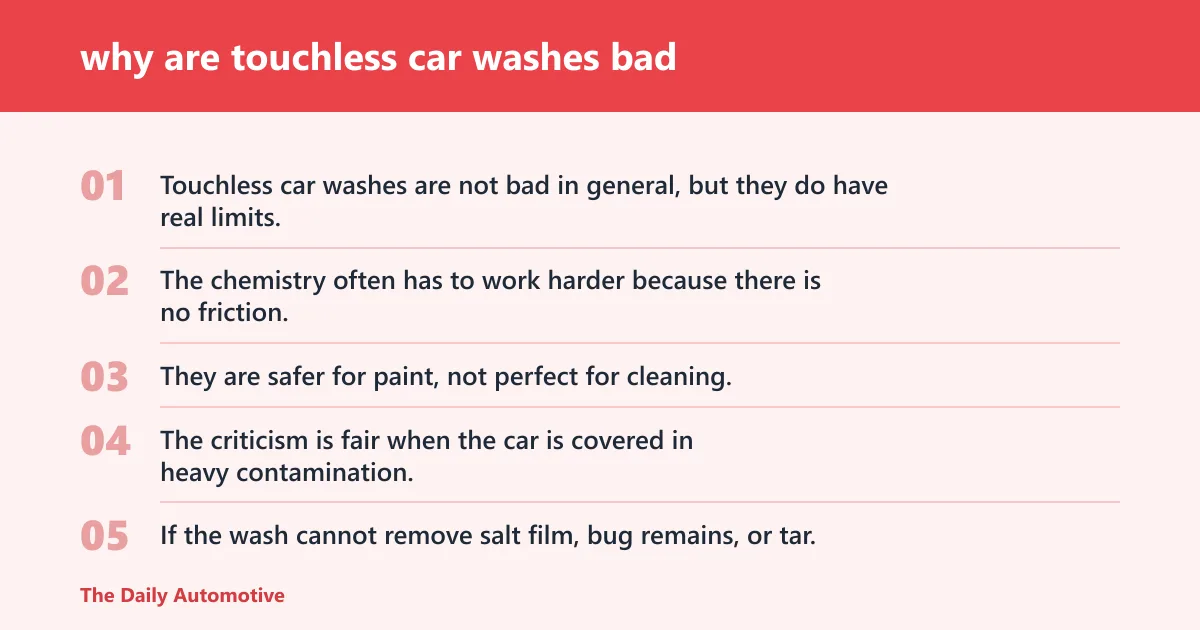
Touchless car washes are not bad in general, but they do have real limits. The chemistry often has to work harder because there is no friction, and that can mean more residue left behind or more stress on waxes and sealants over time. They are safer for paint, not perfect for cleaning.
Where the criticism is fair
The criticism is fair when the car is covered in heavy contamination. If the wash cannot remove salt film, bug remains, or tar, then the finish may look clean from a distance while still holding grit close to the surface.
is brush wash bad for ceramic coating
Brush wash is not automatically bad for ceramic coating, but it is a riskier choice than touchless. The coating can be worn faster by abrasive contact, and any embedded dirt in the wash media can add fine marks. That is why many owners with coatings prefer no-contact washing whenever possible.
When a brush wash can still be reasonable
If the car is standard clear coat, the wash is modern, and the equipment is clearly maintained, a brush wash can be reasonable after storms or off-road use. The main issue is not that every brush wash is harmful; it is that the risk rises quickly as the finish gets more sensitive.
what vehicles should avoid brush car washes
Vehicles that should avoid brush car washes include ceramic-coated cars, PPF-covered vehicles, vinyl-wrapped vehicles, matte-finish cars, and dark luxury paint that shows marks easily. These finishes can be damaged, dulled, or visually changed by repeated friction, even when the wash appears gentle.
When brush is still acceptable
Brush washing is still acceptable for many standard factory clear-coated cars, especially when the vehicle is coated in heavy grime and the tunnel is modern and maintained. The right answer depends less on brand or body style and more on how sensitive the finish is and how dirty the vehicle has become.
Products related to this article
Sponsored / affiliate links. As an Amazon Associate I earn from qualifying purchases. I may earn additional commission from eligible campaigns.