What Car Color Should I Get: Top Tips to Choose Perfectly
Choose white, silver, gray, or black if you want the safest resale and easiest upkeep. Pick brighter colors if visibility matters most. Avoid rare hues unless you plan to keep the car long-term. Poor color choices can mean dirt that shows faster, a smaller buyer pool, and weaker road presence. This guide breaks down resale, maintenance, climate, and visibility so you can choose the right finish.
What does car color really change?
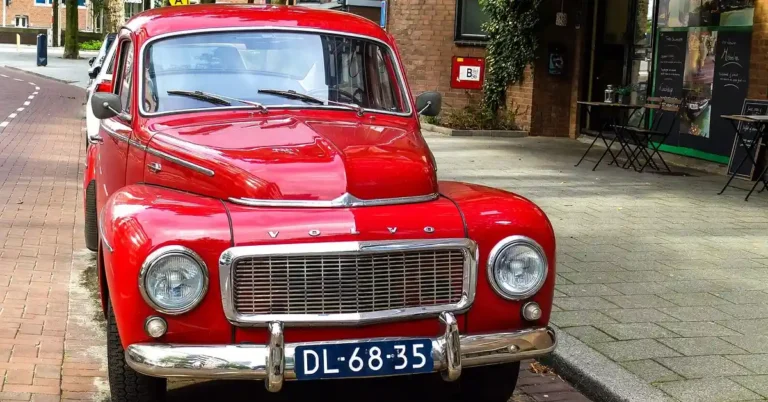
Car color changes more than appearance. It affects first impressions, how often dirt shows, how easily the car is seen in traffic, and how broad your resale market may be. The same paint can also read differently on a sedan, SUV, coupe, or truck because body shape changes how light moves across the panels.
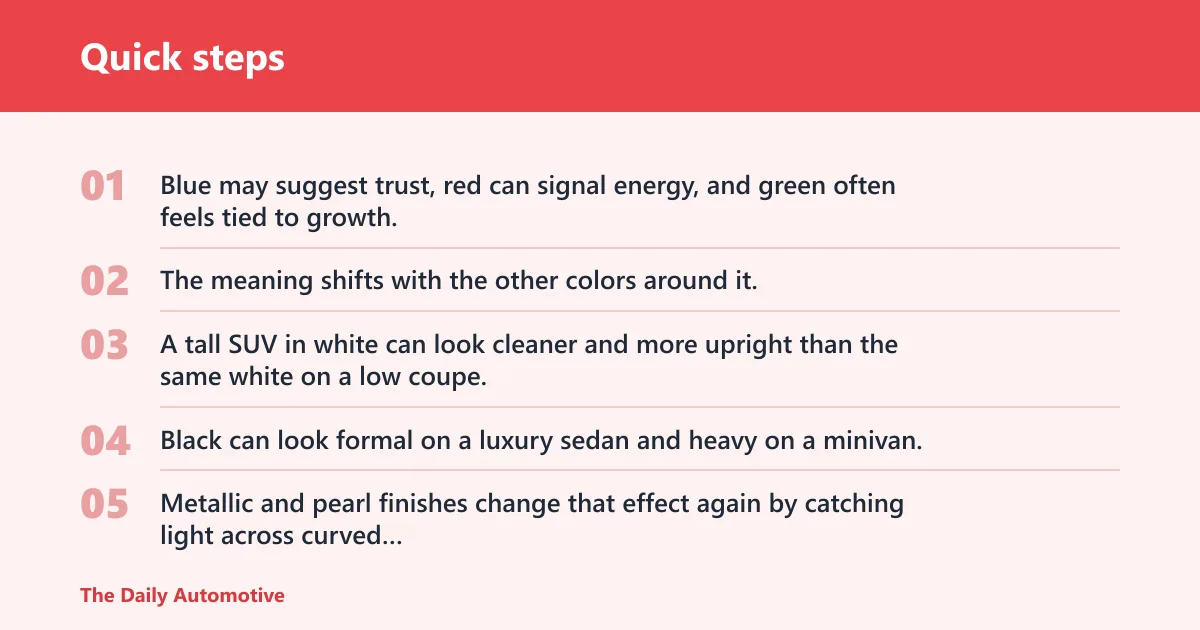
Color also carries perception. Blue may suggest trust, red can signal energy, and green often feels tied to growth. That is not exact science. The meaning shifts with the other colors around it, and context and cultural associations shape how color is experienced.
Why the same color can read differently by body style
A tall SUV in white can look cleaner and more upright than the same white on a low coupe, where the panels show shadow lines more sharply. Black can look formal on a luxury sedan and heavy on a minivan. Metallic and pearl finishes change that effect again by catching light across curved surfaces.
That is why online photos can mislead you. A color that looks calm in a studio image may look flat in direct sun, or busier on a vehicle with many creases and trim pieces.
Where personal taste fits in the decision
Personal preference still matters, but it should sit beside ownership cost, climate, and how long you plan to keep the vehicle. If you change cars often, resale should weigh heavily. If you keep a car for years, you can afford to pick a more unusual shade as long as you accept a smaller buyer pool later.
Which car colors hold value best?
White, black, gray, and silver usually have wider demand because more buyers will accept them when the car is listed. That broader demand does not guarantee the highest price in every case, but it often makes the car easier to sell. Trim level, model type, and region can change the result quickly.
Why white, black, gray, and silver usually lead
These colors fit many body styles and appeal to buyers who want a low-risk choice. White and silver often hide dust better than black. Gray and silver also sit in the middle of the market, which can help them feel neutral to more shoppers. Factory colors generally also match panels more predictably than many aftermarket paint choices.
How region and model type change resale demand
Regional taste matters. In some areas, lighter colors are favored for heat and dust; in others, black or gray may be preferred for a premium look. Model type matters too. A sports car can carry a bolder color more easily than a family crossover, and an unusual shade may fit a special trim better than a base model.
Why unusual colors can help or hurt the future buyer pool
An unusual color can help if the car is a niche model and the shade fits that identity. It can hurt if the color narrows the pool of shoppers who are willing to accept the car. Rare green, beige, yellow, or orange can attract the right buyer later, but they can also sit longer on a lot.
Car color decision matrix
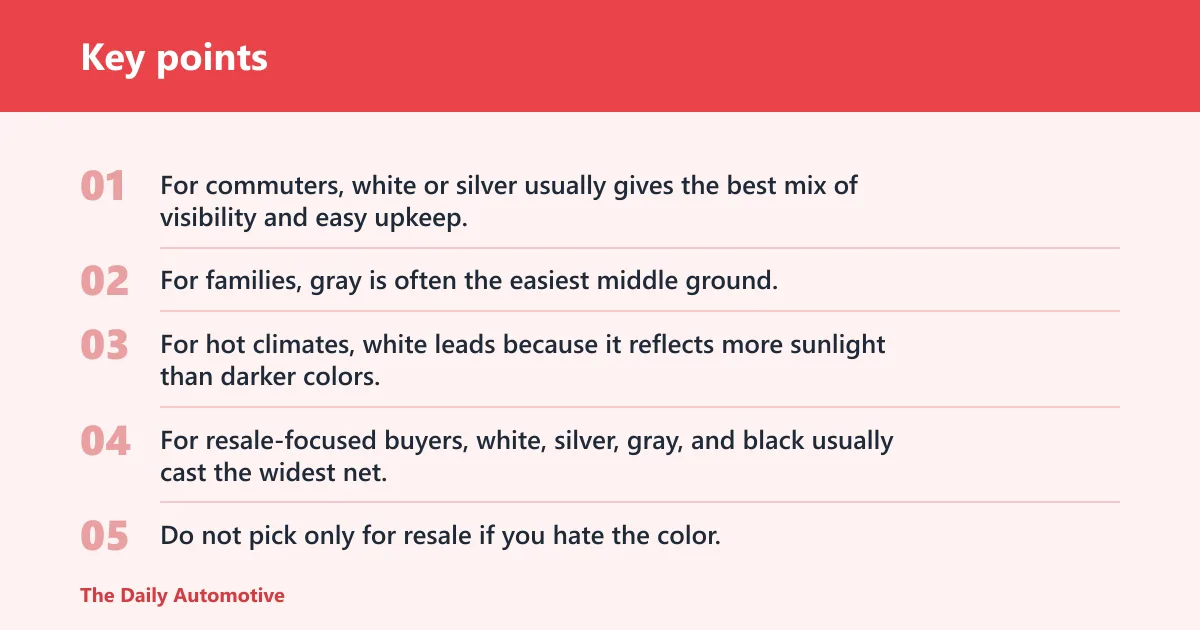
Use this as a buyer’s shortcut, not a rulebook. The scores are practical, not scientific: 1 means weaker fit for that goal, and 5 means stronger fit. The best choice depends on whether you care more about resale, low effort, visibility, heat comfort, or style.
| Color | Resale | Cleaning ease | Visibility | Heat comfort | Style | Best for |
|---|---|---|---|---|---|---|
| White | 5 | 4 | 4 | 5 | 3 | Commuters, hot climates, resale-focused buyers |
| Silver | 5 | 5 | 4 | 4 | 3 | Low-maintenance owners who still want broad demand |
| Gray | 4 | 4 | 3 | 4 | 4 | Daily drivers, families, buyers wanting a balanced look |
| Black | 4 | 2 | 3 | 2 | 5 | Style-first buyers who accept more upkeep |
| Blue | 3 | 3 | 3 | 3 | 4 | Buyers who want color without going too far from mainstream |
| Red | 3 | 3 | 4 | 3 | 5 | Performance trims and drivers who want stronger presence |
| Yellow | 2 | 3 | 5 | 3 | 5 | Visibility-minded buyers and enthusiast models |
| Orange | 2 | 3 | 5 | 3 | 5 | Owners who want high visibility and strong personality |
For commuters, white or silver usually gives the best mix of visibility and easy upkeep. For families, gray is often the easiest middle ground. For hot climates, white leads because it reflects more sunlight than darker colors. For resale-focused buyers, white, silver, gray, and black usually cast the widest net.
How to use the matrix without letting one factor decide everything
Do not pick only for resale if you hate the color, and do not pick only for style if the car will live outside in a dusty area. Weight the categories against your real use. A car parked in a garage at night needs a different answer than one parked on-street under trees or in full sun.
Which colors are easiest to live with?
Silver and white are often easier to live with because they can hide everyday dust, light road film, and small water spots better than black. Gray also works well. Dark colors tend to show swirl marks, fine scratches, and drying marks more clearly, so they often demand more frequent washing and careful drying.
Dirt, dust, road salt, and water spots
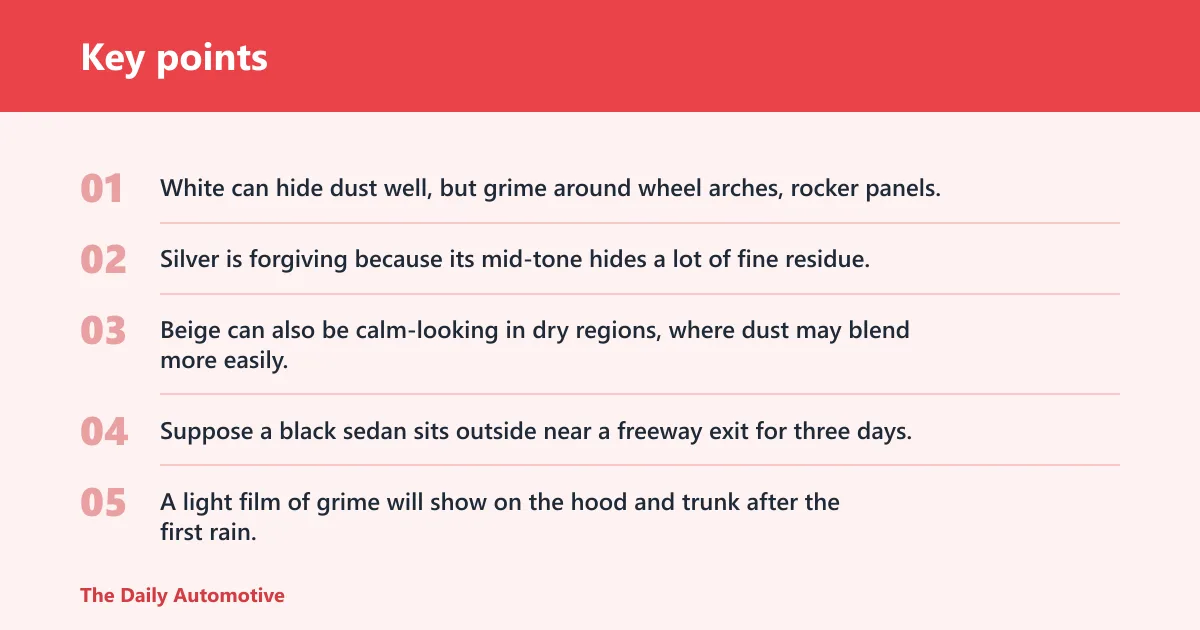
Black shows road dust quickly. White can hide dust well, but grime around wheel arches, rocker panels, and rear bumpers still stands out. Silver is forgiving because its mid-tone hides a lot of fine residue. Beige can also be calm-looking in dry regions, where dust may blend more easily.
Suppose a black sedan sits outside near a freeway exit for three days. A light film of grime will show on the hood and trunk after the first rain, while the same grime is harder to spot on silver. That does not make one color better in every sense, but it changes how often the car feels clean.
Swirl marks, scratches, and blemishes
Dark paint usually reveals swirl marks and wash-induced haze more than light paint. Solid finishes can show defects plainly, while metallic and pearl finishes can scatter light enough to soften the look of minor blemishes. Repair matching is often easier on common factory colors than on exotic aftermarket shades.
A common first-timer mistake is choosing a glossy black car because it looks dramatic under showroom lights, then discovering that every bad wash technique leaves visible trails. The color is not the problem. The maintenance burden is.
How maintenance habits change the best choice
If you wash by hand, use clean mitts, and dry carefully, black can stay impressive. If you rely on automatic washes or park outdoors often, silver, gray, and white are less stressful. The more often you expose the car to sun, dust, sap, and road salt, the more a forgiving color pays off.
How does climate affect your choice?
Light colors are usually better in hot weather because they absorb less heat than dark colors. White is the strongest common choice for sun exposure, and silver and beige can also help. Dark colors may warm the cabin faster when parked outside, especially in direct sun and high-UV regions.
Light colors versus dark colors in strong sun
Color choice will not transform the car’s cooling system, but it does affect how much heat the bodywork and cabin take on after parking. On the same lot, a black car in summer sun can feel harsher to approach than a white or silver one. Window tint, sunshades, and garage parking still matter more than paint alone.
Cabin temperature and parking conditions
If the car lives in open parking, a light color can make daily use more comfortable. If it lives in a garage most nights, the heat difference matters less. In colder regions, some buyers are less concerned about heat absorption and more concerned about grime, slush, and visibility in poor weather.
Picture a family crossover parked all day in a sun-baked apartment lot. White or silver will usually be easier to tolerate when you return at 5 p.m. than black, especially if the vehicle has a large hood and dark interior. The same model in a covered garage changes the equation.
How do paint finish and lighting change the look?
Solid, metallic, and pearl finishes do not read the same way. Solid paint is usually simpler and cheaper to refinish. Metallic and pearl can add depth, but they also make repair matching more complex. Matte finishes are a separate case; they can look striking, yet they often demand more careful care and repairs are harder to blend.
Solid, metallic, and pearl finishes
Solid finishes can make scratches easier to see on some colors, but they are often simpler for body shops to match. Metallic paint uses flakes that catch light and can make a color feel more dimensional. Pearl finishes shift slightly with viewing angle and light, which can look refined but can also complicate repair work.
Repair matching and cost differences
Factory paint is usually easier to match than many aftermarket paint choices because the original formula, application, and clear coat are designed for that vehicle line. If a panel is repaired later, a common color and finish often gives the shop a better starting point than a rare custom mix. That can matter in both cost and appearance.
Why dealer lot lighting can mislead you
Dealer lighting is often bright, directional, and flattering. Garage lighting can flatten a color and make undertones more obvious. A silver car may look clean and crisp outdoors, then turn dull in a dim bay. A pearl white may look premium outside and slightly creamy indoors. Always check both.
How should you test colors before buying?
Test colors in daylight, shade, and the kind of indoor lighting where the car will actually sit. Bring sample swatches if you can, and compare them on the same body style. Testing belongs in the selection process because color changes with its surroundings.
- View the car in full daylight.
- Check it again in shade or under overcast sky.
- Look at the same color in garage or dealer lot lighting.
- Compare swatches on the exact body style you plan to buy.
- Ask whether the color is factory or aftermarket.
- Walk around the car from several angles and check panel reflections.
View swatches in daylight and shade
Sunlight reveals undertones. Shade shows whether a color feels flat, muddy, or more refined than expected. If the color is blue, green, red, or orange, that difference can be large. A shade that looks calm in a brochure may feel louder or duller when parked outside.
Compare samples on the same body style
The same paint looks different on a hatchback, a long hood, or a tall SUV. A small coupe may make a bold color feel more playful, while a large pickup may make the same color look louder than intended. Side-by-side comparison on the same body style is the safest check.
Check factory availability versus aftermarket paint choices
If the color is a factory option, it is usually easier to service later. Aftermarket paint can be excellent, but matching later repairs may be harder and resale may suffer if buyers suspect a respray. If you want a rare look, make sure you are choosing it with your eyes open.
Frequently asked questions
What car color should I get?
Choose white, silver, gray, or black if you want the widest resale appeal and the least surprise in daily ownership. Pick yellow, orange, red, or a more unusual shade only if visibility or personal taste matters more than broad future demand. The right answer depends on how long you will keep the car.
What is the best car color to buy?
There is no single best car color for every buyer. White and silver are often the safest all-around choices because they balance resale, heat comfort, and easy upkeep. Gray and black can also work well, but black asks more from your cleaning routine and parking situation.
What car color has the best resale value?
White, silver, gray, and black usually have the broadest resale demand because more buyers accept them. Exact value still depends on model, trim, mileage, condition, and region. A special edition performance car may tolerate a louder color better than a commuter sedan.
What car color is easiest to keep clean?
Silver is often the easiest to keep looking presentable, with white and gray close behind. These colors hide dust, light road film, and some water spotting better than black. Black can look excellent, but it usually shows swirl marks, dust, and drying marks faster than lighter choices.
What car color is safest on the road?
No color is always safest. Brighter colors such as yellow, orange, and red can improve conspicuity in some conditions, especially in daytime. Visibility still depends on lighting, weather, vehicle shape, reflectors, and how you drive, so color should help recognition rather than replace caution.
What color car is best for hot weather?
White is usually the best common choice for hot weather because it reflects more sunlight than dark colors. Silver and beige can also help. If the car will sit outside for long periods, a lighter color can make the cabin feel less punishing when you return to it.
Products related to this article
Sponsored / affiliate links. As an Amazon Associate I earn from qualifying purchases. I may earn additional commission from eligible campaigns.