What Car Is Jackson Storm In Real Life? The Answer Revealed
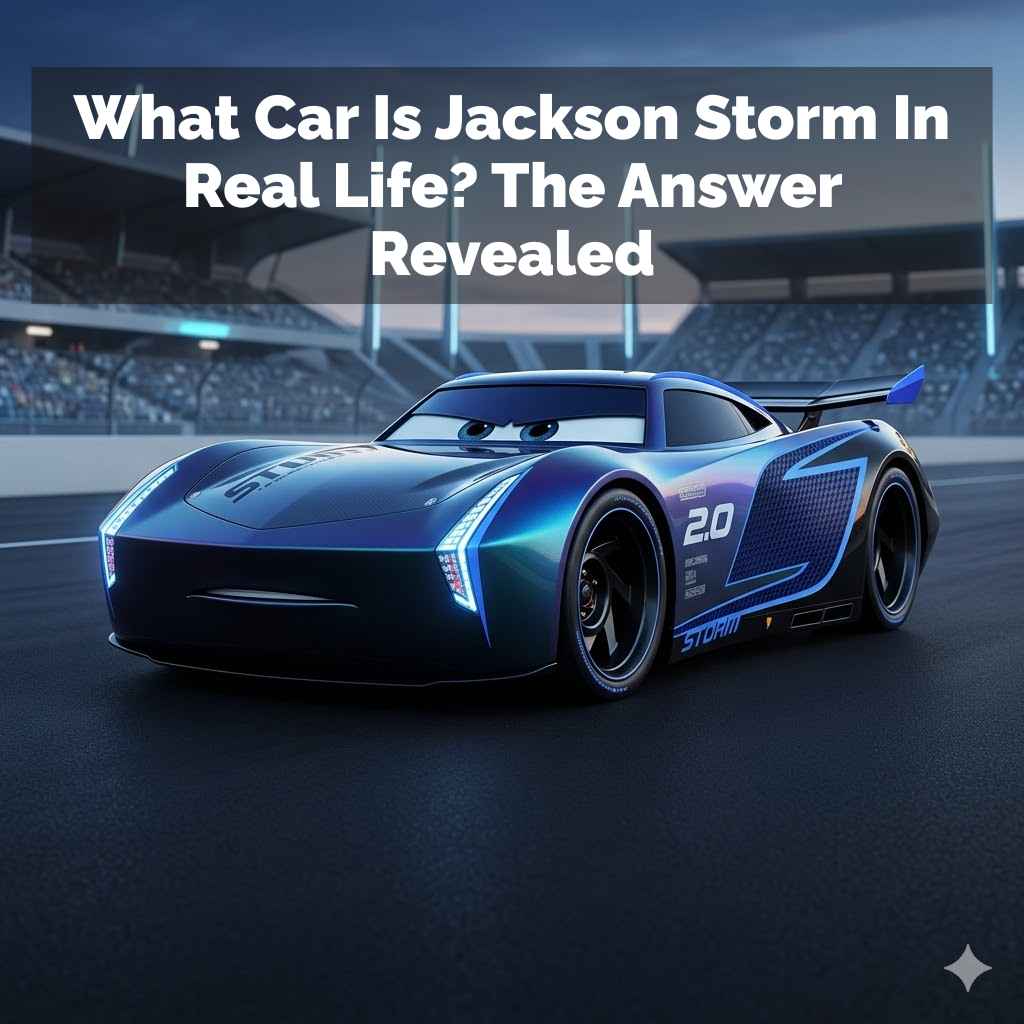
Jackson Storm is a fictional character from the movie Cars 3. While he is not a direct copy of any single real-life car, his design draws inspiration from modern, high-performance race cars, particularly those seen in NASCAR and other speed-focused motorsports. His look combines cutting-edge aerodynamics with a powerful, aggressive stance.
When we first meet Jackson Storm in Cars 3, he represents a new era of racing. He’s incredibly fast, technologically advanced, and a bit of a show-off. He quickly becomes the main rival for our beloved veteran racer, Lightning McQueen.
The contrast between the old guard and the new is a central theme of the movie.
Jackson’s design is meant to embody speed and the future of racing. Think about the cars that compete today in top-tier racing series. They are built for pure performance.
They have sharp lines, large spoilers, and a low profile that hugs the track. Jackson Storm captures this essence perfectly. He’s meant to look like the pinnacle of racing technology.
The creators of the Cars movies are known for their attention to detail. They often take inspiration from real-world automotive designs. They visit car shows, factories, and race tracks.
They talk to car designers and engineers. This allows them to create characters that feel both fantastical and grounded in reality.
For Jackson Storm, the design team looked at what makes a race car fast and imposing. They studied the physics of aerodynamics. This is how air flows over and around a vehicle at high speeds.
They wanted Jackson to look like he was cutting through the air, not fighting against it. His shape is a testament to that.
So, while you won’t find a car on the road with the exact same face or personality as Jackson Storm, his body is a blend of many real-world racing machines. It’s like a super-car collage, designed to make him the ultimate competitor on screen. This blending is a common technique in animation to create unique characters.
My First Encounter with Jackson Storm’s Look
I remember watching Cars 3 for the first time. I was instantly struck by Jackson Storm. He was so different from the cars I knew from the first two movies.
He had this sharp, almost aggressive look. I remember thinking, “Wow, that car looks like it’s made of pure speed.”
My mind immediately started racing. Is this car real? Did I miss something?
I recall thinking about some of the futuristic concept cars I’d seen in magazines. Or maybe it was a super-fast NASCAR car I’d seen on TV. He had that low-slung profile and a very modern feel.
It felt like a real car inspired him.
There was a particular scene where he’s practicing. The way he moved, the way the light glinted off his paint. It all screamed high-tech.
It wasn’t just about being fast; it was about being the latest fast. This is what really got me thinking about the real-world automotive world.
I’ve always loved how the Cars movies blend animation with reality. They take familiar things and give them life. So, when a character like Jackson Storm appears, it’s natural to wonder about his origins.
Is he a Dodge Viper? A Corvette? Or something else entirely?
The mystery made him even more intriguing to me.
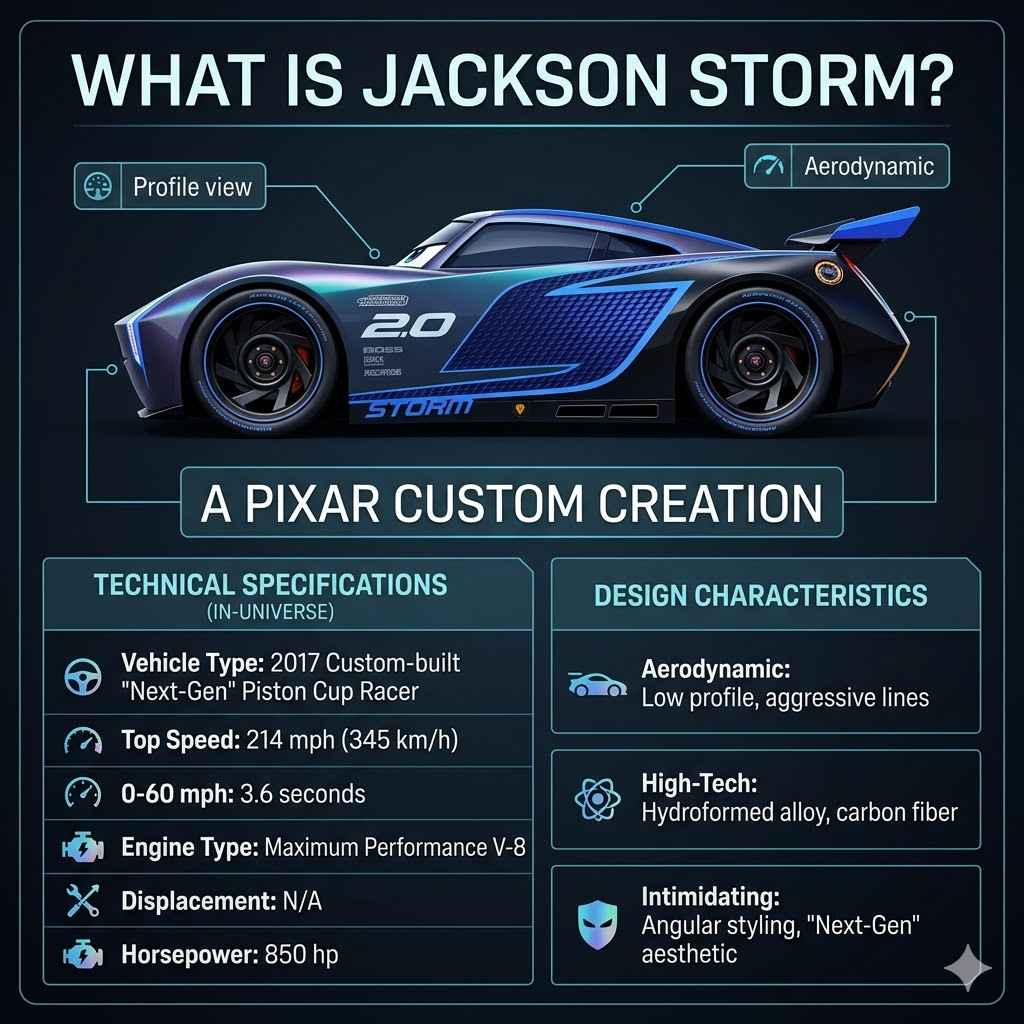
What Makes Jackson Storm Look So Futuristic?
Jackson Storm’s design is a masterclass in blending. He’s not just a race car; he’s a statement about the future of motorsports. The animators paid close attention to several key features that make him stand out.
These elements are borrowed from real-world advancements in car design and racing technology.
One of the most noticeable features is his aerodynamic shape. His body is very smooth and sculpted. It’s designed to slice through the air with minimal resistance.
This is crucial in real racing. Less drag means more speed. You can see this in modern F1 cars and NASCAR stock cars.
His stance is also very low and wide. This gives him a stable, planted look. It suggests incredible grip on the track.
A wider base helps a car corner at high speeds without tipping over. This is something engineers work hard to achieve in real sports cars.
The colors also play a role. Jackson Storm’s primary color is a bright, electric blue. This color often signifies innovation and technology.
It’s a stark contrast to Lightning McQueen’s classic red. This visual difference highlights the generational shift in racing.
His headlights and taillights are sharp and angular. They don’t have the rounded look of older car designs. This gives him a more aggressive, almost menacing appearance.
It’s like he has piercing eyes, always focused on the finish line.
His wheels are large and have a complex spoke design. They look like they’re built for maximum airflow and cooling. In real cars, wheel design is a balance between looks, weight, and performance.
Jackson’s wheels look like they lean heavily towards performance.
Finally, his overall form is very sleek. There are no unnecessary bumps or edges. Everything flows together.
This makes him look incredibly modern and fast. It’s a look that says, “I am the future of speed.”
Jackson Storm’s Design Elements Explained
Aerodynamics: His body is shaped to reduce air resistance. This is key for speed.
Low Stance: He sits very close to the ground. This improves stability.
Color Palette: Electric blue suggests advanced technology and a new era.
Sharp Lighting: Angular headlights and taillights give him a modern, intense look.
Performance Wheels: Large, intricate wheels suggest high-speed capability.
Sleek Form: Smooth lines and minimal sharp edges create a futuristic feel.
Inspiration from Real Racing Series
The creators of Cars 3 did a lot of research into modern racing. They didn’t just invent Jackson Storm out of thin air. They looked at what makes cars fast and popular in the real world.
Several racing series likely influenced Jackson’s design.
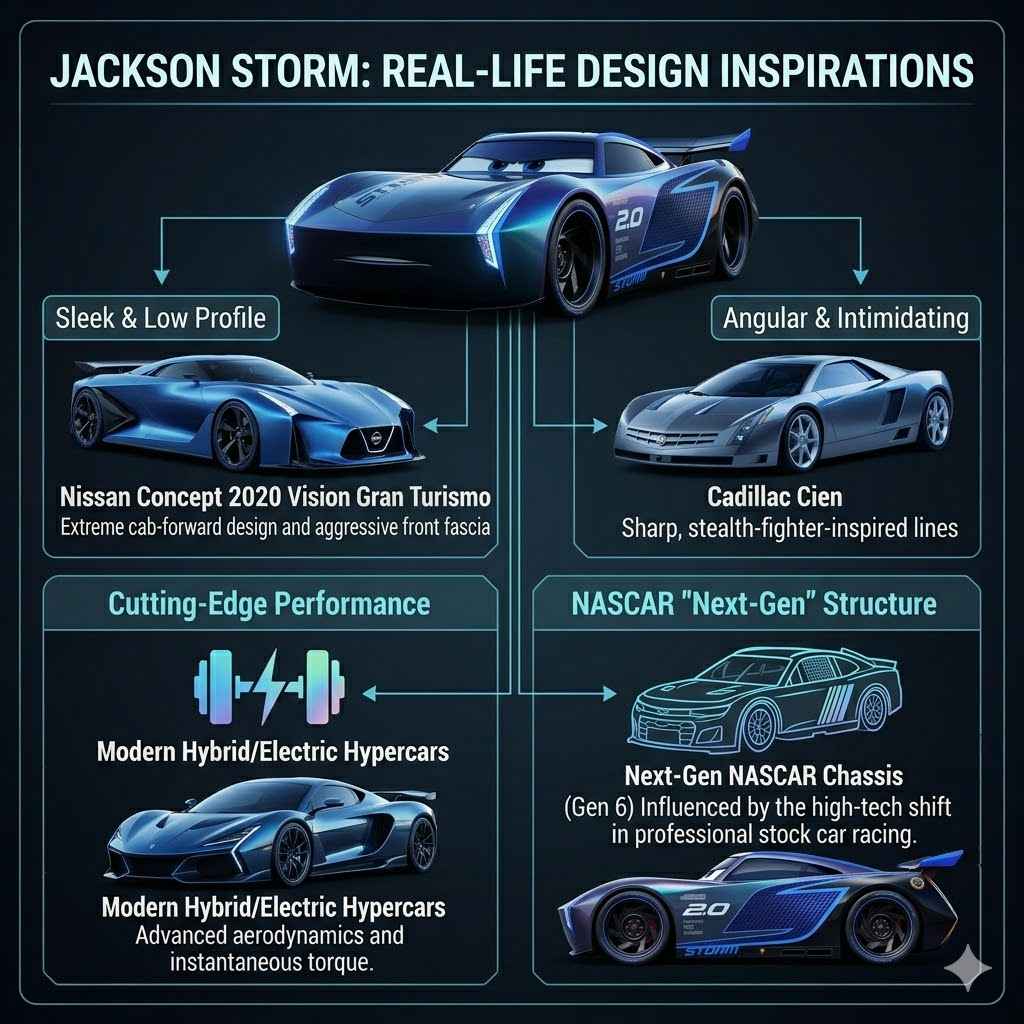
NASCAR is a very strong contender for inspiration. Jackson Storm has the broad, stock-car-like proportions. His wide body and prominent fenders are reminiscent of today’s NASCAR Cup Series cars.
These cars are designed for oval tracks, where aerodynamics and raw power are paramount.
Formula 1 (F1) racing also offers clues. While Jackson doesn’t have the complex wings and fins of an F1 car, his sleek, low-profile design and focus on airflow echo F1 principles. The emphasis on downforce and cutting through the air is a shared goal.
F1 cars are the epitome of aerodynamic engineering.
Other sports car racing series could also have played a role. Think about Le Mans or endurance racing. Cars in these events are built for speed over long distances.
They need to be efficient and reliable. Jackson’s streamlined body suggests this kind of high-performance endurance.
The look of modern GT cars might also be a subtle influence. These are high-performance cars that are still based on production models. They have a powerful, muscular look combined with aerodynamic enhancements.
Jackson has this blend of power and form.
When animators design characters, they often mix and match features. They might take the profile of one car, the grille shape of another, and the wheel design from a third. The goal is to create something that feels familiar yet entirely new.
This is exactly what they did with Jackson Storm.
They wanted Jackson to represent the cutting edge. He needed to look like he belonged in a race where technology is constantly advancing. By studying the most advanced and visually striking real-world race cars, they could craft a character that truly embodied this new generation of speed.
Racing Series That Might Have Inspired Jackson Storm
NASCAR: Influenced by the wide body and stock car proportions.
Formula 1: Contributed to the focus on aerodynamics and sleekness.
Sports Car Racing (Le Mans, etc.): Inspired the idea of high-performance endurance and efficiency.
GT Cars: May have influenced the muscular yet streamlined appearance.
The Car Industry’s Shift Towards Technology
Jackson Storm’s character is more than just a cool-looking car. He represents a significant shift happening in the real-world automotive industry. Cars are becoming smarter, faster, and more technologically driven than ever before.
We’re seeing a rise in electric vehicles (EVs). Many high-performance EVs can accelerate incredibly quickly. They often have very sleek, aerodynamic designs to maximize battery range.
Jackson’s futuristic look mirrors this trend. His implied speed and advanced nature fit perfectly with the EV revolution.
Advanced driver-assistance systems (ADAS) are becoming standard. Features like lane keeping assist, adaptive cruise control, and automatic emergency braking are common. While Jackson is a character with a personality, his advanced capabilities on the track hint at the sophisticated electronics in modern cars.
Connectivity is another big factor. Cars today connect to our phones and the internet. They have large touchscreens and advanced infotainment systems.
Jackson’s character, being a product of modern technology, embodies this connected world.
The pursuit of speed and efficiency is constant. Manufacturers are always looking for new ways to make cars go faster using less energy. This involves lighter materials, better engines, and more sophisticated computer controls.
Jackson’s design is a visual representation of this ongoing innovation.
So, Jackson Storm isn’t just a rival for Lightning McQueen. He’s a symbol of the automotive world’s evolution. He shows how technology is shaping the cars we drive and the races we watch.
He’s a look into the future, delivered on four wheels.
This shift also means that cars are becoming more than just machines. They are becoming digital platforms. This is a concept that the Cars universe often explores, giving human-like qualities to vehicles that are, in essence, advanced pieces of technology.
Why No Direct Real-Life Car Inspiration?
There’s a good reason why Jackson Storm isn’t a direct replica of any single car. Disney Pixar’s Cars franchise creates original characters. They are not trying to advertise or endorse specific car models from real manufacturers.
If they based Jackson Storm too closely on, say, a specific Ferrari or Lamborghini, it could cause legal issues. It might also alienate fans of other car brands. The goal is to create characters that appeal to a broad audience.
Instead, they use inspiration from many sources. This allows them to create a unique character. Jackson Storm is his own entity.
He has a distinct personality and appearance that serves the story. He’s not just a branded car; he’s a character with a role to play.
This approach also lets them push the boundaries of design. They can create cars that are more expressive and exaggerated than real-world vehicles. The exaggerated proportions and bold features of characters like Jackson are part of the charm of the Cars movies.
Think about the earliest characters in the franchise, like Lightning McQueen. While he’s clearly a stock car, he’s not an exact replica of any single car from a specific year. He’s a composite, an idealization of a racing machine.
Jackson Storm follows this same principle.
So, when you look at Jackson Storm, you’re seeing a creative interpretation. You’re seeing the essence of modern racing and futuristic automotive design. It’s a smart way to create memorable characters that resonate with car enthusiasts and general audiences alike.
They capture the spirit without being tied to one specific brand.
The Art of Creating Original Car Characters
No Direct Endorsement: Avoids legal issues and brand bias.
Creative Freedom: Allows for unique and exaggerated designs.
Broad Appeal: Creates characters that resonate with many viewers.
Composite Design: Blends features from various real-world vehicles.
Storytelling Focus: Characters serve the narrative, not commercial interests.
Real-World Cars That Share Jackson Storm’s Vibe
Even though Jackson Storm is fictional, there are many real-world cars that share his futuristic and aggressive racing spirit. If you’re a fan of his look, you might appreciate these vehicles. They represent the cutting edge of automotive design and performance.
Modern NASCAR Cup Series Cars: As mentioned, these are a strong influence. Cars like the current generation Chevrolet Camaro ZL1, Ford Mustang Dark Horse, and Toyota Camry TRD race on tracks today. They have advanced aerodynamics and powerful V8 engines.
They embody the speed and intensity that Jackson represents.
Chevrolet Corvette C8 Z06: This car has a mid-engine design, which is common in supercars. It features aggressive styling, a wide stance, and incredible performance. Its sharp lines and aerodynamic elements certainly echo Jackson Storm’s visual language.
Ford GT: The Ford GT is a modern supercar with a focus on aerodynamics. Its low profile, sculpted body, and large rear wing give it a very aggressive and futuristic appearance. It looks like it’s built to cut through the wind at extreme speeds, much like Jackson.
Lamborghini Huracán / Aventador: These Italian supercars are known for their dramatic styling and extreme performance. They have sharp angles, aggressive vents, and a low, wide profile that screams speed and power. Jackson’s bold, modern look aligns well with the unmistakable presence of a Lamborghini.
McLaren 720S / 750S: McLaren cars are built with advanced aerodynamics and lightweight construction. The 720S and 750S, in particular, have a very sleek, sculpted design. They look like they’re ready to set records on any track, sharing Jackson’s high-tech racing aesthetic.
Concept Cars: Manufacturers often release concept cars that showcase future design directions. Many of these concepts feature radical aerodynamics, advanced lighting, and futuristic silhouettes. Jackson Storm shares the spirit of these “what-if” vehicles that push the boundaries of what a car can look like.
These vehicles, through their design and engineering, capture the essence of what makes Jackson Storm so compelling. They represent the constant drive for innovation and performance in the automotive world. They are the real-life embodiment of the future of speed.
Real Cars with a Jackson Storm Vibe
- Current NASCAR Cup Series Cars
- Chevrolet Corvette C8 Z06
- Ford GT
- Lamborghini Huracán / Aventador
- McLaren 720S / 750S
- Various Automotive Concept Cars
The Difference Between Inspiration and Imitation
It’s important to understand that the creators of Cars 3 are masters of inspiration, not imitation. They take the spirit of real-world vehicles and translate it into their animated characters. This is a crucial distinction.
Inspiration means looking at the form, function, and aesthetic of real cars. It means understanding what makes a race car look fast. It involves studying the curves, the lines, the proportions.
Then, they take these elements and combine them in a way that serves their story and creates a unique character.
Imitation, on the other hand, would be copying a specific car too closely. This would mean making Jackson Storm look exactly like a Dodge Viper or a Ford Mustang. That’s not what happens in the creative process for Cars.
The goal is to create characters that are relatable and believable within their animated world. They need to have personalities, emotions, and stories. Simply recreating a real car wouldn’t allow for that depth.
A character needs more than just a cool exterior.
The design of Jackson Storm is a testament to this. He looks like a cutting-edge race car, but he’s not a carbon copy of anything you’ll find in a dealership or on a track. He’s a creative synthesis, a character born from the admiration of speed and technology.
This is why Jackson Storm feels both familiar and entirely new. We recognize elements from real-world performance cars, but the final character is something distinct. It’s the magic of animation and storytelling at its finest, taking inspiration and transforming it into something memorable.
When Does Inspiration Become Too Close?
In the world of character design, especially for vehicles, the line between inspiration and imitation can be tricky. For the Cars franchise, Disney Pixar has a strong track record of avoiding direct copies. They aim for characters that feel inspired by real automotive design trends, rather than being direct representations.
What often defines this boundary is the level of originality and transformation. If a character takes the core design cues, like the overall shape, proportions, and key visual elements of a specific car, and merely adds a face, it leans towards imitation. This can sometimes lead to intellectual property issues or at least a lack of creative integrity.
However, if designers take elements from multiple sources and blend them together to create something entirely new, that’s inspiration. Jackson Storm, for instance, embodies traits from various high-performance race cars. His sleekness might come from F1, his bulk from NASCAR, and his aggressive front end from modern supercars.
The key difference is that the final design doesn’t strongly resemble any single real-world car. Instead, it captures the essence or vibe of modern, high-speed automotive engineering. This approach allows for creative freedom while still acknowledging the rich history and ongoing evolution of car design.
Furthermore, the Cars universe gives these vehicles distinct personalities and a life of their own. This anthropomorphism is a massive departure from simply replicating a car. A real car, no matter how sporty, doesn’t have eyes that blink or a mouth that talks.
This fundamental difference ensures that Jackson Storm is a character, not just a replica.
So, while you might see hints of your favorite supercar or race car in Jackson Storm, remember that he is a unique creation. He’s a character designed to serve a story, and his visual inspiration is drawn from a wide spectrum of real-world automotive excellence.
Real-World Cars with Similar Technology
Jackson Storm represents the cutting edge of racing technology. While he’s fictional, the technology he embodies is very much a reality in today’s automotive world. Modern cars are packed with innovations that make them faster, safer, and more efficient.
Advanced Aerodynamics: Jackson’s design is all about reducing drag. Real-world cars achieve this through sculpted body panels, active spoilers that adjust at speed, and underbody diffusers. Think of cars like the Bugatti Chiron or the Mercedes-AMG ONE.
They use sophisticated airflow management.
Lightweight Materials: To increase speed and agility, manufacturers use lightweight materials. Carbon fiber, aluminum, and high-strength steel are common. This reduces the car’s overall weight, making it more responsive.
Many performance EVs and supercars heavily rely on these materials.
Powerful Electric Powertrains: While Jackson isn’t explicitly stated as electric, his performance aligns with modern EVs. Cars like the Tesla Model S Plaid or the Rimac Nevera offer insane acceleration and top speeds. Their instant torque provides a driving experience that feels futuristic and incredibly quick.
Sophisticated Suspension Systems: To handle high speeds and cornering, advanced suspension is critical. Real cars use adaptive dampers, multi-link setups, and active roll control systems. These systems constantly adjust to road conditions, providing both comfort and performance.
Jackson’s ability to hug the track suggests this level of engineering.
Digital Dashboards and Driver Aids: Jackson’s advanced nature implies sophisticated onboard technology. Modern cars feature large digital displays, advanced navigation, and driver-assistance systems (ADAS) like adaptive cruise control and lane centering. These systems enhance safety and convenience.
Data Acquisition and Telemetry: In professional racing, data is king. Cars collect vast amounts of data about performance. Jackson’s focus on precision racing likely mirrors this.
Real race cars use telemetry to monitor everything from tire pressure to engine temperature, optimizing performance in real-time.
So, while Jackson Storm might be a character from an animated movie, the technological principles behind his speed and efficiency are very much present in the vehicles we see on the road and the race tracks today. He’s a fictional icon representing real-world progress.
What This Means for the Future of Racing
Jackson Storm’s arrival in Cars 3 wasn’t just about introducing a new rival. It was a narrative device to explore the evolving landscape of motorsports. His character serves as a stark representation of how racing is changing, and what this means for its future.
The Rise of Data and Technology: Jackson’s performance is driven by advanced simulation and data. This reflects how real racing teams now rely heavily on analytics, AI, and simulation software. Drivers train in simulators that mimic real tracks with incredible accuracy.
Data analysis helps optimize every aspect of a car’s performance.
Generational Shift in Drivers: Jackson is a younger, faster driver who represents a new breed. He’s a product of a different training and technological environment. This mirrors real sports where younger athletes often leverage new training methods and technologies that previous generations didn’t have access to.
The Pace of Innovation: The movie shows how quickly technology can advance in racing. Jackson’s emergence forces Lightning McQueen to adapt. This constant race for innovation is a core part of motorsports.
Teams are always pushing boundaries to gain an edge, whether through aerodynamics, engine power, or materials science.
Potential for Electric Racing: While not explicitly stated, Jackson’s clean, high-tech design and immense speed could easily align with the future of electric racing. Formula E is already a prominent example of this. The silent, instant torque of EVs offers a different, yet equally thrilling, racing experience.
Fan Engagement and Spectacle: Jackson is also a character who commands attention. His sleek design and aggressive style contribute to the spectacle of racing. Modern motorsports often focus on creating engaging fan experiences, and characters like Jackson add to the drama and excitement.
Ultimately, Jackson Storm represents the inevitable march of progress. Racing, like any sport, evolves. He’s a reminder that embracing new technologies and adapting to change is crucial for staying competitive.
His presence challenges the status quo and pushes the boundaries of what’s possible on the track, both in the movie and in real life.
Frequently Asked Questions About Jackson Storm’s Real-Life Inspiration
Is Jackson Storm based on a real car model?
No, Jackson Storm is a fictional character. While his design is inspired by various real-world high-performance race cars, he is not a direct replica of any single model.
What real-life racing series influenced Jackson Storm’s design?
Jackson Storm’s design likely draws inspiration from modern NASCAR Cup Series cars due to his proportions, as well as elements from Formula 1 and other sports car racing series that emphasize aerodynamics and speed.
What technology does Jackson Storm represent?
Jackson Storm represents advanced automotive technology, including cutting-edge aerodynamics, high-performance engines (implied), and sophisticated digital systems that are increasingly common in modern cars and race cars.
Are there any real cars that look similar to Jackson Storm?
Yes, several modern performance cars share a similar aggressive, futuristic aesthetic. These include cars like the Chevrolet Corvette C8 Z06, Ford GT, and various models from Lamborghini and McLaren, as well as modern NASCAR stock cars.
Why didn’t Disney Pixar just use a real car model for Jackson Storm?
Disney Pixar creates original characters for their films. This allows them creative freedom to design unique characters with distinct personalities and appearances that serve the story, without being tied to specific brand endorsements or legal restrictions.
Does Jackson Storm’s character reflect the future of racing?
Yes, Jackson Storm’s character symbolizes the evolution of racing towards greater reliance on technology, data, and advanced engineering. He represents a new generation of racers and vehicles that push the boundaries of performance.
Final Thoughts on Jackson Storm’s Automotive Roots
So, to wrap it all up, Jackson Storm is a character born from a deep appreciation for automotive engineering and the thrill of speed. He’s not a single car you can point to and say, “That’s him!” Instead, he’s a brilliant composite, a creative blend of what makes modern race cars so exciting.
He embodies the spirit of innovation and the relentless pursuit of faster, more efficient, and more technologically advanced vehicles. Whether you see him as a futuristic NASCAR racer or a super-powered sports car, Jackson Storm represents the cutting edge. He’s a reminder that the world of cars is always moving forward, just like in the movies.
Products related to this article
Sponsored / affiliate links. As an Amazon Associate I earn from qualifying purchases. I may earn additional commission from eligible campaigns.
 4G GPS Tracker Car Anti-Theft Long Battery Life 20000mAh Real Time GPS Tracking Device Magnet No Geographic Restriction Car Tracker with Alerts, Geo Fence, History Playback TK905C
 Solar Powered Car Window Fan - Universal Solar Car Front/Rear Window Exhaust Fan Car Window Cooler Fan Air Ventilator Exhaust Radiator, Eliminate Smell (Black)